Within Curious Gabon
Why Bwiti Is More Than an Iboga Curiosity
Bwiti collections reveal a complex world of initiation, healing, music and ancestry that cannot be reduced to psychedelic spectacle.
On this page
- Initiation, healing and community membership
- Doors, figures and instruments in ritual settings
- How museums can avoid psychedelic stereotypes
Page outline Jump by section
Introduction
Bwiti is often introduced to international audiences through a single plant: iboga. That narrow focus obscures what makes the tradition distinctive in Gabon. For practitioners, Bwiti is an initiation religion and community of practice centred on moral education, healing, music, ancestral relationships and ritual knowledge. The objects associated with it are not simply ethnographic curiosities or accessories to a psychoactive experience. They are meaningful tools within ceremonies that mark membership, transmit teachings and maintain links between the living and the ancestors.[African Archive]africanarchive.orgOpen source on africanarchive.org.
For visitors exploring Gabon’s unusual collections, this matters because museums increasingly face the challenge of displaying Bwiti material without reducing it to the global fascination with psychedelics. Harps, carved ritual panels, ceremonial doors, staffs, costumes and musical instruments all carry meanings that only become fully understandable when viewed as parts of a living religious tradition rather than isolated art objects.[Smithsonian Music]music.si.eduSmithsonian Music Ngombi (Harp) | Smithsonian MusicSmithsonian Music Ngombi (Harp) | Smithsonian Music
Initiation, healing and community membership
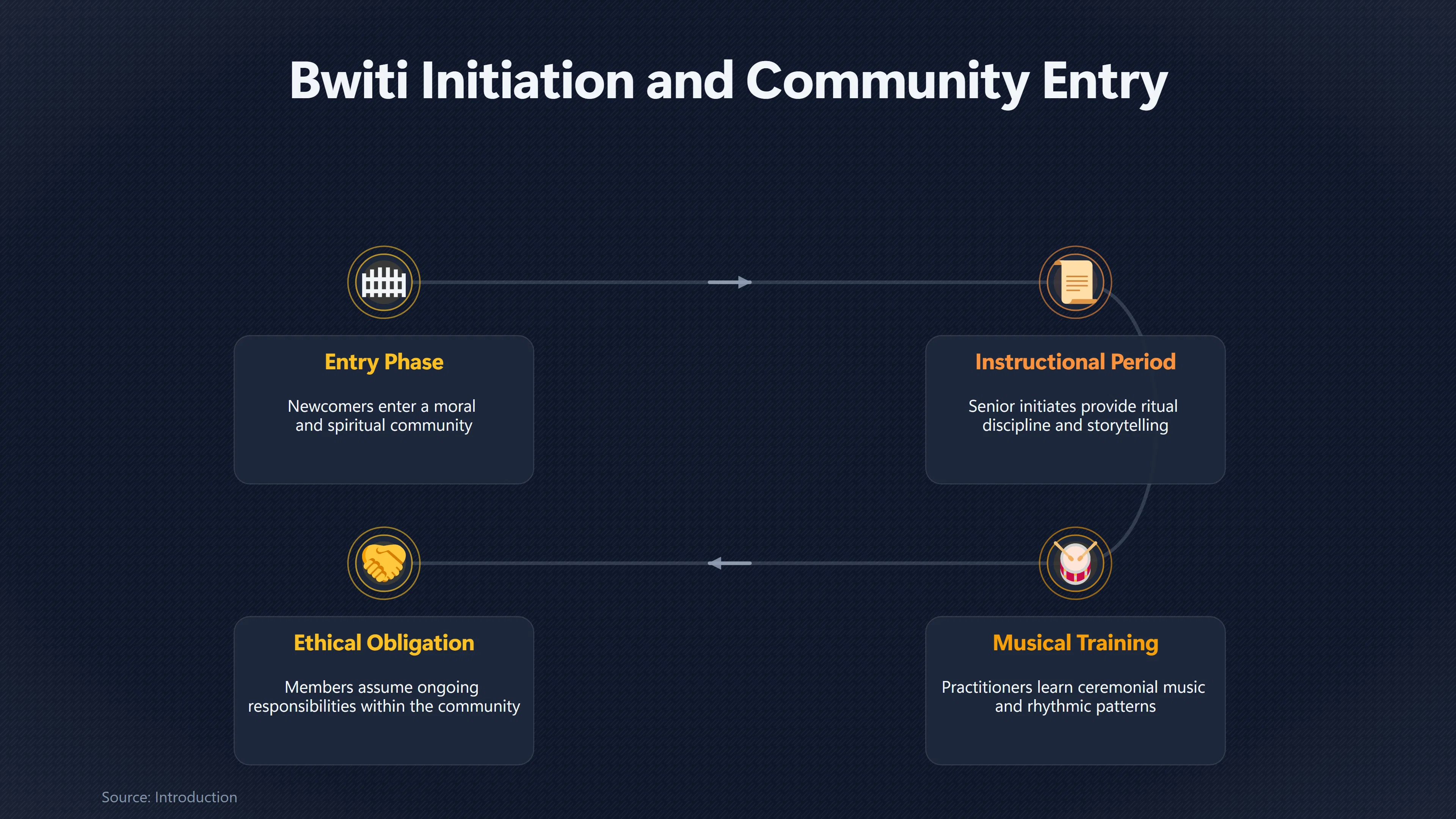
Bwiti is best understood as an initiation system rather than a collection of mysterious artefacts. Although practices differ between Fang, Mitsogho, Myene and other communities, initiation generally marks a person’s entry into a moral and spiritual community with responsibilities extending well beyond a single ceremony. Senior initiates guide newcomers through instruction, ritual discipline, music, storytelling and ethical obligations that continue after initiation itself.[Bwiti Roots]bwitiroots.orgBwiti Roots Bwiti Culture – Bwiti RootsBwiti Roots Bwiti Culture – Bwiti Roots
Healing occupies a similarly broad place. While outsiders frequently associate Bwiti with visionary experiences, practitioners traditionally understand healing as involving family relationships, social harmony, ancestral balance, physical wellbeing and spiritual guidance. Ritual specialists spend years learning ceremonial knowledge, medicinal plants, music and community responsibilities before assuming leadership roles.[Bwiti Roots]bwitiroots.orgBwiti Roots Bwiti Culture – Bwiti RootsBwiti Roots Bwiti Culture – Bwiti Roots
This wider perspective changes how ritual objects should be viewed. A carved figure, ritual seat or musical instrument is not valuable simply because it was present during an initiation. Its importance lies in the relationships it helps sustain between participants, teachers, ancestors and the ceremonial community.
Doors, figures and instruments in ritual settings
Many of the most striking Bwiti objects lose much of their meaning when removed from their original ceremonial environment.
Ritual spaces are carefully organised
Traditional ceremonial houses are more than meeting halls. Their painted surfaces, carved architectural features and interior arrangements create a symbolic environment where initiation unfolds. Decorative panels and carved elements are part of a ritual landscape rather than independent artworks, helping define sacred space and organise ceremonial movement.[African Archive]africanarchive.orgOpen source on africanarchive.org.
Doors and thresholds can therefore carry symbolic weight. Crossing into the ceremonial space represents movement between ordinary social life and a setting devoted to instruction, remembrance and transformation. When museums preserve carved architectural elements, they preserve fragments of this larger ritual environment rather than isolated pieces of sculpture.[African Archive]africanarchive.orgOpen source on africanarchive.org.
Musical instruments are central objects, not background decoration
Perhaps the most misunderstood Bwiti objects are its musical instruments.
The sacred ngombi harp occupies a particularly important place. Rather than serving as entertainment, it is understood by practitioners as a medium through which ancestral presence is invoked during ceremonies. Museum collections often display the harp as an example of elegant African craftsmanship, but within Bwiti its role is inseparable from performance, ritual authority and religious teaching.[si.edu]music.si.eduSmithsonian Music Ngombi (Harp) | Smithsonian MusicSmithsonian Music Ngombi (Harp) | Smithsonian Music
Other important ceremonial instruments include:
- the mouth bow, whose resonant sound accompanies ritual performance and ancestral communication;
- drums that structure the rhythm of extended night ceremonies;
- bells, rattles and horns that signal transitions and coordinate participants.[bwitiroots.org]bwitiroots.orgBwiti Roots Bwiti Culture – Bwiti RootsBwiti Roots Bwiti Culture – Bwiti Roots
Taken together, these instruments create a continuous musical environment. Their significance lies as much in the performance as in the physical objects themselves.
Carved figures are active participants
Carved figures associated with Bwiti are often displayed in art museums for their aesthetic qualities. Ethnographic research, however, consistently emphasises that they originally functioned within ritual settings as participants in ceremonies, helping materialise relationships with ancestors or embody elements of religious teaching rather than serving as decorative sculpture.[African Archive]africanarchive.orgOpen source on africanarchive.org.
How museums can avoid psychedelic stereotypes
International attention to iboga has created a new interpretive challenge. Visitors sometimes arrive expecting exhibitions about altered states of consciousness, while the collections themselves point towards a much richer cultural landscape.
Museums can counter this stereotype in several ways.
First, objects should be interpreted within complete ceremonial systems rather than labelled primarily by their association with iboga. Explaining who used an object, when it appeared, who could handle it and what social role it fulfilled gives visitors a more accurate understanding of its purpose.[African Archive]africanarchive.orgOpen source on africanarchive.org.
Second, music deserves equal prominence. Audio recordings, instrument demonstrations and explanations of ceremonial performance reveal that sound is fundamental to Bwiti practice. A silent display case cannot communicate why a harp or mouth bow mattered to participants. Gabon’s National Museum has built important collections of both ritual objects and ethnomusicological recordings, making it well placed to interpret this connection between material culture and living performance. Présidence de la République Gabonaise[presidence.ga]presidence.gaOpen source on presidence.ga.
Third, museums should acknowledge that Bwiti remains a living religion. Many ritual objects in collections originated within traditions that continue today. Presenting them solely as relics of the past risks turning active religious practice into exotic folklore. Current scholarship increasingly stresses provenance, community consultation and the continuing religious significance of ceremonial objects.[African Archive]africanarchive.orgOpen source on africanarchive.org.
Why these collections matter in Gabon’s curiosity landscape
Within Gabon’s landscape of unusual collections, Bwiti material stands apart because its fascination does not depend on mystery or spectacle. The objects are compelling precisely because they challenge the expectations many visitors bring with them.
A sacred harp is simultaneously a musical instrument and a religious presence. A carved doorway is both architecture and ritual threshold. Painted ceremonial interiors are both works of art and spaces of instruction. None of these can be understood adequately through the popular narrative that reduces Bwiti to the consumption of iboga.
For anyone interested in Gabon’s distinctive heritage, the country’s museums and ethnographic collections offer an opportunity to encounter a living tradition in which craftsmanship, music, healing, ancestry and communal identity remain inseparable. That broader picture is ultimately far more unusual—and far more revealing—than the familiar psychedelic myth alone.[africanarchive.org]africanarchive.orgOpen source on africanarchive.org.

Amazon book picks
Further Reading
Books and field guides related to Why Bwiti Is More Than an Iboga Curiosity. Use these as the next step if you want deeper reading beyond the article.
The Forest of Symbols
First published 1967. Subjects: Ndembu (African tribe), Ndembu (African people), Ndembu, Rites and ceremonies, Ethnology.

African Religions and Philosophy
First published 1970. Subjects: Religion, African Philosophy.

Iboga: The Visionary Root of Africa
First published 2007. Subjects: Psychotropic plants, Tabernanthe iboga, Shamanism, Ibogaine, Bwiti sect.
eBay marketplace picks
Marketplace Samples
Live-tested eBay searches with available results related to this page.
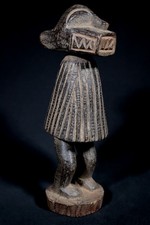
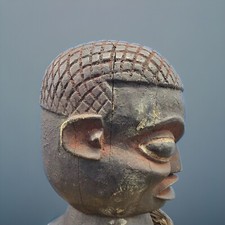
Selected fromAfrican ritual art oneBay.co.uk.
Endnotes
1.
Source: africanarchive.org
Link:https://africanarchive.org/en/glossary/bwiti-religion
2.
Source: presidence.ga
Link:https://presidence.ga/la-culture-du-gabon/
3.
Source: music.si.edu
Title: Smithsonian Music Ngombi (Harp) | Smithsonian Music
Link:https://music.si.edu/object-day/ngombi-harp
4.
Source: bwitiroots.org
Title: Bwiti Roots Bwiti Culture – Bwiti Roots
Link:https://bwitiroots.org/bwiti-culture/
5.
Source: tianmu.org
Title: Anglican Church Bwiti — The Way of Iboga · Tianmu Anglican Church
Link:https://tianmu.org/good-work-library/ethnotheology/africa/bwiti-the-way-of-iboga
Source snippet
THE TEMPLE AND THE NIGHT — STRUCTURE OF THE SACRED The site of Bwiti ceremony is the ebandza (also written ebandja or bwiti-house) — a re...
6.
Source: indigenouspeople.org.uk
Title: Indigenous Peoples Mbilou, Bwiti Nganga from Gabon
Link:https://www.indigenouspeople.org.uk/mbilou/
Source snippet
Indigenous PeoplesMbilou, Bwiti Nganga from Gabon - Indigenous People...
7.
Source: folkways.si.edu
Link:https://folkways.si.edu/music-from-an-equatorial-microcosm-fang-bwiti-from-gabon-republic-africa-with-mbiri-selections/world/album/smithsonian
8.
Source: artmuseum.princeton.edu
Link:https://artmuseum.princeton.edu/art/collections/objects/31750
Additional References
9.
Source: gabonmediatime.com
Link:https://gabonmediatime.com/musee-national-lexposition-de-la-tradition-a-la-modernite-de-la-chine-ouverte-le-15-juillet/
Source snippet
July 13, 2026 — MUSÉE NATIONAL: L’EXPOSITION «DE LA TRADITION À LA MODERNITÉ » DE LA CHINE OUVERTE LE 15 JUILLET Blandine Biloghe 13 jui...
Published: July 13, 2026
10.
Source: youtube.com
Title: Bwiti Initiation Music from Gabon for Iboga Shamanic Journeying
Link:http://www.youtube.com/watch?v=SEAWet6qYNw
Source snippet
Arqued Harp and mouth bow from Gabon, a bwiti ritual played by Papé Nziengui...
11.
Source: africabib.org
Link:https://africabib.org/rec.php?DB=p&RID=324484836
12.
Source: noma.org
Link:https://noma.org/collection/bwiti-association-sacred-pillar-movenga/
13.
Source: institutfrancais-gabon.com
Link:https://institutfrancais-gabon.com/evenements/exposition-photographie-esprits-du-bwiti-tour/
14.
Source: bwitialliance.org
Link:https://www.bwitialliance.org/missoko-bwiti-tradition
15.
Source: brooklynmuseum.org
Link:https://www.brooklynmuseum.org/opencollection/objects/100716
16.
Source: thismomentrecords.bandcamp.com
Link:https://thismomentrecords.bandcamp.com/album/calling-the-spirits-missoko-bwiti-music-of-gabon
17.
Source: catalogue.bnf.fr
Link:https://catalogue.bnf.fr/ark%3A/12148/cb47310618w
18.
Source: catalogue.bnf.fr
Link:https://catalogue.bnf.fr/rechercher.do?index=AUT3&numNotice=18103693