Within Strange Chile
Should Chile's Oldest Mummies Be on Display?
Chile's Chinchorro collections reveal an ancient mortuary tradition while raising difficult questions about displaying human remains.
On this page
- How Chinchorro mummification worked
- What visitors see at Colón 10 and Azapa
- Why displaying human remains is contested
Page outline Jump by section
Introduction
The Chinchorro mummies are among Chile’s most remarkable archaeological treasures, but they also raise one of the country’s most difficult museum questions: should ancient human remains be displayed at all? Created by coastal communities in what is now northern Chile more than 7,000 years ago, these are the world’s oldest known artificially mummified bodies, predating Egypt’s royal mummies by millennia. Today, visitors can encounter them in carefully curated settings around Arica, where museums balance scientific interpretation, public education and respect for the dead. That balance is increasingly important as UNESCO recognition has brought greater international attention while also highlighting the ethical responsibilities that come with exhibiting human remains.[UNESCO World Heritage Centre]whc.unesco.orgUNESCO World Heritage CentreSettlement and Artificial Mummification of the Chinchorro Culture in the Arica and Parinacota Region - UNESCO…

Should Chile’s Oldest Mummies Be on Display?
The debate is not about whether the Chinchorro mummies are significant. Their archaeological importance is undisputed. Instead, the central question is whether the educational value of public display outweighs the moral obligation to treat the dead with privacy and dignity.
Unlike many famous Egyptian mummies, the Chinchorro dead were not exclusively rulers or elites. Archaeological evidence suggests that adults, children and even infants were deliberately prepared through elaborate processes of dismantling, reinforcing and reconstructing the body. This broad participation means museums are displaying ordinary members of an ancient community rather than exceptional political figures. That difference shapes modern ethical discussions.[UNESCO World Heritage Centre]whc.unesco.orgUNESCO World Heritage CentreSettlement and Artificial Mummification of the Chinchorro Culture in the Arica and Parinacota Region - UNESCO…
Museums today generally avoid presenting the mummies as curiosities or spectacles. Instead, they frame them as evidence of an early society whose relationship with death differed fundamentally from modern expectations. The bodies are interpreted as archaeological individuals with cultural identities rather than anonymous specimens.
How Chinchorro Mummification Worked
The unusual appearance of the Chinchorro mummies reflects deliberate reconstruction rather than simple preservation.
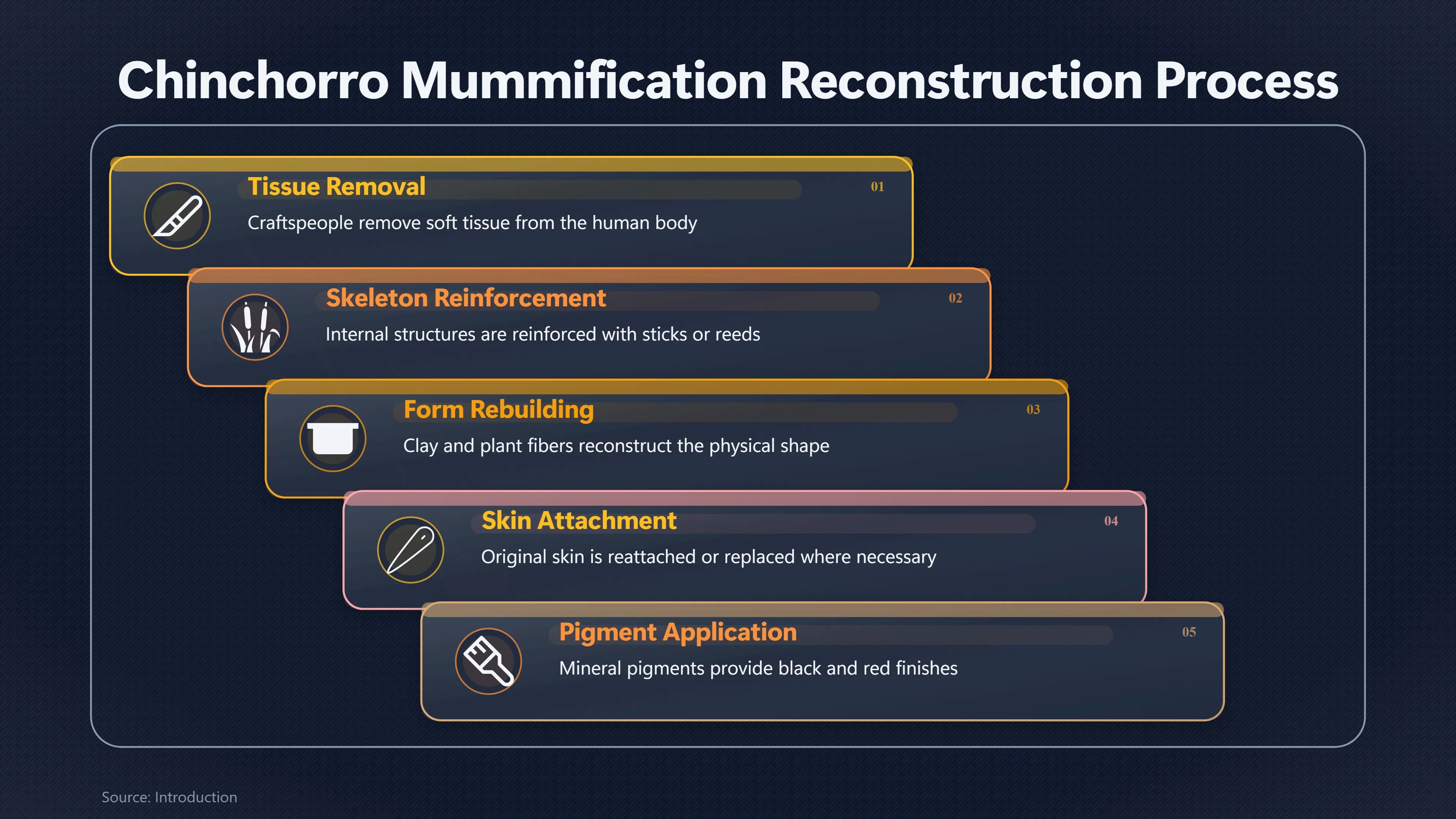
Early methods often involved:
- Removing soft tissue from the body.
- Reinforcing the skeleton with sticks or reeds.
- Rebuilding the form using clay, plant fibres and other materials.
- Reattaching skin or replacing it where necessary.
- Applying mineral pigments, including the distinctive black and later red finishes seen on different styles of mummification.
Rather than preserving a body exactly as it appeared in life, Chinchorro craftspeople effectively recreated it. Many archaeologists interpret this as evidence that the deceased continued to occupy an active place within family or community life before final burial, although aspects of these practices remain debated. UNESCO describes the mummies as reflecting the “fundamental social role of the dead” within Chinchorro society rather than merely representing a technical achievement.[UNESCO World Heritage Centre]whc.unesco.orgWorld Heritage Centre UNESCO World Heritage CentreUNESCO World Heritage CentreUNESCO World Heritage Centre - Decision - 44 COM 8B.48…
This understanding influences exhibition design. Visitors are encouraged to see the mummies not simply as ancient corpses but as products of a sophisticated cultural tradition centred on memory, identity and relationships between the living and the dead.
What Visitors See at Colón 10 and Azapa
The two principal visitor experiences present the Chinchorro story in noticeably different ways.
Colón 10
Colón 10 preserves an archaeological discovery in its original urban location. Instead of transferring everything into a conventional gallery, the site allows visitors to view excavated burials close to where they were uncovered beneath modern Arica.
This approach shifts attention from individual mummies to archaeological context. Visitors gain an appreciation of how ancient cemeteries survive beneath contemporary streets and why preserving them in place can be as important as displaying individual bodies. Colón 10 also demonstrates that the UNESCO World Heritage Site is not simply a museum collection but part of a living urban landscape.[UNESCO World Heritage Centre]whc.unesco.orgUNESCO World Heritage CentreSettlement and Artificial Mummification of the Chinchorro Culture in the Arica and Parinacota Region - UNESCO…
San Miguel de Azapa Archaeological Museum
The museum in the Azapa Valley presents one of the world’s best-known collections of Chinchorro remains alongside textiles, tools and other archaeological material from northern Chile.
Displays place the mummies within broader cultural history rather than isolating them as shocking objects. Lighting is subdued, interpretation is scientific rather than theatrical, and accompanying exhibits explain chronology, burial customs and environmental preservation in the Atacama Desert. UNESCO documentation identifies the museum as one of the principal places where visitors encounter Chinchorro mummies while learning about the wider archaeological landscape.[UNESCO World Heritage Centre]whc.unesco.orgWorld Heritage Centre UNESCO World Heritage CentreUNESCO World Heritage CentreUNESCO World Heritage Centre - Document - Chinchorro mummy deposit on exhibition at the San Miguel de Azapa A…
Why Displaying Human Remains Is Contested
Human remains occupy a special category in museum ethics because they are simultaneously scientific evidence, cultural heritage and the physical remains of once-living people.
Several competing principles shape decisions about the Chinchorro collections.
Education and research. Public display helps visitors understand an extraordinary chapter of human history. The mummies continue to support archaeological, biological and conservation research, while exhibitions explain why they matter beyond simple age or rarity.
Respect and dignity. Many museum professionals argue that human remains should never become entertainment. Modern display techniques therefore emphasise careful interpretation, controlled photography policies where appropriate, and restrained presentation.
Community involvement. UNESCO has stressed that decisions surrounding the World Heritage property should involve local stakeholders and communities with an interest in the Chinchorro legacy. This reflects a broader international movement towards greater consultation over how ancestral remains are conserved, researched and exhibited.[UNESCO World Heritage Centre]whc.unesco.orgUNESCO World Heritage CentreSettlement and Artificial Mummification of the Chinchorro Culture in the Arica and Parinacota Region - UNESCO…
Changing museum standards. Museums worldwide have become more cautious about exhibiting human remains over the past few decades. Institutions increasingly review whether displays remain justified, whether interpretation is sufficiently respectful, and whether descendant or local communities have meaningful input.
The Chinchorro collections therefore sit within an international conversation that also includes Indigenous ancestors in North America, Egyptian mummies in Europe, and archaeological remains held in university collections around the world.
How UNESCO Has Changed the Conversation
UNESCO’s 2021 inscription recognised the Chinchorro sites for their exceptional testimony to an ancient cultural tradition, but it also highlighted management responsibilities extending beyond conservation alone.
The World Heritage documentation explicitly notes that ethical issues surrounding the treatment of human remains require continuing attention. It also encourages community outreach and participation in future decision-making, recognising that archaeological preservation is inseparable from public understanding and local engagement.[UNESCO World Heritage Centre]whc.unesco.orgUNESCO World Heritage CentreSettlement and Artificial Mummification of the Chinchorro Culture in the Arica and Parinacota Region - UNESCO…
More recent UNESCO conservation reports have focused on protecting archaeological sites, improving museum infrastructure and strengthening long-term management as visitor interest continues to grow following World Heritage inscription.[UNESCO World Heritage Centre]whc.unesco.orgWorld Heritage Centre UNESCO World Heritage CentreUNESCO World Heritage CentreUNESCO World Heritage Centre - Decision - 47 COM 7B.141…
Why the Debate Matters
For many visitors, the Chinchorro mummies are unforgettable because they are simultaneously scientific discoveries, works of extraordinary craftsmanship and the remains of real individuals.
Their display forces museums to answer questions that extend well beyond archaeology. How should institutions balance education with respect? When does exhibition become voyeurism? Can ancient human remains ever be presented without objectifying the people they once were?
Chile’s leading Chinchorro museums increasingly answer these questions not by hiding the mummies or sensationalising them, but by placing them within their original cultural, archaeological and ethical context. The result is less a display of ancient death than an invitation to consider how every society—including our own—chooses to remember the dead.

Amazon book picks
Further Reading
Books and field guides related to Should Chile's Oldest Mummies Be on Display?. Use these as the next step if you want deeper reading beyond the article.
The Mummy Congress: Science, Obsession, and the Everlasting Dead
Now available in paperback--The Mummy Congress is "clear, direct and intense . . . all the stories sparkle. Pringle is a crack-shot story...
Death, Ritual and Belief: The Rhetoric of Funerary Rites
First published 1997. Subjects: Religious aspects of Death, Death, Comparative studies, Funeral rites and ceremonies, Death, religious as...
eBay marketplace picks
Marketplace Samples
Live-tested eBay searches with available results related to this page.
Selected fromancient artifact decor oneBay.co.uk.
Endnotes
1.
Source: whc.unesco.org
Link:https://whc.unesco.org/en/list/1634
Source snippet
UNESCO World Heritage CentreSettlement and Artificial Mummification of the Chinchorro Culture in the Arica and Parinacota Region - UNESCO...
2.
Source: whc.unesco.org
Title: World Heritage Centre UNESCO World Heritage Centre
Link:https://whc.unesco.org/en/decisions/7967/
Source snippet
UNESCO World Heritage CentreUNESCO World Heritage Centre - Decision - 44 COM 8B.48...
3.
Source: whc.unesco.org
Title: World Heritage Centre UNESCO World Heritage Centre
Link:https://whc.unesco.org/en/documents/181890
Source snippet
UNESCO World Heritage CentreUNESCO World Heritage Centre - Document - Chinchorro mummy deposit on exhibition at the San Miguel de Azapa A...
4.
Source: whc.unesco.org
Title: World Heritage Centre UNESCO World Heritage Centre
Link:https://whc.unesco.org/en/decisions/8866/
Source snippet
UNESCO World Heritage CentreUNESCO World Heritage Centre - Decision - 47 COM 7B.141...
6.
Source: unesco.org
Title: La UNESCO felicita a Chile por la inscripción de su séptimo sitio en
Link:https://www.unesco.org/es/articles/la-unesco-felicita-chile-por-la-inscripcion-de-su-septimo-sitio-en-la-lista-del-patrimonio-mundial
Source snippet
July 27, 2021 — LA UNESCO FELICITA A CHILE POR LA INSCRIPCIÓN DE SU SÉPTIMO SITIO EN LA LISTA DEL PATRIMONIO MUNDIAL: EL ASENTAMIENTO Y M...
Published: July 27, 2021
8.
Source: unesco.org
Link:https://www.unesco.org/archives/multimedia/document-1341
9.
Source: whc.unesco.org
Link:https://whc.unesco.org/es/list/1634
10.
Source: whc.unesco.org
Link:https://whc.unesco.org/ja/list/1634
11.
Source: sfgp.gob.cl
Link:https://www.sfgp.gob.cl/patrimonio-mundial-generos-y-territorios/chinchorro
Additional References
12.
Source: patrimoniocultural.gob.cl
Link:https://www.patrimoniocultural.gob.cl/noticias/taller-internacional-abordo-en-arica-excavacion-conservacion-y-exhibicion-de-cuerpos
Source snippet
ional del Patrimonio CulturalJuly 5, 2024 — TALLER INTERNACIONAL ABORDÓ EN ARICA EXCAVACIÓN, CONSERVACIÓN Y EXHIBICIÓN DE CUERPOS MOMIFIC...
Published: July 5, 2024
13.
Source: nationalgeographic.com
Title: Can UNESCO status save the Chinchorro mummies?
Link:https://www.nationalgeographic.com/history/article/can-unesco-status-save-the-worlds-oldest-mummies
Source snippet
National GeographicOctober 25, 2021 — The so-called Chinchorro mummies, which were discovered in the early 20th century in the Atacama...
Published: October 25, 2021
14.
Source: chile.un.org
Link:https://chile.un.org/es/137604-patrimonio-mundial-asentamiento-y-momificaci%C3%B3n-artificial-de-la-cultura-chinchorro-es
15.
Source: gob.cl
Link:https://www.gob.cl/en/news/unesco-includes-archaeological-sites-and-artificial-mummification-chinchorro-culture-its-world-heritage-list/
16.
Source: monumentos.gob.cl
Title: Declaración Pública | Consejo de Monumentos Nacionales de Chile
Link:https://www.monumentos.gob.cl/prensa/noticias/declaracion-publica-0
17.
Source: youtube.com
Link:https://www.youtube.com/watch?v=BCiKSDMN7o0
18.
Source: youtube.com
Link:https://www.youtube.com/watch?v=R-6dpabuJXE
19.
Source: youtube.com
Link:https://www.youtube.com/watch?v=XnJHughJVEE
20.
Source: youtube.com
Link:https://www.youtube.com/watch?v=fkdk9dEX-r0
21.
Source: youtube.com
Link:https://www.youtube.com/watch?v=lml7S5-teqc