Within Micronesian Curiosities
Is Chuuk Lagoon a Museum or War Grave?
Chuuk Lagoon preserves a vast drowned wartime collection whose appeal as a dive site is inseparable from danger, memory and human loss.
On this page
- What survives beneath the lagoon
- Diving, memorial respect and visitor safety
- Corrosion, pollution and the wrecks' future
Page outline Jump by section
Introduction
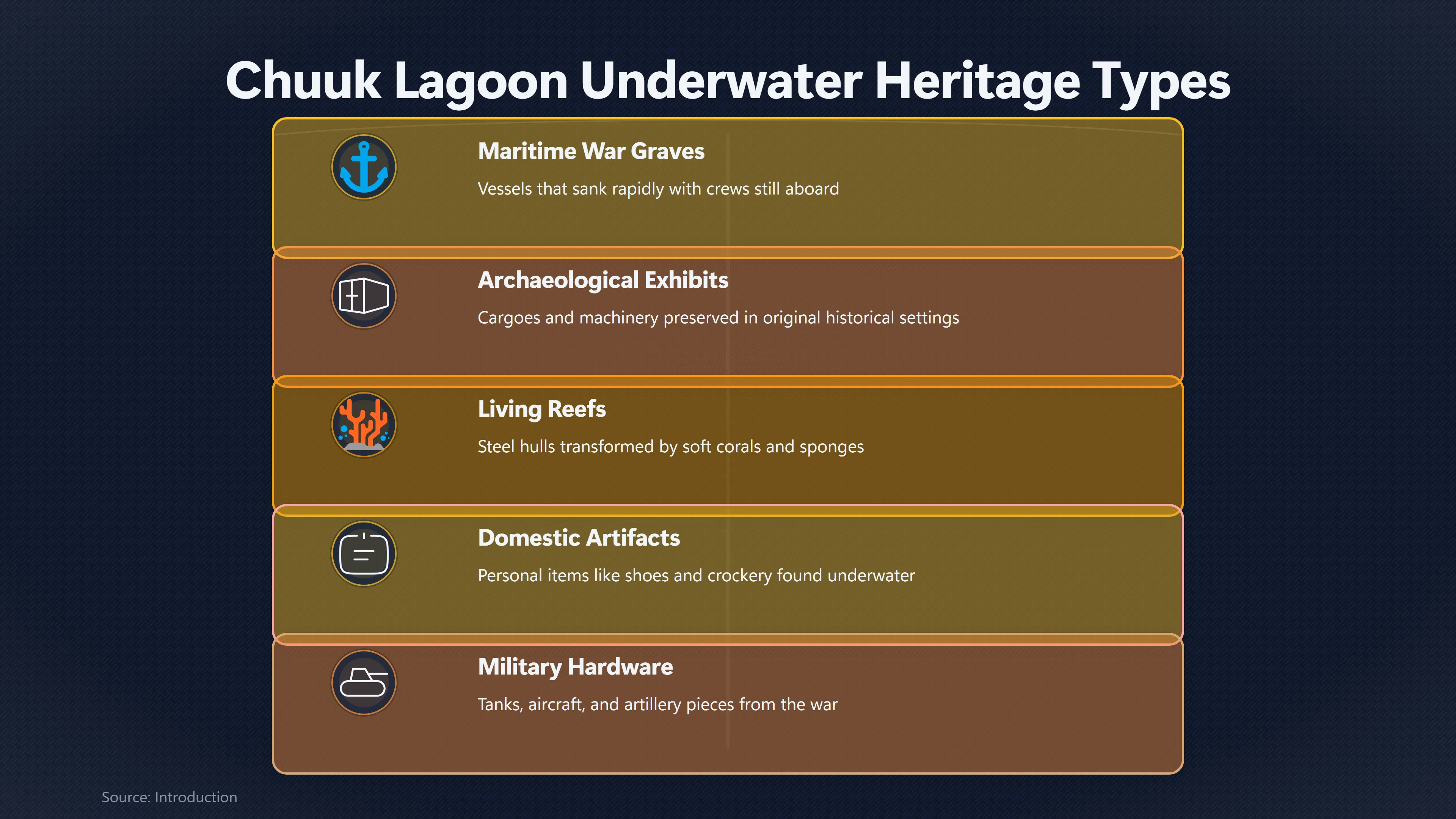
Chuuk Lagoon is one of the world’s most remarkable underwater heritage sites, but it cannot be understood simply as a spectacular wreck-diving destination. Beneath its calm waters lie dozens of Japanese merchant ships, naval auxiliaries, aircraft, weapons, vehicles and everyday personal possessions sunk during the American Operation Hailstone attacks in February 1944. Together they form an accidental underwater museum while also serving as maritime war graves where many servicemen died and, in some cases, remain. This dual identity shapes every serious visit: the wrecks are both historical exhibits and places of remembrance, demanding curiosity balanced with respect.[National Park Service]nps.govNational Park ServiceUncovering WWII Shipwrecks in Chuuk Lagoon (U.S. National Park Service)July 27, 2023…
Unlike a conventional museum, nothing was arranged for display. Cargo still sits in holds, machinery remains in engine rooms, and coral has transformed military hardware into living reefs. Divers therefore encounter history largely where it fell, creating an unusually direct connection between archaeology, ecology and wartime memory.
What survives beneath the lagoon?
Operation Hailstone destroyed what had been one of Japan’s most important Pacific bases. More than 60 ships and around 250 aircraft were lost in and around the lagoon, leaving one of the world’s largest concentrations of Second World War underwater archaeology.[National Park Service]nps.govNational Park ServiceUncovering WWII Shipwrecks in Chuuk Lagoon (U.S. National Park Service)July 27, 2023…
The surviving material ranges from enormous cargo ships to fighter aircraft, trucks, tanks, artillery pieces, ammunition, bottles, medical supplies and domestic goods intended for the Japanese garrison. Many wrecks have become famous among experienced divers because their cargoes remain visible inside holds, while bridges, telegraphs, engines and gun emplacements still convey how the vessels originally functioned.
This combination makes Chuuk unusual even among famous wreck sites. Instead of displaying isolated artefacts in cases, the lagoon preserves complete historical settings. A diver entering a cargo hold sees objects in relation to one another, allowing the wreck itself to function as the exhibition space.
Marine life has added another layer to this “museum”. Soft corals, sponges and reef fish now cover steel hulls that once carried war across the Pacific. The result is neither untouched nature nor preserved machinery, but a constantly changing partnership between biological growth and decaying industrial remains.
Why the wrecks are also war graves
Calling Chuuk Lagoon an underwater museum captures only half the story. Many vessels went down rapidly with their crews aboard, making numerous wrecks recognised maritime war graves. Although Japanese recovery missions after the war removed many human remains, not all could be recovered, and some are still believed to remain within wrecks or beneath surrounding sediment.[National Park Service]nps.govNational Park ServiceUncovering WWII Shipwrecks in Chuuk Lagoon (U.S. National Park Service)July 27, 2023…
This creates an ethical tension absent from most museums. Visitors are not simply examining historical objects; they are entering places associated with violent deaths. Responsible dive operators therefore stress that wrecks should be treated much like military cemeteries:
- Human remains, if encountered, should never be disturbed.
- Artefacts should remain in place rather than being collected as souvenirs.
- Penetration dives require exceptional care both for safety and to avoid damaging the archaeological record.
- Photography is generally accepted, but sensational treatment of remains or personal possessions is widely discouraged.
The atmosphere underwater often reinforces this sense of respect. Personal items such as shoes, bottles, tools and crockery remind visitors that these ships were also workplaces and temporary homes before becoming battlefields.
Diving, memorial respect and visitor safety
The lagoon attracts divers from around the world because many wrecks remain accessible in relatively clear tropical water. However, Chuuk is not an underwater theme park. The qualities that make it fascinating also make it hazardous.
Many celebrated wrecks involve overhead environments, confined spaces, unstable structures, silt-filled compartments and depths beyond those suitable for inexperienced recreational divers. Corrosion continually weakens decks, ladders and bulkheads, meaning routes used safely decades ago may no longer be appropriate.[Frontiers]frontiersin.orgFrontiersFrontiers | In-situ Corrosion Measurements of WWII Shipwrecks in Chuuk Lagoon, Quantification of Decay Mechanisms and Rates of D…
Experienced operators increasingly present dives as heritage experiences rather than treasure hunts. Modern practice emphasises:
- careful buoyancy to avoid damaging fragile structures;
- leaving artefacts undisturbed;
- recognising that wreck interiors continue to change;
- respecting any local restrictions or guidance relating to memorial sites.
This approach reflects a broader shift in underwater archaeology, where preservation in situ—keeping remains where they lie—is often considered preferable to removing objects unless conservation requires it.
Corrosion, pollution and the wrecks’ future
The lagoon’s appearance can create the illusion that the wrecks are frozen in time, but they are steadily disappearing. Steel hulls continue to corrode, protective marine concretions periodically break away, and structural collapse becomes increasingly likely as metal weakens. Scientific monitoring has shown that corrosion rates vary with depth, oxygen levels, water movement and the orientation of individual wrecks.[Frontiers]frontiersin.orgFrontiersFrontiers | In-situ Corrosion Measurements of WWII Shipwrecks in Chuuk Lagoon, Quantification of Decay Mechanisms and Rates of D…
Another concern is environmental rather than archaeological. While aircraft generally no longer pose significant fuel risks, several ships still contain bunker fuel trapped in tanks. As corrosion advances, leaks become more likely, creating potential pollution threats to reefs, fisheries and nearby communities. This has prompted international cooperation on risk assessment and mitigation, including work supported through UNESCO’s Heritage Emergency Fund and partnerships with the Federated States of Micronesia to identify the highest-risk wrecks.[UNESCO]unesco.orgActivities supported by the Heritage Emergency Fund in the FEDERATEDSeptember 29, 2025…
The challenge is therefore twofold: conserving an internationally significant underwater cultural landscape while preventing environmental damage from ageing wartime vessels. Unlike objects inside climate-controlled museums, these collections cannot simply be placed behind glass. Every year the sea reshapes them.
A distinctive place in Micronesia’s curiosity landscape
Within the Federated States of Micronesia, Chuuk Lagoon stands apart because it blurs the boundaries between museum, archaeological site, living reef and military cemetery. Visitors do not encounter carefully curated galleries but an entire historical landscape preserved underwater, where natural processes continue to alter every exhibit.
Its fascination lies precisely in that complexity. The wrecks are extraordinary because they preserve everyday traces of wartime life alongside dramatic military history, yet they also remind visitors that the most compelling collections are not always those assembled intentionally. In Chuuk Lagoon, history survives where it happened, making respect for memory as important as admiration for the remarkable underwater archaeology.
Amazon book picks
Further Reading
Books and field guides related to Is Chuuk Lagoon a Museum or War Grave?. Use these as the next step if you want deeper reading beyond the article.
Pacific Worlds
Asia, the Pacific Islands and the coasts of the Americas have long been studied separately. This essential single-volume history of the P...
The Cambridge History of the Pacific Islanders
An authoritative and comprehensive history of the Pacific islanders from 40,000 BC to the present day.
Animation in Asia and the Pacific
Animation has had a global renaissance during the 1990s, and nowhere is this more evident than in Asia. With the exception of China and J...
The Archaeology of Maritime Landscapes
Maritime cultural landscapes are collections of submerged archaeological sites, or combinations of terrestrial and submerged sites that r...
eBay marketplace picks
Marketplace Samples
Live-tested eBay searches with available results related to this page.
Selected fromshipwreck diving patch oneBay.co.uk.
Endnotes
1.
Source: unesco.org
Link:https://www.unesco.org/en/node/187456?hub=195868
Source snippet
Activities supported by the Heritage Emergency Fund in the FEDERATEDSeptember 29, 2025...
Published: September 29, 2025
2.
Source: unesco.org
Title: World War Shipwrecks in Southeast Asia – threats of marine pollution
Link:https://www.unesco.org/en/articles/world-war-shipwrecks-southeast-asia-threats-marine-pollution-and-looting
Source snippet
January 24, 2024 — WORLD WAR SHIPWRECKS IN SOUTHEAST ASIA – THREATS OF MARINE POLLUTION AND LOOTING On 6 -7 December 2023, UNESCO Jakarta...
Published: January 24, 2024
3.
Source: nps.gov
Link:https://www.nps.gov/articles/000/uncovering-wwii-shipwrecks-in-chuuk-lagoon.htm
Source snippet
National Park ServiceUncovering WWII Shipwrecks in Chuuk Lagoon (U.S. National Park Service)July 27, 2023...
Published: July 27, 2023
4.
Source: frontiersin.org
Link:https://www.frontiersin.org/journals/marine-science/articles/10.3389/fmars.2016.00038/full
Source snippet
FrontiersFrontiers | In-situ Corrosion Measurements of WWII Shipwrecks in Chuuk Lagoon, Quantification of Decay Mechanisms and Rates of D...
5.
Source: patrinum.ch
Link:https://patrinum.ch/record/482259
Source snippet
In-situ Corrosion Measurements of WWII Shipwrecks in Chuuk Lagoon, Quantification of Decay Mechanisms and Rates of DeteriorationMarch 30...
Additional References
6.
Source: researchgate.net
Link:https://www.researchgate.net/publication/233575528_Corrosion_and_conservation_management_of_iron_shipwrecks_in_Chuuk_Lagoon_Federated_States_of_Micronesia
Source snippet
January 1, 2006 — Article PDF Available CORROSION AND CONSERVATION MANAGEMENT OF IRON SHIPWRECKS IN CHUUK LAGOON, FEDERATED STATES OF MIC...
Published: January 1, 2006
7.
Source: researchgate.net
Link:https://www.researchgate.net/publication/299497034_In-situ_Corrosion_Measurements_of_WWII_Shipwrecks_in_Chuuk_Lagoon_Quantification_of_Decay_Mechanisms_and_Rates_of_Deterioration
Source snippet
March 30, 2016 — IN-SITU CORROSION MEASUREMENTS OF WWII SHIPWRECKS IN CHUUK LAGOON, QUANTIFICATION OF DECAY MECHANISMS AND RATES OF DETER...
Published: March 30, 2016
8.
Source: research-portal.uea.ac.uk
Link:https://research-portal.uea.ac.uk/en/publications/ticking-ecological-time-bombs-risk-characterisation-and-managemen/
Source snippet
ecological time bombs: Risk characterisation and management of oil polluting World War II shipwrecks in the Pacific Ocean - University of...
9.
Source: tandfonline.com
Link:https://www.tandfonline.com/doi/abs/10.1179/135050306793137359
Source snippet
Corrosion and conservation management of iron shipwrecks in Chuuk Lagoon, Federated States of Micronesia: Conservation and Management of...
10.
Source: onlinelibrary.wiley.com
Title: j.1095 9270.2006.00093.x
Link:https://onlinelibrary.wiley.com/doi/10.1111/j.1095-9270.2006.00093.x
Source snippet
128-136 IN-SITU CORROSION STUDIES ON WRECKED AIRCRAFT OF THE IMPERIAL JAPANESE NAVY IN CHUUK LAGOON, FEDERATED STATES OF MICRONESIA Ian D...
11.
Source: onlinelibrary.wiley.com
Title: j.1095 9270.2006.00093.x
Link:https://onlinelibrary.wiley.com/doi/abs/10.1111/j.1095-9270.2006.00093.x
Source snippet
128-136 IN-SITU CORROSION STUDIES ON WRECKED AIRCRAFT OF THE IMPERIAL JAPANESE NAVY IN CHUUK LAGOON, FEDERATED STATES OF MICRONESIA Ian D...
12.
Source: pubmed.ncbi.nlm.nih.gov
Link:https://pubmed.ncbi.nlm.nih.gov/33548805/
Source snippet
Estimates of current corrosion rates show many wrecks are at risk of structural collapse. However, the scale of...
13.
Source: youtube.com
Title: THE GHOST FLEET: Inside the World’s Deadliest Ship Graveyard | Paskvan Podcasts
Link:https://www.youtube.com/watch?v=vn_yLnTkXv8
Source snippet
MYSTERIES OF THE DEEP: Exploring Sunken WW2 Shipwrecks...
14.
Source: youtube.com
Title: 82 Years Later Operation Hailstone The Wrecks of Chuuk Lagoon
Link:https://www.youtube.com/watch?v=19-eXhgRoyk
Source snippet
THE GHOST FLEET: Inside the World's Deadliest Ship Graveyard | Paskvan Podcasts...
15.
Source: youtube.com
Link:https://www.youtube.com/watch?v=zARgs3tu_gw
Source snippet
The Naval Base So Secret the Enemy Didn't Know It Existed...