Within Colombia Curiosities
Who Should Display Colombia's Human Remains?
Colombia's anatomical displays reveal how medical education, spectacle and modern expectations of dignity can collide.
On this page
- Inside the Museum of the Human Being
- From Medical Teaching to Public Spectacle
- Consent, Provenance and Respect
Page outline Jump by section
Introduction
Colombia’s collections of human remains sit at the intersection of science, education and public curiosity. Unlike archaeological mummy museums that focus on distant history, the country’s best-known anatomical collections contain real human organs, skeletons and preserved bodies assembled for medical teaching. They raise difficult questions that many visitors now ask before they even enter the gallery: Who gave permission for these remains to be displayed? How well is each specimen documented? When does education become spectacle?
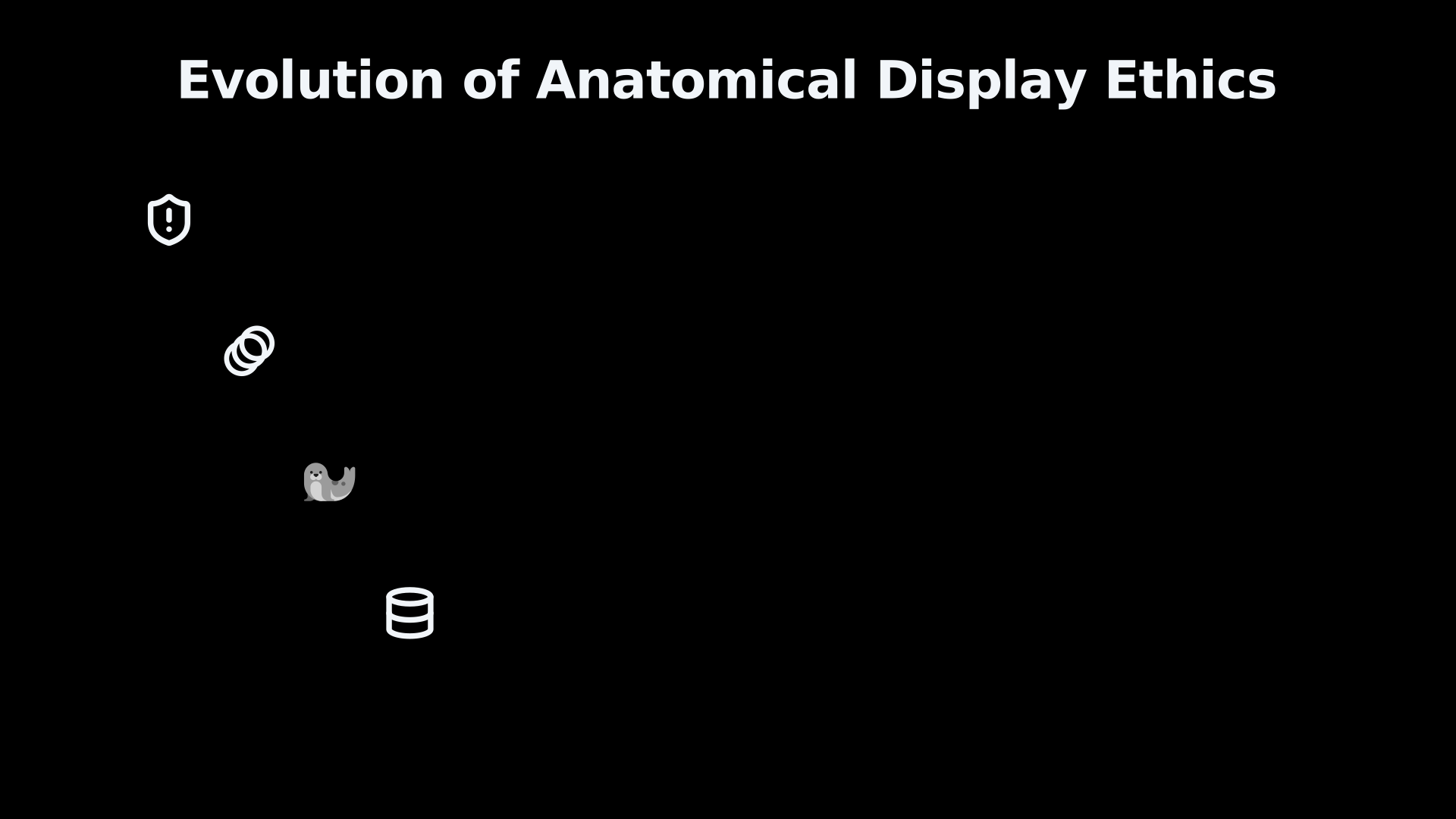
These questions are particularly relevant to Bogotá’s Museum of the Human Being, where scientific collections are presented to the public in ways that reflect both older traditions of anatomical display and modern expectations of transparency and dignity. Rather than asking whether such museums should exist at all, the more useful debate is how they should explain provenance, respect the dead and balance educational value against the possibility of turning human remains into curiosities.[International Council of Museums]icom.museumInternational Council of Museums Code of EthicsInternational Council of MuseumsCode of Ethics - International Council of Museums - International Council of Museums…
Inside the Museum of the Human Being
Bogotá’s Museum of the Human Being occupies an unusual place within Colombia’s landscape of strange museums. It is neither a conventional medical school collection closed to the public nor a large national science museum with extensive interpretive galleries. Instead, visitors encounter hundreds of genuine anatomical specimens, including preserved organs, foetuses, skeletons and examples of congenital abnormalities, presented with the stated aim of teaching anatomy and illustrating human disease.
The educational purpose is genuine. Anatomical collections have long been central to training doctors, surgeons and nurses, particularly before digital imaging and three-dimensional modelling became commonplace. Real specimens preserve details that are difficult to reproduce artificially and continue to hold scientific value for teaching pathology and anatomy.
Yet the museum’s intimate scale and cabinet-like atmosphere also evoke nineteenth- and early twentieth-century medical collections, when unusual bodies were frequently displayed because they were visually striking as much as scientifically informative. That historical legacy shapes modern reactions. Many visitors leave with both admiration for the educational mission and discomfort about the presentation itself, illustrating how scientific collections can also function as powerful emotional experiences.[PMC]pmc.ncbi.nlm.nih.govOpen source on nih.gov.
From Medical Teaching to Public Spectacle
The central ethical tension is not whether human remains may ever be displayed. Museums, universities and medical schools around the world continue to exhibit genuine human material. The real question is what changes when a teaching collection becomes a public attraction.
Medical students normally study specimens within a professional environment governed by ethical rules, supervision and educational objectives. Public museums serve a broader audience whose motivations vary widely. Some visitors arrive seeking medical knowledge, while others are drawn by horror, curiosity or dark tourism.
That shift changes the responsibilities of the institution. Modern museum ethics increasingly encourage curators to provide visitors with enough context to understand why the remains are present rather than simply presenting unusual bodies as extraordinary objects. Good interpretation explains:
- how the specimen contributed to medical knowledge;
- why it remains scientifically important;
- whether identities are known or intentionally protected;
- what ethical standards govern display today.
Without that context, authentic scientific collections can unintentionally resemble historical “cabinets of curiosities”, where rarity rather than understanding became the organising principle.[icom.museum]icom.museumInternational Council of Museums Code of EthicsInternational Council of MuseumsCode of Ethics - International Council of Museums - International Council of Museums…
Consent, Provenance and Respect
The most significant questions surrounding Colombia’s public anatomical collections concern provenance—the documented history of how specimens entered the collection—and consent.
Many anatomical collections worldwide contain material assembled decades before today’s ethical standards existed. Historical specimens may have originated from hospitals, medical schools or unclaimed bodies handled under laws that differed substantially from current expectations. This historical reality does not automatically make every specimen unethical, but it does mean museums should explain what is known and acknowledge where documentation is incomplete rather than implying certainty that does not exist.
Visitors increasingly expect museums to answer questions such as:
- Was the body donated voluntarily?
- If not, under what legal framework was it obtained?
- Can the individual still be identified?
- Are relatives or descendant communities involved in decisions about display?
- Why is public exhibition still justified today?
Public descriptions of Bogotá’s Museum of the Human Being emphasise scientific education but provide relatively limited information about the provenance of every individual specimen. As a result, the debate is less about authenticity—there is no serious dispute that the anatomical material is genuine—than about the level of documentation and interpretation accompanying it.[International Council of Museums]icom.museumInternational Council of Museums Code of EthicsInternational Council of MuseumsCode of Ethics - International Council of Museums - International Council of Museums…
How International Museum Standards Change the Conversation
International museum practice has evolved considerably over recent decades. The International Council of Museums (ICOM) treats human remains as especially sensitive collections rather than ordinary museum objects.
Its ethical guidance stresses several principles that are directly relevant to Colombian collections:
Human Remains(#endnote-15 “Endnote 15”) ns should be acquired lawfully and responsibly;[amnh.org]amnh.orghuman remains stewardshiphuman remains stewardship
- museums should care for them with dignity and professional respect;
- displays should avoid sensationalism;
- museums should consider the interests and beliefs of descendant communities where these are known;
- requests concerning removal or repatriation should be handled respectfully and promptly.
Importantly, these standards do not require every human remain to be removed from exhibition. Instead, they encourage museums to justify why each display exists and to demonstrate that education, research and public benefit outweigh the risks of objectifying the dead.[International Council of Museums]icom.museumInternational Council of Museums Code of EthicsInternational Council of MuseumsCode of Ethics - International Council of Museums - International Council of Museums…
Why Colombia’s Debate Is Different
Colombia’s discussion differs from countries whose museums primarily display ancient archaeological mummies or prehistoric skeletons. Some Colombian collections include comparatively recent human remains, meaning the individuals may have descendants, identifiable biographies or continuing cultural connections.
This makes ethical decisions more immediate. Questions about consent and dignity are harder to separate from living memory than they are with remains thousands of years old. The nearby example of San Bernardo’s naturally preserved mummies illustrates a related but distinct challenge: bodies that became tourist attractions while still belonging to recognisable local families and communities. Although the Museum of the Human Being and San Bernardo represent different kinds of collections—medical versus funerary—they both remind visitors that displayed human bodies were once identifiable people rather than anonymous exhibits.
That shared reality has encouraged museums internationally to move away from displays that rely on shock value and towards interpretation that foregrounds biography, scientific purpose and ethical reflection.[International Council of Museums]icom.museumInternational Council of Museums Code of EthicsInternational Council of MuseumsCode of Ethics - International Council of Museums - International Council of Museums…
What Visitors Should Expect
Visitors interested in Colombia’s unusual museums should approach anatomical collections differently from conventional attractions.
Rather than asking only whether the displays are authentic, it is worth considering:
- Does the exhibition explain why these remains are displayed?
- Is scientific learning clearly prioritised over entertainment?
- Is the provenance described where known?
- Are sensitive subjects handled respectfully?
- Does the museum encourage reflection rather than simple fascination?
Viewed through those questions, the Museum of the Human Being becomes more than an unsettling curiosity. It represents an important point where Colombia’s history of medical education meets changing international expectations about transparency, consent and the respectful treatment of the dead.
Amazon book picks
Further Reading
Books and field guides related to Who Should Display Colombia's Human Remains?. Use these as the next step if you want deeper reading beyond the article.
Body Worlds: The Anatomical Exhibition of Real Human Bodies
Catalog of Gunther von Hagen's exhibition of human bodies preserved by "plastination"and presented as "natural art" (p. 13).

The Bone Detectives: How Forensic Anthropologists Solve Crime...
First published 1996. Subjects: Forensic anthropology, Juvenile literature, Forensic sciences, Criminal investigation, New York Times rev...
eBay marketplace picks
Marketplace Samples
Live-tested eBay searches with available results related to this page.
Selected fromanatomy art print oneBay.co.uk.
Endnotes
1.
Source: icom.museum
Title: International Council of Museums Code of Ethics
Link:https://icom.museum/en/resources/standards-guidelines/code-of-ethics/
Source snippet
International Council of MuseumsCode of Ethics - International Council of Museums - International Council of Museums...
2.
Source: pmc.ncbi.nlm.nih.gov
Link:https://pmc.ncbi.nlm.nih.gov/articles/PMC7927479/
3.
Source: icom.museum
Link:https://icom.museum/en/news/international-repatriation-of-human-remains-of-indigenous-peoples/
Source snippet
International Council of MuseumsInternational repatriation of human remains of indigenous peoples - International Council of Museums - In...
4.
Source: icom.museum
Title: The ethics of concealment: When preserving means not showing
Link:https://icom.museum/en/news/the-ethics-of-concealment-when-preserving-means-not-showing/
Source snippet
International Council of Museums - International Council of MuseumsApril 22, 2026 — April 22, 2026 ICOM VOICES THE ETHICS OF CONCEALMENT...
Published: April 22, 2026
5.
Source: cimuset.mini.icom.museum
Title: museum ICO M code of Ethics for Museums
Link:https://cimuset.mini.icom.museum/members/icom-code-of-ethics-for-museums/
6.
Source: pmc.ncbi.nlm.nih.gov
Link:https://pmc.ncbi.nlm.nih.gov/articles/PMC7618824/
Source snippet
ethical disagreement on ancestral human remains in museums - PMCFebruary 11, 2026 — INTRODUCTION This paper explores two participative, i...
Published: February 11, 2026
7.
Source: amnh.org
Title: human remains stewardship
Link:https://www.amnh.org/about/human-remains-stewardship
8.
Source: pmc.ncbi.nlm.nih.gov
Link:https://pmc.ncbi.nlm.nih.gov/articles/PMC6913807/
9.
Source: redcol.minciencias.gov.co
Link:https://redcol.minciencias.gov.co/Record/UNIANDES2_af1fe4c545b055b4863d12a26477ac77/Details
10.
Source: medicinalegal.gov.co
Link:https://www.medicinalegal.gov.co/investigaciones-antropologicas-arrojan-aportes-para-procesos-de-identificacion-de-cuerpos
11.
Source: funcionpublica.gov.co
Link:https://www.funcionpublica.gov.co/eva/gestornormativo/norma.php?i=14522
12.
Source: penn.museum
Link:https://www.penn.museum/about/statements-and-policies/statement-on-human-remains
13.
Source: ucl.ac.uk
Link:https://www.ucl.ac.uk/social-historical-sciences/archaeology/research/human-remains-policy
14.
Source: nhm.ac.uk
Link:https://www.nhm.ac.uk/about-us/governance/human-remains-in-the-collection.html
15.
Source: redcol.minciencias.gov.co
Link:https://redcol.minciencias.gov.co/Record/UNIANDES2_af1fe4c545b055b4863d12a26477ac77/Description
16.
Source: sciencemuseum.org.uk
Link:https://www.sciencemuseum.org.uk/human-remains
Additional References
17.
Source: cambridge.org
Link:https://www.cambridge.org/core/journals/international-journal-of-cultural-property/article/testing-ethical-disagreement-on-ancestral-human-remains-in-museums/1010E88D6D8E6F0661019D19350ADBA1
Source snippet
Testing ethical disagreement on ancestral human remains in museums | International Journal of Cultural Property | Cambridge CoreFebruary...
18.
Source: caracol.com.co
Title: ¿Por qué momifican a las personas en Colombia?
Link:https://caracol.com.co/2026/04/04/por-que-momifican-a-las-personas-en-colombia-este-es-el-pueblo-que-tiene-un-museo-de-momias/?event_log=okdesc
Source snippet
Este es el pueblo que tiene un museo de momias | Tendencias | Caracol RadioApril 4, 2026 — ¿POR QUÉ MOMIFICAN A LAS PERSONAS EN COLOMBIA?...
Published: April 4, 2026
19.
Source: sula.com.co
Title: Naturally Mummified Bodies of the Museum of Mummies in Colombia
Link:https://sula.com.co/naturally-mummified-bodies-of-the-museum-of-mummies-in-colombia/
Source snippet
/ April 15, 2026 When you think of mummies, you surely think about Egypt, and its famous mummified pharaohs...
Published: April 15, 2026
20.
Source: youtube.com
Title: MUSEUM OF THE HUMAN BODY: Discovering life through death
Link:https://www.youtube.com/watch?v=9aW9qnEq3ug
Source snippet
We visited the Museum of Man in Bogotá, Colombia...
21.
Source: youtube.com
Title: Así es el museo de momias que se encuentra en Bogotá
Link:https://www.youtube.com/watch?v=SeH7srb-e98
Source snippet
Ethical considerations for caring and managing human remains in museums...
22.
Source: youtube.com
Title: We visited the Museum of Man in Bogotá, Colombia
Link:https://www.youtube.com/watch?v=jRX5rIbL0WU
Source snippet
Así es el museo de momias que se encuentra en Bogotá...
23.
Source: scielo.org.co
Link:https://www.scielo.org.co/scielo.php?pid=S0121-52562012000200001&script=sci_arttext
24.
Source: cultura.gob.es
Link:https://www.cultura.gob.es/msorolla/va/colecciones/carta-compromiso-restos-humanos.html
25.
Source: elespanol.com
Link:https://www.elespanol.com/ciencia/20240506/misterio-momias-san-bernardo-pueblo-cadaveres-no-descomponen/851665136_0.html
26.
Source: noticiascaracol.com
Link:https://www.noticiascaracol.com/colombia/el-pueblo-de-colombia-donde-los-muertos-se-convierten-en-momias-que-misterio-hay-detras-rg10?_amp=true