Within Strange Guyana
Why Guyana's Giant Sloth Feels Almost Mythical
Guyana's National Museum turns prehistoric scale and ageing animal displays into the country's most accessible encounter with physical oddities.
On this page
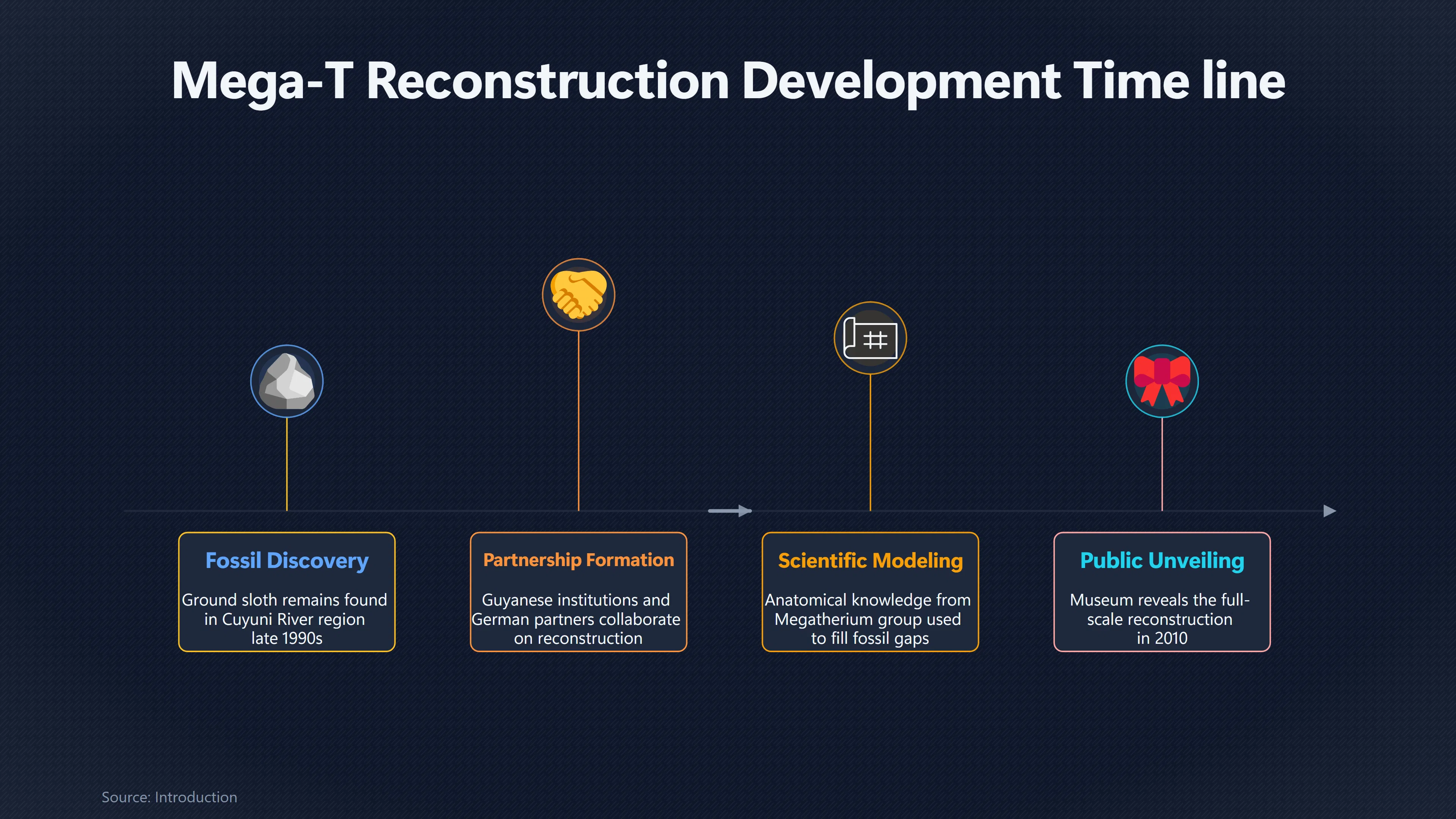
- The Mega T reconstruction and its fossil basis
- What the ageing taxidermy reveals
- How natural history becomes uncanny
Page outline Jump by section
Introduction
The most memorable object in Guyana’s National Museum is not a rare gemstone or colonial relic, but a towering reconstruction of a giant ground sloth. Standing above visitors with enormous claws outstretched, the Mega-T brings back to life an animal that disappeared from South America thousands of years ago. It has become one of the museum’s defining exhibits because it combines genuine palaeontological evidence with a dramatic full-scale reconstruction, making prehistoric Guyana feel unexpectedly tangible.[Stabroek News]stabroeknews.comStabroek News Giant sloth replica on display at National MuseumStabroek NewsGiant sloth replica on display at National Museum - Stabroek NewsApril 13, 2010…
Alongside the giant sloth, the museum’s ageing taxidermy collection creates a different kind of fascination. Rows of preserved birds, mammals and reptiles reflect an older style of natural history museum in which specimens were collected to document the country’s wildlife long before colour photography or widespread ecological tourism. Today, these displays often strike visitors as slightly uncanny, yet they remain an important record of both Guyana’s biodiversity and the history of museum practice.
Why Guyana’s Giant Sloth Feels Almost Mythical
At first glance, the Mega-T resembles something from folklore rather than science. Rising on its hind legs and stretching almost to the ceiling, it challenges modern expectations of what a sloth should look like. Most people associate sloths with slow-moving tree dwellers no larger than a dog. The reconstruction instead depicts an Ice Age giant that reached roughly 4.5 metres in height when standing upright and could weigh several tonnes.[Stabroek News]stabroeknews.comStabroek News Giant sloth replica on display at National MuseumStabroek NewsGiant sloth replica on display at National Museum - Stabroek NewsApril 13, 2010…
That contrast explains why many visitors initially mistake the exhibit for a fantasy creature. It occupies the same imaginative space as mythical beasts or cryptids while remaining firmly grounded in palaeontological evidence. Rather than encouraging mystery, the display demonstrates how scientific reconstruction can make extinct animals appear almost unbelievable.
Within Guyana’s landscape of unusual collections, the exhibit succeeds because it transforms a prehistoric fossil record into something physically immediate. Instead of viewing isolated bones in a case, visitors encounter an animal at full scale.
The Mega-T Reconstruction and Its Fossil Basis
The museum’s reconstruction was unveiled in 2010 through collaboration between Guyanese institutions, private sponsors and German partners. It was designed to translate fragmentary fossil discoveries into a life-sized display that could be appreciated by the general public.[Stabroek News]stabroeknews.comStabroek News Giant sloth replica on display at National MuseumStabroek NewsGiant sloth replica on display at National Museum - Stabroek NewsApril 13, 2010…
Its scientific basis comes from giant ground sloth fossils discovered in Guyana’s interior, particularly around the Omai area and Oko Creek in the Cuyuni River region during the late 1990s. Those remains demonstrated that enormous ground sloths once inhabited what is now Guyana, adding the country to the map of South American Pleistocene research. The original fossils themselves are necessarily incomplete, so the museum uses anatomical knowledge from the wider Megatherium group to reconstruct the complete animal.[Stabroek News]stabroeknews.comStabroek News Giant sloth replica on display at National MuseumStabroek NewsGiant sloth replica on display at National Museum - Stabroek NewsApril 13, 2010…
This distinction matters. Visitors are not looking at a preserved skeleton exactly as it was found, but at an evidence-based interpretation assembled from fossil remains and comparative anatomy. That approach is standard in palaeontology, allowing extinct animals to be visualised while remaining clear about where reconstruction begins.
The display also places the sloth within a recreated prehistoric environment rather than presenting it as an isolated specimen. Artificial vegetation and accompanying animals help visitors imagine the ecosystem in which such giants once lived.[Stabroek News]stabroeknews.comStabroek News Giant sloth replica on display at National MuseumStabroek NewsGiant sloth replica on display at National Museum - Stabroek NewsApril 13, 2010…
What the Ageing Taxidermy Reveals
If the giant sloth represents modern interpretation, the museum’s taxidermy represents an earlier era of natural history.
Many of the mounted animals have been on display for decades. Their poses, glass eyes and traditional mounting techniques reflect museum standards of the mid-twentieth century rather than contemporary exhibition design. Some visitors find them charming, while others describe them as eerie or unintentionally unsettling. Those reactions have become part of the museum’s identity, but they should not obscure the original purpose of the collection.
Before digital media and widespread travel into Guyana’s vast rainforest interior, preserved specimens allowed urban visitors and school groups to encounter wildlife they might never otherwise see. The mounts documented birds, mammals, reptiles and other native species for education as much as exhibition.[Stabroek News]stabroeknews.comStabroek News Ambitious five-year plan for National MuseumStabroek NewsAmbitious five-year plan for National Museum - Stabroek News…
The displays therefore preserve two histories simultaneously:
- the biological diversity of Guyana;
- the history of museum collecting and scientific education;
- older taxidermy techniques and exhibition styles;
- changing ideas about how natural history should be presented to the public.
Rather than replacing every ageing specimen with modern interactive displays, the museum retains many older mounts as part of its own institutional history.
How Natural History Becomes Uncanny
The museum demonstrates how ordinary scientific collections can gradually acquire an atmosphere of curiosity.
The giant sloth is scientifically accurate in intention, yet appears almost monstrous simply because modern people have no living equivalent for comparison. The taxidermy specimens become uncanny for the opposite reason: they depict familiar animals using preservation techniques that have visibly aged over time.
Together they blur the line between natural history and the emotional experience of visiting a curiosity collection. Nothing is presented as supernatural, but the encounter still produces surprise and wonder.
This effect is strengthened by the museum’s traditional galleries, where mineral collections, archaeological material, historical artefacts and preserved wildlife sit close together. The result resembles older nineteenth-century museums, where different branches of knowledge shared the same display spaces instead of being separated into specialised institutions.
Why the Collection Matters
The giant sloth has become one of Guyana’s strongest public symbols of prehistoric life. Museum staff have described it as a major attraction since its installation, drawing families, school groups and overseas visitors while encouraging greater interest in the country’s fossil heritage. Plans developed after its unveiling even included educational brochures and miniature replicas for visitors, reflecting its popularity as the museum’s signature exhibit.[Stabroek News]stabroeknews.comStabroek News Ambitious five-year plan for National MuseumStabroek NewsAmbitious five-year plan for National Museum - Stabroek News…
Equally significant is what the taxidermy collection represents. Although modern museums increasingly favour multimedia interpretation and ecological storytelling, these preserved animals remain valuable historical objects. They document how Guyana introduced generations of visitors to its extraordinary wildlife before digital technology transformed museum practice.
Taken together, the Mega-T and the ageing taxidermy create one of the country’s most distinctive public encounters with natural history. One reconstructs a vanished giant from scattered fossils; the other preserves familiar animals in increasingly historic forms. Both remind visitors that museums do more than display nature—they preserve changing ways of imagining and understanding it.
Amazon book picks
Further Reading
Books and field guides related to Why Guyana's Giant Sloth Feels Almost Mythical. Use these as the next step if you want deeper reading beyond the article.
The Sixth Extinction
"Over the last half billion years, there have been five major mass extinctions, when the diversity of life on Earth suddenly and dramatic...

The Last Days of the Dinosaurs
First published 2022. Subjects: Extinction (Biology), Dinosaurs, Extinction, Biological Extinction, Extinction (Biologie).
Other Minds
A leading philosopher of science discusses the evolution of the cephalopod mind, shares photos of cephalopod encounters taken during his...
The Hidden Life of Trees
A NEW YORK TIMES, WASHINGTON POST, AND WALL STREET JOURNAL BESTSELLER • One of the most beloved books of our time: an illuminating accoun...
eBay marketplace picks
Marketplace Samples
Live-tested eBay searches with available results related to this page.
Selected fromnatural history collectible oneBay.co.uk.



Endnotes
1.
Source: stabroeknews.com
Title: Stabroek News Giant sloth replica on display at National Museum
Link:https://www.stabroeknews.com/2010/04/13/news/guyana/giant-sloth-replica-on-display-at-national-museum/
Source snippet
Stabroek NewsGiant sloth replica on display at National Museum - Stabroek NewsApril 13, 2010...
Published: April 13, 2010
2.
Source: stabroeknews.com
Title: Stabroek News Ambitious five-year plan for National Museum
Link:https://www.stabroeknews.com/2010/06/07/news/guyana/ambitious-five-year-plan-for-national-museum/
Source snippet
Stabroek NewsAmbitious five-year plan for National Museum - Stabroek News...
3.
Source: stabroeknews.com
Title: 46 graduate from Taxidermy Camp
Link:https://www.stabroeknews.com/2015/08/21/news/guyana/46-graduate-from-taxidermy-camp/
Source snippet
Stabroek NewsAugust 21, 2015 — Guyana News 46 GRADUATE FROM TAXIDERMY CAMP By Stabroek News August 21, 2015 On Wednesday, the National Mu...
Published: August 21, 2015
4.
Source: stabroeknews.com
Title: Contract signed for first national petting zoo
Link:https://www.stabroeknews.com/2014/01/29/news/guyana/contract-signed-first-national-petting-zoo/
Source snippet
Stabroek NewsJanuary 29, 2014 — CONTRACT SIGNED FOR FIRST NATIONAL PETTING ZOO By Stabroek News January 29, 2014 Construction work for Gu...
Published: January 29, 2014
5.
Source: stabroeknews.com
Title: National Trust launches book of historic photos
Link:https://www.stabroeknews.com/2010/10/05/news/guyana/national-trust-launches-book-of-historic-photos/
Source snippet
Stabroek NewsOctober 5, 2010 — NATIONAL TRUST LAUNCHES BOOK OF HISTORIC PHOTOS By Stabroek News October 5, 2010 The National Trust of Guy...
Published: October 5, 2010
6.
Source: stabroeknews.com
Title: Zoo being mismanaged, under-funded
Link:https://www.stabroeknews.com/2010/03/23/news/guyana/zoo-being-mismanaged-under-funded/
Source snippet
Stabroek NewsMarch 23, 2010 — ZOO BEING MISMANAGED, UNDER-FUNDED By Stabroek News March 23, 2010 By Sara Bharrat A combination of poor de...
Published: March 23, 2010
7.
Source: stabroeknews.com
Title: Whose sloth?
Link:https://www.stabroeknews.com/2010/03/20/news/guyana/whose-sloth/
Source snippet
Stabroek NewsMarch 20, 2010 — WHOSE SLOTH? By Stabroek News March 20, 2010 Queries are being made to determine the origins of the three-t...
Published: March 20, 2010
8.
Source: en.tripadvisor.com.hk
Title: tripadvisor.com.hk Guyana National Museum
Link:https://en.tripadvisor.com.hk/Attraction_Review-g294078-d3210285-Reviews-or30-Guyana_National_Museum-Georgetown_Demerara_Mahaica.html
Source snippet
National Museum - All You SHOULD Know Before Going 2026 (with Reviews)GUYANA NATIONAL MUSEUM Save Review See all things to do Guyana Nati...
Additional References
9.
Source: thingsguyana.com
Title: Guyana National Museum- From the ashes upwards…
Link:https://thingsguyana.com/guyana-national-museum-from-the-ashes-upwards/
Source snippet
Things GuyanaMarch 10, 2019 — GUYANA NATIONAL MUSEUM- FROM THE ASHES UPWARDS… March 10, 2019 * Things Guyana * 7 years ago * 0 The Guyana...
Published: March 10, 2019
10.
Source: kaieteurnewsonline.com
Title: Giant sloth unveiled at the National Museum
Link:https://kaieteurnewsonline.com/2010/04/11/giant-sloth-unveiled-at-the-national-museum/
Source snippet
Kaieteur NewsApril 11, 2010 — GIANT SLOTH UNVEILED AT THE NATIONAL MUSEUM Apr 11, 2010 News The dinosaur is as familiar an animal to the...
Published: April 11, 2010
11.
Source: youtube.com
Link:https://www.youtube.com/watch?v=NDXciebkNdg
Source snippet
Top 10 Things to Do in Georgetown, Guyana | Culture, Food & Coastal Life...
12.
Source: ntg.gov.gy
Title: At present there are n
Link:https://ntg.gov.gy/monument-type/national-monuments/
Source snippet
National Monuments – National TrustSearch [Input: Search...] NATIONAL MONUMENTS National monuments are the vested responsibility of the N...
13.
Source: tripadvisor.com
Title: Guyana National Museum
Link:https://www.tripadvisor.com/Attraction_Review-g294078-d3210285-Reviews-or30-Guyana_National_Museum-Georgetown_Demerara_Mahaica.html
Source snippet
All You SHOULD Know Before Going (2026 Reviews)Guyana National Museum See all things to do GUYANA NATIONAL MUSEUM Save Review See all thi...
14.
Source: youtube.com
Title: Top 10 Things to Do in Georgetown, Guyana | Culture, Food & Coastal Life
Link:https://www.youtube.com/watch?v=ehE0XNlnNvE
Source snippet
Could Giant Ground Sloths Survive Nowadays?...
15.
Source: youtube.com
Title: Could Giant Ground Sloths Survive Nowadays?
Link:https://www.youtube.com/watch?v=rmxM9BnDtrE
Source snippet
Art and craft of taxidermy...
16.
Source: youtube.com
Title: Art and craft of taxidermy
Link:https://www.youtube.com/watch?v=ijWXOAqVpSE
Source snippet
The Hidden Art of Museum Dioramas...
17.
Source: youtube.com
Title: The Hidden Art of Museum Dioramas
Link:https://www.youtube.com/watch?v=d_tKwhBaWOg