Within Tajik Curiosities
The Lost Silk Road City of Panjakent
Panjakent's surviving paintings and artefacts reveal the lost world of Sogdian traders and Silk Road cultures.
On this page
- The ancient Sogdian city and its discoveries
- Wall paintings from a vanished society
- Why Panjakent matters today
Page outline Jump by section
Introduction
The ruins of Panjakent in western Tajikistan preserve one of the most vivid windows into the lost world of the Sogdians, the merchants, artists and city-builders who connected Central Asia across the Silk Roads. What makes Panjakent unusual is not a single mysterious object but the survival of an entire visual world: painted halls, religious scenes, epic stories, battle images and everyday details left behind when the city disappeared in the eighth century.[Sogdians]sogdians.si.eduSogdians The City of Panjikent and Sogdian Town-Planning | The SogdiansSogdians The City of Panjikent and Sogdian Town-Planning | The Sogdians
Often described as a “Pompeii of Central Asia”, Panjakent is a ruined city rather than a conventional museum. Its discoveries, however, have become part of Tajikistan’s most remarkable archaeological collections, with important wall paintings and artefacts preserved in institutions including the National Museum of Antiquities of Tajikistan and the State Hermitage Museum in St Petersburg.[Tajikistan Museum of Antiquities]ombt.tjTajikistan Museum of Antiquities NATIONAL MUSEUM OF ANTIQUITIES OF TAJIKISTANTajikistan Museum of Antiquities NATIONAL MUSEUM OF ANTIQUITIES OF TAJIKISTAN The mystery surrounding Panjakent comes from a rare combination: a forgotten civilisation, unfinished traces of a dramatic historical collapse, and artworks that reveal a society far more cosmopolitan than many modern visitors expect from ancient Central Asia.[Sogdians]sogdians.si.eduSogdians The Castle on Mount Mugh and Its Documents | The SogdiansSogdians The Castle on Mount Mugh and Its Documents | The Sogdians
The ancient Sogdian city and its discoveries
A Silk Road city frozen at the end of an era
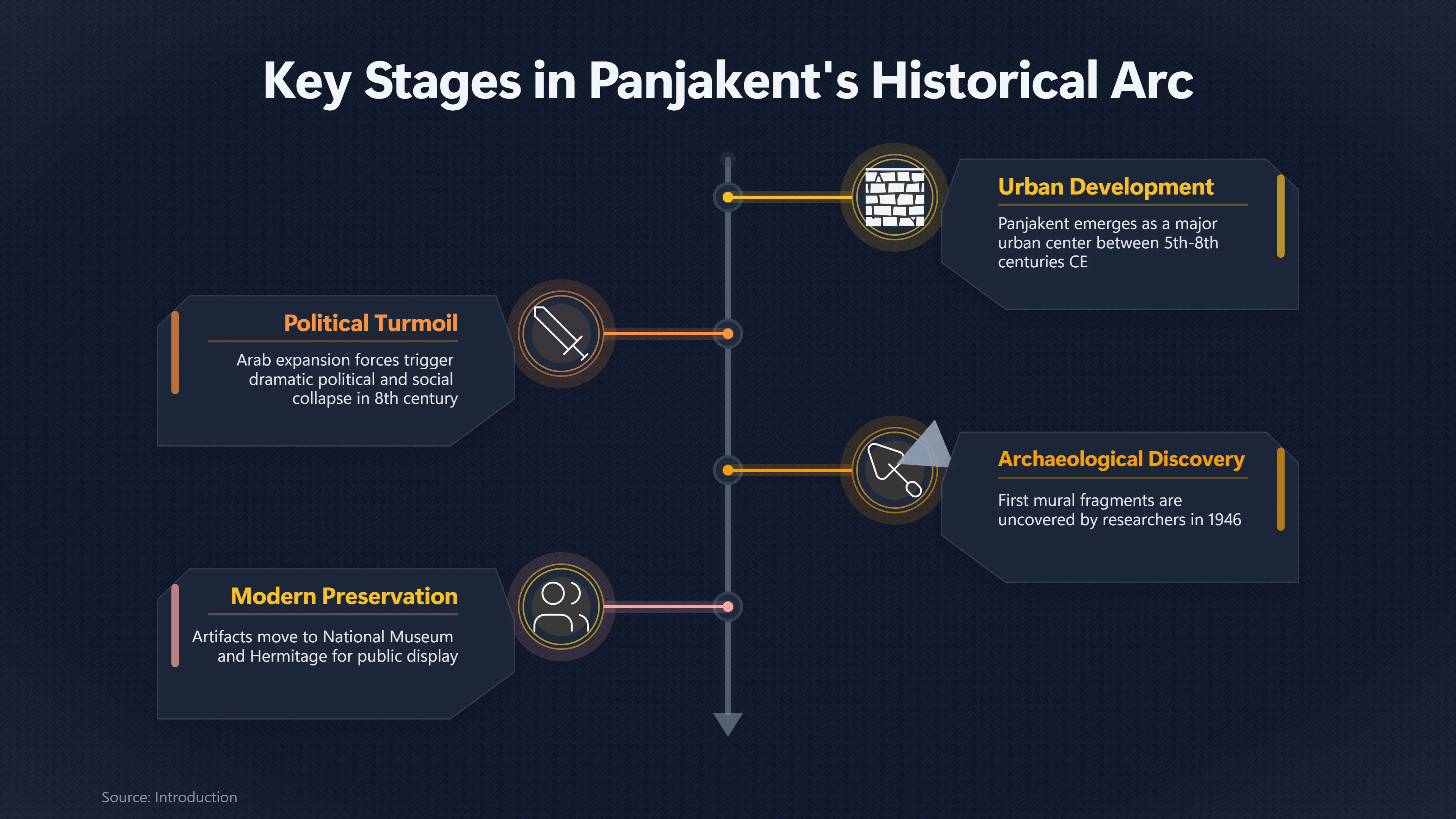
Ancient Panjakent developed in the Zeravshan Valley between the fifth and eighth centuries CE. It was one of the major urban centres of Sogdiana, a region whose cities played an important role in long-distance trade between China, Iran, India and the Mediterranean world. Archaeological work has revealed a fortified citadel, residential areas, temples and large decorated buildings, showing that Panjakent was not simply a trading stop but a sophisticated urban community.[UNESCO World Heritage Centre]whc.unesco.orgWorld Heritage Centre The Site of Ancient Town of PyanjekentUNESCO World Heritage CentreThe Site of Ancient Town of Pyanjekent - UNESCO World Heritage CentreNovember 9, 1999…
The city’s greatest archaeological importance comes from the moment of its abandonment. During the early eighth century, Central Asia was undergoing major political change as Arab forces expanded into the region. Panjakent’s final ruler, Devashtich, became involved in this turbulent period and later appears in documents discovered at nearby Mount Mugh. Those documents provide rare written evidence about Sogdian politics, administration and daily life at the moment when the old order was collapsing.[UNESCO]unesco.orgCollection of documents from Mount MughCollection of documents from Mount Mugh - Memory of the World…
This connection between ruins, paintings and written records makes Panjakent especially valuable. Many ancient cities leave behind buildings but little sense of the people who lived inside them. Panjakent provides a more personal picture: the decoration of homes and temples, the stories chosen for public display, and the concerns of rulers and communities facing political upheaval.[Sogdians]sogdians.si.eduSogdians The City of Panjikent and Sogdian Town-Planning | The SogdiansSogdians The City of Panjikent and Sogdian Town-Planning | The Sogdians
How the lost city became a major archaeological collection
Excavations began uncovering Panjakent’s exceptional wall paintings in the twentieth century, with the first murals discovered in 1946. Since then, archaeologists have continued studying the site, revealing paintings from temples, houses and elite buildings.[Sogdians]sogdians.si.eduSogdians The City of Panjikent and Sogdian Town-Planning | The SogdiansSogdians The City of Panjikent and Sogdian Town-Planning | The Sogdians
The survival of the artwork was partly due to destruction and collapse. When buildings fell, some painted surfaces were buried rather than exposed to centuries of weathering. Archaeologists were therefore able to recover fragments of a visual culture that might otherwise have vanished completely.[Sogdians]sogdians.si.eduSogdians The City of Panjikent and Sogdian Town-Planning | The SogdiansSogdians The City of Panjikent and Sogdian Town-Planning | The Sogdians
Today, visitors to Tajikistan may encounter Panjakent through the ruins themselves or through museum displays. The National Museum of Antiquities of Tajikistan highlights ancient Panjakent paintings among its major cultural treasures, while many famous reconstructed murals are held in the Hermitage collection.[Tajikistan Museum of Antiquities]ombt.tjTajikistan Museum of Antiquities NATIONAL MUSEUM OF ANTIQUITIES OF TAJIKISTANTajikistan Museum of Antiquities NATIONAL MUSEUM OF ANTIQUITIES OF TAJIKISTAN
Wall paintings from a vanished society
The art that made Panjakent famous
The murals of Panjakent are among the most important examples of early medieval Central Asian painting. They are unusual because they do not present a single religious or political message. Instead, they combine mythology, epic storytelling, ceremonies, warfare and scenes from elite life.[Sogdians]sogdians.si.eduSogdians The Rustam Cycle | The SogdiansSogdians The Rustam Cycle | The Sogdians
One of the best-known examples is the Rustam Cycle, a series of paintings showing episodes connected with Rustam, the legendary hero of Iranian epic tradition. The paintings are arranged as a narrative sequence, similar to a visual story unfolding across the walls of a hall. They reveal how Sogdian artists used monumental painting to communicate heroic tales and cultural identity.[Sogdians]sogdians.si.eduSogdians The Rustam Cycle | The SogdiansSogdians The Rustam Cycle | The Sogdians
Another striking image is the depiction of a siege scene from Panjakent’s citadel. The artwork shows a military machine used in an attack, offering historians evidence not only about artistic style but also about warfare and technological exchange across Eurasia. It is a reminder that Silk Road art was not only decorative; it recorded political realities and international connections.[Sogdians]sogdians.si.eduSogdians Siege of a Sogdian City | The SogdiansSogdians Siege of a Sogdian City | The Sogdians

Religious mysteries and changing interpretations
Some of Panjakent’s most fascinating paintings are difficult to interpret because Sogdian religious life was complex. The city’s art includes divine figures, ritual scenes and mythological imagery, reflecting a society influenced by several traditions rather than a single religious system. Scholars continue to debate the identities and meanings of some figures, especially where inscriptions are missing or damaged.[Sogdians]sogdians.si.eduSogdians The Sogdians at Home | The SogdiansSogdians The Sogdians at Home | The Sogdians
A famous example is the mourning scene from Temple II, which shows a dramatic funeral-related composition with mourners, divine figures and symbolic elements. The exact interpretation remains a subject of scholarly discussion, but the painting clearly demonstrates the emotional and ceremonial power of Panjakent’s art.[Sogdians]sogdians.si.eduSogdians Mourning Scene | The SogdiansSogdians Mourning Scene | The Sogdians
This uncertainty is part of what makes Panjakent compelling. Unlike a modern exhibition where every object has a fixed label, ancient wall paintings often preserve fragments of stories whose original audiences understood far better than modern researchers can. The mystery is not that the paintings are unexplained, but that they offer many layers of meaning still being reconstructed.[Sogdians]sogdians.si.eduSogdians The Sogdians at Home | The SogdiansSogdians The Sogdians at Home | The Sogdians
Why Panjakent matters today
A rare portrait of Silk Road life beyond trade routes
The Silk Roads are often imagined through objects moving between empires: coins, luxury goods and caravans. Panjakent adds something different. It shows the people who lived along those routes, including their beliefs, entertainment, political struggles and artistic ambitions.[Sogdians]sogdians.si.eduSogdians The City of Panjikent and Sogdian Town-Planning | The SogdiansSogdians The City of Panjikent and Sogdian Town-Planning | The Sogdians
The city challenges the idea that Central Asia was only a passageway between larger civilisations. Panjakent reveals an active cultural centre with its own artistic traditions and international connections. Its paintings show influences and exchanges from across Eurasia while maintaining a distinct Sogdian character.[Iranica Online]iranicaonline.orgIranica Online SOGDIANA iii. HISTORY AND ARCHAEOLOGYIranica OnlineSOGDIANA iii. HISTORY AND ARCHAEOLOGY - Encyclopaedia IranicaMarch 4, 2011…
For visitors interested in unusual history, this makes Panjakent particularly distinctive. It functions almost like an archaeological cabinet of curiosities: a ruined city containing forgotten stories, mysterious images and evidence of a society that disappeared from everyday memory for centuries.
Visiting Panjakent as a living archaeological mystery
Modern Panjakent offers a different experience from a traditional museum visit. The ruins provide the physical setting where the paintings once existed, while museum collections preserve fragile pieces that cannot remain exposed at the archaeological site. Together, they create two parts of the same story: the landscape of the lost city and the surviving fragments of its imagination.[UNESCO World Heritage Centre]whc.unesco.orgWorld Heritage Centre The Site of Ancient Town of PyanjekentUNESCO World Heritage CentreThe Site of Ancient Town of Pyanjekent - UNESCO World Heritage CentreNovember 9, 1999…
The site is also connected to wider Sogdian discoveries in Tajikistan, especially the Mount Mugh documents that preserve letters, contracts and administrative records from the final years of the Panjakent principality. These written archives complement the paintings by giving names, events and human voices to a world otherwise known mainly through archaeology.[UNESCO]unesco.orgCollection of documents from Mount MughCollection of documents from Mount Mugh - Memory of the World…
Panjakent’s lasting appeal lies in this meeting point between evidence and mystery. The ruins do not reveal a lost civilisation through legends or speculation, but through surviving walls, pigments, documents and carefully studied fragments. They show a Silk Road society that was wealthy, creative and connected — and whose art still raises questions more than a thousand years later.[Sogdians]sogdians.si.eduSogdians The City of Panjikent and Sogdian Town-Planning | The SogdiansSogdians The City of Panjikent and Sogdian Town-Planning | The Sogdians
Amazon book picks
Further Reading
Books and field guides related to The Lost Silk Road City of Panjakent. Use these as the next step if you want deeper reading beyond the article.

The Silk Road: A New History
First published 2012. Subjects: Sources, Trade routes, Historic sites, Local History, Description and travel.
The Silk Roads: A New History of the World
Far more than a history of the Silk Roads, this book is truly a revelatory new history of the world, promising to destabilize notions of...
Sogdian Traders: A History
The Sogdian Traders were the main go-between of Central Asia from the fifth to the eighth century. From their towns of Samarkand, Bukhara...
Lost Enlightenment: Central Asia's Golden Age from the Arab C...
The forgotten story of Central Asia's enlightenment—its rise, fall, and enduring legacy In this sweeping and richly illustrated history,...
eBay marketplace picks
Marketplace Samples
Live-tested eBay searches with available results related to this page.
Selected fromSilk Road poster oneBay.co.uk.

Current eBay listing
Time Hoppers: The Silk Road Poster – Epic Sci-Fi Adventure Film Art
Current eBay listing
Silk Road Blotter Art Acid Art Sheet Poster Psychedelic Print
Endnotes
1.
Source: whc.unesco.org
Title: World Heritage Centre The Site of Ancient Town of Pyanjekent
Link:https://whc.unesco.org/en/tentativelists/1385
Source snippet
UNESCO World Heritage CentreThe Site of Ancient Town of Pyanjekent - UNESCO World Heritage CentreNovember 9, 1999...
Published: November 9, 1999
2.
Source: unesco.org
Title: Collection of documents from Mount Mugh
Link:https://www.unesco.org/en/memory-world/collection-documents-mount-mugh
Source snippet
Collection of documents from Mount Mugh - Memory of the World...
3.
Source: en.unesco.org
Title: cultural selection illustrations literary exchange along silk roads
Link:https://en.unesco.org/silkroad/content/cultural-selection-illustrations-literary-exchange-along-silk-roads
4.
Source: sogdians.si.edu
Title: Sogdians The City of Panjikent and Sogdian Town-Planning | The Sogdians
Link:https://sogdians.si.edu/sidebars/the-city-of-panjikent-and-sogdian-town-planning/
5.
Source: ombt.tj
Title: Tajikistan Museum of Antiquities NATIONAL MUSEUM OF ANTIQUITIES OF TAJIKISTAN
Link:https://ombt.tj/en
6.
Source: sogdians.si.edu
Title: Sogdians The Castle on Mount Mugh and Its Documents | The Sogdians
Link:https://sogdians.si.edu/sidebars/the-castle-on-mount-mugh-and-its-documents-exemplified-by-letter-v-18/
7.
Source: sogdians.si.edu
Title: Sogdians The (Re)discovery of the Sogdians | The Sogdians
Link:https://sogdians.si.edu/the-rediscovery-of-the-sogdians/
8.
Source: sogdians.si.edu
Title: Sogdians The Rustam Cycle | The Sogdians
Link:https://sogdians.si.edu/rustam-cycle/
9.
Source: sogdians.si.edu
Title: Sogdians The Sogdians at Home | The Sogdians
Link:https://sogdians.si.edu/the-sogdians-at-home/
10.
Source: sogdians.si.edu
Title: Sogdians Siege of a Sogdian City | The Sogdians
Link:https://sogdians.si.edu/siege-of-a-sogdian-city/
11.
Source: sogdians.si.edu
Title: Sogdians Mourning Scene | The Sogdians
Link:https://sogdians.si.edu/mourning-scene/
12.
Source: iranicaonline.org
Title: Iranica Online SOGDIANA iii. HISTORY AND ARCHAEOLOGY
Link:https://www.iranicaonline.org/articles/sogdiana-iii-history-and-archaeology/
Source snippet
Iranica OnlineSOGDIANA iii. HISTORY AND ARCHAEOLOGY - Encyclopaedia IranicaMarch 4, 2011...
Published: March 4, 2011
13.
Source: iranicaonline.org
Title: MURA L PAINTING
Link:https://www.iranicaonline.org/articles/mural-painting/
14.
Source: iranicaonline.org
Title: SOGDIAN A iv. SOGDIAN ART
Link:https://www.iranicaonline.org/articles/sogdiana-vi-sogdian-art/
15.
Source: iranicaonline.org
Title: HERMITAG E MUSEUM i. COLLECTION OF THE PRE-ISLAMIC PERIOD
Link:https://www.iranicaonline.org/articles/hermitage-museum-i/
16.
Source: iranicaonline.org
Title: PANJIKAN T
Link:https://www.iranicaonline.org/articles/panjikant/
17.
Source: iranicaonline.org
Title: MUG H, MOUNT
Link:https://www.iranicaonline.org/articles/mugh-mount/
18.
Source: iranicaonline.org
Title: AR T IN IRAN vi. PRE-ISLAMIC EASTERN IRAN AND CENTRAL ASIA
Link:https://www.iranicaonline.org/articles/art-in-iran-vi-pre-islamic-eastern-iran-and-central-asia/
19.
Source: sites.uci.edu
Title: mount mugh documents
Link:https://sites.uci.edu/sasanika/mount-mugh-documents/
20.
Source: sogdians.si.edu
Title: afrasiab mural paintings
Link:https://sogdians.si.edu/afrasiab-mural-paintings/
21.
Source: sogdians.si.edu
Title: banqueting in sogdiana
Link:https://sogdians.si.edu/sidebars/banqueting-in-sogdiana/
22.
Source: asia.si.edu
Title: the sogdians
Link:https://asia.si.edu/whats-on/exhibitions/the-sogdians/
23.
Source: asia-archive.si.edu
Title: the sogdians
Link:https://asia-archive.si.edu/exhibition/the-sogdians/
24.
Source: sogdians.si.edu
Title: seal and its impression
Link:https://sogdians.si.edu/seal-and-its-impression/
25.
Source: en.wikivoyage.org
Link:https://en.wikivoyage.org/wiki/Panjakent
26.
Source: ombt.tj
Link:https://ombt.tj/en/%D0%BF%D0%B5%D0%BD%D0%B4%D0%B6%D0%B8%D0%BA%D0%B5%D0%BD%D1%82-%D0%B4%D1%80%D0%B5%D0%B2%D0%BD%D0%B5%D0%B5-%D0%B3%D0%BE%D1%80%D0%BE%D0%B4%D0%B8%D1%89%D0%B5-v-vii-%D0%B2
27.
Source: ombt.tj
Link:https://ombt.tj/en/node/21
28.
Source: ombt.tj
Link:https://ombt.tj/en/%D1%8D%D0%BD%D0%B5%D0%BE%D0%BB%D0%B8%D1%82-%D0%B8-%D1%8D%D0%BF%D0%BE%D1%85%D0%B0-%D0%B1%D1%80%D0%BE%D0%BD%D0%B7%D1%8B
Additional References
29.
Source: youtube.com
Title: Secret History: The Sogdian Merchants of the Silk Road
Link:https://www.youtube.com/watch?v=uv1XcMQHNOw
Source snippet
When relics speak: Panjakent murals in Tajikistan This video directly highlights the 6th-to-8th-century Sogdian murals discovered in anci...
30.
Source: youtube.com
Link:https://www.youtube.com/watch?v=MJSJPEtvVRw
Source snippet
Panjakent: An Ancient Sogdian City in Tajikistan...
31.
Source: youtube.com
Title: When relics speak: Panjakent murals in Tajikistan
Link:https://www.youtube.com/watch?v=3yy8Rg75H-U
Source snippet
Ancient Panjakent: Exploring Ruins of a 2500 year old city...
32.
Source: osorkhonaimilliidip.tj
Link:https://osorkhonaimilliidip.tj/en/about-us-en/
33.
Source: ticketon.tj
Link:https://ticketon.tj/en/museums/event/natsionalnyy-muzey-drevnostey-tadzhikistana-2026
34.
Source: tour.tj
Link:https://tour.tj/en/regions/rrp-region/dushanbe/national-museum-of-antiquities-of-tajikistan/
35.
Source: osorkhonaimilliidip.tj
Link:https://osorkhonaimilliidip.tj/en/exhibitions/opening-of-the-exhibition-achievements-of-archaeology-of-the-national-museum-during-the-period-of-independence/
36.
Source: osorkhonaimilliidip.tj
Link:https://osorkhonaimilliidip.tj/en/presentation-of-the-monuments-of-the-national-museum-of-tajikistan-at-the-international-exhibition-cultural-heritage-of-national-museums-of-the-member-states-of-the-shanghai-cooperation-organization-a/
37.
Source: tobunken.go.jp
Link:https://www.tobunken.go.jp/materials/ekatudo/205885.html
38.
Source: paris-iea.fr
Link:https://www.paris-iea.fr/en/events/sogdian-documents-from-mount-mugh-historical-archaeological-administrative-and-economic-geographies-of-central-asia-at-the-eve-of-islamization-2