Where Sri Lanka Keeps Its Strangest Stories
Sri Lanka does not have a large, clearly branded circuit of “weird museums” in the manner of countries known for witchcraft galleries, cryptid collections or commercial cabinets of curiosities. Its unusual collection culture is more dispersed.
Page outline Jump by section
Introduction
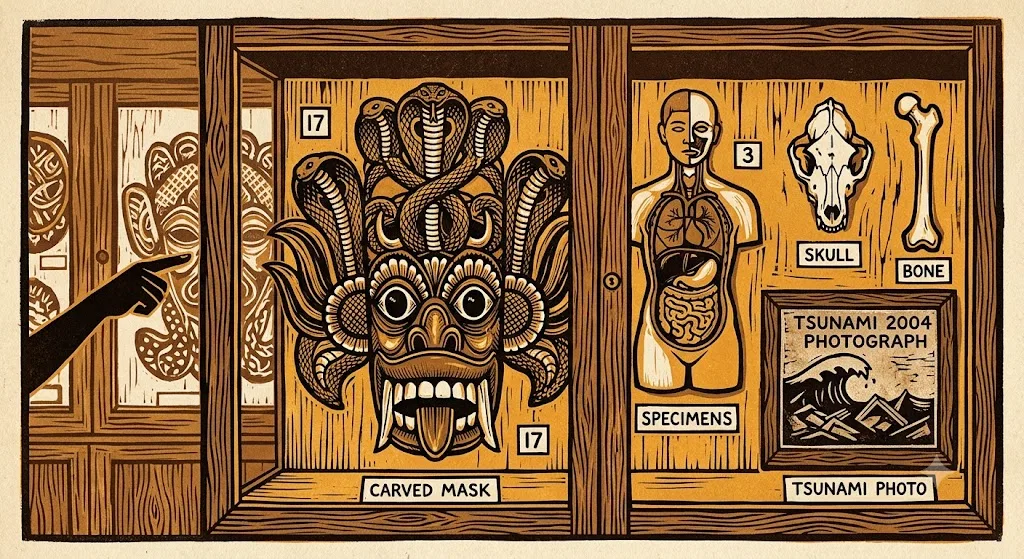
The most distinctive thread is the overlap between folklore, healing and performance. In Ambalangoda, carved demon masks preserve an old ritual classification of disease. Elsewhere, medical museums display dissected human bodies, temples present graphic models of punishment after death, and community museums preserve photographs and objects from the 2004 Indian Ocean tsunami. These are not interchangeable attractions: some are devotional, some academic, some commercial and some deeply personal memorial projects. Understanding who created a display, and why, matters as much as the objects themselves.[nih.gov]pmc.ncbi.nlm.nih.govSri Lankan sanni masks: an ancient classification of diseaseby MS Bailey · 2006 · Cited by 21 — The Sanni Yakuma is the best known exo…
Where folklore becomes a museum
The clearest starting point for Sri Lanka’s strange museum landscape is Ambalangoda, a southern coastal town closely associated with carved masks. The best-known visitor-facing institution is the Ariyapala Mask Museum, a small family-linked museum, workshop and shop devoted to masks used in folk drama, processions and ritual healing. Visitors can expect brightly painted wooden faces with bulging eyes, fangs, snakes, distorted mouths and other deliberately exaggerated features, along with explanations of carving traditions and, when operating, demonstrations by craftspeople.[tripadvisor.co.uk]tripadvisor.co.ukTripadvisor ARIYAPALA MASK MUSEUMAriyapala mask museum has a small work shop, library and a museum. It exhibits different types of masks used at Sri Lanka. The…Read more…
What makes the collection more than a display of theatrical props is its connection to traditional ideas about sickness. One important group represents demons believed to cause particular ailments. A medical discussion published in the British Medical Journal describes the associated healing ceremony as Sri Lanka’s best-known exorcistic ritual and notes that masked figures embodied conditions ranging from fever and stomach illness to paralysis, deafness and disturbed mental states. The masks can therefore be read as an old visual taxonomy of suffering: disease is given a face, summoned into a performance and symbolically brought under control.[PMC]pmc.ncbi.nlm.nih.govSri Lankan sanni masks: an ancient classification of diseaseby MS Bailey · 2006 · Cited by 21 — The Sanni Yakuma is the best known exo…
This should not be interpreted as evidence that present-day Sri Lankan medicine treats demons as clinical causes. The museum preserves a ritual and artistic system shaped by folk belief, Buddhist culture, performance, humour and community healing. Historically, the ceremony combined frightening appearances with comic dialogue and dramatic negotiation. The afflicted person’s problem was not simply represented; it was placed within a shared social event involving dancers, drummers, relatives and spectators.[PMC]pmc.ncbi.nlm.nih.govSri Lankan sanni masks: an ancient classification of diseaseby MS Bailey · 2006 · Cited by 21 — The Sanni Yakuma is the best known exo…
The displays also reveal how living traditions become tourist objects. Masks once intended for ceremonies may now be reproduced for walls, hotels and souvenir shops. Older ritual meanings survive, but they sit beside commercial carving and cultural performance. This makes the museum both valuable and complicated: it protects knowledge that might otherwise disappear, while inevitably presenting a shortened, visitor-friendly version of practices that originally unfolded over many hours and within particular communities. Researchers and museum sources have noted the decline of some performance traditions and the increasing importance of museums and international collections in preserving their material remains.[abhijna-emuseum.com]abhijna-emuseum.comAbhijna e-Museum Mask Art of Sri Lanka: A dying TraditionAbhijna e-MuseumMask Art of Sri Lanka: A dying Tradition - Abhijna e-Museum29 Aug 2019 — The Ambalangoda museum houses different types of…
A broader version of this folk-curiosity tradition can be found at the Martin Wickramasinghe Folk Museum in Koggala. It is not a “horror museum”, but its wide-ranging collection includes ritual masks, puppets, drums, religious objects, tools, village technologies and representations of legendary figures. Its value lies in context: masks appear alongside the everyday equipment, crafts and beliefs of the society that produced them, rather than as isolated monsters for tourists. The museum is operated by a charitable trust and describes itself as a repository of Sri Lankan folk culture from ancient to modern times.[martinwickramasinghe.com]martinwickramasinghe.comOpen source on martinwickramasinghe.com.
Bodies, bones and preserved animals
Sri Lanka’s most literal medical curiosity collection is the Museum of Human Anatomy at the University of Peradeniya. Run by the university’s Department of Anatomy, it was created primarily for medical and allied-health teaching but is also described by the university as open to schools and the public. Its displays include dissected anatomical regions and preparations intended to show the structure of the human body in detail.[med.pdn.ac.lk]med.pdn.ac.lkOpen source on pdn.ac.lk.
The atmosphere is therefore closer to a teaching laboratory than a commercial museum of grotesques. Visitors should expect educational presentation rather than theatrical horror. Even so, seeing real anatomical preparations can be confronting, especially for people accustomed only to plastic models or diagrams. The collection’s strangeness comes from proximity: structures normally hidden inside the body are made permanent, labelled and available for close study.
Access should be confirmed directly before travelling. University museums may organise public visits differently from conventional ticketed attractions, and teaching requirements can affect availability. Ethical expectations are also different from those surrounding ordinary antiquities. Human remains should be approached as educational material connected to once-living people, not simply as macabre entertainment.
Sri Lanka also has several scientific collections that resemble classical cabinets of natural history. The Zoological Museum at the University of Colombo reports more than 9,000 wet and dry specimens, including skins, skeletons and both native and exotic animals. Among its more visually memorable holdings are complete skeletal preparations and specimens chosen for their importance to evolutionary or zoological study. The museum was restored and reopened in its present form in 2023.[museum.zoology.cmb.ac.lk]museum.zoology.cmb.ac.lkOpen source on cmb.ac.lk.
A second university collection, at the University of Sri Jayewardenepura, holds more than 8,000 zoological specimens and invites school pupils, researchers and members of the public to visit. These collections are credible academic repositories rather than roadside oddity displays. Their fascination lies in the older museum tradition of preserving nature through jars, skins, bones and taxonomic arrangement.[science.sjp.ac.lk]science.sjp.ac.lkOpen source on sjp.ac.lk.
The National Museum of Natural History in Colombo offers the most conventional public introduction to this material. Official tourism information highlights rare and threatened Sri Lankan plants and animals as well as prehistoric fossils of elephants, rhinoceroses and hippopotamuses recovered from gem-bearing deposits around Balangoda. Those fossils can be surprising to visitors who associate the island’s natural history only with species living there today.[Sri Lanka Travel]srilanka.travelOpen source on srilanka.travel.
Museums shaped by catastrophe and confinement
Near Hikkaduwa and Telwatta, small tsunami museums preserve one of the most disturbing chapters in recent Sri Lankan history. The Community Tsunami Museum focuses on the Indian Ocean tsunami of 26 December 2004, using photographs, personal accounts, objects, news material and explanatory displays. Unlike a state museum built at a comfortable historical distance, it is closely tied to people and communities who directly experienced the disaster.[tripadvisor.co.uk]tripadvisor.co.ukTripadvisor Community Tsunami MuseumTripadvisor Community Tsunami Museum
The exhibition style is often described as direct and emotionally difficult. Images show destroyed settlements, casualties and the aftermath of the waves, while survivor testimony connects the disaster to named places and individual lives. Some nearby displays and memorial sites also refer to the destruction of the crowded coastal train at Peraliya, one of the deadliest railway disasters recorded.[australiancrickettours.com]australiancrickettours.comcommunity tsunami museum hikkaduwacommunity tsunami museum hikkaduwa
These institutions sit somewhere between museum, archive, memorial and education centre. Their collections are not “strange” because the events are mysterious, but because ordinary things have acquired traumatic significance. A damaged object, newspaper clipping or family photograph becomes evidence of a sudden break between life before and after the wave.
Visitors should expect limited institutional polish compared with a national museum. That informality can be part of the value, since local narration and survivor involvement give the displays immediacy. It also means graphic material may not always be mediated through the warnings, controlled lighting or interpretive frameworks used by larger memorial museums. The experience is best approached as an act of remembrance rather than dark-tourism spectacle.
Bogambara Prison in Kandy represents a different form of difficult heritage. Opened under British colonial rule in 1876, it operated as a high-security prison until its closure in 2014. The complex contained hundreds of cells and gallows, and was one of the Sri Lankan prisons where executions were carried out. After closure, redevelopment plans recast the site as a cultural and tourism precinct.[Wikipedia]WikipediaBogambara PrisonBogambara Prison
The site is frequently described as a museum or visitor attraction, but its status has changed during a long redevelopment process. It is safer to regard it as a preserved former prison and evolving cultural site rather than assume that a fully curated prison museum is always operating. Public access to interiors, cells or specific displays may vary.
Bogambara’s importance lies in the tension between preservation and reuse. A colonial prison can be interpreted through architecture, punishment, political imprisonment, capital punishment and the lives of ordinary inmates. It can also be softened into an atmospheric commercial venue. How much of that darker history remains legible will determine whether the complex functions as serious prison heritage or merely as an unusual backdrop.

Sacred objects and visions of punishment
Sri Lanka’s religious collections require a different kind of attention because many objects are not simply historical artefacts. They remain part of active systems of worship, offering and pilgrimage.
The Temple of the Sacred Tooth Relic in Kandy is centred on a relic believed by devotees to be a tooth of the Buddha. It is both a major pilgrimage site and a UNESCO-associated heritage monument, visited by worshippers as well as tourists. The relic itself is normally enclosed within nested reliquaries and ceremonial structures rather than presented like a conventional museum specimen.[sridaladamaligawa.lk]sridaladamaligawa.lkOpen source on sridaladamaligawa.lk.
The temple’s museum complex displays royal clothing, manuscripts, models, portraits, ritual objects, antiques, ornaments and donations accumulated over centuries. This is a treasury shaped by devotion: many objects entered the collection as offerings or as material connected to the custodianship of the relic. Their meaning cannot be reduced to rarity or visual splendour, because political legitimacy, kingship and Buddhist practice are embedded in the collection.[sridaladamaligawa.lk]sridaladamaligawa.lkOpen source on sridaladamaligawa.lk.
For travellers interested in reliquaries and unusual sacred collections, Kandy is therefore more significant than a novelty museum. It demonstrates how an object understood as a bodily remnant can become the organising centre of architecture, ritual, political history and museum display. Questions about scientific authentication are not the principal concern of the institution; its public significance rests on continuous religious belief and historical custodianship.
The nearby International Buddhist Museum offers a more comparative collection, with galleries created through contributions from Buddhist countries across Asia. Opened in 2011, it presents different national histories and material expressions of Buddhism in a former administrative building beside the temple complex. It is less uncanny than the relic treasury, but useful for understanding how religious objects change meaning across national traditions and exhibition settings.[Wikipedia]WikipediaInternational Buddhist MuseumInternational Buddhist Museum
A more graphic encounter with Buddhist moral imagery appears at Wewurukannala temple near Dickwella. Before reaching the complex’s enormous seated Buddha, visitors pass through a hall commonly described as a “tunnel of hell”. Painted figures and life-sized tableaux show demons inflicting punishments on wrongdoers, turning ideas about karmic consequences into physical scenes of cutting, burning and bodily torment.[sltravel.lk]sltravel.lkSL Travel SLTravel | The Traveler's Connection | Place | Wewrukannala TempleSL Travel SLTravel | The Traveler's Connection | Place | Wewrukannala Temple
This is not a museum of torture in the secular sense. The figures operate within a religious teaching environment, contrasting the results of harmful conduct with the path towards moral improvement and liberation. Their exaggerated violence has an instructional purpose, much as medieval European church art used images of damnation to make abstract consequences memorable.
The temple has nevertheless become an offbeat tourist attraction because the dioramas resemble a religious horror exhibition. Visitors should resist treating the scenes as merely camp or bizarre. They remain inside an active place of worship, so modest dress, respectful behaviour and sensitivity towards devotees are more important than the informal “hall of horrors” label might suggest.
How credible are Sri Lanka’s unusual collections?
Sri Lanka’s curiosity landscape is strongest when it is read as a mixture of institutions rather than a ranked list of strange attractions. Credibility depends on the kind of claim being made.
University anatomy and zoology museums have academic authority over specimens, although public access may be limited. National and archaeological museums are official custodians, but their interpretation may be traditional and object-centred. Family mask museums possess craft knowledge and inherited connections to performance, while also selling reproductions. Tsunami museums derive authority from local testimony and accumulated documentation rather than from large professional curatorial departments. Temple museums explain objects within living devotional traditions, where religious truth and scientific proof are not treated as equivalent questions.[museum.gov.lk]museum.gov.lkOpen source on museum.gov.lk.
A useful visitor should therefore ask:
- Is the collection active or historic? A mask may represent a continuing ritual tradition, a reconstructed performance or an object now made mainly for sale.
- Who controls the interpretation? Universities, government departments, families, religious custodians and disaster survivors each speak with different forms of authority.
- Are the objects originals, replicas or teaching models? This matters especially with masks, sacred objects, anatomical displays and reconstructed scenes.
- Is the attraction reliably open? Small museums, university collections and redeveloping heritage sites may not follow the predictable arrangements of major national institutions.
- Could the material be distressing? Anatomy collections, tsunami photographs and punishment tableaux can involve real remains or graphic representations of death and injury.
The result is a national curiosity culture built less around self-conscious eccentricity than around intense ways of making invisible forces visible. Demons are carved into diagnostic faces; anatomy is fixed in preserved specimens; extinct animals return as fossils; catastrophe survives in damaged objects and photographs; moral consequences become painted bodies; and a sacred relic anchors an entire museum complex. Sri Lanka’s strangest collections are most rewarding when they are approached not as isolated oddities, but as evidence of how communities preserve fear, belief, memory and knowledge.
Amazon book picks
Further Reading
Books and field guides related to Where Sri Lanka Keeps Its Strangest Stories. Use these as the next step if you want deeper reading beyond the article.
The Anthropology of Religion, Magic, and Witchcraft
AutoCite helps to correctly cite sources in a variety of formats.
The Museum Experience
As the first book to take a "visitor's eye view" of the museum visit, The Museum Experience revolutionized the way museum professionals u...
The Oxford Handbook of Material Culture Studies
Written by an international team of experts, the Handbook makes accessible a full range of theoretical and applied approaches to the stud...
The Routledge Companion to Intangible Cultural Heritage
This collection provides an in-depth and up-to-date examination of the concept of Intangible Cultural Heritage and the issues surrounding...
eBay marketplace picks
Marketplace Samples
Live-tested eBay searches with available results related to this page.
Selected fromSri Lanka art print oneBay.co.uk.

Endnotes
1.
Source: pmc.ncbi.nlm.nih.gov
Link:https://pmc.ncbi.nlm.nih.gov/articles/PMC1761180/
Source snippet
Sri Lankan sanni masks: an ancient classification of diseaseby MS Bailey · 2006 · Cited by 21 — The Sanni Yakuma is the best known exo...
2.
Source: med.pdn.ac.lk
Link:https://med.pdn.ac.lk/departments/anatomy/museum.php
3.
Source: sridaladamaligawa.lk
Link:https://sridaladamaligawa.lk/museums/
4.
Source: getyourguide.com
Link:https://www.getyourguide.com/en-gb/ariyapala-mask-museum-l166692/
Source snippet
Ariyapala Mask Museum, Ambalangoda - Book Tickets &...Ariyapala Masks Museum in Ambalangoda showcases Sri Lanka's ritual and...
5.
Source: khm.uio.no
Link:https://www.khm.uio.no/english/collections/srilanka/
6.
Source: Wikipedia
Link:https://en.wikipedia.org/wiki/Ambalangoda
7.
Source: museum.zoology.cmb.ac.lk
Link:https://museum.zoology.cmb.ac.lk/
8.
Source: museum.zoology.cmb.ac.lk
Link:https://museum.zoology.cmb.ac.lk/collections/
9.
Source: science.sjp.ac.lk
Link:https://science.sjp.ac.lk/zoo/services-and-facilities/museum/
10.
Source: Wikipedia
Title: Bogambara Prison
Link:https://en.wikipedia.org/wiki/Bogambara_Prison
11.
Source: sridaladamaligawa.lk
Link:https://sridaladamaligawa.lk/
12.
Source: Wikipedia
Title: Temple of the Tooth Museum
Link:https://en.wikipedia.org/wiki/Temple_of_the_Tooth_Museum
13.
Source: Wikipedia
Title: International Buddhist Museum
Link:https://en.wikipedia.org/wiki/International_Buddhist_Museum
14.
Source: museum.gov.lk
Link:https://www.museum.gov.lk/v1/about-us
15.
Source: nationalzoo.gov.lk
Title: Sri Lanka National Zoological Gardens | Official Website
Link:https://nationalzoo.gov.lk/
16.
Source: ich.unesco.org
Link:https://ich.unesco.org/en/lists
17.
Source: museum.gov.lk
Link:https://www.museum.gov.lk/
18.
Source: opac.museum.gov.lk
Link:https://opac.museum.gov.lk/cgi-bin/koha/opac-search.pl?count=20&offset=140&q=ccl%3Dsu%3A%22Zoology+%22&sort_by=relevance
19.
Source: opac.museum.gov.lk
Title: opac search.pl
Link:https://opac.museum.gov.lk/cgi-bin/koha/opac-search.pl?q=copydate%3A%221962%22
20.
Source: tripadvisor.com
Title: Attractions g293961 Activities c49 t30 Sri Lanka
Link:https://www.tripadvisor.com/Attractions-g293961-Activities-c49-t30-Sri_Lanka.html
21.
Source: tripadvisor.com
Link:https://www.tripadvisor.com/Attraction_Review-g304138-d6466269-Reviews-Bogambara_Prison-Kandy_Kandy_District_Central_Province.html
22.
Source: tripadvisor.com
Link:https://www.tripadvisor.com/Attraction_Review-g644046-d4007017-Reviews-or70-Wewurukannala_Vihara-Dikwella_Southern_Province.html
23.
Source: tripadvisor.com
Title: Wewurukannala Vihara
Link:https://www.tripadvisor.com/Attraction_Review-g644046-d4007017-Reviews-Wewurukannala_Vihara-Dikwella_Southern_Province.html
24.
Source: nationalzoo.gov.lk
Title: Zoological Gardens | Sri Lanka National Zoological Gardens Open Hours: Mon
Link:https://nationalzoo.gov.lk/zoological-gardens/
25.
Source: nationalzoo.gov.lk
Link:https://nationalzoo.gov.lk/downloads/
26.
Source: nationalzoo.gov.lk
Link:https://nationalzoo.gov.lk/about-us/
27.
Source: nationalzoo.gov.lk
Link:https://nationalzoo.gov.lk/ta/
28.
Source: ccf.gov.lk
Link:https://ccf.gov.lk/vsl/museums
29.
Source: about.lk
Link:https://www.about.lk/wewurukannala-vihara-sri-lanka
30.
Source: medicalmuseum.health.mil
Link:https://medicalmuseum.health.mil/index.cfm/collections/anatomical/index
31.
Source: youtube.com
Title: Ariyapala Mask Museum | Ambalangoda | Sri Lanka
Link:https://www.youtube.com/watch?v=z3WPkUtlnPA
Source snippet
Mask Museum - Ambalangoda, Sri Lanka...
32.
Source: youtube.com
Title: Mask Museum
Link:https://www.youtube.com/watch?v=cTwz3bzjJ2U
Source snippet
Beautiful Masks in a Museum in Sri Lanka...
33.
Source: youtube.com
Title: Sri Lanka Devil Mask Dance
Link:https://www.youtube.com/watch?v=AAmskw__iIc
Source snippet
Tsunami Museum | Sri Lanka Memories...
34.
Source: youtube.com
Title: Tsunami Museum | Sri Lanka Memories
Link:https://www.youtube.com/watch?v=wiIWyBPlF6c
Source snippet
Exploring Tradition and Artistry at Ariyapala Mask Museum...
35.
Source: lovesrilanka.org
Link:https://www.lovesrilanka.org/tsunami-museum/
Source snippet
Love Sri LankaTsunami Museum | Attractions in HikkaduwaUnderstand how devastating the Boxing day tsunami was by visiting the Tsunami Muse...
36.
Source: tripadvisor.co.uk
Title: Tripadvisor ARIYAPALA MASK MUSEUM
Link:https://www.tripadvisor.co.uk/Attraction_Review-g612378-d523525-Reviews-Ariyapala_Mask_Museum-Ambalangoda_Galle_District_Southern_Province.html
Source snippet
Ariyapala mask museum has a small work shop, library and a museum. It exhibits different types of masks used at Sri Lanka. The...Read more...
37.
Source: abhijna-emuseum.com
Title: Abhijna e-Museum Mask Art of Sri Lanka: A dying Tradition
Link:https://www.abhijna-emuseum.com/exhibition/mask-art-of-sri-lanka-a-dying-tradition/
Source snippet
Abhijna e-MuseumMask Art of Sri Lanka: A dying Tradition - Abhijna e-Museum29 Aug 2019 — The Ambalangoda museum houses different types of...
38.
Source: historiskmuseum.no
Link:https://www.historiskmuseum.no/english/exhibitions/exhibitions-archive/masks-for-life-and-death/introduction/
39.
Source: martinwickramasinghe.com
Link:https://www.martinwickramasinghe.com/museum.html
40.
Source: martinwickramasinghe.info
Link:https://www.martinwickramasinghe.info/english/museum/index.htm
41.
Source: martinwickramasinghe.info
Link:https://www.martinwickramasinghe.info/english/museum/special.htm
42.
Source: martinwickramasinghe.info
Link:https://martinwickramasinghe.info/english/trust/index.htm
43.
Source: srilanka.travel
Link:https://www.srilanka.travel/national-museum
44.
Source: tripadvisor.co.uk
Title: Tripadvisor Community Tsunami Museum
Link:https://www.tripadvisor.co.uk/Attraction_Review-g304134-d8614149-Reviews-Community_Tsunami_Museum-Hikkaduwa_Galle_District_Southern_Province.html
45.
Source: australiancrickettours.com
Title: community tsunami museum hikkaduwa
Link:https://australiancrickettours.com/blogs/postcards/community-tsunami-museum-hikkaduwa
46.
Source: tripadvisor.co.uk
Title: Tripadvisor TSUNAMI PHOTO MUSEUM
Link:https://www.tripadvisor.co.uk/Attraction_Review-g1723094-d1987707-Reviews-Tsunami_Photo_Museum-Telwatta_Western_Province.html
47.
Source: lonelyplanet.com
Title: Lonely Planet Tsunami Education Centre and Museum
Link:https://www.lonelyplanet.com/points-of-interest/tsunami-education-centre-and-museum/1566651
48.
Source: attractionsinsrilanka.com
Title: bogambara prison
Link:https://www.attractionsinsrilanka.com/travel-directory/bogambara-prison/
49.
Source: sltravel.lk
Title: SL Travel SLTravel | The Traveler’s Connection | Place | Wewrukannala Temple
Link:https://sltravel.lk/destination/view-place?destination_id=26&place_id=23&place_type_id=15
50.
Source: lonelyplanet.com
Title: Lonely Planet Wewurukannala Vihara | The South, Sri Lanka | Attractions
Link:https://www.lonelyplanet.com/points-of-interest/wewurukannala-vihara/1194667
51.
Source: hiriketiya.lk
Link:https://hiriketiya.lk/wewurukannala/
52.
Source: srilankatravellife.com
Title: museums in sri lanka
Link:https://srilankatravellife.com/2026/06/19/museums-in-sri-lanka/
53.
Source: srilankatravellife.com
Title: traditional masks in sri lanka
Link:https://srilankatravellife.com/2026/06/10/traditional-masks-in-sri-lanka/
54.
Source: martinwickramasinghe.info
Link:https://www.martinwickramasinghe.info/english/library/index.htm
55.
Source: martinwickramasinghe.info
Link:https://www.martinwickramasinghe.info/english/museum/location.htm
56.
Source: martinwickramasinghe.info
Link:https://www.martinwickramasinghe.info/english/museum/road.htm
57.
Source: tripadvisor.co.uk
Title: Ariyapala Traditional Masks & Museum
Link:https://www.tripadvisor.co.uk/Attraction_Review-g612378-d26714773-Reviews-Ariyapala_Traditional_Masks_Museum-Ambalangoda_Galle_District_Southern_Province.html
58.
Source: tripadvisor.co.uk
Title: SR I DALADA MUSEUM
Link:https://www.tripadvisor.co.uk/Attraction_Review-g304138-d7654403-Reviews-Sri_Dalada_Museum-Kandy_Kandy_District_Central_Province.html
59.
Source: tripadvisor.co.uk
Title: WEWURUKANNAL A VIHARA
Link:https://www.tripadvisor.co.uk/Attraction_Review-g644046-d4007017-Reviews-Wewurukannala_Vihara-Dikwella_Southern_Province.html
60.
Source: tripadvisor.co.uk
Title: WEWURUKANNAL A VIHARA
Link:https://www.tripadvisor.co.uk/Attraction_Review-g644046-d4007017-Reviews-or50-Wewurukannala_Vihara-Dikwella_Southern_Province.html
61.
Source: lovesrilanka.org
Link:https://www.lovesrilanka.org/eerie-unusual-attractions-you-need-to-visit-in-sri-lanka/
62.
Source: ed.ac.uk
Link:https://www.ed.ac.uk/visit/museums-galleries/anatomical
63.
Source: southernsrilanka.lk
Title: Wewurukannala Temple
Link:https://southernsrilanka.lk/destination/wewurukannala-temple
64.
Source: srilanka.travel
Title: Sri Lanka Tourism
Link:https://www.srilanka.travel/heritage-discover-the-past
65.
Source: srilanka.travel
Title: Sri Lanka Tourism
Link:https://www.srilanka.travel/scenic-beauty
Additional References
66.
Source: youtube.com
Title: Exploring Tradition and Artistry at Ariyapala Mask Museum
Link:https://www.youtube.com/watch?v=OrLoklspdcU
Source snippet
Ariyapala Mask Museum Tour This video offers an insider look at the Ariyapala Mask Museum in Ambalangoda, showcasing Sri Lanka's traditio...
67.
Source: visiticeland.com
Link:https://www.visiticeland.com/article/strange-museums/
68.
Source: atlasobscura.com
Link:https://www.atlasobscura.com/things-to-do/iceland/museums
69.
Source: atlasobscura.com
Link:https://www.atlasobscura.com/things-to-do/sri-lanka
70.
Source: socialinnovationsjournal.com
Link:https://socialinnovationsjournal.com/index.php/sij/article/download/10022/8919/35160
71.
Source: facebook.com
Link:https://www.facebook.com/atkellyslk/videos/a-stay-in-at-kellys-is-about-more-than-ocean-views-and-slow-morningsjust-5-minut/1820196762751735/
72.
Source: shutterstock.com
Link:https://www.shutterstock.com/search/ambalangoda-mask-museum
73.
Source: lanka-excursions-holidays.com
Link:https://www.lanka-excursions-holidays.com/ambalangoda.html
74.
Source: facebook.com
Link:https://www.facebook.com/groups/277933739075780/posts/889257464610068/
75.
Source: wanderlog.com
Link:https://wanderlog.com/place/details/225504/community-tsunami-education-center–museum