Within Vincentian Curiosities
Can Old Museum Labels Misrepresent Saint Vincent's Past?
Saint Vincent's archaeological collections reveal deep island history while exposing how colonial labels can distort the meaning of ancient objects.
On this page
- What survives in the national collection
- Why terms such as Carib and Arawak are disputed
- How archaeology separates evidence from assumption
Page outline Jump by section
Introduction
Saint Vincent and the Grenadines preserves an important but comparatively small collection of pre-colonial artefacts, including pottery, stone tools, carved objects and other archaeological finds recovered from Indigenous settlements. These collections are unusual not because the objects themselves are mysterious, but because the labels attached to them have changed dramatically over time. Many museum displays and older catalogues identified artefacts simply as “Carib” or “Arawak”, reflecting colonial-era assumptions that archaeologists now regard as oversimplified or, in some cases, misleading. Modern archaeology places greater emphasis on excavation evidence, pottery styles, radiocarbon dating and Indigenous perspectives rather than repeating broad ethnic labels inherited from European chroniclers.[museum.gd]museum.gdGrenada National Museum KalinagoGrenada National MuseumKalinago - Grenada National Museum…
For visitors interested in Saint Vincent’s stranger historical collections, this makes the archaeological holdings especially thought-provoking. They demonstrate how museums do not merely preserve objects: they also preserve ideas about the past, including ideas that later research can overturn.
What survives in the national collection
The archaeological collections associated with Saint Vincent’s heritage institutions, including material curated through the Saint Vincent and the Grenadines National Trust, contain evidence of thousands of years of Indigenous occupation. Visitors encounter fragments rather than spectacular treasures, but these fragments are precisely what archaeologists rely upon to reconstruct the island’s history.
Typical collections include:
- Decorated ceramic vessels and pottery fragments.
- Stone axes, adzes and cutting tools.
- Grinding stones and domestic implements.
- Shell artefacts and ornaments.
- Small carved ceremonial objects.
- Material recovered from documented archaeological excavations rather than chance discoveries.
Unlike many colonial museums assembled around collectors’ curiosities, the scientific value of these collections depends heavily on provenance. A plain pottery fragment recovered from a carefully excavated village layer can reveal more about chronology, trade and settlement than a visually striking object with no recorded origin. Archaeologists therefore place enormous importance on excavation records, soil layers and associated finds rather than judging artefacts in isolation.[Oxford Architecture]arch.ox.ac.ukOpen source on ox.ac.uk.
This also explains why museum labels are regularly revised. An object once identified simply by appearance may later be reassigned after improved dating methods or comparisons with newly excavated sites elsewhere in the Lesser Antilles.
Why terms such as “Carib” and “Arawak” are disputed
Many older museum labels divided the Indigenous history of the Caribbean into two neat populations: peaceful “Arawaks” followed by warlike “Caribs”. This narrative appeared in colonial accounts for centuries and became deeply embedded in schoolbooks and museum displays.
Modern research paints a much more complicated picture.
European chroniclers often used the names “Carib” and “Arawak” inconsistently, sometimes applying them according to political alliances rather than clear ethnic distinctions. Archaeological evidence has not supported the once-popular idea of a simple military conquest in which one population entirely displaced another across the Lesser Antilles. Instead, researchers increasingly see long periods of interaction, migration, cultural exchange and local continuity.[Grenada National Museum]museum.gdGrenada National Museum KalinagoGrenada National MuseumKalinago - Grenada National Museum…
Language has also complicated the older model. The historic Indigenous language of the Lesser Antilles belongs to the Arawakan language family despite European descriptions that associated the people with mainland Carib-speaking groups. This mismatch forced archaeologists to question whether the traditional labels accurately reflected historical communities at all.[Grenada National Museum]museum.gdGrenada National Museum KalinagoGrenada National MuseumKalinago - Grenada National Museum…
Today many scholars prefer more specific terms where evidence permits, while recognising that names can refer to language, material culture, historical communities or modern Indigenous identities rather than interchangeable categories.
For Saint Vincent in particular, the name Kalinago is increasingly used when referring to the Indigenous people encountered during European colonisation, reflecting both contemporary Indigenous preference and updated historical practice. However, archaeologists remain cautious about applying that name automatically to every earlier archaeological culture on the island because the material evidence spans many centuries before European contact.[Grenada National Museum]museum.gdGrenada National Museum KalinagoGrenada National MuseumKalinago - Grenada National Museum…
How archaeology separates evidence from assumption
The strongest safeguard against misleading labels is archaeology itself.
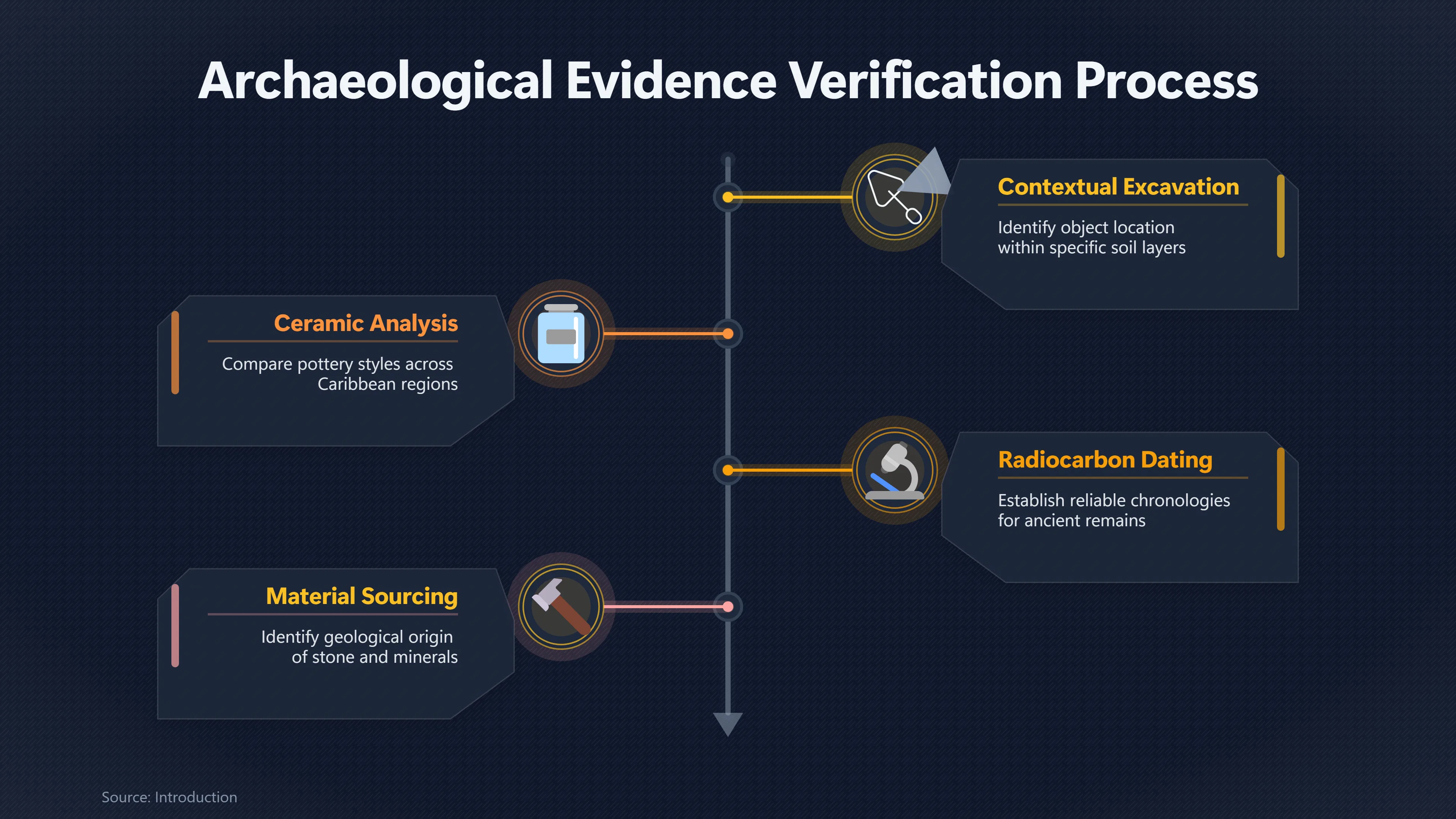
Rather than assigning identity from appearance alone, archaeologists combine several independent forms of evidence:
- Excavation context, showing where an object was found and what surrounded it.
- Ceramic analysis, comparing pottery styles across the Caribbean.
- Radiocarbon dating, establishing reliable chronologies.
- Material analysis, identifying the geological origin of stone and minerals.
- Historical comparison, using early written accounts carefully rather than uncritically.
Saint Vincent has played a surprisingly important role in this reassessment.
For decades archaeologists struggled to identify pottery belonging to the Indigenous communities present at the time of European arrival. The breakthrough came through recognition of the Cayo ceramic complex, first identified on Saint Vincent. What had once been treated as an unusual or isolated pottery style is now regarded as critical evidence for understanding the late pre-colonial history of the Windward Islands. Later discoveries of similar pottery containing European trade materials helped confirm that this tradition continued into the contact period rather than belonging to a much earlier population.[Grenada National Museum]museum.gdGrenada National Museum KalinagoGrenada National MuseumKalinago - Grenada National Museum…
The lesson extends beyond pottery. Scientific examination has also revised assumptions about unusual carved artefacts from Saint Vincent. Research using modern analytical techniques demonstrated that certain black stone carvings were actually fashioned from cannel coal sourced from northern South America rather than locally available materials. That finding strengthened evidence for long-distance exchange networks across the southern Caribbean before European colonisation.[Oxford Architecture]arch.ox.ac.ukOpen source on ox.ac.uk.
Why old museum labels still matter
Older labels are not simply mistakes to be discarded. They are historical evidence in their own right.
Many nineteenth- and early twentieth-century collections recorded artefacts using the terminology available at the time. A ceramic figure collected in Saint Vincent, for example, may still carry an accession label identifying it as “Carib” because that was the accepted classification when it entered a museum collection. Modern curators generally preserve these historical records while explaining that interpretation has changed.[collections.maa.cam.ac.uk]collections.maa.cam.ac.ukJune 6, 2024…
This creates an interesting challenge for visitors. A single object may have:
- its original collector’s description;
- an older museum catalogue classification;
- a revised archaeological interpretation;
- and a modern label reflecting current Indigenous terminology.
Rather than indicating uncertainty or poor scholarship, these layered interpretations demonstrate how historical knowledge develops through new evidence.
Reading the collection with modern eyes
Saint Vincent’s Indigenous artefacts are best understood as evidence rather than relics of a fixed story. Their significance lies less in spectacular appearance than in the questions they continue to answer about migration, exchange, settlement and identity across the Lesser Antilles.
Visitors interested in unusual collections will find something subtler than a cabinet of curiosities. The real curiosity is intellectual: ordinary-looking pottery fragments and stone tools have forced historians to rethink long-accepted colonial narratives. As museum terminology continues to evolve alongside archaeological discoveries and Indigenous perspectives, these collections remind us that even a small display case can reveal not only the ancient past but also the changing ways societies choose to describe it.
Amazon book picks
Further Reading
Books and field guides related to Can Old Museum Labels Misrepresent Saint Vincent's Past?. Use these as the next step if you want deeper reading beyond the article.

1491: New Revelations of the Americas Before Columbus
Rating: 4.3/5 from 31 Google Books ratings
Mann shows how a new generation of researchers equipped with novel scientific techniques have come to previously unheard-of conclusions a...
A History of Archaeological Thought
Bruce Trigger's new book is the first ever to examine the history of archaeology from medieval times to the present in world-wide perspec...
The Oxford Handbook of Caribbean Archaeology
The Oxford Handbook of Caribbean Archaeology provides an overview of archaeological investigations in the insular Caribbean, understood h...
eBay marketplace picks
Marketplace Samples
Live-tested eBay searches with available results related to this page.
Selected fromarchaeology collectible oneBay.co.uk.
Endnotes
1.
Source: museum.gd
Title: Grenada National Museum Kalinago
Link:https://museum.gd/kalinago/
Source snippet
Grenada National MuseumKalinago - Grenada National Museum...
2.
Source: colonialcaribbean.amdigital.co.uk
Title: Language and Terminology
Link:https://www.colonialcaribbean.amdigital.co.uk/introduction/language-and-terminology
Source snippet
lonial Caribbean...
3.
Source: collections.maa.cam.ac.uk
Link:https://collections.maa.cam.ac.uk/objects/542080/
Source snippet
June 6, 2024...
Published: June 6, 2024
4.
Source: maa.cam.ac.uk
Link:https://maa.cam.ac.uk/caribbean-cambridge-pre-columbian-archaeology-collections
5.
Source: arch.ox.ac.uk
Link:https://www.arch.ox.ac.uk/publication/1108501/ora-hyrax
Additional References
6.
Source: cambridge.org
Link:https://www.cambridge.org/core/journals/latin-american-antiquity/article/reimagining-creolization-the-deep-history-of-cultural-interactions-in-the-windward-islands-lesser-antilles-through-the-lens-of-material-culture/F57E4C86854638C17A5EA612D5634D98
Source snippet
The social perimeter of its transmission is superimposed on the social boundaries of the...
7.
Source: nps.gov
Title: The Arrival of the Kalinago (U.S
Link:https://www.nps.gov/places/the-arrival-of-the-kalinago.htm
Source snippet
National Park Service)June 4, 2026 — THE ARRIVAL OF THE KALINAGO Salt River Bay National Historical Park and Ecological Preserve Image: H...
Published: June 4, 2026
8.
Source: home.nps.gov
Title: native american artifacts
Link:https://home.nps.gov/articles/000/native-american-artifacts.htm
Source snippet
National Park Service)September 28, 2021 — TYPES OF NATIVE AMERICAN ARTIFACTS The Native American archeology collections at Saugus Iron W...
Published: September 28, 2021
9.
Source: youtube.com
Title: Indigenous Caribbean People
Link:https://www.youtube.com/watch?v=F3FWySQi22c
Source snippet
Saint Vincent and the Grenadines' Three Hundred-Year Fight For Sovereignty with Dr. Garrey Dennie...
10.
Source: youtube.com
Link:https://www.youtube.com/watch?v=yyF4LPogyVU
Source snippet
Indigenous Caribbean People - Read by Paul Campbell for Island SPACE Magic at the Museum...
11.
Source: metmuseum.org
Title: Indigenous Arts of the Caribbean
Link:https://www.metmuseum.org/de/essays/indigenous-arts-of-the-caribbean
Source snippet
The Metropolitan Museum of ArtJune 1, 2021 — INDIGENOUS ARTS OF THE CARIBBEAN In the centuries before 1492, Taíno peoples and people from...
Published: June 1, 2021
12.
Source: youtube.com
Title: Why are These stones so important to St.Vincent
Link:https://www.youtube.com/watch?v=sv5yMm1YeYU
Source snippet
St Vincent National Trust indigenous artifacts carib arawak The Untold Story of Black American Indians BlackAmericanIndians...
13.
Source: youtube.com
Link:https://www.youtube.com/watch?v=GetF7BzknxM
Source snippet
Why are These stones so important to St.Vincent...
14.
Source: youtube.com
Title: Are the Taino extinct? This woman knows otherwise | PBS
Link:https://www.youtube.com/watch?v=kpX6dpC5MQg
Source snippet
Indigenous leaders confront the museum | Making of "More Than Gold" pt. 2 | Unpacking the Universe...
15.
Source: kingstonheritage.org.uk
Link:https://www.kingstonheritage.org.uk/collections/ancient-origins