Within Strange Honduras
At Copan, Which Monuments Are Actually Original?
Copan places replicas among the ruins and protects originals indoors, turning conservation into a fascinating question about what counts as authentic.
On this page
- Why original sculptures were moved indoors
- How replicas changed the outdoor ruins
- What the Rosalila reconstruction can and cannot show
Page outline Jump by section
Introduction
The Copán Sculpture Museum presents visitors with an unusual question: if the monument in front of you is a replica, where is the “real” one, and does that make the archaeological site any less authentic? At Copán in western Honduras, many of the most important Maya sculptures have been moved indoors for conservation, while carefully made copies now stand in their original outdoor locations. Rather than hiding this decision, the museum turns it into part of the visitor experience. The result is one of the most thought-provoking heritage sites in Central America, where authenticity is defined not simply by original material but by preserving both the monuments themselves and the historic landscape in which they were created.[UNESCO World Heritage Centre]whc.unesco.orgWorld Heritage Centre Maya Site of CopanUNESCO World Heritage CentreMaya Site of Copan - UNESCO World Heritage Centre…
At Copán, which monuments are actually original?
Many visitors assume that every carved monument in the archaeological park is exactly where Maya artists left it over a thousand years ago. In reality, this is only partly true.
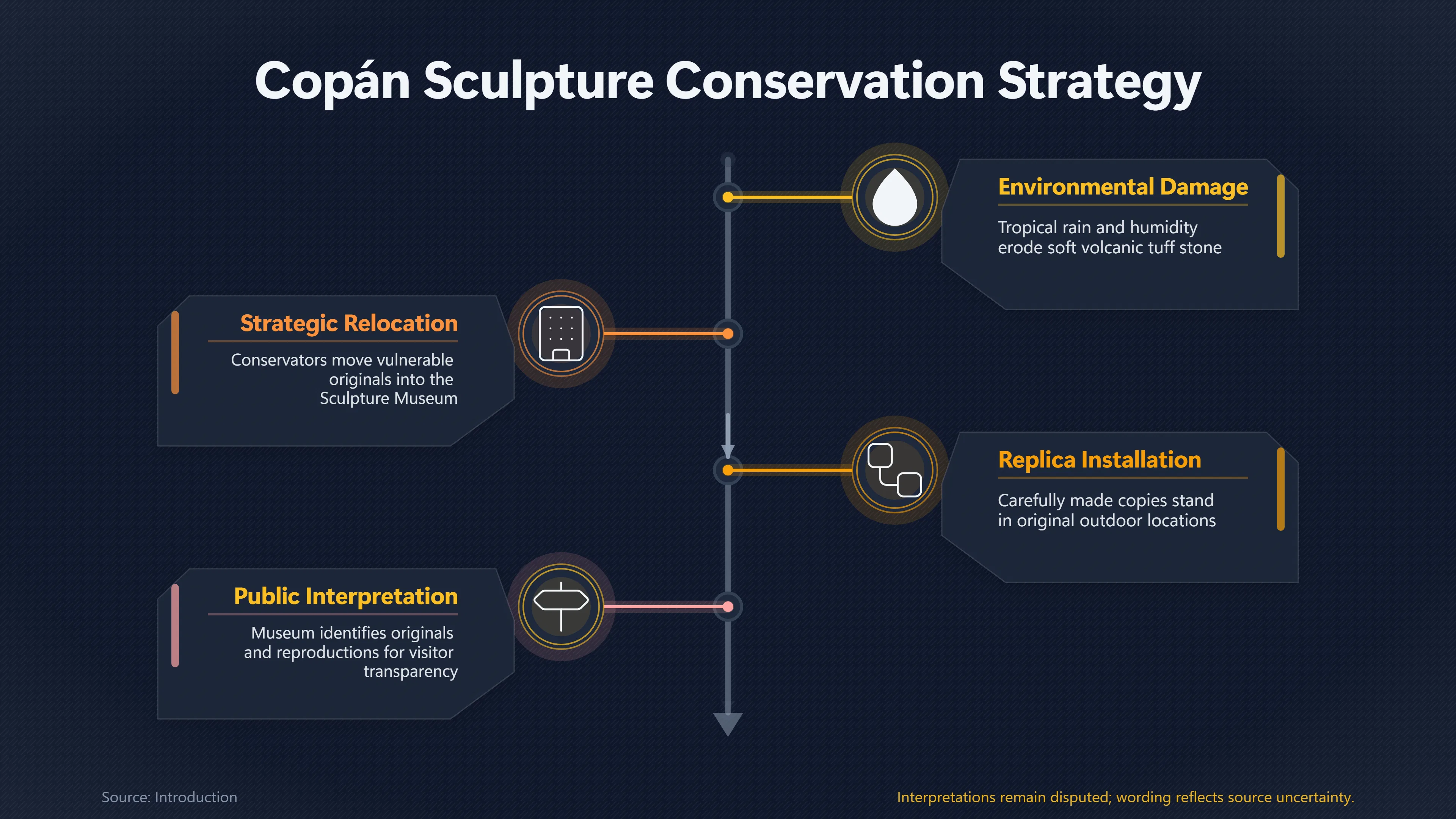
From the 1990s onwards, conservators recognised that centuries of exposure to tropical rain, humidity, biological growth and temperature changes were steadily damaging Copán’s carved stone monuments. Some of the finest sculptures were therefore transferred into the purpose-built Sculpture Museum, while replicas were installed outside to preserve the appearance and interpretation of the archaeological site. This approach was recommended as a conservation strategy by UNESCO and later became part of the site’s long-term management.[UNESCO World Heritage Centre]whc.unesco.orgWorld Heritage Centre UNESCO World Heritage CentreUNESCO World Heritage CentreUNESCO World Heritage Centre - Decision - 17 COM X…
Among the best-known originals moved indoors are:
- Stelae including Stela A and Stela P.
- The celebrated Altar Q, whose carvings record the dynastic succession of Copán’s rulers.
- The richly carved doorway from Structure 22.
- Other important architectural sculptures and decorative elements judged especially vulnerable to weathering.[mused.com]mused.comThe Story of the Copan Sculpture Museum | Copán RuinasThe Story of the Copan Sculpture Museum | Copán Ruinas
Not every monument has been removed. Some sculptures remain in their original locations under protective shelters, illustrating that conservation decisions are made individually rather than through a blanket policy. UNESCO monitoring reports have even noted that the precise criteria for deciding which monuments remain outdoors continue to evolve as conservation techniques improve.[UNESCO World Heritage Centre]whc.unesco.orgUNESCO World Heritage CentreReport on the joint UNESCO -WHC / ICOMOS reactive monitoring mission to the Maya site of Copan (Honduras) (c…
Why the originals were moved indoors
The decision was driven by preservation rather than tourism.
Copán’s sculptures were carved from volcanic tuff, a relatively soft stone that gradually deteriorates when exposed to rainwater, salts, plant growth and changing environmental conditions. Once details are lost through erosion, they cannot truly be recreated.
Housing originals inside the museum offers several advantages:
- Stable environmental conditions slow further deterioration.
- Sculptures can be examined closely without continual weather damage.
- Conservation work can be carried out nearby.
- Visitors gain access to carvings that would otherwise require barriers or protective coverings outdoors.[UNESCO World Heritage Centre]whc.unesco.orgUNESCO World Heritage CentreReport on the joint UNESCO -WHC / ICOMOS reactive monitoring mission to the Maya site of Copan (Honduras) (c…
The museum itself was designed around this conservation mission. Much of the building is concealed beneath an earth-covered mound so it does not dominate the archaeological landscape, while natural lighting and ventilation help protect the collections despite the region’s challenging climate.[asociacioncopan.org]asociacioncopan.orgMuseo Escultura – Asociacion CopanMuseo Escultura – Asociacion Copan
How replicas changed the outdoor ruins
Replacing originals with replicas raises an obvious concern: is the archaeological park still authentic?
Heritage specialists generally answer yes, because authenticity at Copán is understood as more than the physical survival of every individual stone. UNESCO specifically states that the site’s authenticity has been maintained even though selected monuments have been replaced with replicas for conservation purposes. The replicas were introduced according to conservation criteria rather than for commercial spectacle or reconstruction fantasy.[UNESCO World Heritage Centre]whc.unesco.orgWorld Heritage Centre Maya Site of CopanUNESCO World Heritage CentreMaya Site of Copan - UNESCO World Heritage Centre…
The replicas perform several practical functions.
They preserve the visual relationships between temples, plazas and monuments, allowing visitors to experience the ceremonial layout intended by Maya builders. Without them, many key locations would simply stand empty, making it much harder to understand how rulers used sculpture within public space.
Importantly, the replacements are not intended as secret substitutes. Museum interpretation identifies which monuments are original and which are reproductions, shifting the emphasis from deception to transparency. The copies are educational tools that help preserve both the archaeological landscape and the fragile originals.[mused.com]mused.comThe Story of the Copan Sculpture Museum | Copán RuinasThe Story of the Copan Sculpture Museum | Copán Ruinas
What the Rosalila reconstruction can — and cannot — show
The museum’s most striking exhibit is not an original building but a full-scale reconstruction of the Temple of Rosalila.
Rosalila was discovered remarkably well preserved because later Maya builders enclosed it within newer construction instead of demolishing it. Archaeologists found surviving architectural details and traces of its original paint, providing unusually rich evidence for how an Early Classic Maya temple once appeared. Because exposing the original permanently would have endangered it, the actual temple remains protected inside the later pyramid.[maya.nmai.si.edu]maya.nmai.si.eduCopán | Living Maya TimeCopán | Living Maya Time
The museum’s reconstruction therefore serves several purposes.
It demonstrates that Maya temples were once brightly painted rather than bare stone, challenging the popular image of monochrome ruins. It also allows visitors to appreciate the building’s scale, sculptural programme and colour scheme in a way that would be impossible underground. The reconstruction’s colours were based on archaeological evidence and extensive research into surviving pigments rather than artistic imagination alone.[mused.com]mused.comThe Story of the Copan Sculpture Museum | Copán RuinasThe Story of the Copan Sculpture Museum | Copán Ruinas
However, the reconstruction also has clear limits.
It is not the original monument, and it cannot reproduce every surface, texture or uncertainty. Some colours, finishes and architectural details remain scholarly interpretations based on the available evidence. The replica is therefore best understood as an informed visual hypothesis built upon exceptionally good archaeological data, not a perfect resurrection of the sixth-century temple.[mused.com]mused.comThe Story of the Copan Sculpture Museum | Copán RuinasThe Story of the Copan Sculpture Museum | Copán Ruinas

The authenticity puzzle
Copán illustrates a broader debate in archaeology and museum practice.
Two different kinds of authenticity are in tension:
- Material authenticity: preserving the actual stones carved by Maya artists.
- Contextual authenticity: preserving the experience of seeing monuments where ancient people intended them to stand.
Removing every sculpture to a museum would maximise protection but diminish the site’s historic setting. Leaving every original outdoors would preserve context while gradually sacrificing irreplaceable carvings to erosion.
Copán’s solution is deliberately hybrid. The originals survive in controlled conditions, while replicas preserve the appearance and interpretive value of the archaeological park. Rather than choosing between museum and ruin, the site treats both as parts of a single conservation strategy. UNESCO continues to recognise the archaeological park as retaining its authenticity despite this balance between preservation and replication.[UNESCO World Heritage Centre]whc.unesco.orgWorld Heritage Centre Maya Site of CopanUNESCO World Heritage CentreMaya Site of Copan - UNESCO World Heritage Centre…
Why this matters in Honduras’s curiosity landscape
Among Honduras’s unusual heritage attractions, the Copán Sculpture Museum stands out because its central curiosity is philosophical rather than supernatural.
Visitors are invited to confront questions that rarely arise so clearly elsewhere. Is the object in the museum more authentic because it is original? Is the replica outside more authentic because it occupies the historic place? Can a faithful reconstruction communicate truths that an inaccessible original cannot?
These questions have no simple answer, but Copán demonstrates that conservation itself can become an exhibit. Instead of presenting authenticity as an all-or-nothing quality, the museum shows how careful replication, transparent interpretation and scientific preservation can work together to protect one of the Maya world’s greatest artistic legacies while allowing visitors to continue experiencing the ancient city as a coherent whole.
Amazon book picks
Further Reading
Books and field guides related to At Copan, Which Monuments Are Actually Original?. Use these as the next step if you want deeper reading beyond the article.
Maya Art and Architecture
“In addition to serving as an introduction to Maya art, the book communicates enthusiasm for the art’s aesthetic power and grace.” —Choic...
The Archaeology of Ancient Mexico and Central America
This reference is devoted to the pre-Columbian archaeology of the Mesoamerican culture area, one of the six cradles of early civilization...
The Future of the Past
An engrossing look at the cultural consequences of technological change and globalization Space radar, infrared photography, carbon datin...
eBay marketplace picks
Marketplace Samples
Live-tested eBay searches with available results related to this page.
Selected fromMaya figure model oneBay.co.uk.

Endnotes
1.
Source: whc.unesco.org
Title: World Heritage Centre Maya Site of Copan
Link:https://whc.unesco.org/en/list/129
Source snippet
UNESCO World Heritage CentreMaya Site of Copan - UNESCO World Heritage Centre...
2.
Source: asociacioncopan.org
Title: Museo Escultura – Asociacion Copan
Link:https://asociacioncopan.org/es/museo-escultura/
3.
Source: whc.unesco.org
Title: World Heritage Centre UNESCO World Heritage Centre
Link:https://whc.unesco.org/en/decisions/3294/
Source snippet
UNESCO World Heritage CentreUNESCO World Heritage Centre - Decision - 17 COM X...
4.
Source: whc.unesco.org
Link:https://whc.unesco.org/document/116601
Source snippet
UNESCO World Heritage CentreReport on the joint UNESCO -WHC / ICOMOS reactive monitoring mission to the Maya site of Copan (Honduras) (c...
5.
Source: mused.com
Title: The Story of the Copan Sculpture Museum | Copán Ruinas
Link:https://mused.com/stories/1039/qs-mthf-kwbn-llnht
6.
Source: whc.unesco.org
Title: World Heritage Centre UNESCO World Heritage Centre
Link:https://whc.unesco.org/document/171276
Source snippet
UNESCO World Heritage CentreUNESCO World Heritage Centre...
7.
Source: asociacioncopan.org
Title: Sculpture Museum – Asociacion Copan
Link:https://asociacioncopan.org/sculpture-museum//
8.
Source: maya.nmai.si.edu
Title: Copán | Living Maya Time
Link:https://maya.nmai.si.edu/gallery/copan
9.
Source: asociacioncopan.org
Title: rescate rosalila
Link:https://asociacioncopan.org/es/rescate-rosalila/
10.
Source: whc.unesco.org
Link:https://whc.unesco.org/fr/list/129
12.
Source: mused.com
Link:https://mused.com/tours/241/sculpture-museum-copan/
13.
Source: archive.archaeology.org
Link:https://archive.archaeology.org/0609/reviews/maya.html
14.
Source: mayan.org
Link:https://mayan.org/ruins/museums/copan-sculpture-museum/
Additional References
15.
Source: elheraldo.hn
Title: Un recorrido por las piezas originales en el museo de la escultura
Link:https://www.elheraldo.hn/tierraadentro/un-recorrido-por-las-piezas-originales-en-el-museo-de-la-escultura-JDEH865590
Source snippet
El recinto, al que se llega a través de un túnel de piedra, custodia una gran cantidad de...
16.
Source: michaelharrison.org.uk
Title: Copan Sculptural Museum
Link:https://michaelharrison.org.uk/2023/08/copan-sculptural-museum/
Source snippet
Left side of the roadLeft side of the roadAugust 8, 2023 — COPAN SCULPTURAL MUSEUM Posted on 08/08/2023 by Michael Copan Sculptural Museu...
Published: August 8, 2023
17.
Source: youtube.com
Title: Copan Ruins
Link:https://www.youtube.com/watch?v=AeUqdKD_GwM
Source snippet
Copan Sculpture Museum Honduras Rosalila Rosalila, Sculpture Museum of Copán, Honduras, 2023 Wolf...
18.
Source: culturalsurvival.org
Link:https://www.culturalsurvival.org/publications/cultural-survival-quarterly/investing-past-build-better-future-copan-sculpture-museum
19.
Source: harvardmagazine.com
Link:https://www.harvardmagazine.com/sites/default/files/html/1997/01/maya.2.html
20.
Source: researchgate.net
Link:https://www.researchgate.net/figure/The-Rosalila-replica-in-the-Copan-Sculpture-Museum-inset-original-polychrome-stucco-on_fig3_259924993
21.
Source: tripadvisor.co.uk
Link:https://www.tripadvisor.co.uk/Attraction_Review-g292022-d4418369-Reviews-Sculpture_Museum-Copan_Ruinas_Copan_Department.html
22.
Source: youtube.com
Title: Maya Site of Copan (UNESCO/NHK)
Link:https://www.youtube.com/watch?v=kszS5ovZtt4
Source snippet
These Mayan Ruins Are UNREAL! (Copan, Honduras)...
23.
Source: youtube.com
Title: Temples that speak: Art and Architecture at Copan, Honduras
Link:https://www.youtube.com/watch?v=UPK018pDoLI
Source snippet
The Rosalila Temple of Copan, Honduras...
24.
Source: youtube.com
Title: These Mayan Ruins Are UNREAL! (Copan, Honduras)
Link:https://www.youtube.com/watch?v=PHRqeaynALU
Source snippet
Copan Ruins - Altar Q...