Within Curious Belize
Was Belize's Famous Crystal Skull Really Maya?
The Mitchell-Hedges skull is famous as a Belizean mystery, but its excavation story conflicts with documentary and technical evidence.
On this page
- The Lubaantun discovery story
- Dealer records and the provenance problem
- Modern tool marks, paranormal claims and lasting appeal
Page outline Jump by section
Introduction
The Mitchell-Hedges crystal skull is one of the best-known mysteries associated with Belize, yet it is also one of the most thoroughly investigated. Popular accounts claim that the life-sized quartz skull was discovered beneath a collapsed altar at the Maya site of Lubaantun in southern Belize during the 1920s by Anna Mitchell-Hedges, the adopted daughter of British adventurer Frederick Albert Mitchell-Hedges. That story has inspired books, television programmes, paranormal theories and films, helping to make the skull an enduring part of Belize’s curiosity landscape.
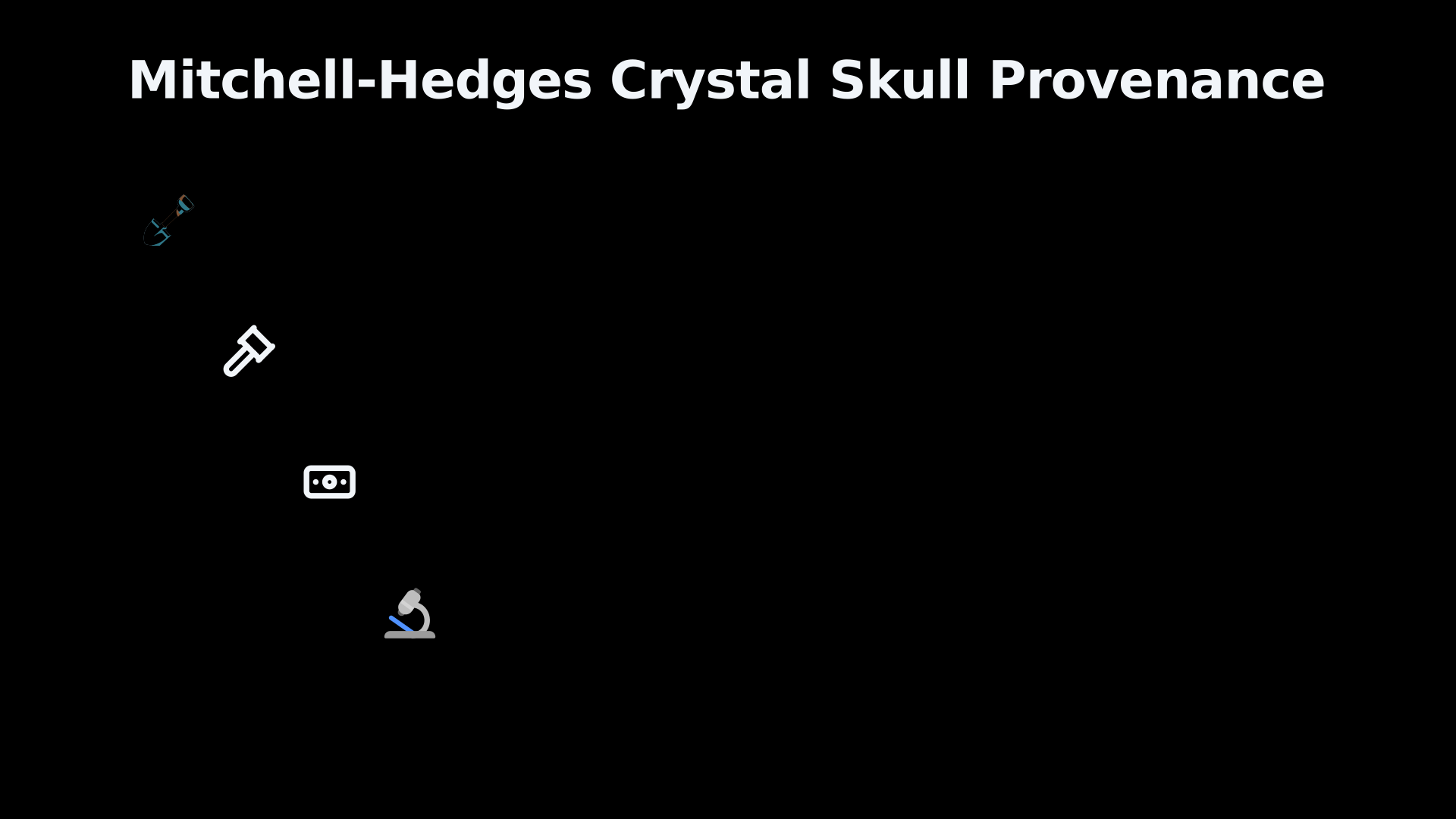
However, the evidence behind the discovery story has steadily weakened. Archival records, auction documents and scientific examination point towards a very different history: one in which the skull entered the modern antiquities market before being purchased by Mitchell-Hedges in London in 1943. Today the object remains fascinating not because it appears to be an authentic Maya artefact, but because it demonstrates how legend, tourism, archaeology and popular culture can transform a disputed object into a lasting cultural icon.[smithsonianmag.com]smithsonianmag.comSmithsonian Magazine Why the Smithsonian Has a Fake Crystal SkullSmithsonian MagazineWhy the Smithsonian Has a Fake Crystal SkullMay 29, 2008…
The Lubaantun discovery story
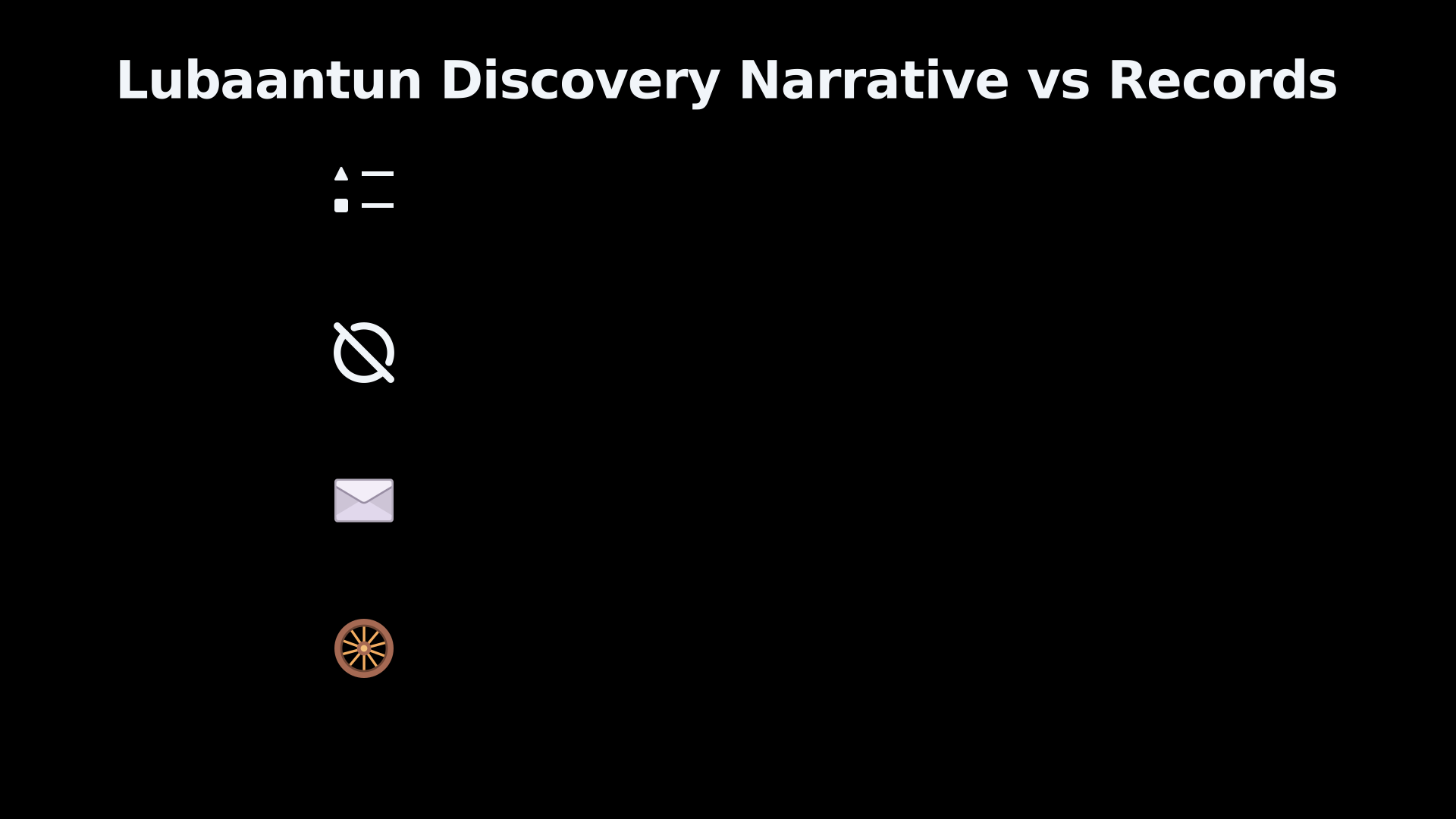
Lubaantun is a genuine Late Classic Maya ceremonial centre in present-day Toledo District, Belize. Frederick Mitchell-Hedges participated in excavations there during the 1920s, making the site a believable setting for an extraordinary discovery. According to the version that became famous decades later, Anna Mitchell-Hedges found a crystal skull beneath the remains of a temple altar on her seventeenth birthday, with the detachable lower jaw recovered a few months afterwards.
This dramatic account became central to the skull’s reputation, but contemporary evidence presents problems. Mitchell-Hedges’ own published writings about Lubaantun make no mention of discovering such an extraordinary object, despite his tendency to recount dramatic adventures. Likewise, surviving excavation records and accounts from others associated with the work do not document the discovery of a crystal skull at the site. Researchers have also questioned whether Anna was even present throughout the excavation period described in later retellings.[archaeology.org]archive.archaeology.orgMagazine The Skull of DoomArchaeology MagazineThe Skull of Doom - Acquisition History - Archaeology Magazine Archive…
The absence of contemporary documentation is particularly significant because a life-sized quartz skull would have been an exceptional archaeological find. Such an object would almost certainly have attracted immediate scholarly attention had it genuinely emerged from a controlled excavation.
Dealer records and the provenance problem
The strongest challenge to the traditional story comes not from speculation but from paperwork.
Researchers uncovered records showing that the crystal skull was sold at a Sotheby’s auction in London on 15 October 1943. The purchaser was Frederick Mitchell-Hedges, who bought it from the collection of London art dealer Sydney Burney. Even more damaging to the excavation narrative is a letter Mitchell-Hedges wrote to his brother later that year in which he plainly described acquiring the skull from Burney rather than excavating it in Belize.[archaeology.org]archive.archaeology.orgMagazine The Skull of DoomArchaeology MagazineThe Skull of Doom - Acquisition History - Archaeology Magazine Archive…
These documents do not explain where the skull originated before appearing in the London art market. That gap remains unresolved. Nevertheless, they do establish a documented ownership history beginning in the early 1940s that conflicts directly with the later claim that the skull had already been in the Mitchell-Hedges family’s possession since the 1920s.
For archaeologists, this distinction is crucial. A spectacular object without secure excavation records loses much of its historical value because there is no reliable evidence linking it to a specific civilisation, date or archaeological context. The uncertainty surrounding the skull’s earlier history therefore makes it impossible to treat it as a proven Maya artefact simply because it became associated with a Maya site.
Modern tool marks, paranormal claims and lasting appeal
Scientific examination has shifted the debate from storytelling to manufacturing techniques. Researchers at the British Museum and the Smithsonian Institution used scanning electron microscopy to study crystal skulls, including comparable examples and related specimens. They identified microscopic traces consistent with modern rotary cutting tools and industrial abrasives that were unavailable to ancient Maya stoneworkers. These findings indicate manufacture in the modern era rather than in pre-Columbian Mesoamerica.[Smithsonian Institution]si.eduSmithsonian InstitutionScience in the News: The Truth about Crystal Skulls | Smithsonian InstitutionJuly 10, 2008…
The Mitchell-Hedges skull itself has long attracted claims that go far beyond archaeology. Supporters have described it as possessing mysterious energies, psychic abilities or healing powers, while popular books have connected it with Atlantis, lost civilisations and the modern legend of the “thirteen crystal skulls”. None of these paranormal claims has been verified through scientific testing, and they are not accepted within mainstream archaeology.[repository.si.edu]repository.si.eduNovember 18, 2005…
Yet scientific scepticism has not diminished the object’s popularity. Instead, the debate itself has become part of the attraction. Visitors interested in Belize’s archaeological heritage often encounter the crystal skull story alongside genuine Maya sites, illustrating how authentic archaeology and modern myth can become intertwined in public imagination.
Why the skull still matters in Belize’s curiosity culture
Although the evidence no longer supports the famous excavation story, the Mitchell-Hedges crystal skull retains an important place within Belize’s landscape of unusual heritage.
Its significance lies in several overlapping themes:
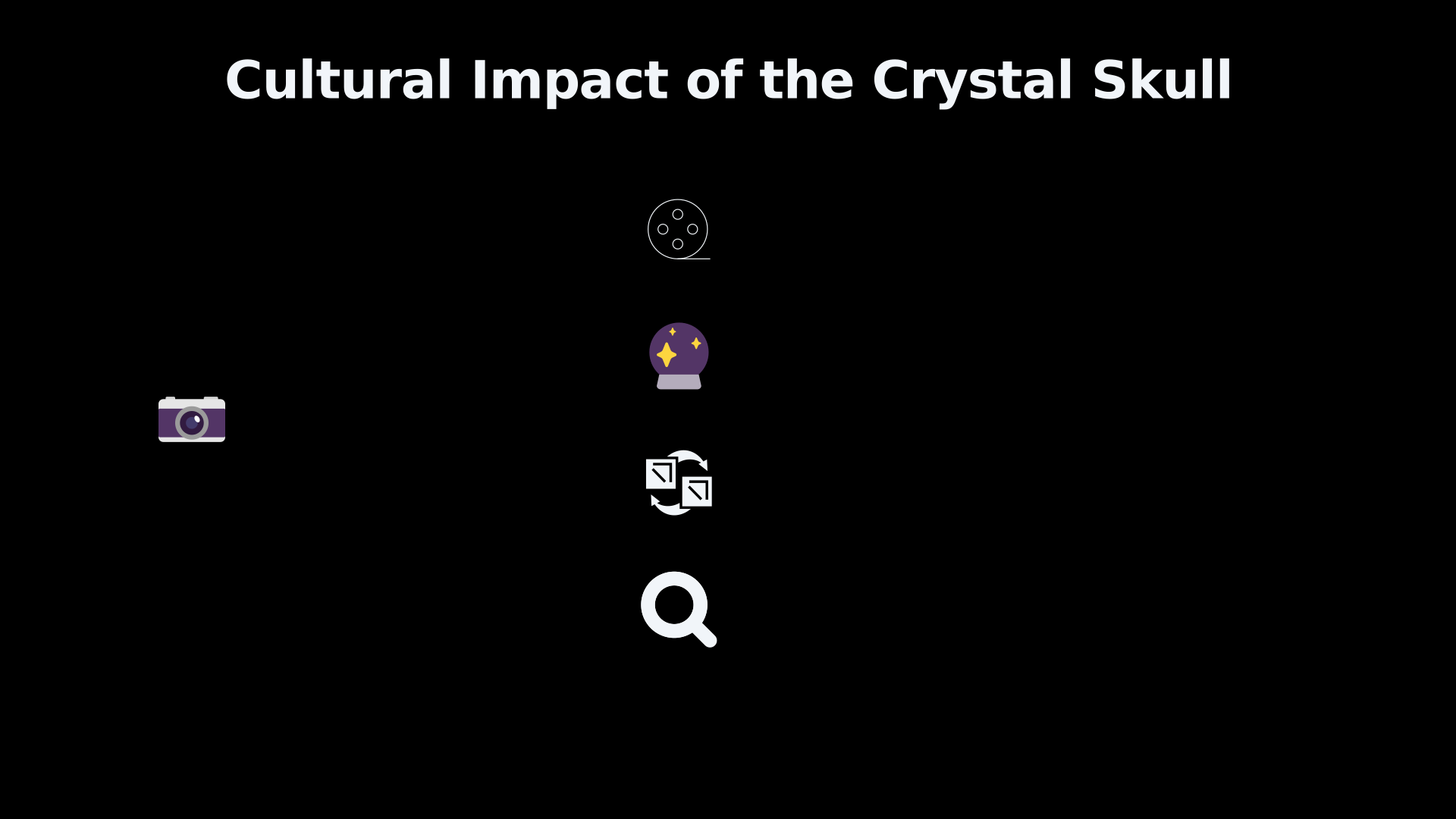
- A case study in disputed provenance. The skull demonstrates why documented excavation records matter as much as spectacular appearance.
- A lesson in the antiquities trade. The object’s documented emergence through London’s art market reflects the poorly regulated international trade in archaeological curiosities during the late nineteenth and early twentieth centuries.
- A tourism legend. Lubaantun continues to attract visitors interested in both Maya archaeology and the famous skull story, even though the two are no longer considered securely connected.
- A cultural phenomenon. Books, documentaries, paranormal television and popular films have made the skull more famous than many authentic Maya artefacts.
For Belize, the crystal skull therefore represents a different kind of heritage object. It is not primarily valuable as evidence of ancient Maya craftsmanship but as an example of how myths grow around archaeological places, how contested objects gain international fame, and how careful historical research can separate an engaging legend from its documented provenance.[smithsonianmag.com]smithsonianmag.comSmithsonian Magazine Why the Smithsonian Has a Fake Crystal SkullSmithsonian MagazineWhy the Smithsonian Has a Fake Crystal SkullMay 29, 2008…
Amazon book picks
Further Reading
Books and field guides related to Was Belize's Famous Crystal Skull Really Maya?. Use these as the next step if you want deeper reading beyond the article.
The Mystery of the Crystal Skulls
The crystal skulls are a mystery as profound as the Pyramids of Egypt, the Nazca Lines of Peru, or Stonehenge.
Frauds, Myths, and Mysteries: Science and Pseudoscience in Ar...
Ancient astronauts? Atlantis? Psychic archaeology? Pharaoh's curses? Committed to the scientific investigation of human antiquity, this i...
Archaeological Fantasies
This edited volume examines the phenomenon of pseudoarchaeology from a variety of perspectives. The engaging and stimulating essays, writ...
The Ancient Maya
"Comprehensive synthesis of ancient Maya scholarship. Extensive summary of the archaeology of the Maya world provides the historical cont...
eBay marketplace picks
Marketplace Samples
Live-tested eBay searches with available results related to this page.
Selected fromancient history poster oneBay.co.uk.
Endnotes
1.
Source: archive.archaeology.org
Title: Magazine The Skull of Doom
Link:https://archive.archaeology.org/online/features/mitchell_hedges/acquisition_history.html
Source snippet
Archaeology MagazineThe Skull of Doom - Acquisition History - Archaeology Magazine Archive...
2.
Source: Wikipedia
Title: Crystal skull
Link:https://en.wikipedia.org/wiki/Crystal_skull
3.
Source: si.edu
Link:https://www.si.edu/exhibitions/science-news-truth-about-crystal-skulls-event-event-exhib-4471
Source snippet
Smithsonian InstitutionScience in the News: The Truth about Crystal Skulls | Smithsonian InstitutionJuly 10, 2008...
Published: July 10, 2008
4.
Source: si.edu
Link:https://www.si.edu/newsdesk/releases/mysterious-crystal-skull-exhibit-first-time-smithsonian-s-national-museum-natural-history
Source snippet
Mysterious Crystal Skull on Exhibit for the First Time at Smithsonian’s National Museum of Natural History | Smithsonian InstitutionJuly...
5.
Source: repository.si.edu
Link:https://repository.si.edu/server/api/core/bitstreams/0306542d-2d49-41a2-adc9-37f62a536391/content
Source snippet
November 18, 2005...
Published: November 18, 2005
6.
Source: si.edu
Link:https://www.si.edu/object/mitchell-hedges-crystal-skull-jane-maclaren-walsh%3Asiris_sil_977017
7.
Source: archive.archaeology.org
Link:https://archive.archaeology.org/online/features/mitchell_hedges/facts.html
8.
Source: smithsonianmag.com
Title: Smithsonian Magazine Why the Smithsonian Has a Fake Crystal Skull
Link:https://www.smithsonianmag.com/history/the-smithsonians-crystal-skull-51638609/
Source snippet
Smithsonian MagazineWhy the Smithsonian Has a Fake Crystal SkullMay 29, 2008...
Published: May 29, 2008
Additional References
9.
Source: historyhidden.org
Title: Top 5 Theories On Their Origins. Ah, the Mitchell-Hedges sku
Link:https://www.historyhidden.org/crystal-skulls-origins/
Source snippet
🏺 Crystal Skulls Origins: The Shocking 19th-Century Hoax Exposed (2026) - History HiddenJune 9, 2026 — 🕵️ ♂️ THE MITCHELL-HEDGES EXPEDITI...
Published: June 9, 2026
10.
Source: flickr.com
Title: november song
Link:https://www.flickr.com/photos/november_song/52464767058/
Source snippet
And Fraudulent Claims. | FlickrOctober 30, 2022 — "The suggestion is that it was made in the 1950's or later". The British Museum Skull T...
Published: October 30, 2022
11.
Source: skyjems.ca
Link:https://skyjems.ca/pages/encyclopedia-crystal-skulls
12.
Source: projectunredacted.com
Link:https://www.projectunredacted.com/cases/crystal-skulls-ancient-alien-artifacts
13.
Source: mayan.org
Link:https://mayan.org/mysteries/crystal-skulls/
14.
Source: youtube.com
Link:https://www.youtube.com/watch?v=_PoUr_GEbws
15.
Source: youtube.com
Link:https://www.youtube.com/watch?v=eWHzbYQW7B4
16.
Source: youtube.com
Link:https://www.youtube.com/watch?v=hNrDYLzk87Y
17.
Source: youtube.com
Link:https://www.youtube.com/watch?v=mKIETmsfNaY
18.
Source: youtube.com
Link:https://www.youtube.com/watch?v=vRjnhwWSiEI