Where Egypt Keeps Its Strangest Heritage
Egypt does not have a single “museum of the strange”. Instead, its curiosity culture is spread across archaeological museums, temple collections, medical and zoological institutions, police displays and enormous stores of objects connected with death, divine protection and the body.
Page outline Jump by section
Introduction
What makes these places unusual is not simply that they contain dead bodies, sacred animals or unsettling objects. They preserve beliefs that were once practical parts of life: magic as protection, mummification as preparation for continued existence, animal cults as organised religious economies, and criminal evidence as public memory. The result is a museum landscape in which the apparently macabre is often treated as religious, scientific or national heritage rather than horror entertainment.
Where Egypt’s strangest collections are found
Egypt’s unusual museums fall into several overlapping groups. Some are highly curated state attractions with modern lighting, interpretation and ticketing. Others are specialist collections inside zoos, universities or older cultural complexes, where opening arrangements and display standards can be less predictable.
The strongest examples are:
- The Crocodile Museum at Kom Ombo, devoted to mummified Nile crocodiles and the worship of the crocodile-headed god Sobek.
- The Mummification Museum in Luxor, explaining embalming through tools, amulets, coffins, preserved bodies and ritual objects.
- The Royal Mummies Hall at the National Museum of Egyptian Civilisation, where rulers are presented through archaeology, medical imaging and funerary belief.
- The Zoological Museum at Giza Zoo, an old natural-history collection of mounted animals, skeletons, birds and reptiles, although the wider zoo remains under redevelopment in 2026.
- The National Police Museum in Cairo, combining weapons, uniforms and institutional history with displays about famous murders and popular outlaws.
- The Egyptian Agricultural Museum, an unusually large complex joining farming history with botanical, zoological, archaeological and rural-life collections, but with a recent history of closure and trial reopening.
These are not commercial cabinets of curiosities in the European tradition. Most belong to state ministries or public institutions, and their declared purposes are educational, archaeological, scientific or patriotic. Yet their displays often contain exactly the material sought by visitors interested in strange history: preserved creatures, human remains, protective charms, death rituals, crime narratives and obsolete scientific specimens.
Crocodiles, gods and sacred animal mummies
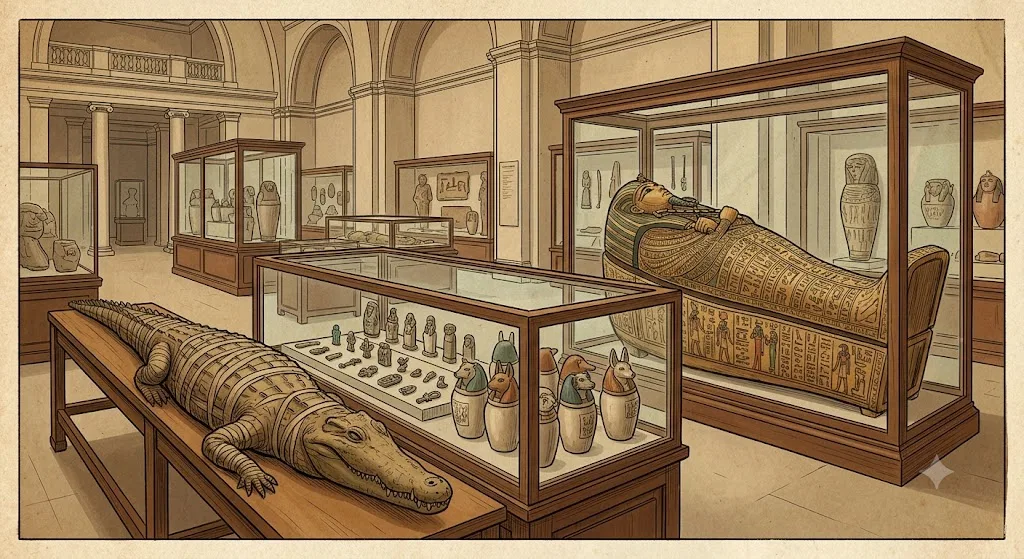
The Crocodile Museum beside the Temple of Kom Ombo is probably Egypt’s clearest example of a museum built around one uncanny type of object. Opened in 2012, it displays mummified Nile crocodiles associated with Sobek. The official description records specimens ranging from about two metres to 4.3 metres long, alongside material explaining the god’s cult and the importance of crocodiles in the region.[Egyptian Monuments]egymonuments.gov.egThis museum has highlighted the crocodile-headed god Sobek since it was openedEgyptian MonumentsCrocodile Museum - Discover Egypt's MonumentsThe Crocodile Museum is located next to the Kom Ombo temple, north of Aswan…
The museum is unusual because the animal is both threatening and sacred. Sobek could represent strength, fertility and protection, while the living crocodile remained one of the Nile’s most dangerous creatures. Mummifying crocodiles did not mean that every crocodile was casually “worshipped” as a god. Sacred animals might embody a divine presence, serve as temple animals or be prepared as offerings connected with a deity. The preserved bodies therefore belong to an organised religious system rather than a collection of monsters.
Visitors can expect a compact, focused display rather than a large archaeological museum. The long rows of dark, elongated bodies are immediately striking, but the real value lies in understanding how temples, animal breeding, pilgrimage, offerings and burial could operate together. Reviews commonly describe the museum as a brief addition to a Kom Ombo visit, often taking between 15 and 30 minutes.[Tripadvisor]tripadvisor.co.ukTripadvisor CROCODILE MUSEUMCROCODILE MUSEUM - All You SHOULD Know Before…The ancient Egyptians mummified crocodiles. It takes about 15-20 minutes to s…
Animal mummies were produced on a vast scale across ancient Egypt. Cats, ibises, baboons, falcons, crocodiles and other animals could be preserved as sacred representatives, temple animals, food provisions or votive offerings made by worshippers. Modern scanning has also shown that an impressive outer bundle does not always contain a complete animal: some hold partial remains, multiple individuals or organic packing material. That variation is not necessarily evidence of a modern-style hoax; it may reflect different grades of offering, temple production practices or meanings that are no longer fully recoverable. Current museum research uses X-rays, computed tomography and other non-destructive methods to investigate such bundles without unwrapping them.[The Times]thetimes.co.ukThe Times British Museum unwraps Egypt's mysterious animal cultsWith around 400 such mummies, the museum will unveil its findings in a major exhibition in autumn 2026. The research utilizes X-rays and…

Inside the craft of mummification
Luxor’s Mummification Museum addresses the subject more directly. Its displays include embalming tools, canopic jars, decorated coffins, amulets, statues of funerary deities and mummified remains. The museum explains both the physical procedures and their religious purpose, making it more useful than attractions that present mummies only as spectacular bodies.[Egyptian Monuments]egymonuments.gov.egEgyptian MonumentsMummification MuseumCanopic jars, elaborately decorated coffins, mummified remains; amulets and statues of deities are…
The central misconception it corrects is that mummification was merely a method of preservation. For ancient Egyptians, preserving the body belonged to a wider system involving identity, ritual purity, divine judgement, spells, offerings and the continued survival of the deceased. Objects placed on or around the dead were not decorative extras. Amulets could protect particular parts of the body, represent regeneration or assist the deceased through dangers imagined in the afterlife.
This is where Egypt’s museum collections come closest to a museum of magic, although the institutions generally avoid presenting the subject as occult entertainment. Ancient Egyptian protective practice did not fit neatly into a modern division between religion, medicine and magic. A charm, spoken formula, divine image and practical treatment could all form part of the same response to danger or illness. Collections of amulets, funerary texts and ritual equipment therefore preserve a working belief system rather than evidence of a secret fringe cult.
The museum’s scale is manageable: reports describe one main gallery with roughly 70 objects rather than a labyrinth of rooms. That concentrated format allows visitors to connect the instruments and substances of embalming with the ideas that gave the procedure meaning.[english.aawsat.com]english.aawsat.comluxor’s mummification museum documents 25 years pharaonic secretsCanopic jars collection, adorned coffins, amulets, deities' statues, and funerary…
Royal mummies without the horror-show treatment
The Royal Mummies Hall at Cairo’s National Museum of Egyptian Civilisation is one of the country’s most prominent displays of human remains. The museum uses modern presentation and medical imaging to explain the lives, deaths and preservation of ancient rulers, alongside the beliefs surrounding burial and mummification.[Egyptian Monuments]egymonuments.gov.egOpen source on egymonuments.gov.eg.
Twenty-two royal mummies were ceremonially transferred from the Egyptian Museum in Tahrir Square during the Pharaohs’ Golden Parade on 3 April 2021. The carefully choreographed procession turned archaeological relocation into a televised act of state ceremony. Rather than treating the bodies as anonymous curiosities, it presented them as named monarchs returning to a specially prepared national collection.[Egyptian Monuments]egymonuments.gov.egEgyptian Monuments The Pharaohs' Golden ParadeEgyptian Monuments The Pharaohs' Golden Parade
The display illustrates a major tension in museums of death. Scientific examination can reveal age, injuries, dental disease, embalming methods and possible causes of death. Computed tomography of Seqenenre Taa II, for example, was used to investigate severe head injuries and the circumstances surrounding his death. Yet the same bodies remain human beings whose descendants cannot consent to exhibition.[Egyptian Monuments]egymonuments.gov.egOpen source on egymonuments.gov.eg.
Egypt’s approach contrasts with the sensational “mummy unwrapping” culture that developed in nineteenth-century Europe and North America. The modern hall is designed as a solemn archaeological and historical experience, though visitors may still disagree about whether any public display of a body can be fully respectful. International museum debate increasingly favours describing such remains as mummified people rather than simply objects, and questions of dignity, research and public access remain unresolved.[LeidenGlobal]leidenglobal.orgegyptian mummified remains in museumsegyptian mummified remains in museums
A zoo museum full of preserved animals
The Zoological Museum at Giza Zoo belongs to a different tradition: the natural-history museum assembled through taxidermy, skeletons and comparative animal specimens. Established in the early twentieth century, it contains mounted mammals, birds and reptiles as well as rare skeletons and preserved animals. Egyptian tourism sources describe it as one of the oldest zoological museums in the Middle East.[Egyptian Monuments]egymonuments.gov.egOpen source on egymonuments.gov.eg.
Older reports have claimed that its collection includes more than 2,000 specimens, some described as “mummified” and ranging widely in date. Such wording should be treated cautiously. In coverage of the museum, “mummified” sometimes appears to include modern taxidermy or preserved zoological material as well as genuinely ancient animal remains. The collection’s strangeness therefore comes partly from its old-fashioned visual language: ranks of motionless animals arranged behind glass, reflecting an era when natural history was taught through collected bodies.[People's Daily]en.people.cnOpen source on people.cn.
Access is presently the difficulty. Giza Zoo closed for major redevelopment in 2023. Plans announced in December 2025 proposed a phased reopening during 2026, with full public access expected by the end of the year. Until reopening is formally confirmed, the zoological museum should be regarded as historically important but not a dependable walk-in attraction.[Ahram Online]english.ahram.org.egEgypt to privatize Giza Zoo operations, phased reo.aspxEgypt to privatize Giza Zoo operations, phased reo.aspx
For curiosity-minded visitors, its importance goes beyond novelty. Zoological museums document how animals were classified, displayed and sometimes exoticised. They can also preserve evidence of species once present in a country but now rare or locally extinct. Research comparing ancient Egyptian animal imagery with archaeological and ecological evidence has shown that Egypt’s large-mammal communities changed dramatically over thousands of years as climate and human pressures altered the landscape.[arXiv]arxiv.orgarXiv Collapse of an ecological network in Ancient EgyptarXiv Collapse of an ecological network in Ancient Egypt
Crime, punishment and national memory
Inside Cairo’s Citadel, the National Police Museum occupies ground associated with the Citadel’s former prison complex. Its displays cover the development of policing through weapons, uniforms, documents, models and institutional history. The more unusual section concerns famous crimes and figures whose stories passed from court records into Egyptian popular culture.[Egyptian Monuments]egymonuments.gov.egEgyptian Monuments National Police MuseumEgyptian Monuments National Police Museum
The best-known case is that of Raya and Sakina, sisters convicted with accomplices of murdering 17 women in Alexandria between 1919 and 1920. The crime became one of Egypt’s most enduring murder narratives, repeatedly retold in theatre, cinema and television. Cairo’s official cultural portal confirms that the museum includes a hall devoted to famous social crimes, including their case, as well as displays concerning celebrated outlaw figures.[Cairo Governorate]cairo.gov.egCairo Governorate The Police National MuseumCairo Governorate The Police National Museum
This is not a modern commercial true-crime attraction. Its main frame is the authority and history of the police, so visitors should expect an institutional account rather than an independent investigation of disputed convictions or policing methods. That matters because the Raya and Sakina story has accumulated mythology. Later writers have questioned how class, gender, colonial Alexandria and popular entertainment shaped the image of the sisters as almost folkloric embodiments of evil.[Qantara]qantara.deOpen source on qantara.de.
The museum is publicly accessible as part of a Citadel visit, with official ticket information listing it within the Citadel area admission. Its mixture of prison setting, crime memorabilia and state history makes it one of Egypt’s more genuinely offbeat museums, even though it is rarely promoted internationally as a standalone attraction.[Egyptian Monuments]egymonuments.gov.egEgyptian Monuments National Police MuseumEgyptian Monuments National Police Museum
Egypt’s sprawling museum of agriculture
The Egyptian Agricultural Museum in Dokki is less macabre but perhaps more eccentric in scale and scope. Founded in the 1930s, it developed as a multi-building complex covering farming, cotton, crops, rural life, scientific study and Egypt’s agricultural past. Displays have included tools, models, botanical material, animal specimens and reconstructed scenes, producing something closer to an encyclopaedic agricultural world than a single themed gallery.
Its curiosity value lies in the collision of categories. A visitor might encounter crop science, historic farm machinery, preserved animals, soil samples, rural dioramas and archaeological material within the same institution. This makes it an example of the twentieth-century “total museum”: a collection intended to demonstrate not merely objects but an entire economic and ecological system.
The museum’s recent status needs careful wording. After a long period of renovation and closure, the Ministry of Agriculture announced a two-week pilot opening beginning on 16 August 2025, with free entry and limited daily hours. State information later described the complex as having undergone extensive redevelopment, but reliable confirmation of continuous full public opening after the trial period remains inconsistent. Visitors should therefore verify access shortly before travelling rather than relying on older guidebook hours.[egypttoday.com]egypttoday.comEgypt Today Egypt announces soft opening for Egyptian AgriculturalEgypt Today Egypt announces soft opening for Egyptian Agricultural
Why there is no single museum of Egyptian magic
Given Egypt’s global association with curses, spells and supernatural archaeology, visitors may expect a museum devoted specifically to ancient magic. The surviving evidence points instead to magical material being dispersed across archaeological collections.
Amulets, divine figures, funerary papyri, protective jewellery and ritual equipment appear in the Egyptian Museum, the Grand Egyptian Museum, the Mummification Museum and regional museums. They are usually interpreted as parts of religion, burial, health or everyday protection, not separated into a sensational “occult” category. The Grand Egyptian Museum, fully opened to the public in November 2025, now brings together nearly 50,000 displayed objects, including the complete Tutankhamun collection, within a broad chronological and thematic account of ancient Egyptian civilisation.[AP News]apnews.comAP News The $1 billion Grand Egyptian Museum opens to the publicAP News The $1 billion Grand Egyptian Museum opens to the public
This dispersed approach is historically sensible. Ancient Egyptian protective practice was embedded in ordinary and official life. Amulets might be worn by the living, wrapped with the dead or attached to particular ritual functions. Funerary texts supplied knowledge and spoken power for the afterlife. Images of gods could operate as protective presences, while healing might combine practical substances with invocations.
It also means visitors should be wary of modern claims about “forbidden Egyptian magic” or cursed museum objects. Genuine artefacts can be strange without supporting supernatural marketing. The useful questions are what the object was designed to do, who used it, where it was found and whether its provenance is securely documented.
Curses, hidden chambers and archaeological mystery
Egyptian museums sit at the centre of a huge modern industry of mystery claims: pharaohs’ curses, alien technology, impossible artefacts and secret pyramid chambers. Some stories are folklore or publicity; others begin with real archaeological uncertainties that become exaggerated in retelling.
The so-called curse of Tutankhamun is the clearest example. The tomb contained funerary objects and protective imagery, but the popular idea of a written curse killing those who entered was largely created through newspaper reporting after the tomb’s discovery. Museums can unintentionally reinforce the myth when they isolate death masks, guardian figures and darkened burial displays from their religious context.
Hidden-space research offers a more credible kind of mystery. The ScanPyramids project used cosmic-ray particles called muons to identify a large previously unknown void above the Grand Gallery inside the Great Pyramid. The detection was independently confirmed using three technologies, but the space’s purpose remains unknown. It is evidence of an unexplained architectural feature, not proof of treasure chambers, lost machines or extraterrestrial construction.[arXiv]arxiv.orgOpen source on arxiv.org.
This distinction matters throughout Egypt’s curiosity landscape. Archaeology frequently produces incomplete answers: sealed spaces, damaged texts, bundles whose contents differ from their outer form, and objects whose precise purpose is uncertain. Responsible museums preserve that uncertainty rather than replacing it with a dramatic legend.
How credible are the displays?
Egypt’s principal archaeological museums are state institutions presenting excavated material, registered antiquities and research-based interpretation. Their collections are generally far more credible than the “mystery museums” and imitation tomb attractions found in some tourist markets. That does not mean every old label, reconstruction or historical claim is beyond revision.
A useful visitor can distinguish several levels of interpretation:
- Secure material fact: an object’s substance, dimensions, excavation context or scientific scan.
- Strong scholarly interpretation: a function supported by texts, parallels and archaeological context.
- Plausible but uncertain interpretation: an object labelled as ritual, medical or magical when several uses remain possible.
- Folklore or popular memory: curse stories, criminal legends and tales repeated long after the events.
- Tourist marketing: simplified claims designed to make an object seem unique, sinister or mysterious.
Provenance is particularly important. Egypt’s collections were shaped by colonial excavation, foreign collecting, division of finds, illicit export and modern repatriation disputes. The 2025 theft and destruction of a 3,000-year-old gold bracelet from a restoration laboratory at the Egyptian Museum also demonstrated that safeguarding problems are not only historical. Egyptian authorities said the stolen object was melted down after passing through dealers, prompting criticism of museum security and collection controls.[AP News]apnews.comTourism and Antiquities Minister Sherif Fathy criticized lax security at the museum and stated that investigations are ongoing. Prominent…
At the same time, the opening of the Grand Egyptian Museum has strengthened Egypt’s ability to conserve and display major collections inside the country. Its restoration facilities and complete Tutankhamun display have become part of a wider argument that Egyptian antiquities need not remain abroad on the grounds that overseas museums can care for them better.[TIME]time.comgrand egyptian museumgrand egyptian museum
Planning an offbeat museum route
For a first journey through Egypt’s unusual collections, the most coherent route follows the Nile.
In Cairo and Giza, the National Museum of Egyptian Civilisation offers the strongest encounter with royal death and scientific investigation. The National Police Museum adds crime, punishment and popular legend. The Grand Egyptian Museum provides the broader context needed to understand amulets, funerary equipment and unusual objects without reducing them to curios. The Agricultural Museum is potentially one of the most eccentric stops, but its access should be confirmed in advance.
In Luxor, the Mummification Museum is the clearest specialist institution for embalming and funerary belief. Luxor Museum and the archaeological sites on both banks of the Nile add tomb equipment, ritual imagery and changing displays of newly restored material. In May 2026, Luxor Museum presented a reconstructed plaster blocking wall from Tutankhamun’s tomb, complete with official seals connected with securing the burial.[Reuters]reuters.comAlso unveiled were the tombs of Rabuya and his son Samut, officials who served as doorkeepers to the deity Amun during the 18th Dynasty…
Farther south at Kom Ombo, the Crocodile Museum is the essential stop for sacred animal mummies. Its location beside the temple allows the objects to be seen in relation to the cult landscape that produced them rather than as isolated zoological oddities.
Opening times and access conditions can change, especially at institutions undergoing redevelopment. The official Egyptian monuments portal is the strongest starting point for state archaeological museums, while university, zoo and agricultural collections may require direct confirmation.
What Egypt’s curiosity culture reveals
Egypt’s strange collections are unusual because categories that modern visitors often separate remain tightly connected. Religion meets medicine; animals become divine representatives; corpses become historical witnesses; protective charms become archaeological evidence; and murder cases become folklore.
The best museums resist the temptation to treat these subjects as freakish. A crocodile mummy is not merely a grotesque object but evidence of temple worship and an economy of offerings. A royal mummy is both a research subject and a dead person. An amulet is small enough to overlook but may embody a complete theory of danger, healing and survival. A police exhibit may preserve legal history while also helping to manufacture a national legend.
Egypt therefore offers something richer than a conventional list of odd museums. Its collections show how the uncanny can become ordinary within another belief system, and how objects once made for protection, devotion or remembrance are repeatedly reinterpreted—as scientific specimens, national treasures, tourist icons and sources of modern mystery.
Amazon book picks
Further Reading
Books and field guides related to Where Egypt Keeps Its Strangest Heritage. Use these as the next step if you want deeper reading beyond the article.
The Mummy in Ancient Egypt: Equipping the Dead for Eternity
A scholarly examination of burial rites and tomb development explains how Egyptian mummies were preserved, wrapped, decorated, and shelte...
Divine Creatures: Animal Mummies in Ancient Egypt
The invention of mummification enabled the ancient Egyptians to preserve the bodies not only of humans but also of animals, so that they...
Egyptian Mummies and Modern Science
Egyptian mummies have always aroused popular and scientific interest; however, most modern studies, although significantly increased in n...
eBay marketplace picks
Marketplace Samples
Live-tested eBay searches with available results related to this page.
Selected fromancient Egypt poster oneBay.co.uk.
Endnotes
1.
Source: arxiv.org
Title: arXiv Automated segmentation of microtomography imaging of Egyptian mummies
Link:https://arxiv.org/abs/2105.06738
2.
Source: english.aawsat.com
Title: luxor’s mummification museum documents 25 years pharaonic secrets
Link:https://english.aawsat.com/home/article/3637451/luxor%E2%80%99s-mummification-museum-documents-25-years-pharaonic-secrets
Source snippet
Canopic jars collection, adorned coffins, amulets, deities' statues, and funerary...
3.
Source: leidenglobal.org
Title: egyptian mummified remains in museums
Link:https://www.leidenglobal.org/highlight/egyptian-mummified-remains-in-museums
4.
Source: sis.gov.eg
Title: giza zoo
Link:https://sis.gov.eg/en/egypt/tourism/recreational-tourism/giza-zoo/
5.
Source: en.people.cn
Link:https://en.people.cn/n3/2016/0313/c90000-9029235-3.html
6.
Source: arxiv.org
Title: arXiv Collapse of an ecological network in Ancient Egypt
Link:https://arxiv.org/abs/1409.7006
7.
Source: qantara.de
Link:https://qantara.de/en/article/egypts-hundred-year-old-whodunnit-revisited-murder-brothel-%E2%80%93-raya-sakina-and-17-female
8.
Source: egypttoday.com
Title: Egypt Today Egypt announces soft opening for Egyptian Agricultural
Link:https://www.egypttoday.com/Article/1/141596/Egypt-announces-soft-opening-for-Egyptian-Agricultural-Museum-next-Saturday
9.
Source: sis.gov.eg
Link:https://sis.gov.eg/en/media-center/news/pilot-opening-of-egyptian-agricultural-museum-kicks-off-with-free-entry/
10.
Source: sis.gov.eg
Title: agriculture museum
Link:https://sis.gov.eg/en/egypt/tourism/cultural-tourism/museums/agriculture-museum/
11.
Source: time.com
Title: grand egyptian museum
Link:https://time.com/collection/worlds-greatest-places/2026/grand-egyptian-museum/
12.
Source: arxiv.org
Link:https://arxiv.org/abs/1711.01576
13.
Source: reuters.com
Link:https://www.reuters.com/world/africa/egypt-unveils-two-restored-new-kingdom-tombs-luxor-2026-05-14/
Source snippet
Also unveiled were the tombs of Rabuya and his son Samut, officials who served as doorkeepers to the deity Amun during the 18th Dynasty...
14.
Source: tripadvisor.com
Title: Mummification Museum
Link:https://www.tripadvisor.com/Attraction_Review-g294205-d553256-Reviews-Mummification_Museum-Luxor_Nile_River_Valley.html
15.
Source: tripadvisor.com
Title: The Police National Museum
Link:https://www.tripadvisor.com/Attraction_Review-g294201-d27569204-Reviews-The_Police_National_Museum-Cairo_Cairo_Governorate.html
16.
Source: tripadvisor.com
Title: Agricultural Museum
Link:https://www.tripadvisor.com/Attraction_Review-g294201-d2422566-Reviews-Agricultural_Museum-Cairo_Cairo_Governorate.html
17.
Source: egypttoday.com
Title: Cairo s historic Giza Zoo to reopen in 2026 as
Link:https://www.egypttoday.com/Article/1/141962/Cairo-s-historic-Giza-Zoo-to-reopen-in-2026-as
18.
Source: youtube.com
Title: Temple of Kom Ombo & Crocodile Museum
Link:https://www.youtube.com/watch?v=JJMKFXJbzLE
Source snippet
Kom Ombo - Temple and Crocodiles...
19.
Source: youtube.com
Title: Kom Ombo
Link:https://www.youtube.com/watch?v=j6PrskgzTCw
Source snippet
Egyptian Military Museum and Police Museum at Cairo Citadel...
20.
Source: egymonuments.gov.eg
Title: This museum has highlighted the crocodile-headed god Sobek since it was opened
Link:https://egymonuments.gov.eg/en/museums/crocodile-museum
Source snippet
Egyptian MonumentsCrocodile Museum - Discover Egypt's MonumentsThe Crocodile Museum is located next to the Kom Ombo temple, north of Aswan...
21.
Source: tripadvisor.co.uk
Title: Tripadvisor CROCODILE MUSEUM
Link:https://www.tripadvisor.co.uk/Attraction_Review-g661499-d16755635-Reviews-Crocodile_Museum-Kom_Ombo_Aswan_Governorate_Nile_River_Valley.html
Source snippet
CROCODILE MUSEUM - All You SHOULD Know Before...The ancient Egyptians mummified crocodiles. It takes about 15-20 minutes to s...
22.
Source: thetimes.co.uk
Title: The Times British Museum unwraps Egypt’s mysterious animal cults
Link:https://www.thetimes.co.uk/article/british-museum-unwraps-egypts-mysterious-animal-cults-x6kzb55wj
Source snippet
With around 400 such mummies, the museum will unveil its findings in a major exhibition in autumn 2026. The research utilizes X-rays and...
23.
Source: egymonuments.gov.eg
Link:https://egymonuments.gov.eg/museums/mummification-museum/
Source snippet
Egyptian MonumentsMummification MuseumCanopic jars, elaborately decorated coffins, mummified remains; amulets and statues of deities are...
24.
Source: egymonuments.gov.eg
Link:https://egymonuments.gov.eg/en/museums/national-museum-of-egyptian-civilization-nmec
25.
Source: egymonuments.gov.eg
Title: Egyptian Monuments The Pharaohs’ Golden Parade
Link:https://egymonuments.gov.eg/en/subportals-group/the-egyptian-museum/the-egyptian-museum-whats-on-root/the-pharaohs-golden-parade/
26.
Source: egymonuments.gov.eg
Link:https://egymonuments.gov.eg/en/news/promoting-the-national-museum-of-egyptian-civilization-in-fustat-after-its-opening/
27.
Source: egymonuments.gov.eg
Link:https://egymonuments.gov.eg/news/ct-scans-of-mummy-of-king-seqenenre-taa-ii-revealed-the-circumstances-of-his-death/
28.
Source: egymonuments.gov.eg
Link:https://egymonuments.gov.eg/news/a-virtual-tour-through-the-zoological-museum/
29.
Source: english.ahram.org.eg
Title: Egypt to privatize Giza Zoo operations, phased reo.aspx
Link:https://english.ahram.org.eg/NewsContent/1/2/558240/Egypt/Society/Egypt-to-privatize-Giza-Zoo-operations%2C-phased-reo.aspx
30.
Source: egymonuments.gov.eg
Title: Egyptian Monuments National Police Museum
Link:https://egymonuments.gov.eg/en/museums/national-police-museum
31.
Source: cairo.gov.eg
Title: Cairo Governorate The Police National Museum
Link:https://www.cairo.gov.eg/en/culture/cultural-destinations/cairo-museums/the-police-national-museum/
32.
Source: english.ahram.org.eg
Link:https://english.ahram.org.eg/News/550992.aspx
33.
Source: apnews.com
Title: AP News The $1 billion Grand Egyptian Museum opens to the public
Link:https://apnews.com/article/f5bf88997dff98cc3c3e95743ababdbd
34.
Source: apnews.com
Link:https://apnews.com/article/13e6958fe0be0765a6ee77446025d7b7
Source snippet
Tourism and Antiquities Minister Sherif Fathy criticized lax security at the museum and stated that investigations are ongoing. Prominent...
35.
Source: egymonuments.gov.eg
Title: The Egyptian Museum
Link:https://egymonuments.gov.eg/en/museums/egyptian-museum
36.
Source: egymonuments.gov.eg
Link:https://egymonuments.gov.eg/news/a-new-2500-years-old-major-archaeological-discovery-today-in-saqqara-egypt/
37.
Source: egymonuments.gov.eg
Link:https://egymonuments.gov.eg/en/events/the-117-anniversary-of-the-opening-of-the-egyptian-museum
38.
Source: egymonuments.gov.eg
Link:https://egymonuments.gov.eg/en/subportals-group/the-egyptian-museum
39.
Source: egymonuments.gov.eg
Link:https://egymonuments.gov.eg/news/the-mummies/
40.
Source: egymonuments.gov.eg
Title: Pharaohs’ Golden Parade
Link:https://egymonuments.gov.eg/events/pharaohs-golden-parade/
41.
Source: egymonuments.gov.eg
Title: completing the preparation and maintenance of 14 royal mummies
Link:https://egymonuments.gov.eg/news/completing-the-preparation-and-maintenance-of-14-royal-mummies/
42.
Source: egymonuments.gov.eg
Title: The Egyptian Museum
Link:https://egymonuments.gov.eg/media/5969/em-en-brochure.pdf
43.
Source: egymonuments.gov.eg
Link:https://egymonuments.gov.eg/en/news/celebrating-the-117th-anniversary-of-the-egyptian-museum
44.
Source: egymonuments.gov.eg
Link:https://egymonuments.gov.eg/en/news/life-guardian-highlights-five-of-the-most-famous-egyptian-museums-to-visit/
45.
Source: egymonuments.gov.eg
Link:https://egymonuments.gov.eg/en/news/the-wait-for-the-royal-parade-is-finally-over
46.
Source: egymonuments.gov.eg
Title: Sharm al-Sheikh Museum
Link:https://egymonuments.gov.eg/en/museums/sharm-al-sheikh-museum
47.
Source: Wikipedia
Title: Egyptian Museum
Link:https://en.wikipedia.org/wiki/Egyptian_Museum
48.
Source: Wikipedia
Title: Raya and Sakina
Link:https://en.wikipedia.org/wiki/Raya_and_Sakina
49.
Source: egymonuments.com
Title: Mummification museum
Link:https://egymonuments.com/details/MummificationMuseumLuxor
50.
Source: english.ahram.org.eg
Title: ahram.org.eg GE M revives tourism
Link:https://english.ahram.org.eg/News/556247.aspx
51.
Source: medicine.cu.edu.eg
Link:https://medicine.cu.edu.eg/history/
52.
Source: gem.eg
Title: Grand Egyptian Museum
Link:https://gem.eg/
53.
Source: lonelyplanet.com
Link:https://www.lonelyplanet.com/points-of-interest/police-museum/1436664
54.
Source: audiala.com
Title: agricultural museum
Link:https://audiala.com/en/egypt/cairo/agricultural-museum
55.
Source: smb.museum
Link:https://www.smb.museum/en/museums-institutions/aegyptisches-museum-und-papyrussammlung/collection-research/collection/
Additional References
56.
Source: ft.com
Link:https://www.ft.com/content/97126ded-88b8-4e5e-9605-622c00bea532
Source snippet
The museum embodies both Egypt’s rich past and complex present, with its state-of-the-art facilities impressing experts and attracting to...
57.
Source: inside-egypt.com
Link:https://www.inside-egypt.com/the-crocodile-museum-in-kom-ombo.html
Source snippet
Inside EgyptThe Crocodile Museum in Kom OmboInside, visitors can see dozens of remarkably preserved mummified crocodiles discovered in ne...
58.
Source: youtube.com
Title: Egyptian Military Museum and Police Museum at Cairo Citadel
Link:https://www.youtube.com/watch?v=o3kJHgUm-eY
Source snippet
Egypt Reopens Africa's Sole Agriculture Museum...
59.
Source: facebook.com
Link:https://www.facebook.com/EgyptIndependent/posts/amay-pilot-opening-of-egyptian-agricultural-museum-kicks-off-with-free-entry/1195463415958006/
60.
Source: vanillatravels.net
Link:https://vanillatravels.net/museums-in-egypt/
61.
Source: vanillatravels.net
Link:https://vanillatravels.net/grand-egyptian-museum-photos/
62.
Source: ashmolean.org
Link:https://www.ashmolean.org/ancient-egypt-and-sudan
63.
Source: memphistours.com
Link:https://www.memphistours.com/egypt/agricultural-museum-in-cairo
64.
Source: museoegizio.it
Link:https://museoegizio.it/en/touring-exhibitions/exhibition/amulets
65.
Source: vanillatravels.net
Link:https://vanillatravels.net/kom-ombo-crocodile-museum/