Within Strange China
Why China's Burial Museums Feel So Unsettling
China's burial museums turn sacrificed animals, tomb architecture and controlled bodies into direct encounters with power and belief.
On this page
- Horse sacrifice in the ancient state of Qi
- Eunuchs, tombs and imperial authority
- How museums interpret death without spectacle
Page outline Jump by section
Introduction
China’s most unsettling burial museums are not frightening because they display gore. They are disturbing because they preserve physical evidence of political power exercised over bodies, both human and animal. Visitors encounter long pits filled with sacrificed horses, carefully planned imperial tombs designed to continue court life after death, and the mausoleums of court eunuchs whose bodies had been permanently altered in service to the emperor. Together, these sites show how ancient and imperial China linked authority, ritual and the afterlife. Modern museums generally present them as archaeological and historical evidence rather than spectacles, encouraging visitors to ask what these burials reveal about hierarchy, belief and state power.[UNESCO World Heritage Centre]whc.unesco.orgWorld Heritage Centre Mausoleum of the First Qin EmperorUNESCO World Heritage CentreMausoleum of the First Qin Emperor - UNESCO World Heritage Centre…
Unlike collections devoted to ghosts or folklore, these museums preserve genuine funerary landscapes. Excavated burial pits, reconstructed tomb architecture and carefully interpreted human remains allow visitors to see how rulers expected their authority to continue beyond death, while also revealing the enormous human and animal costs of those beliefs.
Why burial museums feel so unsettling
Many archaeological museums display beautiful grave goods, but China’s burial museums often preserve the burial itself as the primary exhibit. Instead of removing artefacts from their original setting, museums have been built around tomb complexes, sacrifice pits and mausoleums, allowing visitors to experience the scale of ancient funerary planning.
What makes these places unusual is not simply that they concern death. Rather, they expose systems in which living beings could become part of an emperor’s or noble’s eternal household. Horses, attendants, officials and servants were expected to accompany elite individuals into the afterlife, whether through actual sacrifice in earlier periods or symbolic substitutes such as terracotta figures in later dynasties. The transition from real sacrifice to symbolic representation provides one of the most revealing stories in Chinese archaeology.[khanacademy.org]khanacademy.orgKhan Academy The Tomb of the First Emperor (article) | Khan AcademyKhan Academy The Tomb of the First Emperor (article) | Khan Academy
Horse sacrifice in the ancient state of Qi
One of China’s most remarkable archaeological displays lies at the ancient capital of the State of Qi in modern Linzi, Shandong Province. Near the tomb traditionally associated with Duke Jing of Qi, archaeologists uncovered an extraordinary sacrificial pit approximately 210 metres long containing the remains of more than 600 horses arranged in orderly rows.
Unlike isolated ceremonial burials, this was a carefully organised state ritual on an enormous scale. The horses were not casualties of warfare but offerings connected with the ruler’s funeral. Their arrangement demonstrates deliberate planning rather than hurried disposal, emphasising the wealth and military prestige of the Qi state during the Spring and Autumn period. A museum at the archaeological site preserves and interprets these discoveries, allowing visitors to look directly into sections of the excavated pit rather than viewing the remains as detached specimens.[China Culture]en.chinaculture.orgChina Culture Ancient City of Qi State in LinziChina Culture Ancient City of Qi State in Linzi
For modern audiences, the horse pit illustrates several ideas simultaneously:
- military strength measured through ownership of horses;
- belief that status continued after death;
- sacrifice as a public demonstration of political authority;
- the enormous economic resources available to elite rulers.
The scale of the burial often surprises visitors because later Chinese funerary practice became increasingly symbolic. By the Qin and Han periods, terracotta figures and ceramic models frequently replaced living attendants, reducing the need for large-scale human sacrifice while preserving the idea of an imperial household in the next world.[Khan Academy]khanacademy.orgKhan Academy The Tomb of the First Emperor (article) | Khan AcademyKhan Academy The Tomb of the First Emperor (article) | Khan Academy
Eunuchs, tombs and imperial authority
One of China’s most unusual museums is the Beijing Eunuch Culture Exhibition Hall, centred on the tomb of Tian Yi, a trusted Ming dynasty court eunuch. Rather than celebrating powerful palace officials, the museum explores a social group whose lives were defined by permanent bodily alteration in exchange for access to imperial service.[com.cn]english.visitbeijing.com.cnVisit Beijing Eunuch Culture Exhibition HallVisit BeijingEunuch Culture Exhibition HallNovember 11, 2016…
The exhibition is unusual because it combines a preserved mausoleum with broader social history. Visitors encounter:
- Tian Yi’s remarkably intact tomb complex.
- Stone ceremonial avenues modelled on imperial mausoleums.
- Exhibitions explaining recruitment, palace duties and court hierarchy.
- Interpretation of the physical and psychological consequences of castration.
- Displays examining both influential and marginalised eunuchs.
The museum deliberately avoids reducing eunuchs to familiar literary villains. Instead, it presents them as people caught within the structures of imperial government. Their burial place therefore becomes more than an architectural monument: it is evidence of how political institutions reshaped individual bodies and identities.
The setting reinforces this message. Although Tian Yi was not an emperor, his mausoleum borrows many architectural features associated with imperial tombs, demonstrating both his extraordinary status and the rigid hierarchy that nevertheless separated even the most favoured servant from the ruler he served.[beijing.english.china.org.cn]beijing.english.china.org.cnThe Tomb of Eunuch Tian YiChina.org.cn…
Imperial tombs and the recreation of court life
The Mausoleum of the First Qin Emperor is internationally famous for the Terracotta Army, yet the soldiers represent only one part of a much larger funerary landscape. Archaeological work has revealed accompanying pits containing sacrificed horses, rare animals, stable attendants, officials and numerous specialised groups intended to recreate an entire functioning empire beneath the earth.[UNESCO World Heritage Centre]whc.unesco.orgWorld Heritage Centre Mausoleum of the First Qin EmperorUNESCO World Heritage CentreMausoleum of the First Qin Emperor - UNESCO World Heritage Centre…
This broader context changes how visitors understand the site. Rather than seeing thousands of statues in isolation, archaeologists interpret the mausoleum as a complete model of imperial government, agriculture, transport, entertainment and military organisation intended to operate forever after the emperor’s death.
The accompanying animal burials are especially revealing. Excavations have identified horses from imperial stables alongside exotic animals interpreted as part of the emperor’s private menagerie. Ceramic attendants stand beside them, transforming burial pits into carefully staged reconstructions of working environments rather than simple deposits of sacrificial victims.[Khan Academy]khanacademy.orgKhan Academy The Tomb of the First Emperor (article) | Khan AcademyKhan Academy The Tomb of the First Emperor (article) | Khan Academy
Later imperial tombs, including the Ming and Qing mausoleums recognised by UNESCO, generally shifted emphasis towards monumental architecture, geomancy and ceremonial landscapes instead of mass sacrifice. Their significance lies in how they transformed earlier ideas about serving the dead into increasingly symbolic and architectural expressions of imperial authority.[UNESCO World Heritage Centre]whc.unesco.orgWorld Heritage Centre Imperial Tombs of the Ming and Qing DynastiesUNESCO World Heritage CentreImperial Tombs of the Ming and Qing Dynasties - UNESCO World Heritage Centre…
How museums interpret death without spectacle
Modern Chinese archaeological museums generally avoid sensational presentation. Human and animal remains are displayed within broader explanations of ritual, technology and political organisation rather than as shocking curiosities.
Several interpretive approaches appear repeatedly:
- Archaeological reconstruction. Visitors see excavated burial pits in situ, preserving the original spatial arrangement.
- Historical context. Displays explain changing funerary customs across different dynasties rather than presenting sacrifice as timeless Chinese tradition.
- Architectural interpretation. Tomb layouts are treated as evidence of cosmology, bureaucracy and imperial ideology.
- Ethical distance. Museums acknowledge practices such as animal sacrifice or bodily control without celebrating them or inviting voyeurism.
This approach helps explain why these museums feel emotionally powerful despite their restrained presentation. The evidence is genuine, carefully excavated and largely left to speak for itself.

What these burial museums reveal about imperial China
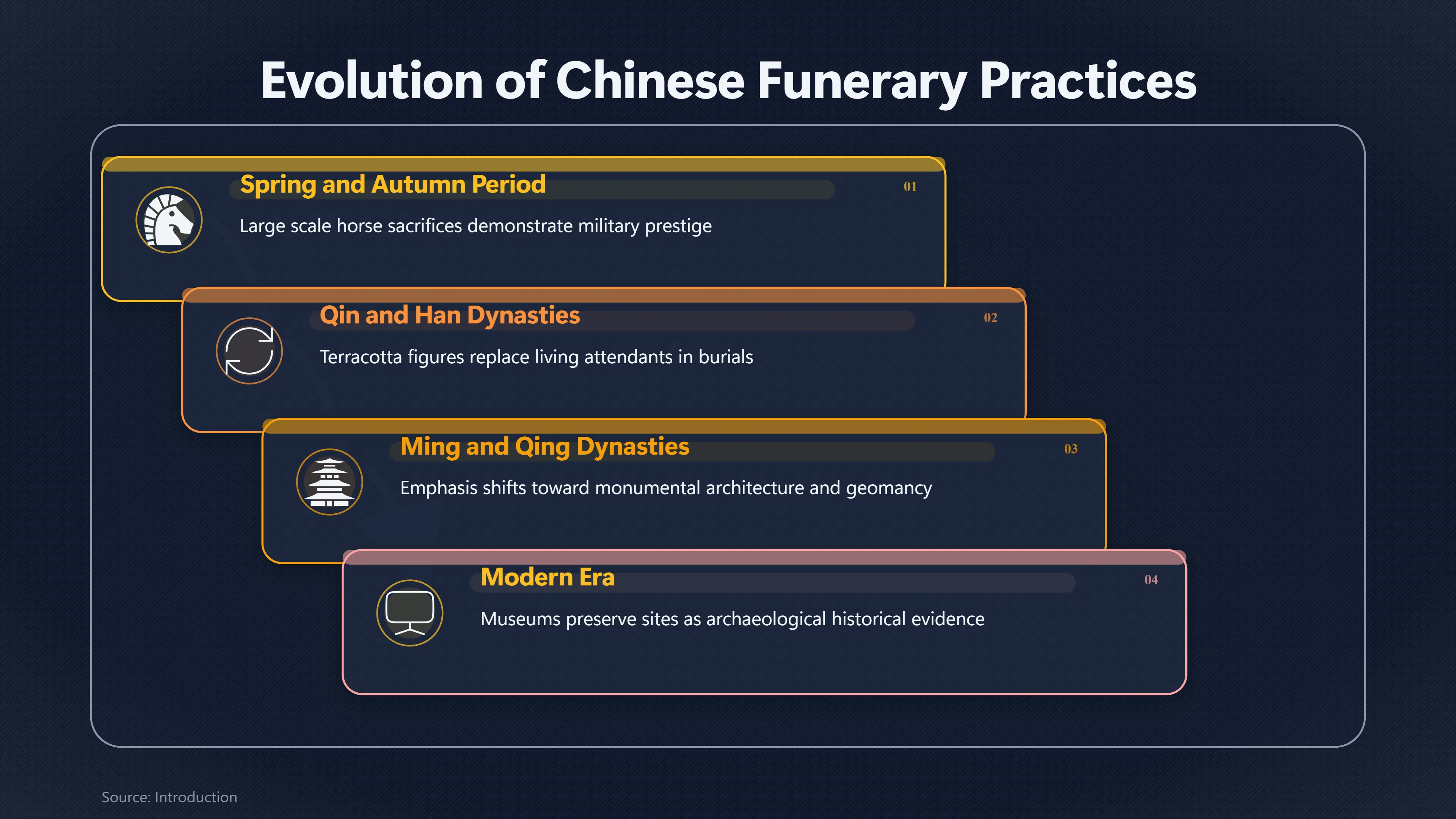
Taken together, China’s burial museums reveal a civilisation in which death was organised with the same precision as government. Sacrificial horse pits demonstrate that wealth and military prestige could be expressed through the destruction of valuable animals. Eunuch mausoleums expose how imperial authority extended into the most intimate aspects of human life. Vast imperial tomb complexes recreate entire administrations beneath the ground, reflecting the expectation that rulers would continue governing after death.
For visitors interested in China’s stranger heritage, these sites stand apart from folklore attractions or commercial curiosities. Their power comes from authentic archaeological evidence preserved where it was found. Instead of relying on mystery or myth, they confront visitors with a more unsettling reality: the immense resources, disciplined labour and controlled bodies that ancient states devoted to making political power appear eternal.
Amazon book picks
Further Reading
Books and field guides related to Why China's Burial Museums Feel So Unsettling. Use these as the next step if you want deeper reading beyond the article.
The Good Earth
First published 1931. Subjects: China, fiction, Fiction, historical, general, Social life and customs, History, Farmers' spouses.
Chinese Civilization: A Sourcebook
First published 1993. Subjects: Sources, Civilization, History, China, civilization, China, history, sources.
The Terracotta Army of the First Emperor of China
First published 2007. Subjects: Tomb, Excavations (Archaeology), Antiquities, Terra-cotta sculpture, Chinese, History.
eBay marketplace picks
Marketplace Samples
Live-tested eBay searches with available results related to this page.
Selected fromChinese history poster oneBay.co.uk.
Endnotes
1.
Source: whc.unesco.org
Title: World Heritage Centre Mausoleum of the First Qin Emperor
Link:https://whc.unesco.org/en/list/441/
Source snippet
UNESCO World Heritage CentreMausoleum of the First Qin Emperor - UNESCO World Heritage Centre...
2.
Source: beijing.english.china.org.cn
Title: The Tomb of Eunuch Tian Yi
Link:https://beijing.english.china.org.cn/2008-11/11/content_16746420.htm
Source snippet
China.org.cn...
3.
Source: china.org.cn
Title: China’s Eunuch Museum – china.org.cn
Link:https://www.china.org.cn/english/travel/234805.htm
4.
Source: whc.unesco.org
Title: World Heritage Centre Imperial Tombs of the Ming and Qing Dynasties
Link:https://whc.unesco.org/en/list/1004/
Source snippet
UNESCO World Heritage CentreImperial Tombs of the Ming and Qing Dynasties - UNESCO World Heritage Centre...
5.
Source: china.org.cn
Title: Having a ball
Link:https://www.china.org.cn/travel/2010-06/03/content_20179268.htm
6.
Source: china.org.cn
Title: China’s Eunuch Museum – china.org.cn
Link:https://www.china.org.cn/travel/where_to_go/2007-12/10/content_1234805.htm
7.
Source: china.org.cn
Title: Ancient Site Reveals Stories of Sacrificed Horses
Link:https://www.china.org.cn/english/features/Archaeology/139518.htm
9.
Source: en.chinaculture.org
Title: China Culture Ancient City of Qi State in Linzi
Link:https://en.chinaculture.org/library/2008-02/15/content_36864.htm
10.
Source: khanacademy.org
Title: Khan Academy The Tomb of the First Emperor (article) | Khan Academy
Link:https://www.khanacademy.org/humanities/art-asia/imperial-china/qin-dynasty/a/the-tomb-of-the-first-emperor
11.
Source: english.visitbeijing.com.cn
Title: Visit Beijing Eunuch Culture Exhibition Hall
Link:https://english.visitbeijing.com.cn/article/47OLVE3197V
Source snippet
Visit BeijingEunuch Culture Exhibition HallNovember 11, 2016...
Published: November 11, 2016
12.
Source: r.visitbeijing.com.cn
Link:https://r.visitbeijing.com.cn/museum/422
Additional References
13.
Source: cambridge.org
Link:https://www.cambridge.org/core/journals/antiquity/article/abs/horses-in-qin-mortuary-practice-new-insights-from-emperor-qin-shihuangs-mausoleum/931BAC393091C66A4883914AB19E3887
Source snippet
June 20, 2022 — HORSES IN QIN MORTUARY PRACTICE: NEW INSIGHTS FROM EMPEROR QIN SHIHUANG'S MAUSOLEUM Published online by Cambridge Univers...
Published: June 20, 2022
14.
Source: govt.chinadaily.com.cn
Title: chinadaily.com.cn Qi Heritage Museum | govt.chinadaily.com.cn
Link:https://govt.chinadaily.com.cn/s/202103/08/WS650a989d498ed2d7b7e9bf11/qi-heritage-museum.html
Source snippet
Heritage Museum | govt.chinadaily.com.cnMarch 8, 2021 — QI HERITAGE MUSEUM Updated: Mar 8, 2021 chinadaily.com.cn Print Share - WeChatIma...
Published: March 8, 2021
15.
Source: smarthistory.org
Title: – The Tomb of the First Emperor
Link:https://smarthistory.org/tomb-first-emperor-qin/
Source snippet
210 B.C.E. (Qin dynasty), Lintong District, Xi’an, Shaanxi, China, painted terracotta (Emperor Qin Shi Huang’s Mausoleum Site Museum; pho...
16.
Source: youtube.com
Title: Bronze Chariots and Horses of Emperor Qin Shi Huang’s mausoleum
Link:https://www.youtube.com/watch?v=JwwWkJR9_dw
Source snippet
Why Scientists Will NEVER Open The Tomb Of China's First Emperor...
17.
Source: youtube.com
Title: Eunuch Museum
Link:https://www.youtube.com/watch?v=vh88fr05tec
Source snippet
Bronze Chariots and Horses of Emperor Qin Shi Huang's mausoleum...
18.
Source: youtube.com
Title: Why Scientists Will NEVER Open The Tomb Of China’s First Emperor
Link:https://www.youtube.com/watch?v=v0vhqlB2tdg
Source snippet
Qin Shi Huang: The Emperor Who Refused to Die...
19.
Source: youtube.com
Title: Qin Shi Huang: The Emperor Who Refused to Die
Link:https://www.youtube.com/watch?v=eJaKij7hY4s
Source snippet
These Chinese Pyramids Hide Mysterious Ancient Mega Tombs...
20.
Source: museum.sinica.edu.tw
Link:https://museum.sinica.edu.tw/en/exhibitions/28/
21.
Source: degruyterbrill.com
Link:https://www.degruyterbrill.com/document/doi/10.1515/char-2015-0012/html
22.
Source: the-past.com
Title: Chinese Museums: the lure of the East – The Past
Link:https://the-past.com/feature/chinese-museums-the-lure-of-the-east/