Within Strange Argentina
Should the Llullaillaco Children Be Displayed?
Salta's preserved Inca children reveal how archaeology, sacred ancestry and museum access can collide.
On this page
- What was found on Llullaillaco
- How the children are preserved and presented
- Indigenous objections, consent and cultural ownership
Page outline Jump by section
Introduction
The Llullaillaco Children are among the most remarkable archaeological discoveries ever made in Argentina, but they are also the country’s most ethically contested museum display. Excavated in 1999 from the summit of the 6,739-metre Llullaillaco volcano in Salta Province, the three exceptionally preserved Inca children are now cared for by the Museum of High-Altitude Archaeology (MAAM). Their preservation has transformed understanding of Inca ritual, yet their public exhibition continues to divide archaeologists, Indigenous communities, museum professionals and visitors.[maam.gob.ar]maam.gob.arMuseo de Arqueología de Alta Montaña The MuseumMuseo de Arqueología de Alta Montaña The Museum
Unlike many debates over human remains in museums, this is not simply an argument about whether ancient bodies should be displayed. It also concerns sacred landscapes, Indigenous rights, scientific research, cultural ownership, consent across centuries and the responsibilities of museums that care for ancestors rather than anonymous specimens. Within Argentina’s landscape of unusual collections, no institution raises more fundamental questions about where education ends and ethical discomfort begins.
What was found on Llullaillaco?
During a scientific expedition in 1999, archaeologists led by Johan Reinhard and Constanza Ceruti excavated a ceremonial Inca shrine near the summit of Llullaillaco volcano on the modern Argentina–Chile border. They recovered the naturally frozen bodies of three children together with an extraordinary collection of textiles, miniature human figures, jewellery, feathered ornaments, food offerings and other ritual objects associated with the Inca capacocha ceremony.[maam.gob.ar]maam.gob.arMuseo de Arqueología de Alta Montaña LlullaillacoMuseo de Arqueología de Alta Montaña Llullaillaco
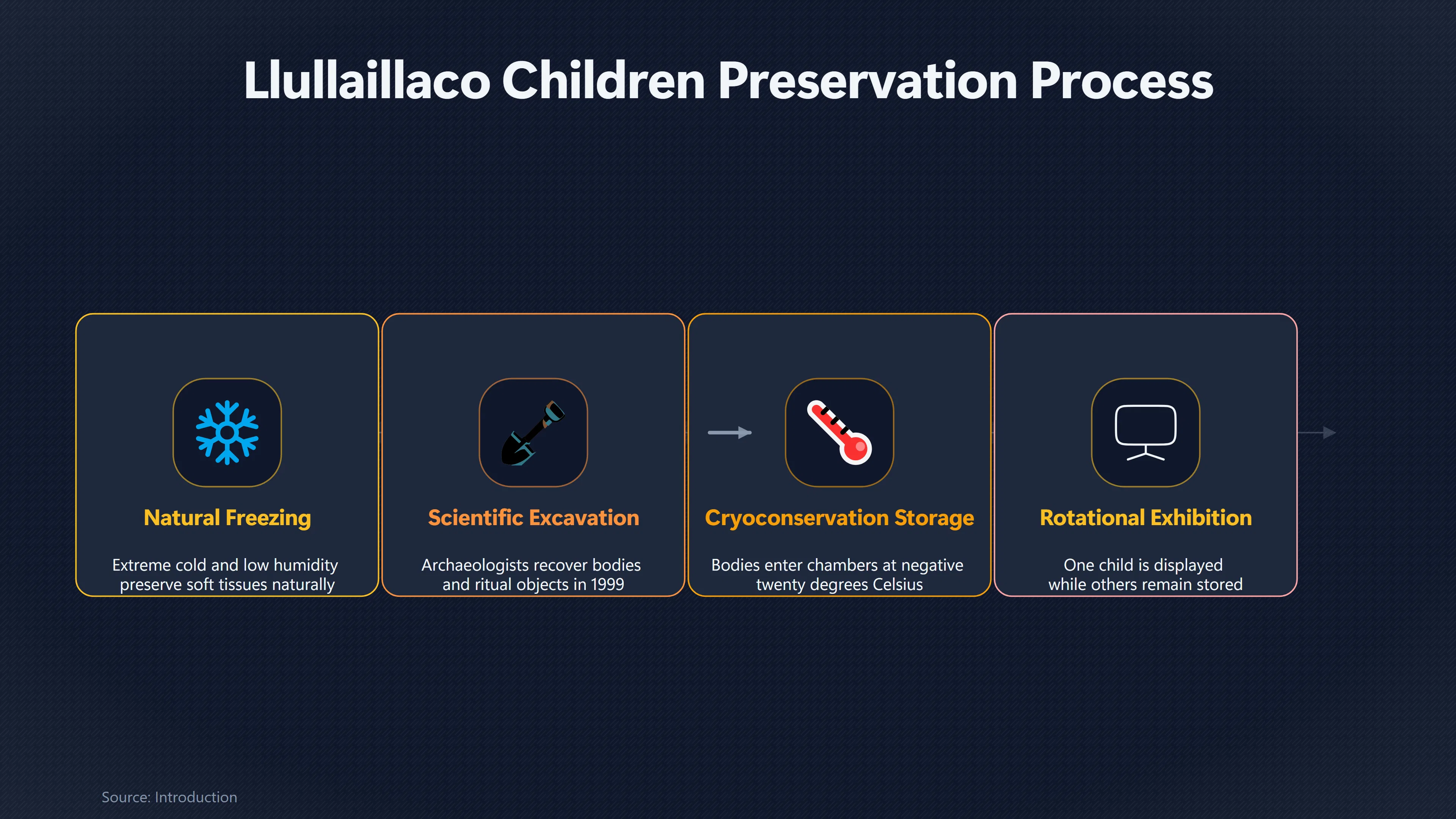
The children—commonly known as the Maiden, the Boy and the Lightning Girl—were preserved by extreme cold, low humidity and the stable conditions of the mountain. Unlike Egyptian mummies, whose preservation depended largely on deliberate embalming, the Llullaillaco children retained soft tissues, hair, clothing and facial features in astonishing condition because the environment itself acted as a natural freezer. Their lifelike appearance is precisely what makes the exhibition emotionally powerful and ethically challenging.[maam.gob.ar]maam.gob.arMuseo de Arqueología de Alta Montaña The MuseumMuseo de Arqueología de Alta Montaña The Museum
Scientific study of the remains has yielded valuable information about Inca religion, diet, health and ceremonial practice. Analyses of hair, clothing and associated artefacts have provided insights into the months leading up to the children’s deaths, allowing researchers to reconstruct aspects of state-sponsored ritual with a level of detail rarely possible in archaeology.[maam.gob.ar]maam.gob.arMuseo de Arqueología de Alta Montaña The MuseumMuseo de Arqueología de Alta Montaña The Museum
How the children are preserved and presented
The Museum of High-Altitude Archaeology was created specifically to care for the Llullaillaco discoveries. Rather than displaying all three children together, the museum normally exhibits only one child at a time while the others remain in controlled conservation conditions. This rotation is intended primarily to reduce light exposure and environmental stress rather than to create a changing attraction.[maam.gob.ar]maam.gob.arMuseo de Arqueología de Alta Montaña LlullaillacoMuseo de Arqueología de Alta Montaña Llullaillaco
The bodies are housed in specially engineered cryoconservation chambers that reproduce key characteristics of the high-altitude environment. The capsules maintain temperatures of approximately –20°C, low oxygen levels, carefully controlled humidity and filtered lighting while continuously recording environmental conditions. According to MAAM, the system is unique and was developed specifically for the preservation of the Llullaillaco children.[maam.gob.ar]maam.gob.arMuseo de Arqueología de Alta Montaña CrioconservationMuseo de Arqueología de Alta Montaña Crioconservation
The museum deliberately presents the children alongside the objects buried with them rather than as isolated curiosities. Clothing, miniature figurines and ceremonial offerings help explain that these were participants in an organised state ritual embedded within the religious and political life of the Inca Empire. The curatorial emphasis is therefore historical and archaeological rather than sensational, although visitors inevitably respond to the children’s strikingly human appearance.[maam.gob.ar]maam.gob.arMuseo de Arqueología de Alta Montaña LlullaillacoMuseo de Arqueología de Alta Montaña Llullaillaco
Why the exhibition remains controversial
The central ethical question is simple but difficult: should ancient human remains that were placed in a sacred burial be publicly displayed at all?
Supporters of the exhibition advance several arguments. They contend that:
- the children have transformed understanding of Inca civilisation through careful scientific study;
- professional conservation protects remains that would otherwise be vulnerable after excavation;
- public display allows millions of visitors to learn about Andean history and religion from authentic evidence rather than replicas;
- the museum presents the children respectfully rather than as entertainment.[maam.gob.ar]maam.gob.arMuseo de Arqueología de Alta Montaña The MuseumMuseo de Arqueología de Alta Montaña The Museum
Critics accept that the discovery is scientifically important but argue that research does not automatically justify permanent exhibition. For many, the issue is not archaeology itself but the continuing public display of deceased children whose burial was intended to remain undisturbed. This debate resembles wider international discussions surrounding Indigenous ancestors in museums, although the exceptional preservation of the Llullaillaco children makes the ethical questions especially immediate.
Indigenous objections, consent and cultural ownership
Some Indigenous organisations and community leaders have consistently argued that the children should be removed from public display and ultimately returned to Indigenous custody or reburied. They describe Llullaillaco as a sacred mountain rather than simply an archaeological site and regard the children as ancestors whose burial should not have been disturbed.[Wikipedia]WikipediaChildren of LlullaillacoChildren of Llullaillaco
Objections generally focus on several connected concerns:
- Sacred geography. The volcano itself remains spiritually significant, meaning excavation cannot be separated from the religious importance of the place.
- Ancestral dignity. Displaying human remains for paying visitors is viewed by critics as incompatible with respect owed to deceased ancestors.
- Ownership and authority. Indigenous groups question who has the right to decide how ancestral remains are studied, displayed or stored.
- Economic benefit. Some representatives have argued that museums and tourism benefit from Indigenous heritage without Indigenous communities exercising comparable control.[wikipedia.org]WikipediaChildren of LlullaillacoChildren of Llullaillaco
However, Indigenous opinion has never been completely uniform. Representatives at the Third World Congress of the Quechua Language expressed support for continued research and public dissemination of knowledge about the children, arguing that such work could help communicate the sophistication of Andean civilisation. The existence of both supportive and opposing Indigenous voices complicates attempts to frame the issue as a simple disagreement between scientists and Indigenous peoples.[Wikipedia]WikipediaChildren of LlullaillacoChildren of Llullaillaco
How museum practice has changed
The Llullaillaco exhibition reflects broader changes in museum ethics over recent decades. Earlier generations of museums often treated archaeological human remains primarily as scientific specimens. Contemporary museums increasingly recognise that many human remains also carry continuing religious, cultural and political significance for descendant communities.
MAAM has responded in several ways that distinguish it from older styles of display. The museum:
- limits exhibition to a single child at a time;
- places strong emphasis on cultural interpretation rather than spectacle;
- invests heavily in conservation technology;
- presents the children within the wider context of Inca religion and ceremonial practice rather than as isolated curiosities.[maam.gob.ar]maam.gob.arMuseo de Arqueología de Alta Montaña LlullaillacoMuseo de Arqueología de Alta Montaña Llullaillaco
These measures have not resolved the ethical debate, but they demonstrate an attempt to balance scientific preservation, public education and respect for the individuals represented.
Why the debate matters beyond Argentina
The Llullaillaco Children have become an international reference point in discussions about displaying human remains. Similar questions arise around Egyptian mummies, bog bodies, anatomical collections and Indigenous ancestors held in museums worldwide, but the Salta case is distinctive because the remains are so recent in appearance, so well documented archaeologically and so closely connected to living Indigenous identities.
For visitors interested in Argentina’s unusual museums, the exhibition is memorable not because it is macabre but because it forces a difficult question with no universally accepted answer. The children are simultaneously archaeological discoveries, scientific evidence, sacred ancestors and museum exhibits. Which of those identities deserves priority depends largely on how one weighs knowledge, heritage, religion and respect for the dead.
That unresolved tension is what makes the Llullaillaco Children one of the country’s most significant—and most challenging—public collections.
Amazon book picks
Further Reading
Books and field guides related to Should the Llullaillaco Children Be Displayed?. Use these as the next step if you want deeper reading beyond the article.
The Museum of Innocence
The Museum of Innocence - set in Istanbul between 1975 and today - tells the story of Kemal, the son of one of Istanbul's richest familie...
Archaeological Ethics
The second edition of Archaeological Ethics is an invitation to an ongoing and lively discussion on ethics. In addition to topics such as...
The Oxford Handbook of the Incas
The Oxford Handbook of the Incas aims to be the first comprehensive book on the Inca, the largest empire in the pre-Columbian world. Usin...
eBay marketplace picks
Marketplace Samples
Live-tested eBay searches with available results related to this page.
Selected fromArgentina travel poster oneBay.co.uk.
Endnotes
1.
Source: maam.gob.ar
Title: Museo de Arqueología de Alta Montaña The Museum
Link:https://maam.gob.ar/en/el-museo/
2.
Source: maam.gob.ar
Title: Museo de Arqueología de Alta Montaña Llullaillaco
Link:https://maam.gob.ar/en/salas_maam/llullaillaco/
3.
Source: maam.gob.ar
Title: Museo de Arqueología de Alta Montaña Llullaillaco
Link:https://maam.gob.ar/en/colecciones_maam/llullaillaco/
4.
Source: maam.gob.ar
Title: Museo de Arqueología de Alta Montaña Crioconservation
Link:https://maam.gob.ar/en/crioconservacion/
5.
Source: maam.gob.ar
Title: Museo de Arqueología de Alta Montaña Llullaillaco
Link:https://maam.gob.ar/salas_maam/llullaillaco/
6.
Source: Wikipedia
Title: Children of Llullaillaco
Link:https://en.wikipedia.org/wiki/Children_of_Llullaillaco
7.
Source: diputados.gov.ar
Link:https://www.diputados.gov.ar/comisiones/permanentes/cpydhumano/proyecto.html?exp=0196-D-2012
8.
Source: ri.conicet.gov.ar
Link:https://ri.conicet.gov.ar/handle/11336/216810
Source snippet
múltiples y disputas acerca de los niños de Llullaillaco: Yuyay Yaku Wawakuna (Salta, Argentina)September 1, 2022 — Artículo SENTIDOS MÚL...
Published: September 1, 2022
9.
Source: diputados.gob.ar
Link:https://diputados.gob.ar/comisiones/permanentes/cpydhumano/proyecto.html?exp=0377-D-2010
Additional References
10.
Source: tandfonline.com
Link:https://www.tandfonline.com/doi/full/10.1080/13527258.2017.1390486
Source snippet
ol 24, No 5 - Get AccessNovember 1, 2017 — 4,843 Views 12 CrossRef citations to date LETTING SKELETONS OUT OF THE CLOSET: THE ETHICS OF...
Published: November 1, 2017
11.
Source: researchgate.net
Title: For some of the person
Link:https://www.researchgate.net/publication/390021822POLITICAL_AND_ETHICAL_CHALLENGES_OF_SCIENTIFIC_BIOBANKS_CASE_STUDY-ARGENTINA-_MAAM_BIOBANK_-_CHAPTER_PHD_Liliana_Virginia_Siede
Source snippet
(PDF) POLITICAL AND ETHICAL CHALLENGES OF SCIENTIFIC BIOBANKS CASE STUDY -ARGENTINA- MAAM BIOBANK - CHAPTER PHD Liliana Virginia SiedeMar...
12.
Source: youtube.com
Title: Should human remains be displayed in museums? | Stuff The British Stole
Link:https://www.youtube.com/watch?v=HpF6P8SDzYk
Source snippet
Ethical considerations for caring and managing human remains in museums...
13.
Source: youtube.com
Title: Ethical considerations for caring and managing human remains in museums
Link:https://www.youtube.com/watch?v=lml7S5-teqc
Source snippet
Should DEAD BODIES be on display? Should human remains be in museums?...
14.
Source: youtube.com
Title: 500 Years Frozen in Time: The Inca Children Mystery
Link:https://www.youtube.com/watch?v=iHoSH8WJ0pw
Source snippet
Should human remains be displayed in museums? | Stuff The British Stole...
15.
Source: youtube.com
Title: Child Gods ~ Unveiling the Inca’s Mountain Rituals
Link:https://www.youtube.com/watch?v=1F-kEQ-ZrAw
Source snippet
500 Years Frozen in Time: The Inca Children Mystery...
16.
Source: researchgate.net
Link:https://www.researchgate.net/publication/365125275_Sentidos_multiples_y_disputas_acerca_de_los_ninos_de_Llullaillaco_Yuyay_Yaku_Wawakuna_Salta_Argentina
17.
Source: youtube.com
Title: Should DEAD BODIES be on display? Should human remains be in museums?
Link:https://www.youtube.com/watch?v=VEqvin_zMpQ
18.
Source: yorku.ca
Link:https://www.yorku.ca/kdenning/3130exam.htm