Within Zimbabwe Curiosities
The Great Zimbabwe Birds Behind a National Mystery
The soapstone birds of Great Zimbabwe reveal how ancient symbols became linked with royalty, spirituality and national identity.
On this page
- Ancient carvings and their discovery
- Symbols, beliefs and changing interpretations
- Colonial removal and modern identity
Page outline Jump by section
Introduction
The Great Zimbabwe Birds are among Zimbabwe’s most recognisable heritage objects: carved soapstone sculptures that transformed from sacred-looking objects at an ancient royal centre into symbols of a modern nation. Found at the Great Zimbabwe archaeological site near Masvingo, the birds are unusual because their meaning is not fixed. They have been interpreted as signs of royal power, links to ancestors, religious objects, and symbols of political identity, yet no surviving written record gives a definitive explanation of what they meant to the people who created them.[The Metropolitan Museum of Art]metmuseum.orgThe Metropolitan Museum of Art Great Zimbabwe (11th–15th CenturyThe Metropolitan Museum of ArtGreat Zimbabwe (11th–15th Century) - The Metropolitan Museum of ArtOctober 1, 2001…
For visitors interested in unusual collections and historical mysteries, the Zimbabwe Birds are compelling because the mystery is genuine rather than manufactured. The uncertainty comes from the limits of archaeology: the carvings survive, but the original ceremonies, stories and beliefs surrounding them are only partly recoverable. Today, the birds sit at the intersection of archaeology, spirituality, colonial collecting and national identity.[greatzimbabwewhs.com]greatzimbabwewhs.comGreat Zimbabwe World Heritage Site – Great Zimbabwe World Heritage SiteGreat Zimbabwe World Heritage Site – Great Zimbabwe World Heritage Site
Ancient carvings and their discovery
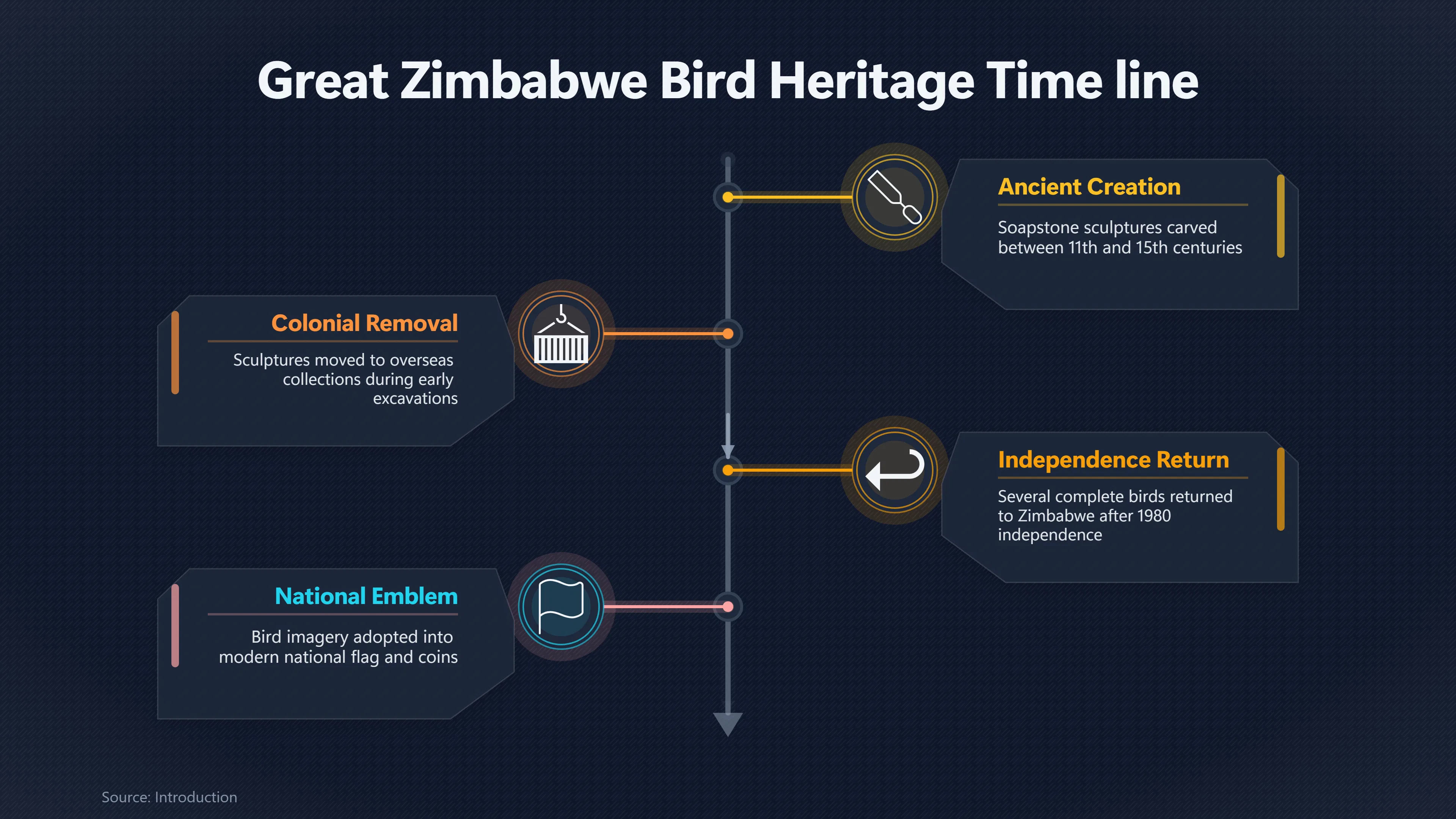
The soapstone birds were created at Great Zimbabwe, a major stone-built settlement occupied mainly between the 11th and 15th centuries. The site was a centre of political authority, trade and ritual life, with monumental stone structures that remain among the most important archaeological achievements in southern Africa. Great Zimbabwe became a UNESCO World Heritage Site in 1986.[UNESCO World Heritage Centre]whc.unesco.orgWorld Heritage Centre Great Zimbabwe National MonumentUNESCO World Heritage CentreGreat Zimbabwe National Monument - UNESCO World Heritage Centre…
The sculptures are distinctive because they combine bird-like and human-like features. Some have carved eyes, beaks and wings, while their proportions and details do not represent a simple naturalistic bird. Scholars have noted that the figures blend avian forms with human characteristics, creating symbolic objects rather than ordinary animal sculptures.[The Metropolitan Museum of Art]metmuseum.orgThe Metropolitan Museum of Art Great Zimbabwe (11th–15th CenturyThe Metropolitan Museum of ArtGreat Zimbabwe (11th–15th Century) - The Metropolitan Museum of ArtOctober 1, 2001…
Several birds were found in the Hill Complex, particularly in the Eastern Enclosure, where they appear to have been associated with important spaces rather than ordinary domestic areas. Their original arrangement is uncertain because archaeological disturbance and early collecting damaged much of the context that might have explained their purpose.[The Metropolitan Museum of Art]metmuseum.orgThe Metropolitan Museum of Art Great Zimbabwe (11th–15th CenturyThe Metropolitan Museum of ArtGreat Zimbabwe (11th–15th Century) - The Metropolitan Museum of ArtOctober 1, 2001…
The earliest modern investigations of Great Zimbabwe were shaped by colonial attitudes. European explorers and excavators often struggled to accept that an African society had built such a large and complex stone settlement. Some promoted theories involving foreign builders, despite later archaeological work demonstrating the site’s African origins. The soapstone birds became caught up in this wider struggle over who had the right to define the history of Great Zimbabwe.[National Geographic Education]education.nationalgeographic.orgNational Geographic Education Great ZimbabweNational Geographic EducationGreat ZimbabweOctober 19, 2023…
A collection shaped by removal and return
The birds also have a history beyond the ruins themselves. During the colonial period, some sculptures were removed from Great Zimbabwe and entered overseas collections. One example recorded by the British Museum was removed during an early excavation connected with James Theodore Bent’s work after Cecil Rhodes commissioned investigations at the site. Several complete birds were later returned to Zimbabwe after independence, although the wider history of collecting remains part of continuing debates about heritage ownership.[British Museum]britishmuseum.orgBritish Museumcast; sculpture | British MuseumBritish Museumcast; sculpture | British Museum
This history makes the birds unusual museum objects: they are not simply archaeological artefacts displayed for curiosity. They are objects whose physical movement across borders became part of their meaning.
Symbols, beliefs and changing interpretations
The central mystery of the Zimbabwe Birds is what they originally represented. Archaeologists generally agree that they were important symbolic objects, but interpretations differ because there is limited direct evidence from the period when Great Zimbabwe flourished.[The Metropolitan Museum of Art]metmuseum.orgThe Metropolitan Museum of Art Great Zimbabwe (11th–15th CenturyThe Metropolitan Museum of ArtGreat Zimbabwe (11th–15th Century) - The Metropolitan Museum of ArtOctober 1, 2001…
One influential interpretation connects the birds with royal authority. Because they were associated with elite spaces, some scholars have suggested that they represented rulers, ancestors or spiritual connections supporting kingship. The bird may have symbolised a link between political leadership and the supernatural world.[The Metropolitan Museum of Art]metmuseum.orgThe Metropolitan Museum of Art Great Zimbabwe (11th–15th CenturyThe Metropolitan Museum of ArtGreat Zimbabwe (11th–15th Century) - The Metropolitan Museum of ArtOctober 1, 2001…
Another approach emphasises religious significance. UNESCO describes the Zimbabwe Birds as evidence that Great Zimbabwe functioned as a place of worship, with the sculptures linked to continuing spiritual importance at the site. The exact beliefs behind them cannot be reconstructed with certainty, but their placement suggests that they belonged to a world where political power, sacred practice and ancestry were closely connected.[UNESCO World Heritage Centre]whc.unesco.orgWorld Heritage Centre Great Zimbabwe National MonumentUNESCO World Heritage CentreGreat Zimbabwe National Monument - UNESCO World Heritage Centre…
Some modern interpretations have attempted to identify the bird species represented, with suggestions including birds of prey such as the bateleur eagle or fish eagle. However, identifying the animal alone does not solve the larger question of meaning. A carved bird at a royal centre could carry symbolic meanings that go beyond the creature itself.[Smarthistory]smarthistory.org– Great ZimbabweSmarthistory – Great ZimbabweJune 4, 2026…
The uncertainty is part of what makes the birds historically important. Unlike a written inscription that states “this object represents X”, the carvings require interpretation through archaeology, comparison with later traditions and careful study of the site.

Colonial removal and modern identity
Few archaeological objects show the transformation from ancient artefact to national emblem as clearly as the Great Zimbabwe Birds. During colonial rule, the sculptures were removed from their original setting and became objects studied and displayed through colonial institutions. After independence in 1980, the same images became central symbols of Zimbabwean identity.[British Museum]britishmuseum.orgBritish Museumcast; sculpture | British MuseumBritish Museumcast; sculpture | British Museum
The Zimbabwe Bird appears on the national flag and other state symbols, turning an uncertain ancient image into a clear modern message: a connection between contemporary Zimbabwe and the achievements of the civilisation that built Great Zimbabwe. The symbol also appears on coins and official designs, reinforcing its role as a national emblem.[British Museum]britishmuseum.orgBritish Museumcoin | British MuseumBritish Museumcoin | British Museum
This creates an interesting tension. The modern meaning of the bird is widely understood, but its ancient meaning remains debated. The state uses it as a symbol of heritage and independence, while scholars continue to examine what the original communities intended. The object therefore carries two histories at once: the history of Great Zimbabwe itself and the modern history of reclaiming African heritage after colonial interpretations challenged local authorship.[The Metropolitan Museum of Art]metmuseum.orgThe Metropolitan Museum of Art Great Zimbabwe (11th–15th CenturyThe Metropolitan Museum of ArtGreat Zimbabwe (11th–15th Century) - The Metropolitan Museum of ArtOctober 1, 2001…
For visitors, this is what makes the birds different from ordinary museum curiosities. Their mystery is not based on claims of the unexplained. Instead, it comes from a real historical gap between a surviving object and a lost world of meanings.
Seeing the birds today
The Great Zimbabwe Birds are closely connected with the Great Zimbabwe National Monument and its site museum, managed by the National Museums and Monuments of Zimbabwe. The experience is unusual because the landscape itself is part of the collection: the stone walls, archaeological remains and surrounding environment provide the setting needed to understand why the carvings mattered.[NMMZ]nmmz.co.zwNational Museums & Monuments of ZimbabweDecember 10, 2019…
Visitors should expect a heritage site rather than a conventional gallery of isolated objects. The birds are best understood alongside the architecture of Great Zimbabwe, where royal authority, trade, ritual and memory came together.[greatzimbabwewhs.com]greatzimbabwewhs.comGreat Zimbabwe World Heritage Site – Great Zimbabwe World Heritage SiteGreat Zimbabwe World Heritage Site – Great Zimbabwe World Heritage Site
The lasting appeal of the Zimbabwe Birds lies in their ability to hold several meanings at once. They are archaeological evidence, sacred heritage objects, contested colonial-era collections and modern national symbols. Their unanswered questions are not weaknesses; they are the reason these small stone sculptures continue to attract attention as some of Zimbabwe’s most powerful cultural curiosities.

Amazon book picks
Further Reading
Books and field guides related to The Great Zimbabwe Birds Behind a National Mystery. Use these as the next step if you want deeper reading beyond the article.
A History of Zimbabwe
The first single-volume history of Zimbabwe with detailed coverage from pre-colonial times to the present, this book examines Zimbabwe's...
The Archaeology of Africa: Food, Metals and Towns
Africa has a vibrant past. It emerges from this book as the proud possessor of a vast and highly complicated interweaving of peoples and...
African Art in Detail
This book opens with the question, What is African art? The answer is a brilliantly colorful and detailed look at the myriad materials an...
eBay marketplace picks
Marketplace Samples
Live-tested eBay searches with available results related to this page.
Selected fromheritage art print oneBay.co.uk.
Endnotes
1.
Source: whc.unesco.org
Title: World Heritage Centre Great Zimbabwe National Monument
Link:https://whc.unesco.org/en/list/364
Source snippet
UNESCO World Heritage CentreGreat Zimbabwe National Monument - UNESCO World Heritage Centre...
2.
Source: greatzimbabwewhs.com
Title: Great Zimbabwe World Heritage Site – Great Zimbabwe World Heritage Site
Link:https://www.greatzimbabwewhs.com/
3.
Source: smarthistory.org
Title: – Great Zimbabwe
Link:https://smarthistory.org/great-zimbabwe/
Source snippet
Smarthistory – Great ZimbabweJune 4, 2026...
Published: June 4, 2026
4.
Source: nmmz.co.zw
Link:https://www.nmmz.co.zw/
Source snippet
National Museums & Monuments of ZimbabweDecember 10, 2019...
Published: December 10, 2019
5.
Source: nmmz.co.zw
Title: NMMZHeritage And Tourism
Link:https://www.nmmz.co.zw/heritage-and-tourism/
Source snippet
National Museums & Monuments of Zimbabwe...
6.
Source: whc.unesco.org
Link:https://whc.unesco.org/en/statesparties/zw
8.
Source: unesco.org
Link:https://www.unesco.org/en/countries/zw?hub=748
9.
Source: metmuseum.org
Title: The Metropolitan Museum of Art Great Zimbabwe (11th–15th Century)
Link:https://www.metmuseum.org/de/essays/great-zimbabwe-11th-15th-century
Source snippet
The Metropolitan Museum of ArtGreat Zimbabwe (11th–15th Century) - The Metropolitan Museum of ArtOctober 1, 2001...
Published: October 1, 2001
10.
Source: education.nationalgeographic.org
Title: National Geographic Education Great Zimbabwe
Link:https://education.nationalgeographic.org/resource/great-zimbabwe/
Source snippet
National Geographic EducationGreat ZimbabweOctober 19, 2023...
Published: October 19, 2023
11.
Source: britishmuseum.org
Title: British Museumcast; sculpture | British Museum
Link:https://www.britishmuseum.org/collection/object/E_CRS-73
12.
Source: britishmuseum.org
Title: British Museumcoin | British Museum
Link:https://www.britishmuseum.org/collection/object/C
13.
Source: britishmuseum.org
Title: British Museumcoin | British Museum
Link:https://www.britishmuseum.org/collection/object/C
14.
Source: metmuseum.org
Title: Great Zimbabwe
Link:https://www.metmuseum.org/de/essays/great-zimbabwe
15.
Source: nmmz.co.zw
Title: National Monuments Management Programme
Link:https://www.nmmz.co.zw/national-monuments-management-programme/
16.
Source: nmmz.co.zw
Title: World Heritage Sites
Link:https://www.nmmz.co.zw/world-heritage-sites/
17.
Source: nmmz.co.zw
Title: Southern Region, Masvingo
Link:https://www.nmmz.co.zw/southern-region-masvingo/
18.
Source: nmmz.co.zw
Link:https://www.nmmz.co.zw/visit/
19.
Source: nmmz.co.zw
Link:https://www.nmmz.co.zw/contacts/
20.
Source: nmmz.co.zw
Title: About Us
Link:https://www.nmmz.co.zw/about-us/
21.
Source: worldhistory.org
Title: Great Zimbabwe
Link:https://www.worldhistory.org/Great_Zimbabwe/
22.
Source: britishmuseum.org
Link:https://www.britishmuseum.org/collection/term/AUTH225991
23.
Source: britishmuseum.org
Link:https://www.britishmuseum.org/collection/object/E_Af1923
24.
Source: britishmuseum.org
Link:https://www.britishmuseum.org/collection/object/C
25.
Source: britishmuseum.org
Link:https://www.britishmuseum.org/collection/object/C
26.
Source: britishmuseum.org
Link:https://www.britishmuseum.org/collection/object/EA_Af-B19-9
27.
Source: zimembassyinfo.com
Title: great zimbabwe
Link:https://zimembassyinfo.com/tourism/great-zimbabwe
Additional References
28.
Source: youtube.com
Title: ZIMBABWE HID This From the WHOLE World: The City That CANNOT Be Explained
Link:https://www.youtube.com/watch?v=B6f-CGwYwDk
Source snippet
They Said Africans Couldn't Build This City. They Lied. (Great Zimbabwe)...
29.
Source: youtube.com
Title: They Said Africans Couldn’t Build This City. They Lied. (Great Zimbabwe)
Link:https://www.youtube.com/watch?v=kPegJSK6afw
Source snippet
Stone Cities & Ocean Trade in Africa | AP African American Studies 1.8...
30.
Source: youtube.com
Title: Great Zimbabwe Birds African Artefacts
Link:https://www.youtube.com/watch?v=J4At9HSp208
Source snippet
ZIMBABWE HID This From the WHOLE World: The City That CANNOT Be Explained...
31.
Source: youtube.com
Title: Stone Cities & Ocean Trade in Africa | AP African American Studies 1.8
Link:https://www.youtube.com/watch?v=u3uh35JbRFA
Source snippet
The Zimbabwe Soapstone Bird Has Hieroglyphs And Is A Cartouche...
32.
Source: dsac.gov.za
Link:https://www.dsac.gov.za/Address%20by%C2%A0%20Minister%20Gayton%20McKenzie%20-%20handover%20ceremony%20of%20Zimbabwe%20Soapstone%20Bird%20and%20Ancestral%20Human%20Remains
33.
Source: sciencedirect.com
Link:https://www.sciencedirect.com/science/article/pii/S0278416526000322
34.
Source: greatzimbabweruins.com
Link:https://www.greatzimbabweruins.com/
35.
Source: zimfieldguide.com
Link:https://zimfieldguide.com/node/70
36.
Source: deptcomms.org.zw
Link:https://deptcomms.org.zw/national-symbols/
37.
Source: researchgate.net
Link:https://www.researchgate.net/publication/301673579_Soapstone_birds_in_soapstone_nests_ethnohistorical_interpretation_of_the_Zimbabwe_birds_based_on_sixteenth-_to_nineteenth-century_Portuguese_documents