Within Strange Germany
Inside Germany's Surviving Baroque Wonder Rooms
Halle and Dresden preserve two contrasting visions of the wonder room: scholarly classification and princely spectacle.
On this page
- What a cabinet of curiosities was
- Halle's preserved scholarly collection
- Dresden's courtly theatre of marvels
Page outline Jump by section
Introduction
Germany preserves two of the most revealing windows into the age of the Baroque wonder room, or cabinet of curiosities. In Halle, visitors can walk through a rare scholarly collection that survives almost exactly as it was arranged in the eighteenth century. In Dresden, the former Saxon court’s collections demonstrate how rulers used spectacular displays of rare objects to project power, wealth and universal knowledge. Together they show that these rooms were far more than eccentric displays of oddities. They were early attempts to organise the entire known world before modern museums divided collections into art, science, archaeology and natural history.
For anyone interested in Germany’s stranger museum heritage, these surviving wonder rooms explain why so many later museums of natural history, medicine and archaeology developed in the way they did. They preserve an older vision in which a whale rib, a carved ivory sculpture, a fossil, a scientific instrument and an object brought from Asia could all be understood as parts of one interconnected picture of creation and human knowledge.[Wunderkammer]wunderkammer.francke-halle.deOpen source on francke-halle.de.
What a cabinet of curiosities was
The German term Wunderkammer (“wonder room”) or Kunstkammer (“art chamber”) describes collections assembled from the sixteenth through eighteenth centuries by princes, scholars, wealthy merchants and religious institutions. Rather than separating objects by academic discipline, collectors deliberately placed different categories side by side.
Typical collections combined:
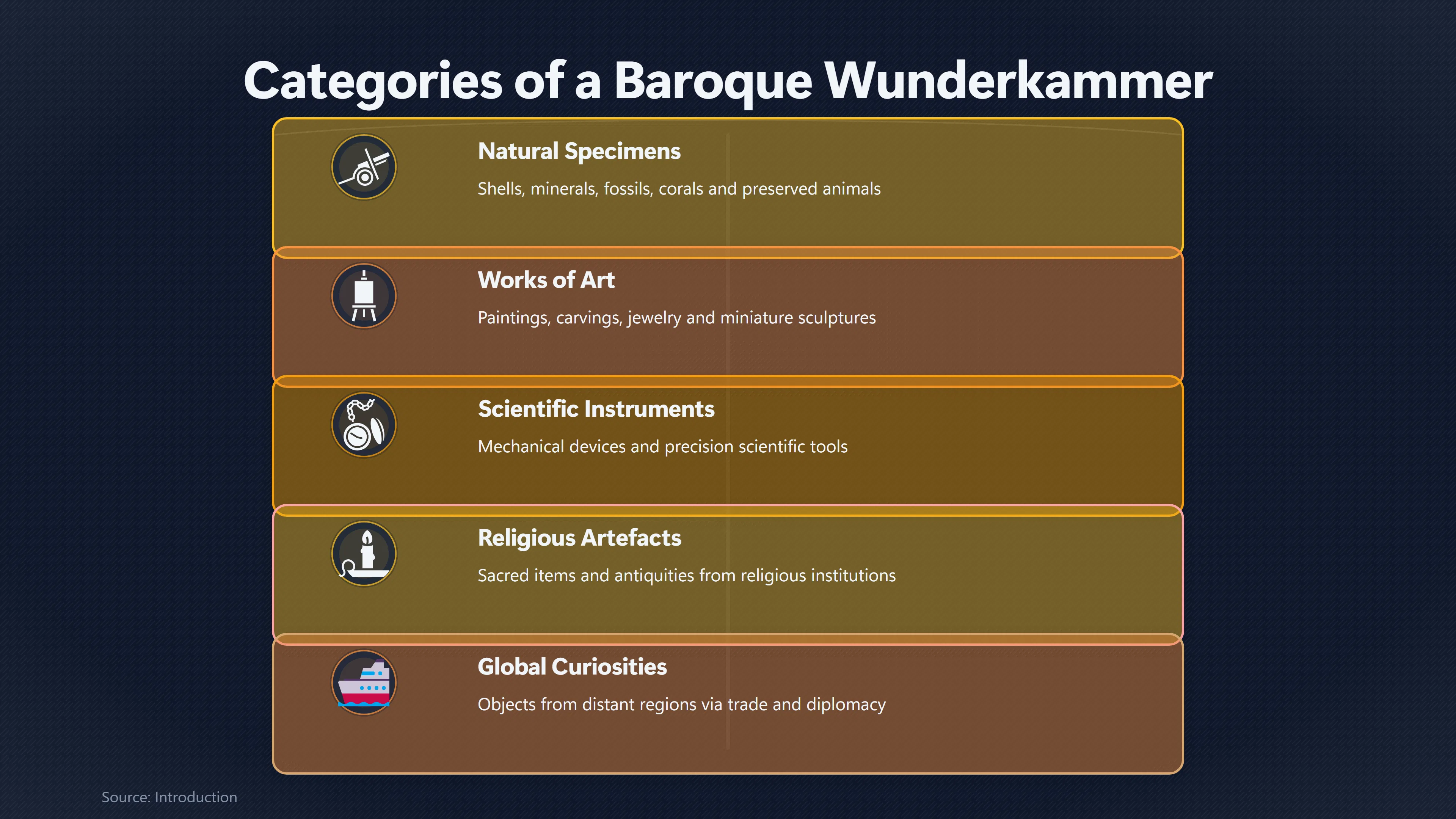
- Natural specimens such as shells, minerals, fossils, corals and preserved animals.
- Works of art including paintings, carvings, jewellery and miniature sculpture.
- Scientific instruments and mechanical devices.
- Religious artefacts and antiquities.
- Objects acquired through diplomacy, trade and missionary activity from distant parts of the world.
- Curiosities that appeared extraordinary because of their rarity, unusual form or uncertain origin.
The goal was not simply accumulation. A visitor was meant to move through the room discovering relationships between seemingly unrelated objects. Nature, craftsmanship, religion and learning were understood as parts of one divine order. The room itself became a physical model of the universe—a “microcosm” representing the larger world.[Franckesche Stiftungen Wissenschaft]wissenschaft.francke-halle.deFranckesche Stiftungen WissenschaftResearch on the Cabinet of Artefacts and Natural Curiosities of the Francke Foundations | Francke Foun…
This way of organising knowledge feels unfamiliar today because modern museums separate these categories into specialist institutions. A fossil belongs in natural history, a sculpture in an art gallery and a scientific instrument in a technology museum. The Baroque wonder room deliberately resisted those boundaries.
Halle’s preserved scholarly collection
Among Germany’s surviving examples, the Cabinet of Artefacts and Natural Curiosities at the Francke Foundations in Halle is exceptional because almost every essential element of the original collection survives together. The room, its fitted cabinets, decorative paintings, catalogues and thousands of objects remain in their historic setting, allowing visitors to experience an eighteenth-century museum much as contemporary audiences did. The Francke Foundations describe it as Germany’s only completely preserved Baroque cabinet of curiosities.[Franckesche Stiftungen]francke-halle.deFranckesche Stiftungen Exhibition | Francke FoundationFranckesche Stiftungen Exhibition | Francke Foundation
Unlike many princely collections, Halle’s cabinet belonged to an educational foundation. It was created to teach pupils, encouraging observation rather than passive admiration. More than 3,000 objects filled the room, ranging from preserved animals and minerals to artworks, ethnographic objects and scientific specimens. A stuffed Nile crocodile suspended from the ceiling remains one of its most striking features, but it was only one element in a carefully planned educational environment.[Franckesche Stiftungen]francke-halle.deFranckesche Stiftungen Exhibition | Francke FoundationFranckesche Stiftungen Exhibition | Francke Foundation
The arrangement followed a systematic logic rather than random spectacle. Visitors could move from one group of natural specimens to another, comparing shells, rocks, plants and animals while also encountering crafted objects that illustrated human ingenuity. The display reflected the growing influence of scientific classification while still presenting the collection as evidence of divine creation rather than purely secular science. Recent scholarship notes that Halle became one of the earliest museum settings to present Carl Linnaeus’s new biological classification system alongside older forms of collecting.[Franckesche Stiftungen Wissenschaft]wissenschaft.francke-halle.deOpen source on francke-halle.de.
Modern research has also expanded understanding of how the collection was assembled. Many artefacts arrived through missionary, commercial and colonial networks reaching South Asia, Borneo and other regions. Contemporary projects now investigate the provenance of these objects and the unequal historical relationships that brought them to Germany, making the cabinet both a preserved Baroque museum and an active site of historical reassessment.[Franckesche Stiftungen Wissenschaft]wissenschaft.francke-halle.deFranckesche Stiftungen WissenschaftObjects from Borneo in the Cabinet of Artefacts and Natural Curiosities of the Francke Foundations Hal…
Dresden’s courtly theatre of marvels
If Halle represents the scholarly wonder room, Dresden illustrates the princely version at its most theatrical.
The Saxon electors, particularly Augustus the Strong, assembled collections intended to impress foreign ambassadors, visiting royalty and wealthy guests as much as to encourage study. Their Kunstkammer eventually evolved into specialised museums, with masterpieces distributed among institutions such as the Green Vault, the Armoury, scientific collections and other branches of today’s Dresden State Art Collections.
Where Halle emphasised education, Dresden emphasised magnificence. Precious gemstones, elaborate ivory carvings, intricate clocks, scientific instruments, ceremonial weapons and luxury objects demonstrated both artistic excellence and the ruler’s command of global trade, skilled craftsmanship and intellectual culture. The collections communicated political authority as much as curiosity.
Visitors were meant to experience surprise at every turn. Rare natural objects appeared beside extraordinary works made by Europe’s finest craftsmen, creating an atmosphere in which human creativity seemed almost as miraculous as nature itself. This theatrical quality explains why many later museums retained dramatic display techniques even after abandoning the mixed collecting practices of the Baroque period.
How these collections organised the world
The surviving German wonder rooms reveal a worldview that differs fundamentally from modern museum thinking.
Instead of asking, “What type of object is this?”, Baroque collectors often asked, “What does this object reveal about the structure of creation?”
Several organising ideas shaped their displays:
- Nature and art belonged together. A carved ivory object and an elephant tusk illustrated different aspects of the same material.
- Rarity mattered more than category. Unusual specimens attracted attention because they challenged ordinary experience.
- Comparison encouraged learning. Similar objects placed together allowed visitors to notice patterns and differences.
- Global collecting expanded understanding. Objects from distant regions demonstrated both the diversity of creation and Europe’s expanding knowledge of the wider world.
- Wonder had educational value. Astonishment was considered the beginning of serious inquiry rather than a distraction from it.
The result was neither purely scientific nor merely decorative. Wonder itself functioned as a method of learning. Encountering something unexpected encouraged visitors to observe more closely, ask questions and search for underlying order.[Wunderkammer]wunderkammer.francke-halle.deOpen source on francke-halle.de.
Why these rooms still matter
Baroque wonder rooms occupy an unusual position within Germany’s museum landscape because they preserve not simply historic objects but an earlier system of thought.
Many later museums inherited individual collections while abandoning the original intellectual framework. Minerals became geological collections. Stuffed animals entered natural history museums. Sculptures moved into art galleries. Scientific instruments found homes in technical museums.
Halle therefore offers something that many larger museums cannot: the opportunity to experience the original relationship between these objects before disciplinary boundaries separated them. Dresden complements that experience by showing how the same collecting tradition could also function as political theatre, transforming knowledge into a display of dynastic prestige.
For visitors exploring Germany’s stranger collections, these surviving wonder rooms provide the missing historical link between Renaissance curiosity cabinets and the specialised museums that dominate today. They demonstrate that Europe’s earliest museums were designed not simply to preserve remarkable things, but to help people imagine that the entire world—natural, artistic, scientific and spiritual—could be understood as one interconnected whole.
Amazon book picks
Further Reading
Books and field guides related to Inside Germany's Surviving Baroque Wonder Rooms. Use these as the next step if you want deeper reading beyond the article.
Baltic Homes
Extraordinary seascapes, a rigorous climate, a fascinating amalgamation of cultures, endless summer days and long winter nights - these a...
Ways of Seeing
"Seeing comes before words. The child looks and recognizes before it can speak. "But there is also another sense in which seeing comes be...
A Cabinet of Curiosities
Exactly the book for every young explorer who loves finding stuff in nature and bringing it home. Cabinet of Curiosities is a lavishly il...
eBay marketplace picks
Marketplace Samples
Live-tested eBay searches with available results related to this page.
Selected frommuseum art print oneBay.co.uk.
Endnotes
1.
Source: kunstkammer.com
Title: Kunst- and Wunderkammer
Link:https://www.kunstkammer.com/index.php/en/kunst-and-wunderkammer
2.
Source: kunstkammer.com
Title: Kunst- und Wunderkammern
Link:https://www.kunstkammer.com/index.php/kunst-und-wunderkammern
3.
Source: youtube.com
Title: The Francke Foundations: A Journey Through an 18th Century Cabinet
Link:https://www.youtube.com/watch?v=kYvM-U85-rY
Source snippet
Wunderkammer: The Art of Collecting the World...
4.
Source: youtube.com
Title: Wunderkammer: The Art of Collecting the World
Link:https://www.youtube.com/watch?v=Zf5hX1rN2oQ
Source snippet
How Cabinets of Curiosities Invented the Modern Museum...
5.
Source: wunderkammer.francke-halle.de
Link:https://wunderkammer.francke-halle.de/en/
6.
Source: wissenschaft.francke-halle.de
Link:https://wissenschaft.francke-halle.de/en/research-centre/projects/research-on-the-cabinet-of-artefacts
Source snippet
Franckesche Stiftungen WissenschaftResearch on the Cabinet of Artefacts and Natural Curiosities of the Francke Foundations | Francke Foun...
7.
Source: francke-halle.de
Title: Franckesche Stiftungen Exhibition | Francke Foundation
Link:https://www.francke-halle.de/en/exhibitions/detail/cabinet-of-artefacts-and-natural-curiosities-6
8.
Source: wissenschaft.francke-halle.de
Link:https://wissenschaft.francke-halle.de/en/publications/publication/300-years-of-curiosity-517
9.
Source: wissenschaft.francke-halle.de
Link:https://wissenschaft.francke-halle.de/en/borneo
Source snippet
Franckesche Stiftungen WissenschaftObjects from Borneo in the Cabinet of Artefacts and Natural Curiosities of the Francke Foundations Hal...
10.
Source: wissenschaft.francke-halle.de
Title: im Auftr. d. Franckeschen Stiftungen v. Tom Gärtig, Philipp Wille, Holger
Link:https://wissenschaft.francke-halle.de/publikationen/publikation/300-jahre-neugier
Source snippet
francke-halle.de300 Jahre Neugier | Franckesche Stiftungen WissenschaftNovember 1, 2025 — 300 JAHRE NEUGIER Verborgenes Wissen aus der Wu...
Published: November 1, 2025
11.
Source: degruyterbrill.com
Link:https://www.degruyterbrill.com/document/isbn/9783422800953/html?lang=en
Source snippet
Your documents are now available to view. Nagel, Christine, Syndram, Dirk and Dresden, Staatliche Kunstsammlungen. Kunstkammer: Weltsicht...
12.
Source: degruyterbrill.com
Link:https://www.degruyterbrill.com/document/isbn/9783422800953/html
Source snippet
Weltsicht und Wissen um 1600, Deutscher Kunstverlag (DKV), 2023. Nagel, C., Syndram, D. & Dresden, S. (2023). Ku...
13.
Source: stadtwikidd.de
Link:https://www.stadtwikidd.de/wiki/Kunstkammer
14.
Source: wissenschaft.francke-halle.de
Title: de Die Wunderkammer der Franckeschen Stiftungen | Francke Foundation Science
Link:https://wissenschaft.francke-halle.de/en/publications/publication/die-wunderkammer-der-franckeschen-stiftungen-229
15.
Source: francke-halle.de
Link:https://www.francke-halle.de/en/exhibitions/detail/the-reference-library-of-the-cabinet-of-artefacts-and-natural-curiosities-21
16.
Source: kultur.francke-halle.de
Link:https://kultur.francke-halle.de/en/digital-offers/tour-through-the-historic-site
17.
Source: kultur.francke-halle.de
Link:https://kultur.francke-halle.de/en/exhibitions/exhibition/300-years-of-curiosity-hidden-knowledge-from-the-cabinet-of-artefacts-and-natural-curiosities
18.
Source: 300-jahre-neugier.francke-halle.de
Link:https://300-jahre-neugier.francke-halle.de/en/kapitel/time
19.
Source: francke-halle.de
Title: At a glance
Link:https://www.francke-halle.de/en/culture/at-a-glance
20.
Source: wissenschaft.francke-halle.de
Link:https://wissenschaft.francke-halle.de/en/research-centre/projects/colonial-art-and-cultural-assets
21.
Source: wunderkammer.francke-halle.de
Link:https://wunderkammer.francke-halle.de/en/kapitel/modell
22.
Source: wunderkammer.francke-halle.de
Link:https://wunderkammer.francke-halle.de/en/kapitel/artefakte
23.
Source: wunderkammer.francke-halle.de
Link:https://wunderkammer.francke-halle.de/en/kapitel/naturalia
24.
Source: kultur.francke-halle.de
Link:https://kultur.francke-halle.de/en/facilities/custodian/klopf-freya
25.
Source: 300-jahre-neugier.francke-halle.de
Link:https://300-jahre-neugier.francke-halle.de/en/chapter/room
Additional References
26.
Source: youtube.com
Title: Art, Science, and Power: The Evolution of the Wunderkammer
Link:https://www.youtube.com/watch?v=zJg5n2k12jI
Source snippet
These videos are relevant because they provide visual and historical context for the Baroque Wunderkammer tradition in Germany, specifica...
27.
Source: youtube.com
Title: The World in a Box: Cabinets of Curiosity
Link:http://www.youtube.com/watch?v=NRBqBTN814w
Source snippet
Cabinet of Curiosities Wunderkammer history What Are the Cabinets of Curiosities? | Emerald, Ivory, & Gold Gemstones...
28.
Source: youtube.com
Title: The Francke Foundations: The Historic Cabinet of Curiosities in Halle
Link:https://www.youtube.com/watch?v=cM3wQ5F1Tts
Source snippet
Cabinets of Curiosities and the History of Collecting...
29.
Source: youtube.com
Title: The Dresden Green Vault: Europe’s Greatest Treasure Chamber
Link:https://www.youtube.com/watch?v=J32V4p6S1dY
Source snippet
The Francke Foundations: A Journey Through an 18th Century Cabinet...
30.
Source: youtube.com
Title: Inside the Wunderkammer: The Royal Collections of Dresden
Link:https://www.youtube.com/watch?v=H7o74h-42pI
Source snippet
The Francke Foundations: The Historic Cabinet of Curiosities in Halle...
31.
Source: youtube.com
Title: Cabinets of Curiosities and the History of Collecting
Link:https://www.youtube.com/watch?v=q6g486z_v5g
Source snippet
Art, Science, and Power: The Evolution of the Wunderkammer...
32.
Source: youtube.com
Title: How Cabinets of Curiosities Invented the Modern Museum
Link:https://www.youtube.com/watch?v=kP_0VlQh494
Source snippet
Treasures of the Saxon Court: The Kunstkammer Tradition...
33.
Source: gepris.dfg.de
Title: de DF G
Link:https://gepris.dfg.de/gepris/projekt/440653566/ergebnisse
Source snippet
und 17. Jahrhunderts als Ort politischer Interaktion, dynastischer Memoria und fürstlicher WissenspraxisJanuary 1, 2024 — ORDNUNG UND AUR...
Published: January 1, 2024
34.
Source: youtube.com
Title: The Cabinet of Curiosities: A Miniature World
Link:https://www.youtube.com/watch?v=F3zWvU-R980
Source snippet
Inside the Wunderkammer: The Royal Collections of Dresden...
35.
Source: sciencedirect.com
Link:https://www.sciencedirect.com/science/article/abs/pii/S003936810900065X