Where Lithuania Keeps Its Strangest Stories
Lithuania’s strangest collections are not dominated by fabricated monsters or carnival-style curiosities.
Page outline Jump by section
Introduction
The country’s curiosity culture repeatedly crosses boundaries between museum, memorial, sacred landscape and tourist attraction. Some places are carefully curated state institutions; others began with an obsessive private collector or remain open-ended communal creations. The most rewarding visits therefore ask more than “Is this strange?” They ask who assembled the objects, what beliefs or traumas they represent, and whether the setting encourages understanding, entertainment, remembrance or all three at once.
Where folklore becomes a collection
Lithuania’s clearest conventional “weird museum” is the Devils’ Museum in Kaunas, formally part of the M. K. Čiurlionis National Museum of Art. It grew from the personal collection of artist Antanas Žmuidzinavičius, who began gathering devil figures after receiving a wooden sculpture in 1906. The collection later expanded far beyond one artist’s eccentric hobby, bringing together folk sculpture, masks, applied art and souvenirs from Lithuania and other countries.[ciurlionis.lt]ciurlionis.ltvelniu kolekcija enDevil CollectionThe Devils Museum in Kaunas grew out of a private collection. A local artist, began to collect figures of devils in 1906…
What makes the museum worthwhile is not simply the quantity of horned figures. In Lithuanian folk culture, the devil is not always the absolute embodiment of evil familiar from strict Christian theology. He may be foolish, greedy, comic, easily tricked or associated with older ideas about wild places, wealth and the underworld. The exhibits consequently shift between religious warning, rustic humour, national folklore and modern kitsch. A carved village devil and a mass-produced souvenir may share a cabinet, but they do not carry the same cultural weight.
This difference matters because the collection can look like a worldwide parade of demonic imagery when viewed quickly. Its stronger interpretation lies in the way beliefs are translated into objects. Some figures preserve local carving traditions; some parody political leaders or human vices; others show how an internationally recognisable supernatural character has been adapted for tourism. The museum is public and institutionally managed, yet its unusual personality still comes from the collecting impulse of one individual.
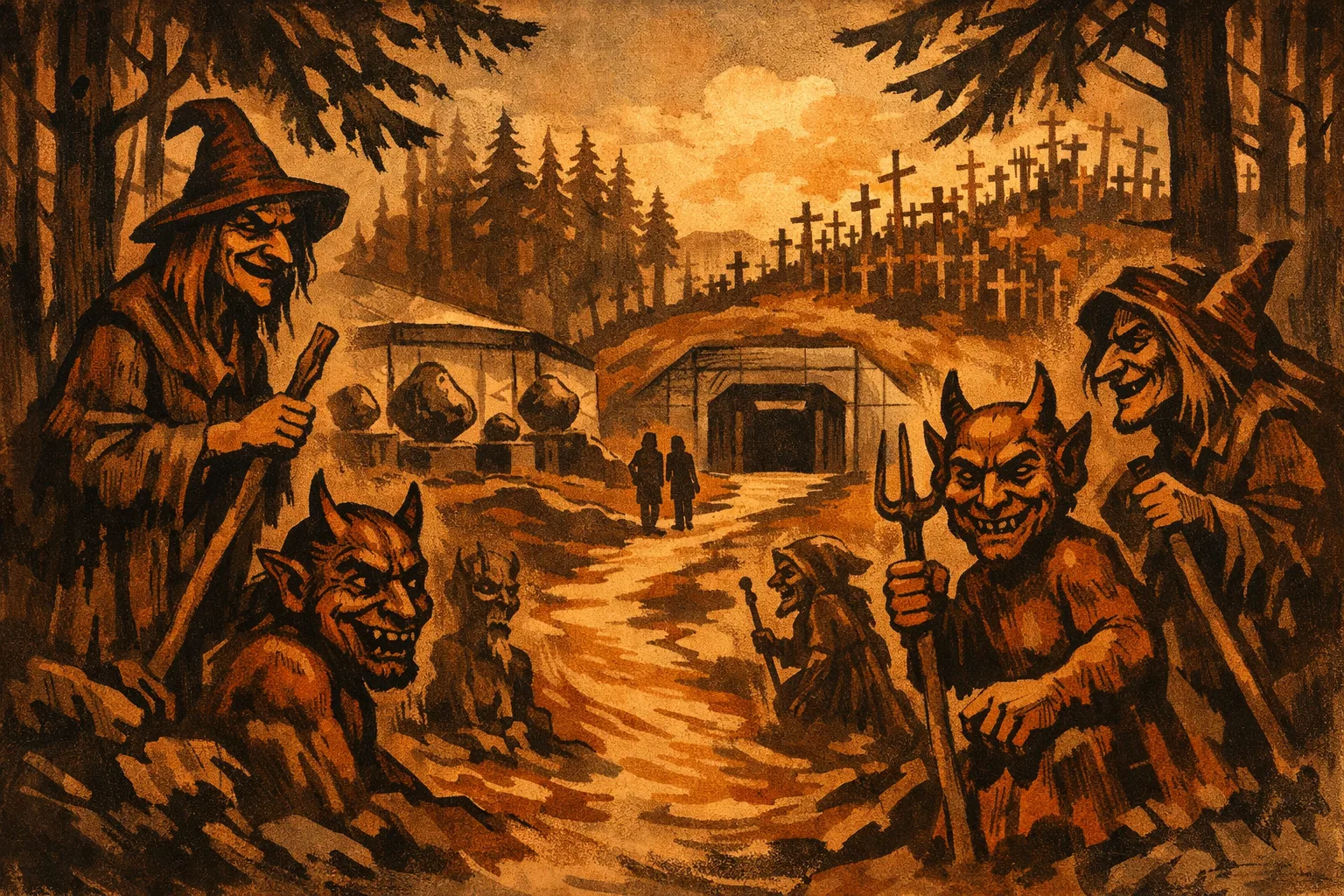
A more immersive counterpart stands on the Curonian Spit. The Hill of Witches is an outdoor ensemble of wooden sculptures in a wooded dune landscape near Juodkrantė. Created from 1979 onwards by carvers and blacksmiths brought together from across Lithuania, it presents witches, devils and figures from fairy tales and legends along winding forest paths. The organisation responsible for the site describes it as a museum of wooden sculpture rather than a surviving ritual ground.[neringosmuziejai.lt]neringosmuziejai.ltAssembled from all over Lithuania in 1979, the authors of sculptures of the Hill of Witches, wood carvers and blacksmiths, were inspired…
That distinction prevents a common misunderstanding. The hill is not evidence that Lithuanian witchcraft has been continuously practised there since ancient times. It is a modern artistic landscape drawing upon folklore and the suggestive atmosphere of an old forest. Visitors encounter a theatrical sequence of comic, grotesque and threatening figures, but the “magic” is consciously constructed through sculpture, scenery and storytelling.
Together, the Devils’ Museum and the Hill of Witches show two different ways Lithuania preserves supernatural tradition. One arranges folklore inside cases and categories; the other allows it to inhabit a landscape. Neither proves the literal reality of witches or devils. Both reveal how such beings remain useful for discussing fear, mischief, morality, creativity and national identity.
A museum where the cosmos includes folklore
The Lithuanian Museum of Ethnocosmology is one of the country’s most conceptually unusual institutions. Located in the wooded lake country north of Vilnius, it does not treat astronomy as an entirely separate scientific subject. Instead, it examines the relationship between humanity and the cosmos across mythology, calendars, religion, philosophy, technology and modern space research.
Its exhibition extends through seven spaces dealing with ancient connections to the sky, methods of measuring the world, calendars, astronomy, space flight, the search for extraterrestrial life and possible futures for civilisation. Objects include meteorites, replicas of Lithuania’s first satellites and traditional household artefacts that demonstrate how celestial cycles once shaped ordinary life. The institution also identifies its meteorite holdings as the largest such collection in the Baltic states.[Lietuvos Etnokosmologijos Muziejus]etnokosmomuziejus.ltLietuvos Etnokosmologijos MuziejusEthnocosmology – links with the cosmic world | Lietuvos Etnokosmologijos MuziejusAcross seven exhibitio…
This is not a UFO museum in the usual sensational sense. Extraterrestrial life appears as one question within a much broader exploration of how people imagine and investigate the universe. Scientific instruments and space technology are placed alongside older systems for reading seasons, time and cosmic order. The result is unusual because it refuses a simple division between “rational astronomy” and “primitive superstition”.
Visitors should nevertheless distinguish cultural interpretation from scientific validation. A traditional belief about the sky can be historically important without being astronomically correct. Likewise, discussing extraterrestrial intelligence does not imply that the museum possesses alien artefacts or endorses unverified visitation claims. Its strength lies in comparison: people have always connected events on Earth to what they see above, although their explanations and methods of evidence have changed.
Architecturally, the complex adds to the otherworldly effect. Observation towers rise above the trees, while night programmes may include telescope use when weather and scheduling permit. It is an academic and public museum rather than an occult attraction, but it belongs firmly within Lithuania’s strange-collections landscape because few institutions combine meteorites, folk cosmology, satellites and speculative futures so directly.
Bunkers, surveillance and the machinery of fear
Lithuania’s Soviet occupation left behind collections whose unsettling quality comes from documented state power rather than legend. The Atomic Bunker in Kaunas occupies a former civil-defence shelter and is privately founded. Its displays include functioning civil-defence equipment, medical instruments and a collection devoted to secret surveillance technologies used by Soviet security bodies, including concealed listening, recording and observation devices.[atominisbunkeris.lt]atominisbunkeris.ltAtomic BunkerThis is a museum founded in the bunker, It has more than 1,200 unusual functioning exhibits. civil defence medical devices a…
The attraction resembles a cabinet of technological paranoia. Devices designed to look ordinary acquire a second identity as tools for monitoring private life. Gas masks, protective equipment and emergency apparatus reveal the material culture of a society instructed to prepare for catastrophe while receiving limited truthful information about political and military risks.
Because the museum is collection-led and privately operated, visitors may find its presentation more object-heavy and less historically comprehensive than that of a national institution. That is part of its appeal, but also a reason to retain critical distance. A concealed camera or miniature recorder is fascinating in itself; understanding who used such technology, against whom and under what legal system requires wider historical context.
For the military side of the same era, the Cold War Museum in Samogitia National Park offers a much larger historical setting. It occupies part of the Plokštinė underground missile complex, where four Soviet medium-range ballistic missiles armed with thermonuclear warheads were deployed between 1963 and 1978. Visitors enter an actual former launch facility rather than a reconstructed bunker assembled for tourism.[Žemaitijos parkas]zemaitijosnp.ltŽemaitijos parkas The Cold War expositionŽemaitijos parkasThe Cold War exposition - PlateliaiCold War Museum is located in the former Soviet Union`s complex of ballistic missile…
The physical site changes the meaning of the exhibits. Maps, uniforms, propaganda and control equipment are not merely Cold War memorabilia when seen beside a missile silo. They belonged to an operational system capable of mass destruction. The museum is therefore best approached as a documented military-history site, not as a playground of Soviet aesthetics.
These two bunkers complement each other. The Kaunas collection reveals surveillance and civil-defence technology at human scale: a room, a medical kit, a hidden microphone. Plokštinė presents the geopolitical scale: underground infrastructure, weapons systems and the possibility of nuclear war. Both are public attractions, but their most important objects were originally designed to remain hidden.
Prisons that resist easy entertainment
Vilnius contains two prison-related sites with very different curatorial purposes. The Museum of Occupations and Freedom Fights occupies the former headquarters of Soviet security organisations. Its basement preserves the internal prison, interrogation spaces and execution chamber. More than a thousand people were shot in that chamber between September 1944 and June 1969, including many connected with resistance to Soviet rule.[Okupacijų ir laisvės kovų muziejus]olkm.ltthe execution chamberthe execution chamber
This is an unusual museum in the gravest sense. Scratched surfaces, cells, documents, prisoners’ possessions and instruments of repression survive close to where the events occurred. Its collections include materials concerning occupation, deportation, armed resistance, imprisonment and the Gulag, including clothing, prayer books and crosses made by prisoners.[Okupacijų ir laisvės kovų muziejus]olkm.ltOpen source on olkm.lt.
The site should not be treated as a “haunted prison” attraction, even though its atmosphere is inevitably disturbing. Its evidential basis is archival and institutional, and its central subject is political persecution. The building also houses the Lithuanian Special Archive, which preserves documents inherited from the former KGB archive, reinforcing the connection between displayed history and surviving records.[Okupacijų ir laisvės kovų muziejus]olkm.ltOpen source on olkm.lt.
Lukiškės Prison follows a more hybrid model. After functioning as a prison for more than a century, it closed in 2019 and reopened as a cultural venue offering guided tours, exhibitions, concerts, studios and hospitality spaces. Current visitor information describes it as home to roughly 250 creators and artists.[Go Vilnius]govilnius.ltOpen source on govilnius.lt.
That transformation makes Lukiškės fascinating but ethically complicated. Its cells and corridors are authentic, yet the site also functions as an entertainment destination and filming location. Contemporary art can bring a disused institution back into civic life, but commercial imagery may sit uneasily beside histories of incarceration, political violence and wartime persecution.
The contrast between the two Vilnius sites is instructive. The former KGB headquarters is principally a memorial museum organised around evidence, victims and systems of repression. Lukiškės is an adaptive-reuse project where history shares space with creative production and nightlife. Visitors looking for rigorous occupation history should prioritise the former; those interested in how an oppressive building can be repurposed may find the latter more revealing.
Collections built from disputed monuments
Grūtas Park, near Druskininkai, gathers Soviet-era statues and ideological objects removed from Lithuanian public spaces during the collapse of Soviet rule and the restoration of independence. Monuments once intended to dominate city squares now stand among paths, trees, guard towers and other visual references to the occupation period. The privately initiated park opened in 2001 after public argument over what should happen to the dismantled sculptures.[Gruto Parkas]grutoparkas.ltGruto Parkas About us – Grūto parkasGruto Parkas About us – Grūto parkas
Its basic curatorial problem is unusually difficult. Destroying the monuments would erase physical evidence of state propaganda. Preserving them risks granting them renewed prominence. Moving them into a park strips away their original authority, but a playful or theatrical presentation can also trivialise the political system they represented.
For this reason, Grūtas Park should not be understood merely as a humorous “Lenin statue graveyard”. The statues were instruments of public ideology as well as works produced by named artists. Their placement once helped declare which people and histories deserved reverence. In the park, visitors can inspect the scale, repetition and visual language of that propaganda without encountering it as official civic honour.
The site’s private, tourist-led format remains part of the debate. Elements of spectacle make the collection accessible, yet they may blur the boundary between criticism and nostalgia. The most useful visit treats the park as a contested museum of displaced power: not a neutral storage facility, but an argument about how a post-occupation society should handle unwanted monuments.
When the collection is still alive
The Hill of Crosses near Šiauliai is not a museum in the normal sense. It is a living Catholic pilgrimage landscape where visitors continue to leave crosses, rosaries, statues, inscriptions and memorial objects. Its precise origins remain uncertain, although the practice became an enduring expression of faith and national persistence. Soviet authorities repeatedly attempted to suppress or destroy the site, but crosses continued to return. After independence was restored, it gained wider international recognition, particularly following the visit of Pope John Paul II in 1993.[Lithuania Travel]lithuania.travelOpen source on lithuania.travel.
The result resembles an enormous open-air collection without a single curator. Large carved monuments stand beside tiny handmade crosses, family dedications, political messages and objects left by international pilgrims. Weathering, crowding and continual additions are not conservation failures in the usual museum sense; they are part of the site’s living character.
Its significance also extends beyond the visual shock of accumulation. Each object may represent prayer, mourning, gratitude, resistance or personal memory. Treating the hill only as a spooky photographic backdrop misses its devotional function. It is publicly accessible and tourist-facing, but it remains a sacred place rather than an art installation assembled for visitors.
A quieter living collection can be found at the Museum of Ancient Beekeeping in Stripeikiai. Established in 1984, it preserves the development of Lithuanian beekeeping through old hives, tools, buildings, carvings and working bee colonies. The displays trace changing methods from obtaining honey in woodland hollows to later framed hives.[aparkai.lt]aparkai.ltancient beekeeping museumancient beekeeping museum
Beekeeping may appear less strange than devils or nuclear bunkers, but the museum belongs in Lithuania’s curiosity culture because it preserves an entire relationship between humans, insects, forests and belief. Traditional apiaries were economic systems, ecological knowledge banks and symbolic landscapes. Carved hives and figures turn practical equipment into folk art, while live bees prevent the collection becoming purely archaeological.
The Hill of Crosses and the beekeeping museum demonstrate that Lithuania’s unusual heritage is often participatory. Pilgrims continue to add sacred objects; beekeepers maintain living colonies and inherited skills. These are not sealed collections of extinct practices. Their meaning depends on people continuing to use, reinterpret and care for them.

What makes Lithuania’s strange museums distinctive
Lithuania’s most memorable unusual collections repeatedly emerge from three forces: folklore, occupation and personal devotion. Devils and witches survive because artists continue to remake old stories. Surveillance devices, prison cells and missile silos survive because an independent country must decide how to display the machinery of former regimes. Crosses and traditional hives survive because communities still attach spiritual or social meaning to them.
The strongest institutions are clear about the difference between object and claim. The Museum of Ethnocosmology can display ancient sky beliefs without presenting them as modern science. The Hill of Witches can evoke pre-Christian mythology without pretending to be an untouched pagan sanctuary. The Devils’ Museum can place folk art beside tourist souvenirs while allowing visitors to see how the same figure changes across contexts.
Credibility is most complicated where entertainment and traumatic history overlap. Private bunkers can turn surveillance technology into collectible gadgetry; sculpture parks can make dictatorship visually quirky; converted prisons can become fashionable cultural venues. None of these approaches is automatically illegitimate. Their value depends on whether interpretation restores the human and political setting that unusual objects alone may conceal.
For visitors, Lithuania therefore offers more than a checklist of odd attractions. Its strange collections reveal how a small country has stored competing versions of its past: sacred and comic, rural and technological, suppressed and commercialised. The curiosities matter because they are rarely just curiosities. They are physical arguments about what should be remembered, what may be laughed at, what remains holy and what must never again be allowed to hide underground.
Amazon book picks
Further Reading
Books and field guides related to Where Lithuania Keeps Its Strangest Stories. Use these as the next step if you want deeper reading beyond the article.

The Oxford Companion to Fairy Tales
Review: "Researchers from scholars to the general public will find this reference source an excellent starting place to find definitions,...
Cabinets of Curiosities
"Maurie`s' tour of strange objects is entertaining and fascinating." --Antiques And The Arts Weekly
The Baltic: A History
First published 2006. Subjects: History, Baltic states, history.
eBay marketplace picks
Marketplace Samples
Live-tested eBay searches with available results related to this page.
Selected fromfolklore decor oneBay.co.uk.

Endnotes
1.
Source: ciurlionis.lt
Title: velniu kolekcija en
Link:https://ciurlionis.lt/activity/permanent-exhibitions/velniu-kolekcija-en/
Source snippet
Devil CollectionThe Devils Museum in Kaunas grew out of a private collection. A local artist, began to collect figures of devils in 1906...
2.
Source: lithuania.travel
Link:https://lithuania.travel/en/why-lithuania/culture-and-heritage/culture-and-art/museums/family-oriented-museums
Source snippet
Family-oriented museums | Travel LithuaniaBoth children and their parents are sure to enjoy the Chocolate Museum, the Lithuanian Aviation...
3.
Source: neringosmuziejai.lt
Link:https://www.neringosmuziejai.lt/en/hill-of-witches/
Source snippet
Assembled from all over Lithuania in 1979, the authors of sculptures of the Hill of Witches, wood carvers and blacksmiths, were inspired...
4.
Source: atominisbunkeris.lt
Link:https://www.atominisbunkeris.lt/en/
Source snippet
Atomic BunkerThis is a museum founded in the bunker, It has more than 1,200 unusual functioning exhibits. civil defence medical devices a...
5.
Source: lithuania.travel
Link:https://lithuania.travel/en/where-to-visit/regions/zemaitija-en/the-hill-of-crosses
6.
Source: aparkai.lt
Title: ancient beekeeping museum
Link:https://www.aparkai.lt/en/sightseeing-places/ancient-beekeeping-museum/
7.
Source: lithuania.travel
Link:https://lithuania.travel/en/where-to-visit/regions/aukstaitija-en/museum-of-ancient-beekeeping-in-stripeikiai
8.
Source: lithuania.travel
Link:https://lithuania.travel/en/where-to-visit/major-cities/kaunas/top-10-places-to-visit-in-kaunas
9.
Source: lithuania.travel
Link:https://lithuania.travel/en/why-lithuania/culture-and-heritage/culture-and-art/museums/innovative-museums/kaunas-city-museum-folk-music-branch
10.
Source: lithuania.travel
Link:https://lithuania.travel/en/where-to-visit/top-sites-in-lithuania/hill-of-crosses
11.
Source: lithuania.travel
Link:https://lithuania.travel/en/what-to-do/history-culture-art/lithuania-for-spiritual-travelers-sacred-places-and-piligrimage-experiences/pilgrimage-of-st-john-paul-ii-in-lithuania
12.
Source: lithuania.travel
Link:https://lithuania.travel/en/why-lithuania/culture-and-heritage/culture-and-art/museums/open-air-museums/museum-of-ancient-beekeeping
13.
Source: lithuania.travel
Link:https://lithuania.travel/en/categories/objects/316
14.
Source: lithuania.travel
Link:https://lithuania.travel/en/what-to-do/history-culture-art/lithuania-for-spiritual-travelers-sacred-places-and-piligrimage-experiences/curiosities-of-pilgrimage
15.
Source: lithuania.travel
Link:https://lithuania.travel/en/why-lithuania/culture-and-heritage/culture-and-art/museums/open-air-museums
16.
Source: lithuania.travel
Link:https://lithuania.travel/en/where-to-visit/top-sites-in-lithuania/curonian-spit-a-kingdom-of-water-sand-and-wind
17.
Source: lithuania.travel
Link:https://lithuania.travel/en/why-lithuania/culture-and-heritage/culture-and-art/museums/open-air-museums/the-hill-of-angels
18.
Source: lithuania.travel
Link:https://lithuania.travel/en/where-to-visit/top-sites-in-lithuania/spa-and-wellness-in-druskininkai/eerie-strangeness-of-the-cold-war
19.
Source: lithuania.travel
Link:https://lithuania.travel/pl/why-lithuania/culture-and-heritage/culture-and-art/museums/open-air-museums/park-grutas
20.
Source: aparkai.lt
Link:https://www.aparkai.lt/en/?action=ajax_get_map_markers_json_data&module=tourism&type=1
21.
Source: etnokosmomuziejus.lt
Link:https://etnokosmomuziejus.lt/en/events/ethnocosmology-links-with-the-cosmic-world/
Source snippet
Lietuvos Etnokosmologijos MuziejusEthnocosmology – links with the cosmic world | Lietuvos Etnokosmologijos MuziejusAcross seven exhibitio...
22.
Source: etnokosmomuziejus.lt
Link:https://etnokosmomuziejus.lt/en/administrative-information/
Source snippet
Lietuvos Etnokosmologijos MuziejusAdministrative InformationThe Regulations of the Lithuanian Museum of Ethnocosmology establish the muse...
23.
Source: zemaitijosnp.lt
Title: Žemaitijos parkas The Cold War exposition
Link:https://zemaitijosnp.lt/en/veikla/places-to-visit/cold-war-exposition/
Source snippet
Žemaitijos parkasThe Cold War exposition - PlateliaiCold War Museum is located in the former Soviet Union`s complex of ballistic missile...
24.
Source: zemaitijosnp.lt
Link:https://zemaitijosnp.lt/en/expositions/
25.
Source: olkm.lt
Title: the execution chamber
Link:https://olkm.lt/en/expositions/the-execution-chamber/
26.
Source: olkm.lt
Title: the kgb prison
Link:https://olkm.lt/en/expositions/the-kgb-prison/
27.
Source: olkm.lt
Link:https://olkm.lt/en/museum/history-of-the-museum/
28.
Source: olkm.lt
Title: lithuanian civilians in soviet prisons and labour camps 1944 1956
Link:https://olkm.lt/en/expositions/lithuanian-civilians-in-soviet-prisons-and-labour-camps-1944-1956/
29.
Source: govilnius.lt
Link:https://www.govilnius.lt/visit-vilnius/places/lukiskes-prison-en
30.
Source: grutoparkas.lt
Title: Gruto Parkas About us – Grūto parkas
Link:https://grutoparkas.lt/en_US/about-us/
31.
Source: grutoparkas.lt
Title: О нас – Grūto parkas
Link:https://grutoparkas.lt/en_US/apie-mus-ru/
32.
Source: grutoparkas.lt
Title: Museums – Grūto parkas
Link:https://grutoparkas.lt/en_US/museums/
33.
Source: grutoparkas.lt
Title: Outdoor exposure – Grūto parkas
Link:https://grutoparkas.lt/en_US/outdoor-exposure/
34.
Source: etnokosmomuziejus.lt
Title: Philosophy – Etnokosmomuziejus
Link:https://etnokosmomuziejus.lt/en/philosophy-2/
35.
Source: etnokosmomuziejus.lt
Link:https://etnokosmomuziejus.lt/en/tours/
36.
Source: etnokosmomuziejus.lt
Link:https://etnokosmomuziejus.lt/en/about-the-museum/
37.
Source: etnokosmomuziejus.lt
Link:https://etnokosmomuziejus.lt/en/
38.
Source: etnokosmomuziejus.lt
Link:https://etnokosmomuziejus.lt/en/registration/
39.
Source: dictionary.cambridge.org
Link:https://dictionary.cambridge.org/us/dictionary/english/official
40.
Source: hill.co.uk
Link:https://www.hill.co.uk/
41.
Source: zemaitijosnp.lt
Link:https://zemaitijosnp.lt/en/excursions/
42.
Source: govilnius.lt
Link:https://www.govilnius.lt/visit-vilnius/museums-galleries
43.
Source: govilnius.lt
Link:https://www.govilnius.lt/visit-vilnius/places/the-hill-of-three-crosses
44.
Source: govilnius.lt
Link:https://www.govilnius.lt/visit-vilnius/places/tauras-hill
45.
Source: govilnius.lt
Link:https://www.govilnius.lt/visit-vilnius/places/the-church-heritage-museum
46.
Source: govilnius.lt
Link:https://www.govilnius.lt/visit-vilnius/former-lukiskes-prison-a-space-for-art-and-creativity
47.
Source: Wikipedia
Link:https://en.wikipedia.org/wiki/Official
48.
Source: Wikipedia
Link:https://en.wikipedia.org/wiki/Hill
49.
Source: olkm.lt
Link:https://olkm.lt/en/
50.
Source: olkm.lt
Link:https://olkm.lt/en/for-visitors/guided-tours/
51.
Source: olkm.lt
Link:https://olkm.lt/en/expositions/
52.
Source: olkm.lt
Title: the kgb 1954 1991
Link:https://olkm.lt/en/expositions/the-kgb-1954-1991/
53.
Source: olkm.lt
Link:https://olkm.lt/en/expositions/an-unequal-fight/
54.
Source: olkm.lt
Title: eavesdropping room
Link:https://olkm.lt/en/expositions/eavesdropping-room/
55.
Source: vocabulary.com
Link:https://www.vocabulary.com/dictionary/official
56.
Source: lithuaniatourism.co.uk
Title: Grūtas Park
Link:https://www.lithuaniatourism.co.uk/index.php?id=358
57.
Source: raganukalnas.lt
Link:https://www.raganukalnas.lt/en/sculptures/sculpture-arrow-pointer-the-hill-of-witches-/12
58.
Source: grutoparkas.lt
Link:https://grutoparkas.lt/en_US/
59.
Source: pamatyklietuvoje.lt
Title: Lietuvos Etnokosmologijos muziejus | pamatyk Lietuvoje.lt
Link:https://www.pamatyklietuvoje.lt/details/lietuvos-etnokosmologijos-muziejus/102
Additional References
60.
Source: youtube.com
Title: Juodkrante, Hill of Witches, wooden sculptures, Curonian Spit, Lithuania
Link:https://www.youtube.com/watch?v=QJBYbBZciuw
Source snippet
Evil side of a ‘Christian’ city • Kaunas Devil Museum...
61.
Source: atlasobscura.com
Link:https://www.atlasobscura.com/things-to-do/lithuania/museums
62.
Source: atlasobscura.com
Link:https://www.atlasobscura.com/things-to-do/kaunas-lithuania/museums
63.
Source: raganukalnas.lt
Link:https://www.raganukalnas.lt/en/about-the-hill/
64.
Source: trip.lt
Link:https://trip.lt/en/place/ancient-beekeeping-museum
65.
Source: tripadvisor.com
Link:https://www.tripadvisor.com/Attraction_Review-g274948-d7982180-Reviews-Atomic_KGB_Bunker_Museum-Kaunas_Kaunas_County.html
66.
Source: saugoma.lt
Link:https://saugoma.lt/en/objects/beekeeping-museum
67.
Source: litva.lt
Link:https://litva.lt/druskininkai/?anchor=mud_druskininkai
68.
Source: lb.lt
Link:https://www.lb.lt/en/news/commemorative-coin-to-promote-a-unique-place-in-lithuania-the-hill-of-crosses
69.
Source: facebook.com
Link:https://www.facebook.com/groups/281886105961506/posts/1759354754881293/