Within Strange Bahrain
How One Bahrain Mound Holds Thousands of Years
At Qal'at al-Bahrain, the mound itself becomes the main exhibit, preserving thousands of years of settlement, trade and rebuilding.
On this page
- Why Qal'at al Bahrain is a tell
- Reading history through archaeological layers
- What the site museum adds to the ruins
Page outline Jump by section
Introduction
Qal’at al-Bahrain is one of the most unusual archaeological sites in the Gulf because the main exhibit is not a single building or collection of artefacts but an entire artificial hill built by thousands of years of human activity. Rather than preserving one frozen moment in history, the site allows visitors to see how settlements were repeatedly built, abandoned, destroyed and rebuilt in almost the same place. Every generation left a new layer, creating a tell—a mound formed by successive occupations—that preserves roughly 4,500 years of continuous history. The result is both an archaeological site and a museum of accumulated time, where the ruins and the nearby site museum work together to explain how archaeologists read history layer by layer rather than monument by monument.[UNESCO World Heritage Centre]whc.unesco.orgWorld Heritage Centre Qal’at al-Bahrain – Ancient Harbour and Capital of DilmunUNESCO World Heritage CentreQal’at al-Bahrain – Ancient Harbour and Capital of Dilmun - UNESCO World Heritage CentreJuly 15, 2005…
Why Qal’at al-Bahrain is a tell
Most ancient ruins represent a single period. Qal’at al-Bahrain represents dozens.
A tell develops when people continually rebuild on the same location. Houses collapse, walls are levelled, streets are resurfaced and new buildings rise on top of older ones. After centuries, these repeated cycles create an artificial hill that contains a vertical timeline of human occupation.
Qal’at al-Bahrain is the largest known tell in Bahrain. The mound measures roughly 300 by 600 metres and rises about 12 metres above the surrounding landscape. Excavations show occupation stretching from around 2300 BC through the Dilmun period, later regional kingdoms, the Islamic era and finally the sixteenth-century Portuguese fort that still dominates the summit today. Rather than clearing away earlier remains to create a neat historical sequence, each civilisation unknowingly sealed parts of the previous one beneath its own buildings.[UNESCO World Heritage Centre]whc.unesco.orgWorld Heritage Centre Qal’at al-Bahrain – Ancient Harbour and Capital of DilmunUNESCO World Heritage CentreQal’at al-Bahrain – Ancient Harbour and Capital of Dilmun - UNESCO World Heritage CentreJuly 15, 2005…
This accumulation makes the mound unusual within Bahrain’s wider landscape of archaeological sites. Whereas the famous Dilmun burial fields preserve ancient cemeteries, Qal’at al-Bahrain preserves the everyday life of a working port city—its streets, workshops, warehouses, temples, fortifications and domestic quarters—all compressed into stacked archaeological layers.
Reading history through archaeological layers
The site’s greatest curiosity lies in how archaeologists reconstruct the past from its vertical sequence.
Unlike spectacular treasure finds, the most valuable evidence often comes from the order in which objects appear. A pottery fragment found beneath a wall tells a different story from an identical fragment discovered above it. Every floor surface, rubbish pit, rebuilding episode and collapsed wall becomes part of a chronological puzzle.
Only around a quarter of the tell has been excavated, deliberately leaving much of the mound untouched for future generations and improved archaeological techniques. Even this limited excavation has revealed residential districts, religious buildings, administrative areas, defensive works and commercial facilities spanning multiple historical periods.[UNESCO World Heritage Centre]whc.unesco.orgWorld Heritage Centre Qal’at al-Bahrain – Ancient Harbour and Capital of DilmunUNESCO World Heritage CentreQal’at al-Bahrain – Ancient Harbour and Capital of Dilmun - UNESCO World Heritage CentreJuly 15, 2005…
The changing layers also document Bahrain’s shifting role within regional trade.
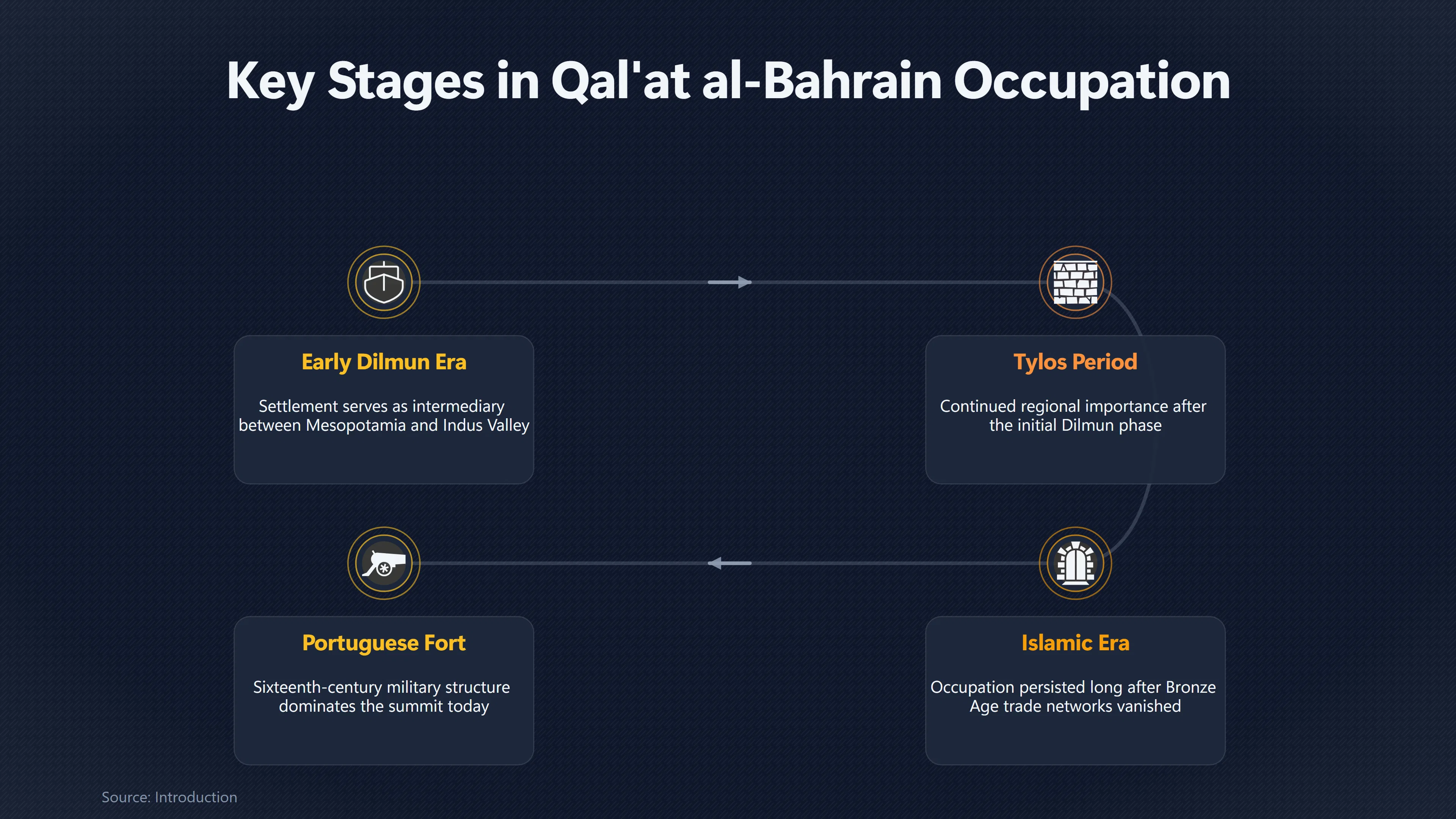
- Early Dilmun occupation reflects Bahrain’s importance as an intermediary between Mesopotamia and the Indus Valley.
- Later phases reveal changing political control and urban planning.
- Tylos-period remains show continued regional importance after Dilmun.
- Islamic-period structures demonstrate that occupation continued long after Bronze Age trade networks disappeared.
- The Portuguese fort illustrates the site’s strategic military value during the sixteenth century.
Instead of replacing one civilisation with another in a clean historical break, the tell records gradual adaptation. Some streets shifted only slightly. Certain defensive positions remained attractive for centuries. Commercial activity repeatedly returned because the location itself—close to the harbour and maritime trade routes—continued to matter.[UNESCO World Heritage Centre]whc.unesco.orgWorld Heritage Centre Qal’at al-Bahrain – Ancient Harbour and Capital of DilmunUNESCO World Heritage CentreQal’at al-Bahrain – Ancient Harbour and Capital of Dilmun - UNESCO World Heritage CentreJuly 15, 2005…

Why the layers matter more than the fort
Many visitors arrive expecting to see a Portuguese fortress. While the fort is visually impressive, it represents only the newest chapter in the mound’s history.
The fort survives precisely because it was constructed on top of thousands of years of earlier occupation. Beneath its foundations lie the remains of earlier cities that would never have been visible without archaeological excavation.
This layered perspective changes how the ruins are read. A stone wall is not simply old; it belongs to a particular occupation phase whose relationship with the layers above and below explains when it was built, altered or abandoned. Archaeology here depends less on isolated masterpieces than on preserving context.
That approach also explains why excavation proceeds cautiously. Removing one layer permanently destroys the physical relationship between deposits, making careful recording essential before any material is lifted. In effect, archaeologists can excavate the tell only once.
What the site museum adds to the ruins
The Qal’at al-Bahrain Site Museum was designed to complement the excavated landscape rather than compete with it.
Opened in 2008, the museum organises discoveries into five chronological galleries that correspond to successive periods represented inside the mound itself. Visitors therefore move between two versions of the same history: the excavated ruins outside and the interpreted archaeological sequence inside. Artefacts that might seem ordinary in a display case—pottery, tools, seals, jewellery and architectural fragments—gain significance because visitors have already seen the places where they were uncovered.[Culture Bahrain]culture.gov.bhCulture BahrainBahrain Authority for Culture and Antiquities - Kingdom of Bahrain | Qalat al Bahrain site and museum…
The museum’s architecture reinforces this idea. Large openings connect interior galleries with views across the archaeological site and the coastline, reminding visitors that the artefacts did not originate in isolation but formed part of a working harbour city. The building also includes educational facilities, guided interpretation and displays explaining how archaeological excavations reconstruct successive periods of occupation rather than simply collecting attractive objects.[Culture Bahrain]culture.gov.bhCulture BahrainBahrain Authority for Culture and Antiquities - Kingdom of Bahrain | Qalat al Bahrain site and museum…
A curiosity built from ordinary lives
For readers interested in unusual collections, Qal’at al-Bahrain offers a different kind of fascination from cabinets of curiosities or museums of strange artefacts.
Its appeal comes from accumulation rather than rarity.
Individual finds may appear modest, but together they reveal repeated cycles of settlement across millennia. The true exhibit is the archaeological sequence itself—a cross-section through human history in which markets, houses, temples, workshops, fortifications and ports slowly emerge from one another.
This also makes the site unusually credible compared with places surrounded by myths of hidden civilisations or mysterious lost kingdoms. Dilmun certainly acquired legendary status in ancient Mesopotamian literature, but the interpretation presented at Qal’at al-Bahrain is firmly grounded in excavated evidence. The site’s significance rests not on speculation but on an exceptionally complete stratigraphic record that documents changing societies over approximately four and a half millennia.[UNESCO World Heritage Centre]whc.unesco.orgWorld Heritage Centre Qal’at al-Bahrain – Ancient Harbour and Capital of DilmunUNESCO World Heritage CentreQal’at al-Bahrain – Ancient Harbour and Capital of Dilmun - UNESCO World Heritage CentreJuly 15, 2005…
Why it stands out in Bahrain’s landscape of curiosities
Within Bahrain’s wider heritage, Qal’at al-Bahrain complements rather than duplicates sites such as the Dilmun burial mounds or the Bahrain National Museum.
The burial fields reveal how ancient communities commemorated their dead. Qal’at al-Bahrain reveals how those same communities—and many that followed them—lived, traded, rebuilt and adapted over thousands of years.
For visitors interested in unusual historical places, the mound demonstrates that archaeology is not only about uncovering ancient objects. Sometimes the most remarkable artefact is the landscape itself, with every metre of soil preserving another chapter beneath the last.
Amazon book picks
Further Reading
Books and field guides related to How One Bahrain Mound Holds Thousands of Years. Use these as the next step if you want deeper reading beyond the article.
Looking for Dilmun
The quest for the real Dilmun, the lost civilisation of Arabia, began when the author Geoffrey Bibby revisited Bahrain in order to explor...
Bahrain Through The Ages - the Archaeology
Introduction, Shoreline changes in Bahrain since the beginning of human Occupation, Variation in holocene land use patterns on the Bahrai...
The Archaeology of the Arabian Gulf, C. 5000-323 BC
The archaeological remains in the Gulf area are astounding, and still relatively unexplored. Michael Rice has produced the first up-to-da...
The Archaeology of Ancient Arabia: Adaptation and Social Form...
The most authoritative and up-to-date archaeology textbook, revised and updated, and now in full color.
eBay marketplace picks
Marketplace Samples
Live-tested eBay searches with available results related to this page.
Selected fromancient ruins model oneBay.co.uk.
Endnotes
1.
Source: whc.unesco.org
Title: World Heritage Centre Qal’at al-Bahrain – Ancient Harbour and Capital of Dilmun
Link:https://whc.unesco.org/en/list/1192/
Source snippet
UNESCO World Heritage CentreQal’at al-Bahrain – Ancient Harbour and Capital of Dilmun - UNESCO World Heritage CentreJuly 15, 2005...
Published: July 15, 2005
3.
Source: whc.unesco.org
Link:https://whc.unesco.org/fr/list/1192/
Source snippet
unesco.orgQal’at al-Bahreïn – ancien port et capitale de Dilmun - UNESCO World Heritage CentreJuly 15, 2005 — QAL’AT AL-BAHREÏN – ANCIEN...
Published: July 15, 2005
5.
Source: unesco.org
Title: Qal’at Al-Bahrain
Link:https://www.unesco.org/archives/multimedia/document-696
Source snippet
Photo: © 2005 Editions Gelbart QAL'AT AL-BAHRAIN - ANCIENT HARBOUR AND CAPITAL OF DILMUN * * * Language: English Qal'at al-Bahrain is a t...
6.
Source: whc.unesco.org
Link:https://whc.unesco.org/es/list/1192
Source snippet
del Patrimonio Mundial -QAL’AT AL BAHREIN, ANTIGUO PUERTO Y CAPITAL DE DILMUN QAL’AT AL-BAHRAIN – ANCIENT HARBOUR AND CAPITAL OF DILMUN Q...
7.
Source: culture.gov.bh
Link:https://culture.gov.bh/en/visitingbahrain/CulturalTourism/Destinations/QalatalBahrainsiteandmuseum/
Source snippet
Culture BahrainBahrain Authority for Culture and Antiquities - Kingdom of Bahrain | Qalat al Bahrain site and museum...
8.
Source: culture.gov.bh
Title: Bahrain Authority for Culture and Antiquities
Link:https://culture.gov.bh/en/mediacenter/news_center/2025/July2025/Name%2C22823%2Cen.html
Source snippet
Kingdom of Bahrain | July 2025July 7, 2025 — 07 July 2025 On the Sidelines of the 47th Session of the World Heritage Committee, Special S...
Published: July 7, 2025
9.
Source: culture.gov.bh
Title: Bahrain Authority for Culture and Antiquities
Link:https://culture.gov.bh/en/mediacenter/news_center/2022/May2022/Name%2C20728%2Cen.html
Source snippet
Kingdom of Bahrain | May 2022May 23, 2022 — 23 May 2022 Bahrain Culture Authority Released the Second Edition of “Qal’at al Bahrain: Anci...
Published: May 23, 2022
10.
Source: culture.gov.bh
Title: Bahrain Authority for Culture and Antiquities
Link:https://www.culture.gov.bh/en/mediacenter/news_center/2015/February2015/Name%2C12004%2Cen.html
Source snippet
Kingdom of Bahrain | February 2015February 17, 2015 — 17 February 2015 Qal’at Al Bahrain Fort Site Museum 7th Anniversary Celebrations Im...
Published: February 17, 2015
11.
Source: culture.gov.bh
Title: Bahrain Authority for Culture and Antiquities
Link:https://www.culture.gov.bh/en/visitingbahrain/CulturalTourism/Destinations/Name%2C9969%2Cen.php
Source snippet
Kingdom of Bahrain | DestinationsQALAT AL BAHRAIN SITE AND MUSEUM Category Museums, Top Must-do's, Archeology & Heritage Area Karbabad Re...
12.
Source: culture.gov.bh
Title: Bahrain Authority for Culture and Antiquities
Link:https://www.culture.gov.bh/en/authority/cultural_sites/BahrainNationalMuseum/HallofDilmun/
Source snippet
Kingdom of Bahrain | Hall of Dilmun* # Hall of Dilmun HALL OF DILMUN The strategic location of the archipelago of Bahrain – the heart of...
Additional References
13.
Source: youtube.com
Title: Qal’at al-Bahrain “Bahrain Fort”
Link:https://www.youtube.com/watch?v=8_0iPiq7XAI
Source snippet
Exploring Bahrain Fort: A Journey Through History and Culture...
14.
Source: youtube.com
Title: Pearl on the Arabian Gulf, Bahrain | Treasures of the World
Link:https://www.youtube.com/watch?v=qIxc8_AVJv8
Source snippet
Qal'at al-Bahrain "Bahrain Fort" - UNESCO World Heritage Site...
15.
Source: youtube.com
Title: Qal’at al-Bahrain: Capital of Ancient Dilmun
Link:https://www.youtube.com/watch?v=pjMNm1HIrg8
Source snippet
Pearl on the Arabian Gulf, Bahrain | Treasures of the World...
16.
Source: youtube.com
Title: Exploring Bahrain Fort: A Journey Through History and Culture!
Link:https://www.youtube.com/watch?v=Piw18h7AKaw
Source snippet
Bahrain Fort (Qal'at al-Bahrain)...
17.
Source: youtube.com
Title: Bahrain Fort (Qal’at al-Bahrain)
Link:https://www.youtube.com/watch?v=jifzEaoJHtc