What Strange Collections Reveal About Laos
Laos is not a country with a large tradition of “weird museums” in the Western sense of dedicated collections of monsters, magic, or medical curiosities. Instead, its most unusual heritage attractions are often landscapes, community collections, archaeological mysteries, and museums that preserve difficult histories.
Page outline Jump by section
Introduction
For visitors interested in strange history, Laos offers something different from a conventional oddities museum: objects whose meaning is still debated, places shaped by ancient beliefs and modern trauma, and collections where folklore, archaeology, religion, and memory overlap. The country’s unusual collections are less about spectacle and more about unanswered questions: who built the giant stone jars, how should societies remember the legacy of war, and how can fragile cultural traditions survive in a changing world?[UNESCO World Heritage Centre]whc.unesco.orgWorld Heritage Centre Megalithic Jar Sites in Xiengkhuang – Plain of JarsUNESCO World Heritage CentreMegalithic Jar Sites in Xiengkhuang – Plain of Jars - UNESCO World Heritage CentreJuly 6, 2019…
The Plain of Jars: Laos’s greatest archaeological mystery
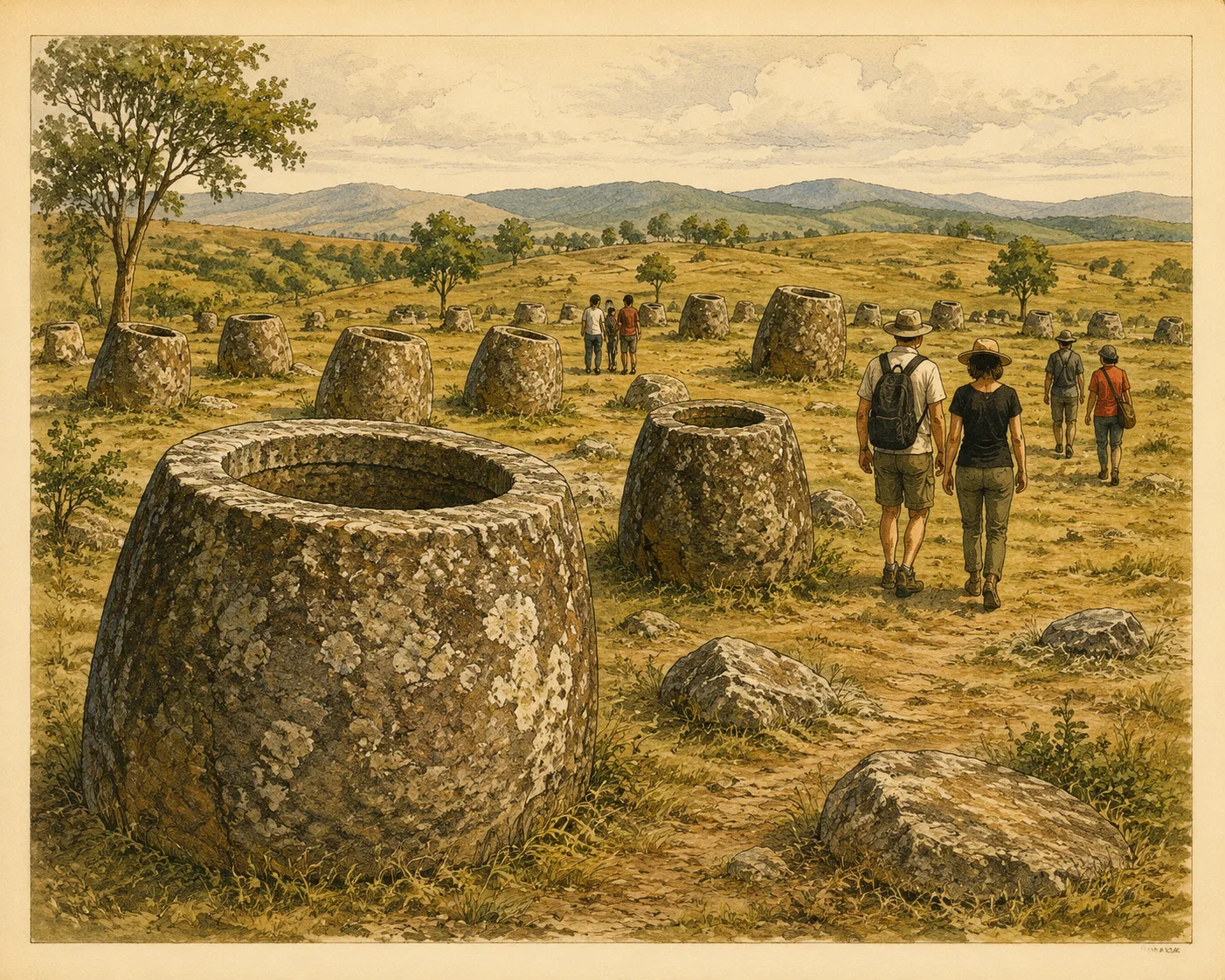
The most famous unusual collection in Laos is not inside a building. It is the Plain of Jars, a vast archaeological landscape in Xieng Khouang Province where thousands of enormous stone vessels sit scattered across hills and valleys. The site was added to the UNESCO World Heritage List in 2019 because it preserves evidence of an ancient megalithic culture and its funerary practices.[UNESCO World Heritage Centre]whc.unesco.orgWorld Heritage Centre UNESCO World Heritage CentreUNESCO World Heritage CentreUNESCO World Heritage Centre - Decision - 43 COM 8B.19…
The jars are striking because they appear almost impossible to explain at first glance. Some are several metres tall, carved from stone, and positioned in groups across the landscape. Archaeologists associate them with mortuary practices from the Iron Age, with current research linking the sites to burial traditions and associated features such as grave markers, quarries, and funerary objects. The exact beliefs and social organisation of the people who created them remain only partly understood.[UNESCO World Heritage Centre]whc.unesco.orgWorld Heritage Centre Megalithic Jar Sites in Xiengkhuang – Plain of JarsUNESCO World Heritage CentreMegalithic Jar Sites in Xiengkhuang – Plain of Jars - UNESCO World Heritage CentreJuly 6, 2019…
What visitors actually see
Visitors do not encounter a conventional museum display of labelled artefacts behind glass. Instead, the “collection” is the landscape itself: stone jars, ancient quarry evidence, burial features, and the surrounding environment. The unusual experience comes from seeing a prehistoric site where the main objects remain close to their original locations rather than being removed into a gallery.[UNESCO World Heritage Centre]whc.unesco.orgWorld Heritage Centre Megalithic Jar Sites in Xiengkhuang – Plain of JarsUNESCO World Heritage CentreMegalithic Jar Sites in Xiengkhuang – Plain of Jars - UNESCO World Heritage CentreJuly 6, 2019…
The mystery has also attracted legends. Local stories have sometimes connected the jars with giants, ancient feasts, or mythical rulers, but these explanations belong to folklore rather than established archaeology. Researchers generally interpret the jars as part of complex funerary traditions, while acknowledging that many details of their makers’ lives remain unknown.[Visit Laos - Untouched Nature]visitlaos.orgVisit LaosUntouched NaturePlain of Jars | Visit Laos – Untouched NatureJune 1, 2019…
The Plain of Jars also has a darker layer. The landscape was heavily affected by bombing during the Indochina War era, leaving bomb craters and unexploded ordnance (UXO) among ancient archaeological remains. This combination of prehistoric mystery and modern conflict makes it one of Southeast Asia’s most unusual heritage environments.[tourismlaos.org]tourismlaos.orgPlain of JarsDecember 4, 2019…
War memory collections: museums of danger, survival and recovery
Another distinctive part of Laos’s curiosity landscape comes from collections dealing with unexploded ordnance. These are not “oddities” in the entertainment sense, but they are unusual museums because they document a continuing physical legacy of twentieth-century warfare.
The COPE Visitor Centre in Vientiane and the UXO Lao Visitor Center in Luang Prabang explain how unexploded bombs and other remnants of conflict have affected daily life in Laos. Their collections include educational displays about UXO clearance, disability, rehabilitation, and the human consequences of war.[COPE Laos]copelaos.orgCOPE Laos Visit Us – COPE LaosCOPE Laos Visit Us – COPE Laos
Why these collections matter
Many military museums focus on battles, weapons, or famous commanders. Laos’s UXO collections focus instead on what happens after a war officially ends. They present bombs not as historical trophies but as hazards that can remain embedded in communities for decades.[uxolao.gov.la]uxolao.gov.laUX O Lao Visitor CenterUXO Lao Visitor Center - Lao National Unexploded Ordnance Programme (UXO LAO)…
This makes them unusual within the wider world of museums. They are part memorial, part public education centre, and part social campaign. The strange objects on display are often ordinary-looking pieces of metal whose significance comes from their hidden history: a bomb casing, a fragment of ammunition, or equipment connected with clearance work.[uxolao.gov.la]uxolao.gov.laUX O Lao Visitor CenterUXO Lao Visitor Center - Lao National Unexploded Ordnance Programme (UXO LAO)…
Living collections: textiles, ritual objects and everyday curiosities
Not all of Laos’s unusual collections are ancient or tragic. The country also has museums that preserve living traditions, where the “curiosity” lies in the diversity of objects and the stories attached to them.
The Traditional Arts and Ethnology Centre (TAEC) in Luang Prabang is one of the best examples. Rather than presenting Laos as a single cultural tradition, it explores the many ethnic communities of the country through clothing, textiles, jewellery, household objects, tools, and ritual items. Its collection includes hundreds of objects representing dozens of ethnic groups.[taeclaos.org]taeclaos.orgOur Collection – Traditional Arts and Ethnology CentreOur Collection – Traditional Arts and Ethnology Centre

Objects with cultural meaning
A textile, musical instrument, or ceremonial object in such a collection is not simply an old object. It may represent identity, belief, social status, marriage customs, or relationships between generations. TAEC’s approach connects museum objects with living communities, using exhibitions, research, and craft programmes rather than treating traditions as frozen relics of the past.[taeclaos.org]taeclaos.orgCurrent Exhibitions – Traditional Arts and Ethnology CentreCurrent Exhibitions – Traditional Arts and Ethnology Centre
This makes these collections relevant to the broader idea of cabinets of curiosity. Their unusual quality comes not from rarity alone, but from revealing hidden worlds behind everyday materials: a piece of clothing can become evidence of migration, belief, craftsmanship, and social memory.
Are there museums of ghosts, monsters or occult objects in Laos?
Compared with some countries in Asia and Europe, Laos has few well-documented public collections devoted specifically to ghosts, witchcraft, cryptids, UFOs, or supernatural objects. Stories of spirits, sacred places, and local beliefs are important parts of Lao culture, but they are usually encountered through temples, village traditions, oral histories, and religious practices rather than through specialist “mystery museums”.
The country’s unusual heritage is therefore better understood through archaeological mysteries, sacred objects, war memory, and community collections. The closest equivalent to a curiosity cabinet is often a place where ordinary categories break down: an ancient stone landscape that looks almost impossible, a museum about invisible dangers left by past wars, or a collection where everyday objects preserve complex spiritual and cultural histories.
Why Laos belongs in the world of strange collections
Laos’s most fascinating collections do not rely on sensational claims. Their appeal comes from genuine uncertainty and human experience. The Plain of Jars remains compelling because archaeology has answered some questions while leaving others open. UXO museums are powerful because they preserve evidence of a conflict whose consequences continue. Ethnographic collections matter because they protect knowledge that could otherwise disappear.[unesco.org]whc.unesco.orgWorld Heritage Centre Megalithic Jar Sites in Xiengkhuang – Plain of JarsUNESCO World Heritage CentreMegalithic Jar Sites in Xiengkhuang – Plain of Jars - UNESCO World Heritage CentreJuly 6, 2019…
For travellers interested in unusual museums and forgotten histories, Laos offers a different model of curiosity culture: not a room of bizarre objects gathered for entertainment, but a country where landscapes, artefacts, and memories themselves become collections.
Amazon book picks
Further Reading
Books and field guides related to What Strange Collections Reveal About Laos. Use these as the next step if you want deeper reading beyond the article.
The Rough Guide to Laos
Laos welcomed approximately 4.3 million tourists in 2015 (Source: Representasianews.com), According to the World Waterfall Database, Khon...

A History of Laos
First published 1986. Subjects: History, Gesellschaft, Politieke ontwikkeling, Conditions sociales, Wirtschaft.
The Art of Southeast Asia
With a wealth of information about the history, traditions, and religious beliefs of Southeast Asia, Philip Rawson throughly and authorit...
eBay marketplace picks
Marketplace Samples
Live-tested eBay searches with available results related to this page.
Selected fromSoutheast Asian decor oneBay.co.uk.

Endnotes
1.
Source: whc.unesco.org
Title: World Heritage Centre Megalithic Jar Sites in Xiengkhuang – Plain of Jars
Link:https://whc.unesco.org/en/list/1587
Source snippet
UNESCO World Heritage CentreMegalithic Jar Sites in Xiengkhuang – Plain of Jars - UNESCO World Heritage CentreJuly 6, 2019...
Published: July 6, 2019
2.
Source: taeclaos.org
Title: Our Collection – Traditional Arts and Ethnology Centre
Link:https://www.taeclaos.org/our-collection/
3.
Source: taeclaos.org
Title: About – Traditional Arts and Ethnology Centre
Link:https://www.taeclaos.org/about/
4.
Source: whc.unesco.org
Title: World Heritage Centre UNESCO World Heritage Centre
Link:https://whc.unesco.org/en/decisions/7378/
Source snippet
UNESCO World Heritage CentreUNESCO World Heritage Centre - Decision - 43 COM 8B.19...
5.
Source: plain-of-jars.org
Link:https://plain-of-jars.org/
6.
Source: visitlaos.org
Title: Visit Laos
Link:https://www.visitlaos.org/explore-laos/plain-of-jars/
Source snippet
Untouched NaturePlain of Jars | Visit Laos – Untouched NatureJune 1, 2019...
Published: June 1, 2019
7.
Source: tourismlaos.org
Title: Plain of Jars
Link:https://www.tourismlaos.org/welcome/ancient-mysteries/plain-of-jars/
Source snippet
December 4, 2019...
Published: December 4, 2019
8.
Source: uxolao.gov.la
Title: UX O Lao Visitor Center
Link:https://uxolao.gov.la/the-uxo-problem/uxo-lao-visitor-center/
Source snippet
UXO Lao Visitor Center - Lao National Unexploded Ordnance Programme (UXO LAO)...
9.
Source: taeclaos.org
Title: Traditional Arts and Ethnology Centre – Preserving Cultural Diversity in Laos
Link:https://www.taeclaos.org/
10.
Source: taeclaos.org
Title: Current Exhibitions – Traditional Arts and Ethnology Centre
Link:https://www.taeclaos.org/current-exhibitions/
11.
Source: kpl.gov.la
Title: Lao Art Museum Opens as Beacon of Heritage, Creativity, and Sustainability
Link:https://kpl.gov.la/En/detail.aspx?id=92570
12.
Source: kpl.gov.la
Title: Lao Art Museum Opens, Showcasing Nation’s Cultural Heritage
Link:https://kpl.gov.la/EN/detail.aspx?id=88469
13.
Source: tourismlaos.org
Title: lao national museum
Link:https://www.tourismlaos.org/lao-national-museum/
14.
Source: kpl.gov.la
Title: UX O Visitor Centre Inaugurated in Luang Prabang
Link:https://kpl.gov.la/EN/detail.aspx?id=85371
15.
Source: kpl.gov.la
Title: Xieng Khouang Province
Link:https://kpl.gov.la/En/detail.aspx?id=78185
16.
Source: tourismlaos.org
Title: Xieng Khouang Province
Link:https://www.tourismlaos.org/northern-provinces/xiangkhouang-province/
17.
Source: tourismlaos.org
Title: Vientiane Capital
Link:https://www.tourismlaos.org/central-provinces/vientiane-capital/
18.
Source: kpl.gov.la
Title: Laos Announces Third UNESCO World Heritage Site
Link:https://kpl.gov.la/En/detail.aspx?id=47223
19.
Source: plain-of-jars.org
Link:https://plain-of-jars.org/about/
20.
Source: plain-of-jars.org
Link:https://plain-of-jars.org/about/acknowledgements/
21.
Source: plain-of-jars.org
Link:https://www.plain-of-jars.org/site-2/
22.
Source: taeclaos.org
Link:https://www.taeclaos.org/visitors-information/
23.
Source: taeclaos.org
Link:https://www.taeclaos.org/our-stores/
24.
Source: taeclaos.org
Link:https://www.taeclaos.org/advocacy-livelihoods/
25.
Source: copelaos.org
Title: COPE Laos Visit Us – COPE Laos
Link:https://copelaos.org/visit-us/
26.
Source: fao.org
Title: Traditional Arts and Ethnology Centre
Link:https://www.fao.org/mountain-partnership/members/detail/traditional-arts-and-ethnology-centre-/en
27.
Source: world-archaeology.com
Title: Plain of Jars
Link:https://www.world-archaeology.com/features/plain-of-jars/
28.
Source: copelaos.org
Title: Who We Are – COPE Laos
Link:https://copelaos.org/who-we-are/
29.
Source: museu.ms
Link:https://museu.ms/museum/details/17879/traditional-arts-and-ethnology-centre
30.
Source: exofoundation.org
Title: cope laos
Link:https://exofoundation.org/project/cope-laos/
31.
Source: copelaos.org
Link:https://copelaos.org/
Additional References
32.
Source: youtube.com
Title: The Mystery of the Giant Stone Jars
Link:https://www.youtube.com/watch?v=2uZJ_ggDUPE
Source snippet
Exploring the Plain of Jars in Laos This video provides a close-up look at Laos's most famous archaeological mystery, which directly rela...
33.
Source: youtube.com
Title: COPE Visitor Centre in Vientiane Prefecture, Laos
Link:https://www.youtube.com/watch?v=OeXSFygWmIo
Source snippet
An Introduction to the Traditional Arts and Ethnology Centre in Luang Prabang, Lao PDR...
34.
Source: youtube.com
Title: The Massive Stone Jars Left by Ancient Giants: Lao’s Plain of Jars
Link:https://www.youtube.com/watch?v=zw8thIA-wVQ
Source snippet
COPE Visitor Centre in Vientiane Prefecture, Laos...
35.
Source: youtube.com
Title: Plain of Jars, Laos | 2,500-Year-Old Stone Mystery
Link:https://www.youtube.com/watch?v=aNOLgM6UD6o
Source snippet
The Massive Stone Jars Left by Ancient Giants: Lao's Plain of Jars...
36.
Source: youtube.com
Link:https://www.youtube.com/watch?v=mPv_0Ostros
Source snippet
The Mystery of the Giant Stone Jars...
37.
Source: researchgate.net
Link:https://www.researchgate.net/publication/230281489_From_revolutionary_heroism_to_cultural_heritage_Museums_memory_and_representation_in_Laos
38.
Source: tourismluangprabang.org
Link:https://tourismluangprabang.org/recommended-trips/5-things/5-reasons-to-visit-the-uxo-centre/
39.
Source: roughguides.com
Link:https://www.roughguides.com/laos/vientiane-northwest/buddha-park/
40.
Source: asiainch.org
Link:https://www.asiainch.org/craft/buddhist-art-and-sculpture/