Within Strange Ecuador
What Can the Guano Mummy Still Reveal?
The Guano mummy turns one rare preserved body into evidence about burial, disease and life after the Spanish conquest.
On this page
- Discovery inside the ruined church at Guano
- How natural preservation protected the body
- Forensic clues about health, burial and identity
Page outline Jump by section
Introduction
The Guano Mummy is Ecuador’s best-known naturally preserved human body and the centrepiece of the Municipal Museum in the town of Guano, near Riobamba. Unlike the deliberately embalmed mummies of ancient Egypt, this body appears to have been preserved by environmental conditions rather than artificial treatment. Its discovery beneath the ruined Church of La Asunción after the devastating 1949 Ambato earthquake transformed an unexpected archaeological find into one of Ecuador’s most remarkable pieces of physical evidence for life in the early colonial period. Scientific investigation has gradually shifted attention away from sensational stories and towards what the body can genuinely reveal about burial customs, disease, health and the daily realities of sixteenth-century Ecuador.[gob.ec]patrimoniocultural.gob.ecOpen source on gob.ec.
Discovery Inside the Ruined Church at Guano
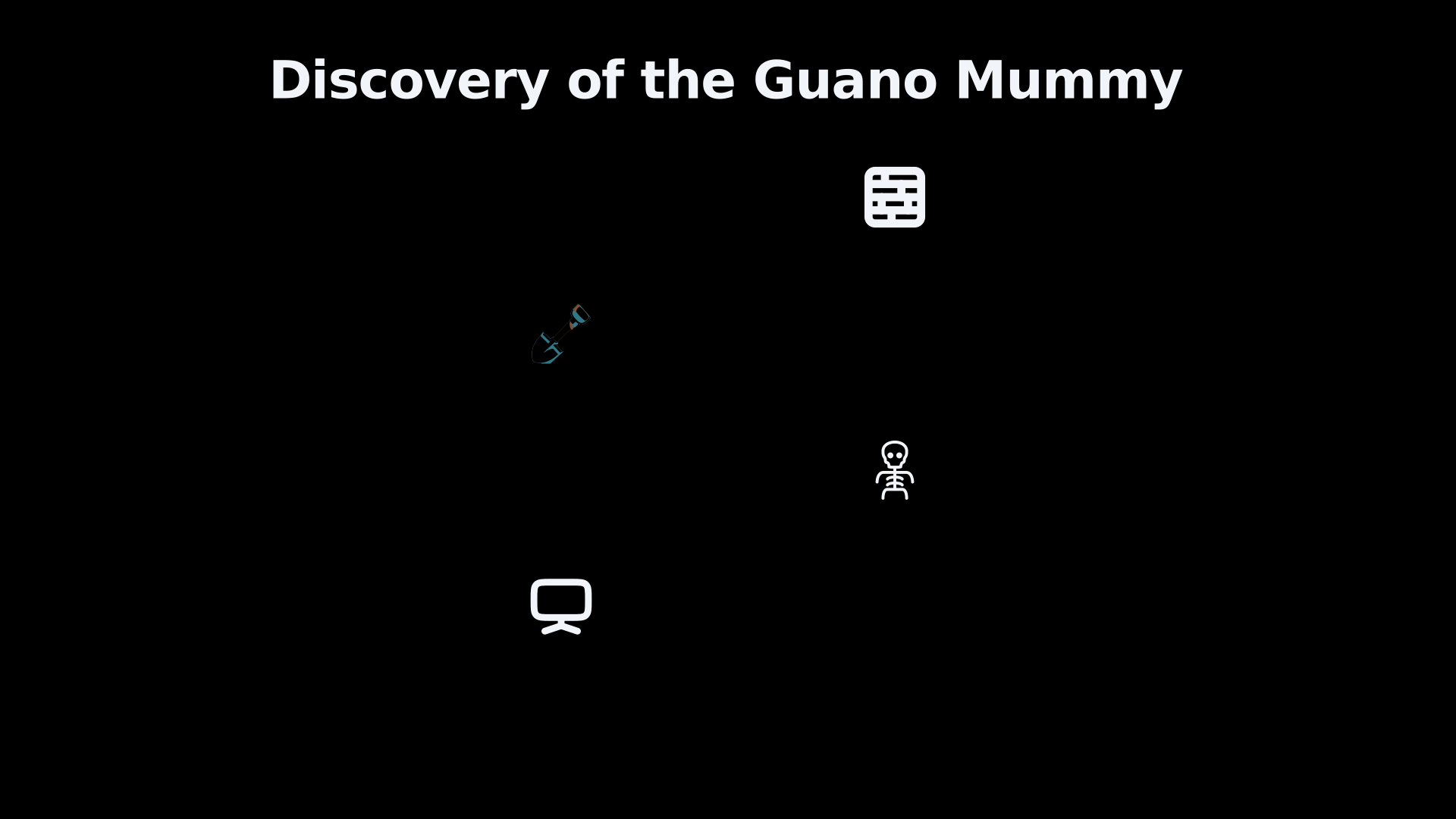
On 5 August 1949, a powerful earthquake devastated much of central Ecuador, destroying the Franciscan Church and Convent of La Asunción in Guano. As workers cleared the rubble, they uncovered a burial chamber built into the church walls. Inside lay an exceptionally well-preserved human body whose skin, hair and clothing had survived in remarkable condition despite being more than four centuries old.[gob.ec]patrimoniocultural.gob.ecOpen source on gob.ec.
The body was eventually transferred to the Municipal Museum of Guano, located close to the ruined church. Rather than displaying numerous archaeological finds, the museum is largely organised around this single extraordinary individual, making it an unusual destination within Ecuador’s museum landscape. Visitors encounter the mummy alongside interpretation explaining its discovery, the history of the Franciscan complex and subsequent scientific investigations.[huecasdelecuador.com]huecasdelecuador.comGuano: la única momia del Ecuador te esperaHuecas del Ecuador…
Early local tradition identified the body as a Franciscan friar. Modern research carried out with Ecuador’s National Institute of Cultural Heritage (INPC) has strengthened this interpretation, identifying the individual as Fray Lázaro de Santofimia (also referred to in some sources as Fray Lázaro de la Cruz de Santofimia), a Spanish Franciscan associated with the convent during the sixteenth century. Although some historical details remain debated, researchers broadly agree that the body belongs to an early colonial religious figure rather than an anonymous burial.[patrimoniocultural.gob.ec]patrimoniocultural.gob.ecOpen source on gob.ec.
How Natural Preservation Protected the Body
The Guano Mummy is significant precisely because there is no evidence that the body underwent intentional embalming. Instead, researchers attribute its preservation to natural mummification.
Several environmental factors probably combined to halt normal decomposition:
- Burial within the thick masonry of the church created a relatively sealed environment.
- Low humidity and good air circulation encouraged dehydration before bacteria could destroy soft tissue.
- Stable temperatures inside the structure slowed biological decay.
- The body gradually dried rather than decomposing, allowing skin, hair and other tissues to survive.[patrimoniocultural.gob.ec]patrimoniocultural.gob.ecOpen source on gob.ec.
This makes the Guano Mummy fundamentally different from deliberately prepared mummies elsewhere in the world. It also provides scientists with an unusually intact snapshot of an individual who lived during Ecuador’s earliest decades under Spanish rule.
An intriguing detail often mentioned in museum displays and scientific reports is the discovery of a naturally preserved rodent close to the body. Although sometimes presented as a curiosity, researchers regard it as supporting evidence that the burial environment itself possessed exceptional preservative conditions rather than the body having received special treatment.[noticias.usfq.edu.ec]noticias.usfq.edu.ecNoticias USFQ…
What Forensic Science Has Revealed
For many decades the mummy attracted public fascination more than scientific study. That changed when Ecuador’s National Institute of Cultural Heritage organised an interdisciplinary investigation involving French forensic specialist Philippe Charlier, the University of San Francisco de Quito and other research institutions. Modern medical imaging allowed researchers to examine the body without damaging it.[gob.ec]patrimoniocultural.gob.ecOpen source on gob.ec.
Computed tomography (CT) scans, microscopic examination of skin and hair, and planned toxicological and genetic sampling enabled researchers to investigate questions that could never have been answered through visual inspection alone. These techniques help distinguish ancient injuries from later damage, estimate age at death and identify pathological changes inside the skeleton.[patrimoniocultural.gob.ec]patrimoniocultural.gob.ecOpen source on gob.ec.
The scientific programme also reflects changing attitudes towards human remains. Rather than treating the mummy simply as a curiosity for display, investigators have approached it as an important archaeological individual whose preservation deserves careful conservation while still allowing new evidence to be recovered through non-destructive methods.[patrimoniocultural.gob.ec]patrimoniocultural.gob.ecOpen source on gob.ec.

Forensic Clues About Health, Burial and Identity
Although research continues, several findings have become central to understanding the Guano Mummy.
The preserved tissues and skeleton provide evidence for reconstructing:
- Approximate age at death, estimated at roughly 55 to 60 years.
- Sex and occupation, consistent with an adult male Franciscan friar.
- Burial practices within an early colonial church, where prominent religious figures could be interred inside the building itself.
- Health and disease, including pathological conditions visible in bone and soft tissue that may reflect illnesses experienced during the colonial era.[gob.ec]patrimoniocultural.gob.ecOpen source on gob.ec.
Researchers have been particularly interested in distinguishing diseases already present in the Andes from illnesses introduced after European contact. The INPC has described the mummy as an important reference for studying both long-standing local diseases and pathologies associated with the colonial period, making it valuable not only to archaeology but also to historical medicine.[patrimoniocultural.gob.ec]patrimoniocultural.gob.ecJanuary 9, 2025…
Because the body retains soft tissue, it offers considerably richer evidence than an ordinary skeleton. Hair, skin and internal structures can preserve traces of nutrition, health and environmental exposure that would otherwise have disappeared.

Why the Guano Mummy Matters
Many countries possess collections of mummies, but Ecuador has relatively few naturally preserved human remains. That makes the Guano Mummy especially significant within the country’s heritage.
Its importance lies in several overlapping roles:
- It is Ecuador’s most famous example of natural mummification.
- It provides direct physical evidence for burial customs during the first century of Spanish colonial settlement.
- It demonstrates how modern forensic science can answer historical questions without destroying fragile remains.
- It anchors a small municipal museum whose identity revolves around one exceptional archaeological discovery rather than a large collection.[patrimoniocultural.gob.ec]patrimoniocultural.gob.ecOpen source on gob.ec.
Within Ecuador’s broader landscape of unusual collections, the Guano Mummy stands apart because its appeal is not based on legend or the supernatural. Visitors may arrive expecting an eerie attraction, but the lasting fascination comes from the way a naturally preserved body has become a source of evidence about real people, real diseases and the practical circumstances of life and death more than 450 years ago. Recent interdisciplinary studies continue to replace speculation with measurable forensic data, ensuring that the mummy remains both a cultural landmark and an active subject of scientific inquiry.[gob.ec]patrimoniocultural.gob.ecJanuary 9, 2025…
Amazon book picks
Further Reading
Books and field guides related to What Can the Guano Mummy Still Reveal?. Use these as the next step if you want deeper reading beyond the article.
The Archaeology of Death and Burial
The archaeology of death and burial is central to our attempts to understand vanished societies. Through the remains of funerary rituals...
The Scientific Study of Mummies
First published 2003. Subjects: Mummies, Paleopathology.
Mummy: The Inside Story
First published 2004. Subjects: Mummies, Radiography, Data processing, Egypt, history.
eBay marketplace picks
Marketplace Samples
Live-tested eBay searches with available results related to this page.
Selected fromMakes Ecuador's Strangest Collections patch oneBay.co.uk.
Endnotes
1.
Source: patrimoniocultural.gob.ec
Link:https://www.patrimoniocultural.gob.ec/philippe-charlier-forense-con-reconocimiento-mundial-analizara-la-momia-de-guano/
2.
Source: noticias.usfq.edu.ec
Link:https://noticias.usfq.edu.ec/2019/01/la-momia-de-guano-es-parte-de-las.html
Source snippet
Noticias USFQ...
3.
Source: huecasdelecuador.com
Title: Guano: la única momia del Ecuador te espera
Link:https://www.huecasdelecuador.com/ec/guano/historia-museos/guano-la-unica-momia-del-ecuador-te-espera/
Source snippet
Huecas del Ecuador...
4.
Source: noticias.usfq.edu.ec
Title: El misterio de la Momia de Guano sorprende al mundo
Link:https://noticias.usfq.edu.ec/2019/02/el-misterio-de-la-momia-de-guano.html
Source snippet
Noticias USFQ...
5.
Source: patrimoniocultural.gob.ec
Link:https://www.patrimoniocultural.gob.ec/la-momia-de-guano-investigacion-cientifica-del-inpc-sera-presentada-en-teleamazonas/
Source snippet
January 9, 2025...
Published: January 9, 2025
6.
Source: repositorio.usfq.edu.ec
Link:https://repositorio.usfq.edu.ec/handle/23000/13064?mode=full
Source snippet
Digital USFQ: Resurrección de la piel: análisis comparativo del estado de preservación de restos momificados naturales e intencionales a...
7.
Source: eltelegrafo.com.ec
Link:https://www.eltelegrafo.com.ec/noticias/cultura/10/forense-analisis-momia-guano
Source snippet
El TelégrafoEl Telégrafo - Un forense francés analizará la momia de Guano...
8.
Source: eltelegrafo.com.ec
Title: El Telégrafo
Link:https://www.eltelegrafo.com.ec/noticias/sociedad/6/francia-y-ecuador-se-unen-para-analizar-a-la-momia-de-guano
Additional References
9.
Source: periodismoecuador.info
Title: el hallazgo de la momia de guano revive con imagenes ineditas en color de 1949
Link:https://periodismoecuador.info/el-hallazgo-de-la-momia-de-guano-revive-con-imagenes-ineditas-en-color-de-1949/
Source snippet
El hallazgo de la Momia de Guano revive con imágenes inéditas en color de 1949 - Periodismo EcuadorOctober 4, 2025 — 16 de julio de 2026...
Published: October 4, 2025
10.
Source: ecuavisa.com
Title: ¿Quién es la momia de Guano?
Link:https://www.ecuavisa.com/ecuador/quien-es-la-momia-de-guano-el-enigma-crece-y-contradice-creencia-20220805-0054.html
Source snippet
El enigma crece y contradice creencia | EcuavisaAugust 5, 2022 — ¿QUIÉN ES LA MOMIA DE GUANO? EL ENIGMA CRECE Y CONTRADICE CREENCIA SEGÚN...
Published: August 5, 2022
11.
Source: youtube.com
Title: The Story of the Guano Mummy
Link:https://www.youtube.com/watch?v=LI0yifnnEKw
Source snippet
New revelations about the Guano Mummy - Day by Day - Teleamazonas...
12.
Source: youtube.com
Title: New revelations about the Guano Mummy
Link:https://www.youtube.com/watch?v=OewkTzNud2s
Source snippet
Ecuadorian mummy analyzed by French scientist...
13.
Source: riobamba.com.ec
Link:https://riobamba.com.ec/es-ec/chimborazo/guano/museos/momia-guano-a6lbsd632
14.
Source: eluniverso.com
Link:https://www.eluniverso.com/noticias/2018/08/13/nota/6903089/momia-guano-sometida-analisis-su-conservacion/
15.
Source: redalyc.org
Link:https://www.redalyc.org/journal/457/45768739036/html/
16.
Source: ecuavisa.com
Title: Momia de Guano, el eslabón perdido de una rara enfermedad en Europa | Ecuavisa
Link:https://www.ecuavisa.com/ecuador/momia-de-guano-el-eslabon-perdido-de-una-rara-enfermedad-en-europa-20190131-0028.html
17.
Source: youtube.com
Title: ¿Quién es la momia de Guano?
Link:https://www.youtube.com/watch?v=HvlTn2Ur_KI
Source snippet
Conociendo una de las MOMIAS mas ESPECIALES del MUNDO...
18.
Source: eltiempo.com
Title: Descubren momia que podría ayudar a identificar enfermedades
Link:https://www.eltiempo.com/vida/ciencia/descubren-momia-que-podria-ayudar-a-identificar-enfermedades-321584