Why Are Dutch Museums So Wonderfully Strange?
The Netherlands has an unusually rich culture of strange collections, but its most rewarding curiosities are rarely simple “weird museums”.
Page outline Jump by section
Introduction
Visitors should nevertheless distinguish between evidence-led institutions and attractions built mainly around atmosphere. Museum Vrolik, Rijksmuseum Boerhaave and Micropia interpret unusual material through current medical or scientific knowledge. Museum De Heksenwaag explains a historic belief system without treating witchcraft accusations as fact. By contrast, commercial torture displays may reproduce devices whose “medieval” histories are doubtful. The most interesting Dutch collections are therefore not merely macabre or eccentric: they reveal how objects gain authority, how old classifications survive and how museums now reconsider collections shaped by colonialism, racial science and unequal power.
Where Dutch curiosity culture comes from
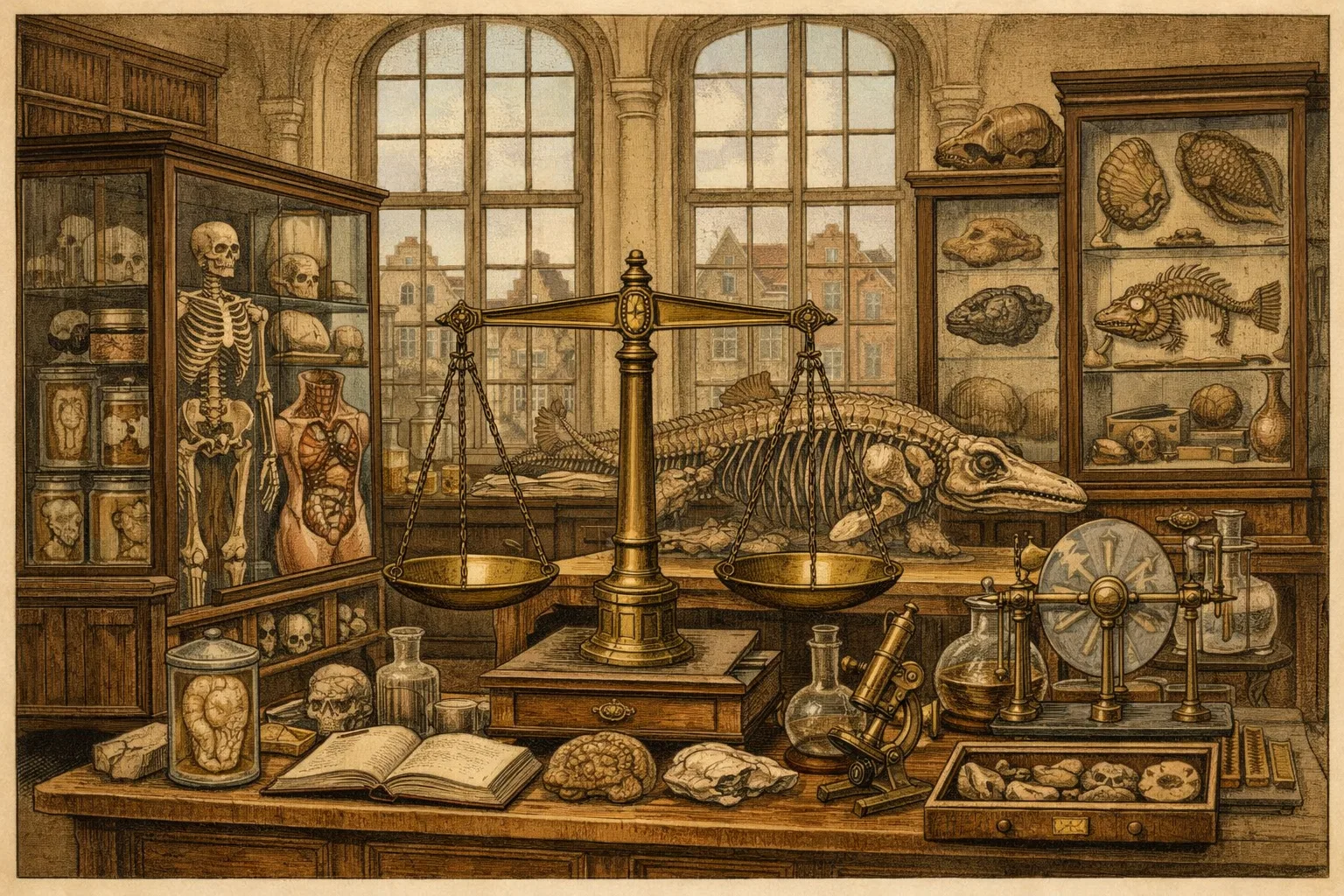
The Dutch tradition of unusual collecting grew partly from the early modern cabinet of curiosities: a room or collection in which natural specimens, antiquities, scientific instruments, artworks and objects brought from distant places were displayed together. Categories that now seem separate—art, zoology, medicine, archaeology and ethnography—were not yet divided into modern museum departments. Collecting was a way to investigate the world, demonstrate learning and display access to international networks.
Teylers Museum in Haarlem is the clearest surviving public expression of this tradition. Its Oval Room opened in 1784, and the museum still brings fossils, minerals, scientific apparatus, coins, books, drawings and prints into close proximity. Its scientific holdings include roughly 75,000 fossil remains and traces, among them specimens that played roles in debates about extinction, human antiquity and the age of the Earth. The building and densely arranged cabinets are as important as any single object: visitors encounter an older model of knowledge in which science was performed, discussed and displayed in an elegant room rather than hidden in a specialist laboratory.[Teylers Museum]teylersmuseum.nlTeylers MuseumThe building of Teylers MuseumTen large display cases hold scientific instruments once used in this museum building for exp…
This collecting culture was never politically neutral. Dutch cabinets and later museums benefited from commercial and colonial connections that determined who could travel, excavate, acquire specimens or remove culturally important material. The country’s institutions are now reassessing those histories. In 2025, for example, the Dutch government agreed to return more than 28,000 fossils from the Eugène Dubois collection to Indonesia after an official committee concluded that they had probably been obtained through coercive colonial circumstances. The collection includes material associated with the discovery of Homo erectus on Java. The decision demonstrates that even apparently scientific specimens can carry questions of ownership, local knowledge and historical injustice.[AP News]apnews.comThe Dutch Colonial Collections Committee concluded that the fossils hold spiritual and economic importance to Indonesians and were obtain…
Anatomy, bodies and the ethics of display
Museum Vrolik
Museum Vrolik, inside Amsterdam University Medical Centre, is probably the Netherlands’ most concentrated encounter with medical oddity. It developed from the private anatomical collection assembled by the Amsterdam professors Gerard Vrolik and his son Willem during the eighteenth and nineteenth centuries. Later anatomists expanded it, and the museum now holds about 25,000 anatomical preparations, instruments and models. Visitors may see preserved organs, skeletons, skulls and developmental specimens, alongside material explaining anatomy, disease and the history of medicine and biology.[Museum Vrolik]museumvrolik.nlMuseum Vrolik Visit the museumMuseum Vrolik is ideally suited for guided tours for everyone interested in learning about anatomy and/or the history of medicine and bio…
The museum is unusual not simply because some displays are visually difficult. Its deeper subject is the changing medical gaze: how doctors classified bodies, how congenital variations were studied and how specimens once treated as teaching material are now presented as human remains requiring dignity. The institution states that it aims to display the collection with care and respect, making this a university museum rather than a commercial chamber of shocks. Visitors should still expect emotionally challenging material, particularly preserved foetuses and human skeletal remains.[Museum Vrolik]museumvrolik.nlMuseum Vrolik Practical informationMuseum Vrolik Practical information
Museum Vrolik also exposes the relationship between anatomy, colonialism and discredited racial classification. Its 2026 exhibition Imagine considers a future in which racialised human remains from colonial contexts have been returned, leaving empty mounts and labels as evidence of the collecting practices themselves. The museum says that it handles restitution requests from relatives or communities of origin and has conducted provenance research into such remains. This makes it one of the most important Dutch examples of a “strange” collection becoming a site of ethical argument rather than merely preserving its old displays unchanged.[Museum Vrolik]museumvrolik.nlexhibition imagineexhibition imagine
Rijksmuseum Boerhaave
Rijksmuseum Boerhaave in Leiden offers a broader and less confronting history of Dutch science and medicine. Its collections cover five centuries of scientific activity, including microscopes, medical instruments, anatomical material and experimental apparatus. The most atmospheric feature is its reconstruction of Leiden University’s anatomical theatre, originally opened in 1594. In the historic theatre, the bodies of executed criminals were publicly dissected during winter sessions attended by students, surgeons and paying spectators.[rijksmuseumboerhaave.nl]rijksmuseumboerhaave.nlOpen source on rijksmuseumboerhaave.nl.
The theatre demonstrates how anatomy once combined education, punishment, theatre and curiosity. When dissections were not taking place, early anatomical theatres could also function as display spaces for skeletons, antiquities and natural curiosities. At Boerhaave, this history is placed within the development of scientific method rather than presented as gothic entertainment. The museum is therefore particularly useful for understanding why human remains entered European collections and why public fascination with bodies was once closely tied to claims about learning and civic improvement.[rijksmuseumboerhaave.nl]rijksmuseumboerhaave.nlanatomical theatreanatomical theatre
Micropia
Micropia in Amsterdam reverses the usual anatomy museum experience: its main subjects are alive but generally invisible. Opened in 2014 beside ARTIS zoo, it was created as a museum devoted to microorganisms. Special viewers allow visitors to observe living microbes moving, feeding and reproducing, while interactive displays examine subjects such as bodily bacteria, decomposition and microbial exchange between people.[Museum.nl]museum.nlOpen source on museum.nl.
Its strangeness comes from a change of scale. Instead of presenting rare monsters or malformed bodies, Micropia reveals that ordinary skin, food, water and household objects contain complex ecosystems. Displays have included colonies grown from everyday items and demonstrations of the microbes exchanged during a kiss. The attraction is highly designed and family-friendly, but its scientific message is serious: most microorganisms are not simply agents of disease, and human life depends on microbial communities. Its location in the Netherlands is especially appropriate because Antoni van Leeuwenhoek’s seventeenth-century microscopy in Delft helped reveal bacteria and other microscopic life to science.[The New Yorker]newyorker.comOpen source on newyorker.com.
Witchcraft without a witch museum fantasy
Museum De Heksenwaag in Oudewater occupies a former weighing house and concentrates on the persecution of people accused of witchcraft during the fifteenth, sixteenth and seventeenth centuries. Its central object is the historic weighing apparatus. According to the institution’s account, Oudewater became known for issuing honest certificates stating that a person’s weight was proportionate to their body—evidence used to challenge the idea that the accused were unnaturally light and therefore capable of flying. Visitors can still be weighed on the scales and receive a certificate, although this is a theatrical continuation of the historical story rather than a genuine test of supernatural ability.[Museum De Heksenwaag Oudewater]heksenwaag.nlMuseum De Heksenwaag Oudewater About the weigh houseMuseum De Heksenwaag Oudewater About the weigh house
The museum’s value lies in explaining an irrational system through the administrative machinery that surrounded it. Witch persecution did not depend only on folklore about broomsticks and magic. It was sustained by courts, testimony, religious fear, local disputes and supposed physical proofs. A public weigh house—normally associated with the regulation of commercial goods—could therefore become a place where official measurement was used against superstition.
Some elements of Oudewater’s story have been repeated in tourist language for centuries, including claims that its weighing process was uniquely authorised by Emperor Charles V. These claims form part of the site’s identity, but visitors should treat the museum primarily as an interpretation of persecution and civic legend, not as proof that weighing was a dependable or universally recognised legal safeguard. The most credible lesson is not that the scales “detected” witches, but that bureaucratic authority could either reinforce an accusation or provide a route of escape from it.[Museum De Heksenwaag Oudewater]heksenwaag.nlMuseum De Heksenwaag Oudewater About the weigh houseMuseum De Heksenwaag Oudewater About the weigh house
Death, punishment and controlled bodies
Amsterdam’s Museum Tot Zover is the Netherlands’ principal museum of funeral culture. Located at De Nieuwe Ooster cemetery, it collects objects associated with death, burial, cremation and remembrance. Its holdings include coffins, urns, death masks, hair pictures and miniature hearses. Rather than presenting death as a haunted-house theme, the museum examines how people give material form to grief and how funeral practices change with religion, technology, fashion and migration.[Museum.nl]museum.nlOpen source on museum.nl.
This is a useful counterpoint to medical museums. At Museum Vrolik, the body becomes an anatomical specimen; at Tot Zover, the dead person remains part of a family, ritual and community. Even apparently eccentric objects—jewellery or pictures made with human hair, elaborate hearses and unusually shaped urns—are best understood as responses to loss. The museum is public, curated and reflective rather than sensational, although its location within a working cemetery gives the visit an atmosphere unlike that of a conventional city museum.
The National Prison Museum at Veenhuizen explores another form of control over bodies: confinement. Veenhuizen began in the nineteenth century as one of the Colonies of Benevolence, where poor people, orphans and others considered socially undesirable were sent as part of an ambitious programme of labour and moral reform. It subsequently developed into a prison settlement, and penal institutions remain part of the area’s identity. The museum’s collection and exhibitions connect this local history with broader changes in punishment, detention and criminal justice.[gevangenismuseum.nl]gevangenismuseum.nlVeenhuizen Collectie en onderzoekVeenhuizen Collectie en onderzoek
The setting makes Veenhuizen more than a display of handcuffs and cells. The planned village, institutional buildings and stories of transported families reveal how benevolent language could coexist with compulsion and surveillance. It sits within the UNESCO-listed Colonies of Benevolence landscape, giving the museum a significance beyond prison tourism: it preserves evidence of an experiment in reorganising poverty through isolation, discipline and work.

Machines that perform by themselves
Museum Speelklok in Utrecht collects self-playing musical instruments, from small music boxes and clocks to barrel organs, player pianos and large mechanical orchestras. Many of the machines are demonstrated in operation, so the museum is experienced through sound and movement rather than silent cases.[Museum Speelklok]museumspeelklok.nlOpen source on museumspeelklok.nl.
These objects occupy an appealing borderland between musical instrument, robot, luxury toy and industrial machine. A mechanical orchestra can imitate a group of performers through pinned cylinders, punched cards, pipes, percussion mechanisms and carefully regulated air pressure. Automata and musical clocks also reflect a long fascination with objects that appear to act independently, centuries before electronic robotics.
The collection matters because mechanical music was not merely a novelty. It changed where and how music could be heard, bringing repeatable performances into houses, public houses, fairgrounds and streets. The machines preserve arrangements and popular tastes as well as engineering skill. Their performances can feel uncanny because sound emerges from elaborate furniture without visible musicians, but the museum’s demonstrations reveal the labour behind the illusion: design, maintenance, restoration and precisely encoded instructions.[West Dean]westdean.ac.ukmuseum speelklok the first installation in a series on automatamuseum speelklok the first installation in a series on automata

Tourist oddities and the problem of authenticity
Amsterdam contains several small commercial attractions devoted to sex, cannabis, torture or other provocative themes. Some preserve genuine material culture, but they vary greatly in historical depth and curatorial transparency. Their displays are often designed for quick recognition and strong photographs rather than sustained explanation. They belong to Dutch curiosity culture because they commercialise taboo subjects, yet they should not automatically be treated as equivalent to accredited medical, scientific or social-history museums.
Torture displays require particular caution. Objects labelled as medieval torture instruments may be later reconstructions, inventions or devices with uncertain histories. The iron maiden is the best-known example: historians have found no convincing evidence that it functioned as a medieval execution machine, and its reputation developed largely through later storytelling and exhibition culture. A display can therefore be historically revealing without being authentic in the way its label implies—it may document nineteenth- or twentieth-century fantasies about medieval cruelty rather than medieval punishment itself.[Medievalists.net]medievalists.netWhy Medieval Torture Devices are NotWhy Medieval Torture Devices are Not
This distinction does not make commercial oddity museums worthless. A reconstructed dungeon can show how tourism packages fear, just as a cabinet of curiosities can show how collectors organised wonder. The difficulty arises when theatrical objects are presented without clear labels separating originals, replicas, legends and disputed claims. Readers choosing between attractions should look for named collections, provenance information, institutional partnerships and explanations of uncertainty. Atmosphere is a valid visitor experience, but it is not evidence.
What makes the Dutch landscape distinctive
The strongest unusual collections in the Netherlands share three characteristics. First, they turn systems of classification into public experiences. Bodies are classified at Museum Vrolik, microbes at Micropia, fossils and instruments at Teylers, offenders at Veenhuizen and supposed witches at Oudewater. The visitor is repeatedly asked to consider who creates a category and what happens to the people or objects placed inside it.
Second, many Dutch collections preserve the physical environment in which knowledge or authority was produced. Teylers retains its eighteenth-century rooms; Boerhaave reconstructs the anatomical theatre; Oudewater uses the weigh house itself; Tot Zover stands in a cemetery; and the Prison Museum forms part of an institutional settlement. Place and collection reinforce each other, allowing visitors to see that science, belief, punishment and ritual were practised through buildings as well as ideas.
Finally, Dutch institutions increasingly make their own collecting histories part of the display. Restitution of colonial objects and fossils, provenance research into human remains and reconsideration of racial science have shifted attention from “What is this strange object?” to “Why is it here, who had the power to collect it, and should it remain?” The Netherlands’ curiosity culture is therefore most compelling where wonder and self-criticism coexist. Its unusual museums do not merely preserve anomalies; at their best, they reveal the changing rules by which people decide what is normal, valuable, scientific, deviant, sacred or worthy of display.[museumvrolik.nl]museumvrolik.nlOpen source on museumvrolik.nl.
Amazon book picks
Further Reading
Books and field guides related to Why Are Dutch Museums So Wonderfully Strange?. Use these as the next step if you want deeper reading beyond the article.
Cabinets of Curiosities
"Maurie`s' tour of strange objects is entertaining and fascinating." --Antiques And The Arts Weekly
Ways of Curating
Drawing on his own experiences and inspirations - from staging his first exhibition in his tiny Zurich kitchen in 1986 to encounters and...
The Dutch Republic
The Dutch Golden Age, known for its renowned artists and writers, was also remarkable for its immense impact on the spheres of commerce,...
The Story of Art
Exquisite cloth-bound edition of the classic art-history text - the ideal gift for every art connoisseur and student For more than 70 yea...
eBay marketplace picks
Marketplace Samples
Live-tested eBay searches with available results related to this page.
Selected fromcabinet of curiosities print oneBay.co.uk.
Endnotes
1.
Source: museums.eu
Link:https://museums.eu/highlight/details/105214
Source snippet
A stroll through the Netherlands' first and oldest museumBuilt in 1784 to house exhibits legated by Pieter Teyler, the Teylers Museum has...
2.
Source: rijksmuseumboerhaave.nl
Link:https://www.rijksmuseumboerhaave.nl/en/collection
3.
Source: rijksmuseumboerhaave.nl
Title: anatomical theatre
Link:https://www.rijksmuseumboerhaave.nl/en/our-worlds/anatomical-theatre
4.
Source: museum.nl
Link:https://www.museum.nl/en/artis-micropia
5.
Source: amsterdam.org
Link:https://amsterdam.org/en/museum/9933/micropia.html
6.
Source: heksenwaag.nl
Title: Museum De Heksenwaag Oudewater About the weigh house
Link:https://heksenwaag.nl/en/about-the-weigh-house/
7.
Source: heksenwaag.nl
Title: Museum De Heksenwaag Oudewater Home
Link:https://heksenwaag.nl/en/
8.
Source: museum.nl
Link:https://www.museum.nl/en/stg-museum-de-heksenwaag
9.
Source: museum.nl
Link:https://www.museum.nl/en/museum-tot-zover
10.
Source: gevangenismuseum.nl
Title: Veenhuizen Collectie en onderzoek
Link:https://gevangenismuseum.nl/en/collectie-en-onderzoek/
11.
Source: museum.nl
Link:https://www.museum.nl/en/nationaal-gevangenismuseum/exhibition/verhaal-van-veenhuizen
12.
Source: gevangenismuseum.nl
Title: Veenhuizen Over het museum
Link:https://gevangenismuseum.nl/en/over_het_museum/ons-verhaal/
13.
Source: medievalists.net
Title: Why Medieval Torture Devices are Not
Link:https://www.medievalists.net/2016/03/why-medieval-torture-devices-are-not-medieval/
14.
Source: artis.nl
Link:https://www.artis.nl/en/artis-micropia
15.
Source: gevangenismuseum.nl
Link:https://gevangenismuseum.nl/en/tentoonstellingen/
16.
Source: backup.gevangenismuseum.nl
Title: nl Tentoonstellingen
Link:https://backup.gevangenismuseum.nl/tentoonstellingen/
17.
Source: backup.gevangenismuseum.nl
Title: nl Collectie en onderzoek
Link:https://backup.gevangenismuseum.nl/collectie-en-onderzoek/
18.
Source: gevangenismuseum.nl
Title: Zien en doen
Link:https://gevangenismuseum.nl/en/zien-en-doen/
19.
Source: heksenwaag.nl
Title: À propos de la balance
Link:https://heksenwaag.nl/fr/a-propos-de-la-balance/
20.
Source: heksenwaag.nl
Link:https://heksenwaag.nl/de/
21.
Source: heksenwaag.nl
Link:https://heksenwaag.nl/fr/
22.
Source: heksenwaag.nl
Link:https://heksenwaag.nl/
23.
Source: heksenwaag.nl
Link:https://heksenwaag.nl/en/organisation/
24.
Source: heksenwaag.nl
Title: Over de waag
Link:https://heksenwaag.nl/over-de-waag/
25.
Source: museum.nl
Link:https://www.museum.nl/en/nationaal-gevangenismuseum
26.
Source: museum.nl
Link:https://www.museum.nl/nl/nationaal-gevangenismuseum/tentoonstelling/verhaal-van-veenhuizen
27.
Source: museum.nl
Link:https://www.museum.nl/nl/stg-museum-de-heksenwaag
28.
Source: museum.nl
Link:https://www.museum.nl/nl/nationaal-gevangenismuseum
29.
Source: museum.nl
Link:https://www.museum.nl/nl/artis-micropia
30.
Source: museum.nl
Link:https://www.museum.nl/en/artis-micropia/activity/the-lab-technician-speaks
31.
Source: museum.nl
Link:https://www.museum.nl/de/artis-micropia
32.
Source: museum.nl
Link:https://www.museum.nl/nl/museum-tot-zover
33.
Source: gevangenismuseum.nl
Title: Over het museum
Link:https://gevangenismuseum.nl/over_het_museum/
34.
Source: gevangenismuseum.nl
Title: Beleid en Bestuur
Link:https://gevangenismuseum.nl/over_het_museum/beleid-en-bestuur/
35.
Source: rijksmuseumboerhaave.nl
Link:https://www.rijksmuseumboerhaave.nl/en/our-worlds
36.
Source: artis.nl
Link:https://www.artis.nl/en/artis-micropia/what-is-artis-micropia
37.
Source: teylersmuseum.nl
Link:https://teylersmuseum.nl/en/discover/building
Source snippet
Teylers MuseumThe building of Teylers MuseumTen large display cases hold scientific instruments once used in this museum building for exp...
38.
Source: teylersmuseum.nl
Link:https://teylersmuseum.nl/en/discover/collection/science
Source snippet
Teylers MuseumThe science collection of Teylers MuseumTeylers Museum's collection of fossils comprises approximately 75,000 fossilized re...
39.
Source: apnews.com
Link:https://apnews.com/article/cfb33babd5ae3e4e881ec1ad0d0d9028
Source snippet
The Dutch Colonial Collections Committee concluded that the fossils hold spiritual and economic importance to Indonesians and were obtain...
40.
Source: museumvrolik.nl
Title: Museum Vrolik Visit the museum
Link:https://www.museumvrolik.nl/en/visit-the-museum/
Source snippet
Museum Vrolik is ideally suited for guided tours for everyone interested in learning about anatomy and/or the history of medicine and bio...
41.
Source: museumvrolik.nl
Title: Museum Vrolik Home
Link:https://www.museumvrolik.nl/en/
Source snippet
Since 1984, Museum Vrolik has been located in the AMC (now part of the Amsterdam UMC).... The Netherlands... ##### Visitor information...
42.
Source: museumvrolik.nl
Title: Museum Vrolik About the museum
Link:https://www.museumvrolik.nl/en/about-the-museum/
Source snippet
After Gerard and Willem Vrolik, several professors of anatomy at what is now Amsterdam University have made important contributions to th...
43.
Source: museumvrolik.nl
Title: Museum Vrolik Practical information
Link:https://www.museumvrolik.nl/en/visit-the-museum/practical-information/
44.
Source: museumvrolik.nl
Title: Museum Vrolik Collection
Link:https://www.museumvrolik.nl/en/collection/
45.
Source: museumvrolik.nl
Title: exhibition imagine
Link:https://www.museumvrolik.nl/en/visit-the-museum/exhibition-imagine/
46.
Source: museumvrolik.nl
Link:https://www.museumvrolik.nl/en/about-the-museum/human-remains/
47.
Source: newyorker.com
Link:https://www.newyorker.com/tech/annals-of-technology/a-visit-to-micropia-amsterdams-microbe-museum
48.
Source: museumspeelklok.nl
Link:https://www.museumspeelklok.nl/en/
49.
Source: westdean.ac.uk
Title: museum speelklok the first installation in a series on automata
Link:https://www.westdean.ac.uk/blog/museum-speelklok-the-first-installation-in-a-series-on-automata
50.
Source: apnews.com
Link:https://apnews.com/article/9075dc135bc2a207f9b22e8762e620d1
51.
Source: museumvrolik.nl
Link:https://www.museumvrolik.nl/
52.
Source: atlasobscura.com
Link:https://www.atlasobscura.com/places/museum-speelklok
53.
Source: oldworldvoyages.com
Link:https://oldworldvoyages.com/teylers-museum/
54.
Source: museumvrolik.nl
Title: Bezoek het museum
Link:https://www.museumvrolik.nl/bezoek-ons/
55.
Source: museumvrolik.nl
Title: Praktische informatie
Link:https://www.museumvrolik.nl/bezoek-ons/praktische-informatie/
56.
Source: Wikipedia
Title: Cabinet of curiosities
Link:https://en.wikipedia.org/wiki/Cabinet_of_curiosities
57.
Source: Wikipedia
Title: Teylers Museum
Link:https://en.wikipedia.org/wiki/Teylers_Museum
58.
Source: Wikipedia
Title: Museum Speelklok
Link:https://en.wikipedia.org/wiki/Museum_Speelklok
59.
Source: iamsterdam.com
Link:https://www.iamsterdam.com/en/whats-on/calendar/museums-and-galleries/museums/museum-vrolik
60.
Source: iamsterdam.com
Link:https://www.iamsterdam.com/uit/agenda/musea-en-galeries/musea/museum-vrolik
61.
Source: iamsterdam.com
Link:https://www.iamsterdam.com/en/whats-on/calendar/museums-and-galleries/museums/museum-tot-zover
62.
Source: iamsterdam.com
Link:https://www.iamsterdam.com/uit/agenda/musea-en-galeries/musea/museum-tot-zover
63.
Source: youtube.com
Title: Museum Speelklok, self-playing musical instruments
Link:https://www.youtube.com/watch?v=W1enQW47wA8
64.
Source: facebook.com
Title: teylers museum in haarlem was founded in 1784 and is the oldest museum in the ne
Link:https://www.facebook.com/themodernleper/posts/teylers-museum-in-haarlem-was-founded-in-1784-and-is-the-oldest-museum-in-the-ne/1574269237395245/
65.
Source: instagram.com
Link:https://www.instagram.com/p/DBYxWTDoWT2/
66.
Source: routestoreturn.com
Title: the netherlands
Link:https://routestoreturn.com/the-netherlands/
67.
Source: totzover.nl
Link:https://www.totzover.nl/
68.
Source: musemap.art
Link:https://musemap.art/en/amsterdam/museum/museum-vrolik
69.
Source: academischerfgoed.nl
Title: Museum Vrolik Amsterdam
Link:https://www.academischerfgoed.nl/instellingen/universiteit-van-amsterdam/museum-vrolik-amsterdam/
70.
Source: restitutionmatters.org
Link:https://restitutionmatters.org/event/imagine-the-future-of-human-remains-from-colonial-contexts-in-amsterdam/
71.
Source: travelertina.blog
Title: teylers museum oldest museum in the netherlands
Link:https://travelertina.blog/2024/05/15/teylers-museum-oldest-museum-in-the-netherlands/
72.
Source: visitleiden.nl
Link:https://www.visitleiden.nl/en/locations/2070439264/rijksmuseum-boerhaave
73.
Source: museumspeelklok.nl
Title: exhibitions 2017
Link:https://www.museumspeelklok.nl/en/exhibitions-2017/
74.
Source: museu.ms
Link:https://museu.ms/museum/details/2426
Additional References
75.
Source: youtube.com
Link:https://www.youtube.com/watch?v=WbgmsStBkzY
Source snippet
The $600 Dinosaur Tail That Proved Warm-Blooded Dinosaurs...
76.
Source: youtube.com
Title: Illicit Fossils: The Ethical Dilemma in Protecting the World’s Natural History
Link:https://www.youtube.com/watch?v=PnssaLktiXw
Source snippet
A tale of two papers: ethics of Burmese amber...
77.
Source: atlasobscura.com
Link:https://www.atlasobscura.com/things-to-do/netherlands/medical-museums
78.
Source: atlasobscura.com
Link:https://www.atlasobscura.com/things-to-do/netherlands/museums
79.
Source: greatvaluevacations.com
Link:https://www.greatvaluevacations.com/travel-inspiration/quirky-netherlands-attractions
80.
Source: musemap.art
Link:https://musemap.art/en/amsterdam/museum/artis-micropia
81.
Source: musemap.art
Link:https://musemap.art/en/amsterdam/whats-on/exhibitions/artis-groote-museum-collect-all-microbe-stamps
82.
Source: facebook.com
Link:https://www.facebook.com/groups/restitutionmatters/posts/3435033919979629/
83.
Source: meubelateliermomentum.nl
Link:https://meubelateliermomentum.nl/projecten/furniture/cabinet-of-curiosities/?lang=en
84.
Source: hollandmuseum.org
Link:https://hollandmuseum.org/exhibition/cabinets-of-curiosities-origins-of-the-modern-museum/