Within Uncanny Guatemala
How to Visit Maximon Without Treating Him as a Curiosity
Maximon is a living devotional figure, not a museum curiosity, and visitors must navigate local rules, offerings and belief with care.
On this page
- Who Maximon is in Santiago Atitlan
- Offerings, petitions and local authority
- Photography, payments and respectful behaviour
Page outline Jump by section
Introduction
A visit to a Maximón shrine is unlike visiting a museum, heritage display or folklore attraction. In Santiago Atitlán, on the shores of Lake Atitlán, Maximón is part of an active devotional tradition maintained by members of the local Tz’utujil Maya community. People come to ask for healing, protection, success, justice or help with deeply personal problems. Visitors are generally welcome, but they enter as guests in a sacred space rather than spectators at a performance.[National Geographic]nationalgeographic.comNational GeographicMeet Maximón: The Liquor-Drinking, Chain-Smoking Saint | National GeographicJanuary 24, 2018…
This distinction matters. Guatemala’s unusual heritage includes places where ancient beliefs, Catholic traditions and contemporary community life overlap. The Maximón shrine is one of the country’s most remarkable examples, but it is also one where respectful behaviour is essential. Understanding local expectations makes for a richer visit and helps avoid turning a living religious practice into a curiosity.
Who Maximón is in Santiago Atitlán
In Santiago Atitlán, Maximón is best understood as a living devotional figure rather than a historical exhibit. His wooden effigy is cared for by a religious brotherhood and traditionally moves from one household to another, with the host family changing according to community custom. The shrine therefore is not a permanent museum but a private home temporarily serving a public religious role.[nationalgeographic.com]nationalgeographic.comNational GeographicMeet Maximón: The Liquor-Drinking, Chain-Smoking Saint | National GeographicJanuary 24, 2018…
Although outsiders often describe Maximón as a “folk saint”, local understandings are more complex. He combines Indigenous Maya traditions with elements that developed during the colonial period, and different devotees emphasise different aspects of his identity. Some seek his help for health or family concerns, others for business success, protection or justice. This diversity explains why visitors should avoid assuming there is a single “correct” interpretation of the figure.[National Geographic]nationalgeographic.comNational GeographicMeet Maximón: The Liquor-Drinking, Chain-Smoking Saint | National GeographicJanuary 24, 2018…
The shrine itself reflects this active relationship. Cigarette smoke, candles, bottles of liquor, flowers, prayers and conversations are all part of an environment where offerings continue throughout the day. What may appear unusual to tourists is entirely ordinary within the devotional life of those who worship there.[National Geographic]nationalgeographic.comNational GeographicMeet Maximón: The Liquor-Drinking, Chain-Smoking Saint | National GeographicJanuary 24, 2018…
Offerings, petitions and local authority
The people responsible for the shrine—not tourists or commercial operators—set the rules for visiting. Their authority comes from their role as custodians of the religious tradition, and visitors should expect local customs to take precedence over outside expectations.
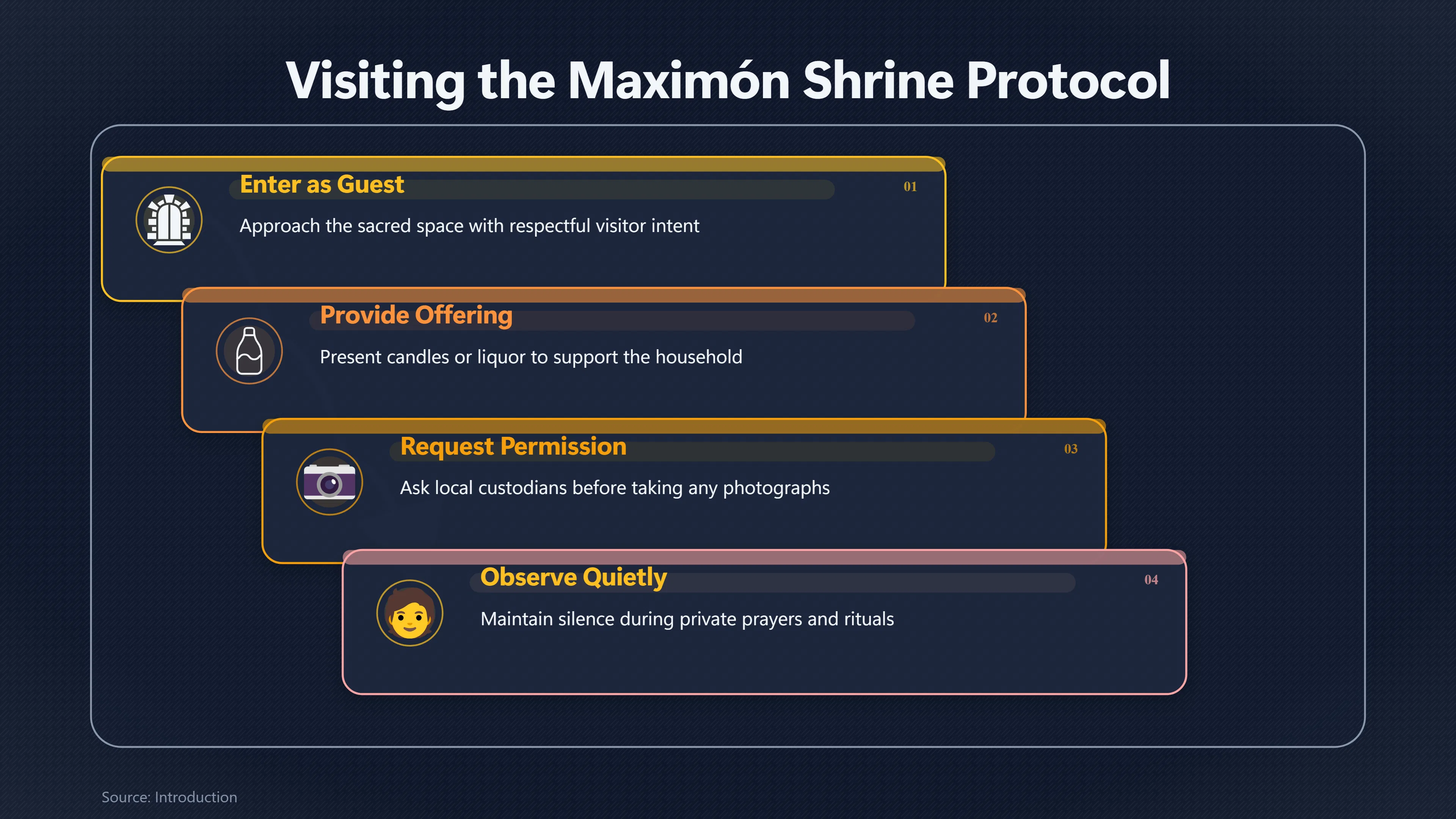
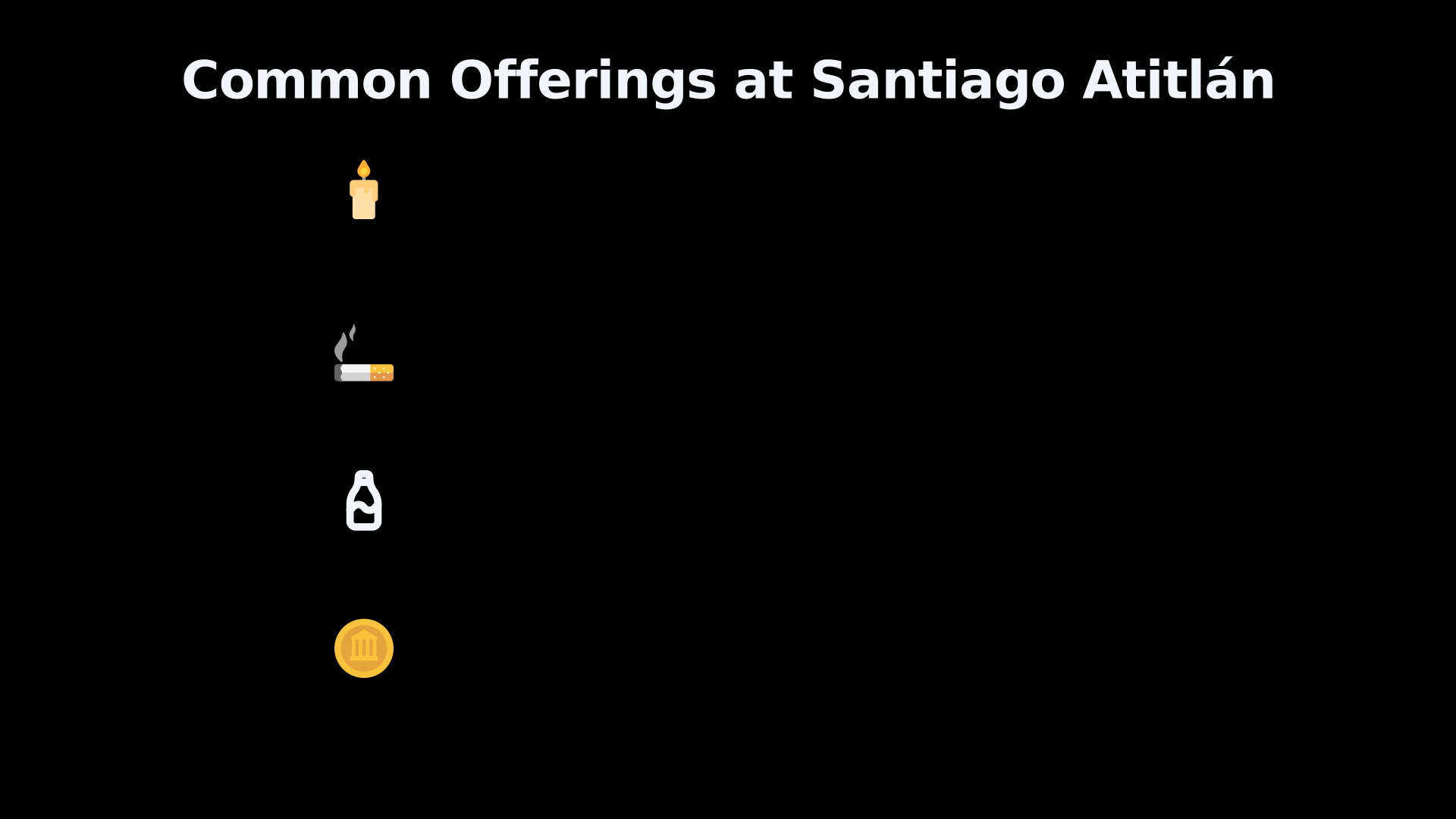
Bringing a small offering is generally regarded as appropriate. Common offerings include:
- Candles.
- Cigarettes or cigars.
- A bottle of local liquor.
- A monetary donation to help support the household and religious activities.
Offerings are not admission fees or purchases of blessings. They acknowledge that visitors are entering a sacred place maintained through community effort. Donations help cover candles, ceremonies and the ongoing responsibilities of the host family and religious brotherhood.[Atitlan Living]atitlanliving.comOpen source on atitlanliving.com.
Some visitors choose simply to observe quietly, while others ask for prayers or blessings. Those wishing to participate in ceremonies are usually advised to arrange this through an experienced local guide or community intermediary who understands both the ritual and the language, since many shrine attendants primarily speak Tz’utujil rather than English or fluent Spanish.[Atitlan Living]atitlanliving.comOpen source on atitlanliving.com.
Photography, payments and respectful behaviour
One of the most common misunderstandings concerns photography. Visitors should never assume that photographs are automatically permitted.
In practice:
- Always ask permission before taking photographs.
- Expect that a photography fee or donation may be requested.
- Never photograph worshippers during private prayer without their consent.
- Do not touch offerings or rearrange objects for a better picture.
Photography charges are sometimes criticised by visitors expecting free access. However, local communities generally regard them as a contribution towards maintaining the shrine rather than a commercial tourist surcharge. Treating the payment as part of being a respectful guest helps avoid reducing the shrine to a photographic attraction.[atitlanliving.com]atitlanliving.comOpen source on atitlanliving.com.
Clothing also matters. Modest dress is appreciated, particularly because the shrine is located within a traditional community rather than a purpose-built visitor attraction. Speaking quietly, removing hats if requested, avoiding disruptive behaviour and accepting that ceremonies proceed according to local rhythms all demonstrate respect for the space.[Atitlan Living]atitlanliving.comOpen source on atitlanliving.com.
Avoiding “curiosity tourism”
For travellers interested in Guatemala’s unusual heritage, Maximón can easily become one of the country’s most memorable encounters. Yet the experience changes depending on how it is approached.
Seeing the shrine only as an exotic spectacle—focusing on cigarettes, alcohol or unusual legends—misses its central importance to the people who maintain it. The same objects that seem strange to outsiders function as ordinary devotional offerings within a continuing religious tradition.[National Geographic]nationalgeographic.comNational GeographicMeet Maximón: The Liquor-Drinking, Chain-Smoking Saint | National GeographicJanuary 24, 2018…
A more rewarding visit comes from slowing down, observing quietly and recognising that the shrine exists first for local worshippers. Spending time listening, supporting local custodians through appropriate donations and accepting that not every ritual is intended for public consumption creates a more accurate understanding of why Maximón remains significant.
Within Guatemala’s landscape of unusual collections and sacred places, this makes the Maximón shrine distinctive. It preserves traditions that have survived centuries of political, religious and social change, but it does so not behind museum glass. The object of interest is still part of an active relationship between a community and the figure it venerates, making respectful conduct as important as historical curiosity.

Amazon book picks
Further Reading
Books and field guides related to How to Visit Maximon Without Treating Him as a Curiosity. Use these as the next step if you want deeper reading beyond the article.
The Sacred and the Profane
Famed historian of religion Mircea Eliade observes that even moderns who proclaim themselves residents of a completely profane world are...
The Nature of Intelligence
First published 1999. Subjects: Psychology, Intellect, Cognition.
eBay marketplace picks
Marketplace Samples
Live-tested eBay searches with available results related to this page.
Selected fromMaya folk art oneBay.co.uk.
Endnotes
1.
Source: nationalgeographic.com
Link:https://www.nationalgeographic.com/travel/article/maximon-santiago-atitlan-maya-saint
Source snippet
National GeographicMeet Maximón: The Liquor-Drinking, Chain-Smoking Saint | National GeographicJanuary 24, 2018...
Published: January 24, 2018
2.
Source: atitlanliving.com
Link:https://atitlanliving.com/guatemala-travel-information/how-to-visit-a-cofradia-in-santiago/
3.
Source: Wikipedia
Link:https://en.wikipedia.org/wiki/Maxim%C3%B3n
4.
Source: pinatravels.org
Title: Pina Travels How to Visit the Mayan Folk Saint Maximón in Lake Atitlan
Link:https://pinatravels.org/saint-maximon-lake-atitlan/
5.
Source: atitlanliving.com
Link:https://atitlanliving.com/santiago-travel-guides/a-deeper-look-into-the-ancient-mayan-traditions-of-santiago-lake-atitlan/
Additional References
6.
Source: growingupbilingual.com
Title: Growing Up Bilingual Santiago Atitlán, Guatemala: A Local’s Complete Guide
Link:https://growingupbilingual.com/santiago-atitlan-guatemala/
Source snippet
Santiago Atitlán, Guatemala: A Local's Complete GuideMay 23, 2026 — WHAT TO DO IN SANTIAGO ATITLÁN VISIT MAXIMÓN: THE LIVING DEITY There...
Published: May 23, 2026
7.
Source: youtube.com
Title: MAXIMON The Drinking Smoking God | A Mysterious Guatemalan Journey (Documentary)
Link:https://www.youtube.com/watch?v=v7wIskiADho
Source snippet
San Simón / Maximón: Biography of a Folk Saint...
8.
Source: youtube.com
Title: Mayan Maximon ritual
Link:https://www.youtube.com/watch?v=HdEOqJcxKcI
Source snippet
Maximon Santiago Atitlan Guatemala shrine MAXIMON The Drinking Smoking God | A Mysterious Guatemalan Journey (Documentary) Outlawes films...
9.
Source: youtube.com
Title: Santiago Atitlan
Link:https://www.youtube.com/watch?v=f60atosWzXQ
Source snippet
Meeting Guatemala’s Mysterious Mayan God: Maximón in Santiago Atitlán...
10.
Source: atitlangt.com
Link:https://atitlangt.com/en/pages/santiago-atitlan
11.
Source: journeysinliving.com
Link:https://journeysinliving.com/how-to-visit-maximon/
12.
Source: alongdustyroads.com
Link:https://www.alongdustyroads.com/posts/santiago-atitlan-guatemala-guide
13.
Source: santiagoatitlan.com
Link:https://www.santiagoatitlan.com/Religion/Santa/santa.html
14.
Source: santiagoatitlan.com
Link:https://www.santiagoatitlan.com/Shrine/shrine.html
15.
Source: livinginguatemala.com
Title: santiago atitlan
Link:https://livinginguatemala.com/municipalities/santiago-atitlan/
Source snippet
Maximon is a wooden figure dressed in scarves and hats, housed by a different cofradia each year. Visitors bring...