Where Slovenia Keeps Its Strangest Stories
Slovenia does not have a single dominant “museum of the weird”.
Page outline Jump by section
Introduction
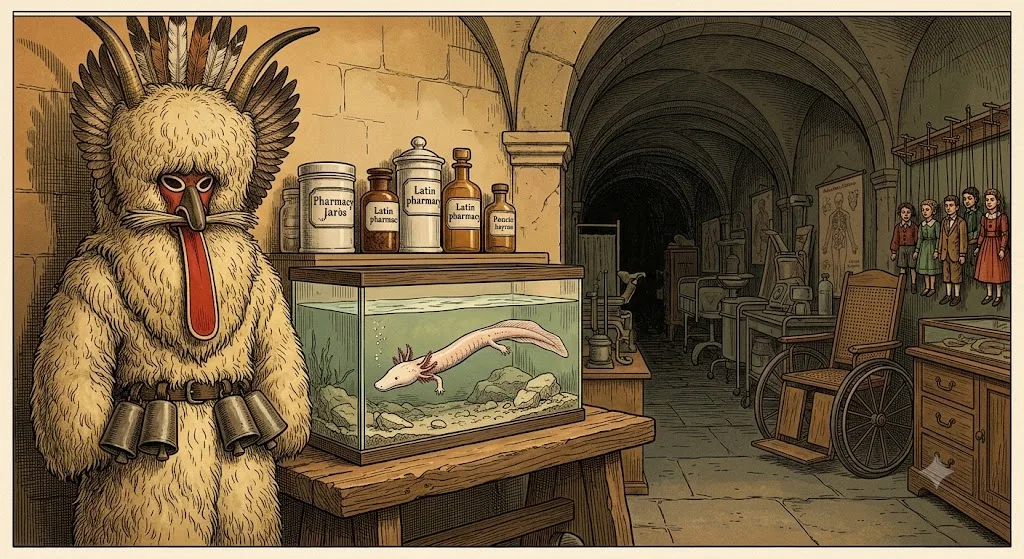
The most rewarding places are not necessarily sensational. Ptuj Castle treats monstrous carnival costumes as living ethnographic heritage; the Postojna Vivarium places dragon legends beside cave biology; and the Museum of Madness uses an old institutional building to question how society has confined and labelled people. Elsewhere, more commercial attractions package historical pharmacy, warfare or underground labour as immersive experiences. Together, these sites show a Slovenian preference for preserving unusual things within their original landscape rather than separating them into a conventional cabinet of curiosities.
Where folklore still has teeth
Slovenia’s strongest contribution to strange museum culture is its collection of carnival masks. These are not simply decorative disguises. They belong to seasonal customs in which villagers become horned animals, shaggy bell-wearers, demons, fools and unsettling human caricatures.
The principal public collection is housed at Ptuj Castle, where the Ptuj–Ormož Regional Museum displays traditional carnival costumes from north-eastern Slovenia. Its best-known figure is the Kurent, a towering character generally dressed in sheepskin, hung with heavy bells and given a long red tongue. The exhibition places the Kurent among a much wider population of regional characters rather than presenting it as an isolated national mascot. Costumes are arranged in a procession-like display, helping visitors understand that these objects were designed to move, make noise and interact with crowds.[pmpo.si]pmpo.siThe Ptuj and Drava Fields, Haloze and Slovenske Gorice hills represent an area in the north-eastern part of Slovenia, famous for the numb…
Tourist descriptions sometimes call the Kurent a pagan being that drives away winter. That is a useful shorthand, but it should not be treated as a securely reconstructed ancient religion. The costumes belong to a living and repeatedly adapted carnival tradition. Their importance lies less in proving direct survival from pre-Christian ritual than in showing how communities use inherited figures to represent fertility, disorder, seasonal change and local identity. Ptuj’s annual carnival has in turn transformed those traditions into a major visitor attraction, so the castle collection occupies an interesting middle ground between ethnographic record and tourism showcase.[pmpo.si]pmpo.si## Korant ali kurent… Leta 1991 so Ptuj sprejeli v Evropsko združenje karnevalskih mest FECC (Federation of European Carnival Cities)…
Cerkno offers a smaller but equally uncanny counterpart. The Idrija Municipal Museum preserves 29 carved wooden masks and one veal-skin mask associated with the town’s carnival runners. The surviving set is partly the product of revival: the custom was renewed in 1956 after an interruption, and additional characters were created over subsequent decades. That history makes the collection especially useful. It demonstrates that folklore is not either “authentic” or “invented”; it can be reconstructed, expanded and still become meaningful to the community that performs it.[Mestni muzej Idrija]muzej-idrija-cerkno.siMestni muzej IdrijaA carnival face masks collectionThe collection includes 29 lime-wood carved face masks of Cerkno runners (laufarji) an…
Ljubljana’s Slovene Ethnographic Museum provides the broader comparative setting. Its collections include masks, amulets, votive objects, folk instruments, household altars and painted religious images. A major exhibition running in 2025–26 brings together more than 120 masks, costumes and props from Slovenian and non-European holdings. This institutional approach is more academic than Ptuj’s castle display, encouraging visitors to compare masquerading as ritual action, festive performance and social transformation rather than merely admiring frightening faces.[etno-muzej.si]etno-muzej.siOn display are more than 120 masks, outfits, and propsMasks: From ritual to carnivalJanuary 23, 2026 — The exhibition presents various forms of masquerading with an emphasis on Slovenia's car…
Baby dragons under scientific observation
At Postojna Cave, one of Slovenia’s most effective pieces of curiosity-making begins with a genuine animal. The olm is a pale, aquatic salamander adapted to life in underground waters. Because of its elongated body, reduced eyes and delicate external gills, it looks strange enough to support centuries of dragon stories without requiring fabricated evidence.
The Postojna Vivarium combines a visitor exhibition with an active research area. Its public section explains cave biology, karst landscapes and the highly specialised animals that survive in darkness. Visitors can see olms in controlled conditions close to the main cave entrance, making the site part natural-history display, part living collection and part conservation attraction.[postojnska-jama.eu]postojnska-jama.euVivarium » Postojna Cave ParkVivarium » Postojna Cave Park
The “baby dragon” label has historical roots, although today it is also powerful tourism branding. In a seventeenth-century account, the naturalist Janez Vajkard Valvasor recorded local claims that strange creatures washed from caves after heavy rain were the offspring of a dragon living underground. Modern interpretation replaces the monster with a scientifically documented species while retaining the older imaginative framework. The result is unusually effective: visitors are invited to enjoy the legend, but the animal itself is not presented as supernatural.[The New Yorker]newyorker.comThe New Yorker What's Behind Slovenia's Love Affair with a Salamander?The New Yorker What's Behind Slovenia's Love Affair with a Salamander?
This distinction matters because Postojna is a heavily commercialised attraction. The dragon language, merchandise and family-oriented storytelling may feel theatrical, yet the biological content is real, and the vivarium has a research and conservation role. The olm also acts as an indicator of the health of underground water systems, which are vulnerable to pollution. The site therefore connects folklore with a less comfortable message: protecting the “dragon” requires protecting an environment that most visitors never see.[I feel Slovenia]slovenia.infoI feel Slovenia Meet "baby dragons" in Postojna Cave In order to keep the environment as clean as possible and to ensure the existence ofI feel Slovenia Meet "baby dragons" in Postojna Cave In order to keep the environment as clean as possible and to ensure the existence of
Alchemy, medicine and the history of belief
The Pharmacy and Alchemy Museum in Radovljica comes closest to a conventional private cabinet of curiosities. Set in a restored town house, it contains old pharmacy furniture, ceramic drug jars, balances, laboratory equipment and objects connected with cosmetics, perfumery, folk medicine and Asian medical traditions. The collection was assembled over approximately four decades and is associated with a family cosmetics business, making it an independent, collector-led museum rather than a national scientific institution.[Radol'ca]radolca.siOpen source on radolca.si.
Its appeal lies in the uneasy historical boundary between tested remedies, inherited medical practice, commercial secret-making and alchemical speculation. Visitors should not expect an occult temple or evidence that alchemists possessed supernatural powers. The museum is better understood as a visual history of the material world surrounding medicine: decorated containers, mysterious substances, specialised tools and the elaborate environments in which practitioners established authority.
The collection is strongest when read critically. Alchemy contributed practical laboratory methods and theories of matter, but it also pursued goals such as metallic transmutation that modern chemistry does not accept. Folk remedies may be culturally important without being medically effective. Because the museum is private and highly atmospheric, its presentation naturally favours wonder; visitors interested in the history of science should distinguish the authenticity of an old vessel or instrument from the truth of the belief once attached to it.
Practical access can be seasonal. Current local listings indicate that the museum closes during several winter months, so it is a place where checking the latest opening arrangements is particularly important.[Radol'ca]radolca.siRadol'ca Current opening times of museums and galleriesRadol'ca Current opening times of museums and galleries
A museum that questions the asylum
The Museum of Madness at Cmurek Castle is Slovenia’s most conceptually unusual museum. The building served for decades as an institution for people described at the time as mentally or neurologically ill. After the institution closed, campaigners and cultural workers began using the castle to examine confinement, social exclusion and the movement away from large asylums. The museum was established as a private institute in the 2010s and now operates with recognised public-interest status in culture and heritage.[culture.si]culture.siMuseum of MadnessMuseum of Madness
Despite its provocative English name, this is not a freak show or a collection of supposed “mad” curiosities. Its stated aim is to preserve the building while contributing to discussion about deinstitutionalisation: the replacement of isolated residential institutions with support embedded in ordinary community life. Exhibitions also address the castle, the surrounding landscape and wider questions about creativity and the boundaries society draws around acceptable behaviour.[Portal]coe.intPortal The Museum of MadnessPortal The Museum of Madness
That approach makes the museum ethically different from older medical displays built around anonymous specimens or sensational case histories. The unusual object here is partly the institution itself: rooms, architecture and administrative memory become evidence of how vulnerable people were separated from society. The museum asks visitors to examine the language of madness rather than treating former residents as objects of curiosity.
It remains a relatively small, project-led organisation rather than a conventional museum with daily year-round access. Its published 2026 programme states that the visitor season runs from April to November, with Sunday and public-holiday closures. Those limitations are part of its character: it functions through exhibitions, events, research and heritage activism rather than mass tourism.[en.muzejnorosti.eu]en.muzejnorosti.euvisit usvisit us
Painted beehives as miniature folk archives
Radovljica’s Museum of Apiculture preserves one of Slovenia’s most distinctive object types: painted wooden panels once fixed to the fronts of beehives. At first glance, a museum devoted to beekeeping may not sound especially strange. The panels change that impression. They form a compact visual archive of saints, biblical episodes, village humour, animals, crimes, soldiers, domestic quarrels and impossible scenes.
The oldest dated panel displayed by the museum is from 1758. Religious subjects dominate many early examples, while later panels range into caricature, folklore and reports of contemporary events. One preserved image even records a nineteenth-century triple murder. These were working agricultural objects, but they also served as identifiers, protective images, conversation pieces and outlets for popular storytelling.[mro.si]mro.siMuseum of Apiculture – Muzeji radovljiške občineMuseum of Apiculture – Muzeji radovljiške občine
The museum is an authorised national specialist institution rather than a novelty attraction. Its displays connect the panels with the history of Slovenian beekeeping and the Carniolan grey bee, while an observation hive operates during the warmer part of the year. This careful setting prevents the painted boards from being reduced to quaint souvenirs. They reveal how rural communities compressed religion, satire, fear and news into images small enough to fit on a hive.[mro.si]mro.siMuseum of Apiculture – Muzeji radovljiške občineMuseum of Apiculture – Muzeji radovljiške občine
Related collections at the Slovene Ethnographic Museum include painted hive fronts, votive images, figurines and domestic devotional objects. Taken together, these holdings show that Slovenia’s traditional curiosity culture often developed outside elite collectors’ cabinets. Its strange images were attached to farms, churches, carnival bodies and household altars before they entered museums.[Culture.si]culture.siOpen source on culture.si.
Underground museums and preserved machines
Several Slovenian museums derive their unusual character from physical immersion. At the Coal Mining Museum in Velenje, visitors descend in a working miners’ lift to the former underground workings. Reconstructed scenes, machinery and life-sized figures present mining labour in the environment where it occurred rather than in a surface gallery. Tours currently require advance booking.[rlv.si]muzej.rlv.siOpen source on rlv.si.
The museum can be theatrical, with staged scenes and visitor experiences, but its underlying subject is industrial history rather than horror entertainment. Its greatest strength is spatial: the darkness, confined passages and descent make the physical conditions of extracting coal difficult to ignore. At the same time, newer interpretation increasingly has to place that heritage beside debates about energy transition and the environmental consequences of lignite mining.
Pivka’s Park of Military History uses a different form of immersion. Developed in former barracks, it contains tanks, aircraft, artillery and a former Yugoslav commando submarine whose interior can be visited on guided tours. Nearby trails lead towards an Italian-built underground fortification and hundreds of metres of tunnels. Open storage displays shared by several national museums further blur the line between polished exhibition and visible museum depot.[culture.si]culture.siPark of Military History PivkaPark of Military History Pivka
Pivka is visitor-focused and includes simulators, events, re-enactments, a restaurant and a shop. That commercial infrastructure does not make its machines inauthentic, but it does shape how military history is consumed. The most responsible reading pays attention not only to engineering spectacle but also to the political systems, wars and individual lives connected with the equipment. The submarine is an impressive curiosity; it is also a surviving tool of Cold War military planning.
Prisons, hidden hospitals and difficult places
At Begunje, the Museum of Hostages occupies part of a mansion used as a Gestapo prison during the Second World War. Its most disturbing exhibits are not elaborate artefacts but the cells themselves and inscriptions left by prisoners on the walls. Occupation proclamations and documentary material place those personal marks within a history of detention, execution and forced displacement.[mro.si]mro.simuseum of hostages begunjemuseum of hostages begunje
The museum records that more than 12,000 people, including children, passed through the prison during the occupation. Because the evidence remains in its original architectural setting, the site has an immediacy that reconstructed prison attractions often lack. It is a memorial museum, not a dungeon-themed entertainment venue, and its power depends on resisting theatrical embellishment.[Culture.si]culture.siMuseum of Hostages, Begunje na GorenjskemMuseum of Hostages, Begunje na Gorenjskem
Franja Partisan Hospital near Cerkno presents another extraordinary preserved environment. Built in a narrow, difficult-to-reach gorge between 1943 and 1945, the clandestine hospital consisted of wooden treatment and support buildings hidden from occupying forces. It later became a museum and received the European Heritage Label.[UNESCO World Heritage Centre]whc.unesco.orgOpen source on unesco.org.
The site is currently closed because of severe storm damage sustained in August 2023. Its official pages continue to present its history and preservation work, while related exhibitions have carried the collection’s story elsewhere. Franja therefore belongs on Slovenia’s unusual-museum map with an important qualification: it is a historic visitor site under recovery, not an attraction that can presently be assumed open.[muzej-idrija-cerkno.si]muzej-idrija-cerkno.siMestni muzej Idrija Franja Partisan HospitalMestni muzej Idrija Franja Partisan Hospital
Small collections worth noticing
Not every distinctive Slovenian collection needs a full day. Several smaller institutions reward visitors who enjoy highly specialised objects.
The Museum of Puppetry at Ljubljana Castle preserves marionettes, stage mechanisms, sketches, scenery and broadcast material from more than a century of Slovenian puppetry. Among its most remarkable holdings are marionettes only about ten centimetres high, retained with their miniature stage setting. Interactive displays allow visitors to experiment with puppet mechanisms, balancing conservation with playful interpretation.[culture.si]culture.siLjubljana Puppet Theatre Museum CollectionLjubljana Puppet Theatre Museum Collection
The National Museum of Slovenia contains the country’s only ancient Egyptian mummy, alongside the much-debated Divje Babe object presented by the museum as a Neanderthal flute. Neither makes the institution a “mummy museum” or mystery-object attraction, but both are important curiosities within a major archaeological collection. The flute’s interpretation has attracted scholarly disagreement, so visitors should distinguish the museum’s confident presentation from the continuing debate over whether the perforated bone was deliberately made as a musical instrument.[nms.si]nms.siNational Museum of SloveniaNational Museum of Slovenia
The open depots at Pivka offer a different pleasure: seeing large numbers of museum objects in storage-like arrangements rather than in a tightly scripted narrative. Such displays expose the usually hidden problem of abundance—national collections hold far more material than standard galleries can show.[Culture.si]culture.siPark of Military History PivkaPark of Military History Pivka
What makes Slovenia’s curiosity culture distinctive
Slovenia’s unusual collections are strongest when they connect an object to the place or practice that produced it. Carnival masks remain tied to active festivities. Olms are shown beside the cave habitat that shaped both their biology and their legend. Mining history is interpreted below ground. Prison writing remains on cell walls. The Museum of Madness occupies the institution whose assumptions it seeks to question.
This closeness can also create tensions. A living tradition may be simplified for tourists; a private museum may favour atmosphere over critical history; a military park may make machines more memorable than victims; and a commercial cave attraction may turn conservation into dragon-themed branding. These are not reasons to dismiss the sites. They are reasons to ask how each one establishes authority and what kind of experience it is selling.
For visitors seeking witchcraft, cryptids or paranormal archives in the narrow sense, Slovenia’s public museum landscape is limited. Its stranger heritage is more grounded and materially specific. The country offers no well-established national UFO collection or major museum devoted solely to witchcraft. Instead, it preserves a richer set of borderlands between categories: dragons that are salamanders, monsters that are carnival performers, alchemical vessels that belong to medical history, folk paintings attached to beehives, and institutions that turn their own difficult past into the subject of the exhibition.
The result is a curiosity culture less concerned with proving the impossible than with showing why people created, feared, believed in, worked with or were confined by unusual things. Slovenia’s best strange museums are therefore not simply rooms full of oddities. They are places where folklore, evidence and visitor spectacle remain visibly—and usefully—in tension.
Amazon book picks
Further Reading
Books and field guides related to Where Slovenia Keeps Its Strangest Stories. Use these as the next step if you want deeper reading beyond the article.
Atlas Obscura: An Explorer's Guide to the World's Hidden Wonders
It's time to get off the beaten path. Inspiring equal parts wonder and wanderlust, Atlas Obscura celebrates over 700 of the strangest and...
The Museum of Extraordinary Things
"An extraordinarily imaginative and immersive novel, this one set in New York from 1911-1925"--
eBay marketplace picks
Marketplace Samples
Live-tested eBay searches with available results related to this page.
Selected fromEuropean heritage poster oneBay.co.uk.

Endnotes
1.
Source: pmpo.si
Link:https://pmpo.si/en/stalne-zbirke/collection-of-traditional-carnival-masks/
Source snippet
The Ptuj and Drava Fields, Haloze and Slovenske Gorice hills represent an area in the north-eastern part of Slovenia, famous for the numb...
2.
Source: pmpo.si
Link:https://pmpo.si/en/nadstropja/stables/
Source snippet
The most popular and plentiful carnival character from this area is the Korant or Kurent.... The main carnival in Ptuj, Kurentovanje, ge...
3.
Source: pmpo.si
Link:https://pmpo.si/nadstropja/konjusnica/
Source snippet
## Korant ali kurent... Leta 1991 so Ptuj sprejeli v Evropsko združenje karnevalskih mest FECC (Federation of European Carnival Cities)...
4.
Source: etno-muzej.si
Title: On display are more than 120 masks, outfits, and props
Link:https://www.etno-muzej.si/en/razstave/masks-from-ritual-to-carnival
Source snippet
Masks: From ritual to carnivalJanuary 23, 2026 — The exhibition presents various forms of masquerading with an emphasis on Slovenia's car...
Published: January 23, 2026
5.
Source: culture.si
Link:https://www.culture.si/en/Slovene_Ethnographic_Museum
6.
Source: postojnska-jama.eu
Title: Vivarium » Postojna Cave Park
Link:https://www.postojnska-jama.eu/en/attractions-in-the-park/vivarium/
7.
Source: postojnska-jama.eu
Title: Postojna Cave Park
Link:https://www.postojnska-jama.eu/
8.
Source: slovenia.info
Link:https://www.slovenia.info/en/stories/meet-[baby-dragons
9.
Source: culture.si
Title: Museum of Madness
Link:https://www.culture.si/en/Museum_of_Madness
10.
Source: en.muzejnorosti.eu
Link:https://en.muzejnorosti.eu/about-us
11.
Source: en.muzejnorosti.eu
Link:https://en.muzejnorosti.eu/
12.
Source: en.muzejnorosti.eu
Link:https://en.muzejnorosti.eu/exhibitions
13.
Source: en.muzejnorosti.eu
Title: visit us
Link:https://en.muzejnorosti.eu/visit-us
14.
Source: muzejnorosti.eu
Link:https://muzejnorosti.eu/
15.
Source: mro.si
Title: Museum of Apiculture – Muzeji radovljiške občine
Link:https://mro.si/en/musem-of-apiculture/
16.
Source: muzej.rlv.si
Link:https://muzej.rlv.si/en/visit
17.
Source: visitsaleska.si
Link:https://www.visitsaleska.si/en/saleska-valley/the-coal-mining-museum-of-slovenia/
18.
Source: visitsaleska.si
Link:https://www.visitsaleska.si/en/saleska-valley/underground-adventure-in-the-coal-mining-museum-of-slovenia/
19.
Source: culture.si
Title: Park of Military History Pivka
Link:https://www.culture.si/en/Park_of_Military_History_Pivka
20.
Source: slovenia.info
Link:https://www.slovenia.info/sl/novinarsko-sredisce/novice/28088-ob-20-letnici-parka-vojaske-zgodovine?__lang=en&_locale=en
21.
Source: mro.si
Title: museum of hostages begunje
Link:https://mro.si/en/museum-of-hostages-begunje
22.
Source: culture.si
Title: Museum of Hostages, Begunje na Gorenjskem
Link:https://www.culture.si/en/Museum_of_Hostages%2C_Begunje_na_Gorenjskem
23.
Source: whc.unesco.org
Link:https://whc.unesco.org/en/tentativelists/1433/
24.
Source: culture.si
Title: Ljubljana Puppet Theatre Museum Collection
Link:https://www.culture.si/en/Ljubljana_Puppet_Theatre_Museum_Collection
25.
Source: nms.si
Title: National Museum of Slovenia
Link:https://www.nms.si/en/plan-your-visit/locations/muzejska
26.
Source: culture.si
Title: Military Museum of Slovenian Armed Forces
Link:https://culture.si/en/Military_Museum_of_Slovenian_Armed_Forces
27.
Source: culture.si
Title: Cmurek Castle
Link:https://www.culture.si/en/Cmurek_Castle
28.
Source: culture.si
Title: Velenje Museum
Link:https://www.culture.si/en/Velenje_Museum
29.
Source: culture.si
Title: Museum of Puppetry
Link:https://www.culture.si/en/Museum_of_Puppetry
30.
Source: culture.si
Link:https://www.culture.si/en/Category%3AMuseums
33.
Source: culture.si
Title: Coal Mining Museum of Slovenia
Link:https://www.culture.si/en/Coal_Mining_Museum_of_Slovenia
34.
Source: slovenia.info
Title: Radovljica: A Timeless Town with a Summer Full of Life | I feel Slovenia
Link:https://www.slovenia.info/en/press-centre/news-of-the-tourism-press-agency/33809-radovljica-a-timeless-town-with-a-summer-full-of-life
35.
Source: ptuj.si
Title: Brezplačne delavnice za družine Ptujske maske rajamo
Link:https://www.ptuj.si/objava/877653
36.
Source: mro.si
Title: Accessibility – Muzeji radovljiške občine
Link:https://mro.si/en/accessibility
37.
Source: mro.si
Title: Notable Objects of Museum of Apiculture – Muzeji radovljiške občine
Link:https://mro.si/en/musem-of-apiculture/notable-objects
38.
Source: mro.si
Title: Painted beehive frontal panel the Pilgrim Mary – Muzeji radovljiške občine
Link:https://mro.si/en/musem-of-apiculture/notable-objects/bozjepotna-marija-panjska-koncnica
39.
Source: slovenia.info
Title: NE W! Pharmacy and alchemy museum in Radovljica | I feel Slovenia
Link:https://www.slovenia.info/en/press-centre/news-of-the-tourism-press-agency/9785-new-pharmacy-and-alchemy-museum-in-radovljica
40.
Source: culture.si
Title: Museum of Apiculture, Radovljica
Link:https://www.culture.si/en/Radovljica_Apiculture_Museum
41.
Source: slovenia.info
Link:https://www.slovenia.info/en/stories/visit-the-most-unusual-museums-in-slovenia
42.
Source: slovenia.info
Link:https://www.slovenia.info/en/stories/top-museum-pieces-in-historical-towns
43.
Source: slovenia.info
Link:https://www.slovenia.info/en/stories/spend-the-day-at-one-of-the-most-unusual-slovenian-museums
44.
Source: slovenia.info
Link:https://www.slovenia.info/en/things-to-do/arts-and-culture/museums
45.
Source: slovenia.info
Link:https://www.slovenia.info/en/things-to-do/slovenia-unique-experiences/43-velenje-underground-a-gastronomic-adventure-160-metres-below-the-surface
46.
Source: muzej.rlv.si
Title: si The Coal Mining Museum of Slovenia
Link:https://muzej.rlv.si/
47.
Source: muzej.rlv.si
Title: si Gift shop
Link:https://muzej.rlv.si/en/tourist-offer/gift-shop
48.
Source: culture.si
Title: The Hidden Gems of Slovenian Museums
Link:https://www.culture.si/en/The_Hidden_Gems_of_Slovenian_Museums
49.
Source: culture.si
Title: Franja Partisan Hospital
Link:https://www.culture.si/en/Franja_Partisan_Hospital
50.
Source: pmpo.si
Link:https://pmpo.si/stalne-zbirke/zbirka-tradicionalnih-pustnih-mask/
51.
Source: pmpo.si
Title: ptuj castle
Link:https://pmpo.si/en/ptuj-castle/?lang=en
52.
Source: pmpo.si
Link:https://pmpo.si/stalne_zbirke/ethnological-collection/?lang=en
53.
Source: pmpo.si
Link:https://pmpo.si/en/permanent-collections/
54.
Source: postojnska-jama.eu
Link:https://www.postojnska-jama.eu/de/attraktionen-im-park/vivarium/
55.
Source: museums.si
Link:https://museums.si/en-us/Home/Units/Museum?id=29626
56.
Source: museums.si
Link:https://museums.si/en-us/Home/Units/Museum?id=392835
57.
Source: museums.si
Link:https://museums.si/en-us/Home/Exhibitions-events/Event?id=431012
58.
Source: nms.si
Link:https://www.nms.si/en/
59.
Source: nms.si
Title: National Museum of Slovenia – Metelkova
Link:https://www.nms.si/en/plan-your-visit/locations/metelkova
60.
Source: slovenia.si
Title: now and then it is fun to be someone else
Link:https://slovenia.si/art-and-cultural-heritage/now-and-then-it-is-fun-to-be-someone-else
61.
Source: slovenia.si
Title: tweets from the past the stories of slovenias oldest artefacts
Link:https://slovenia.si/art-and-cultural-heritage/tweets-from-the-past-the-stories-of-slovenias-oldest-artefacts
62.
Source: radovljica.si
Title: Čebelarski muzej Radovljica
Link:https://www.radovljica.si/objava/59771
63.
Source: arhiv.kurentovanje.net
Link:https://www.arhiv.kurentovanje.net/en/about/
Source snippet
Wearing a mask is a part of the identity of the local population.... They are not amazed only by Kurent, but also by the rich diversity...
64.
Source: muzej-idrija-cerkno.si
Link:https://www.muzej-idrija-cerkno.si/en/zbirka/a-carnival-face-masks-collection/
Source snippet
Mestni muzej IdrijaA carnival face masks collectionThe collection includes 29 lime-wood carved face masks of Cerkno runners (laufarji) an...
65.
Source: newyorker.com
Title: The New Yorker What’s Behind Slovenia’s Love Affair with a Salamander?
Link:https://www.newyorker.com/tech/annals-of-technology/whats-behind-slovenias-love-affair-with-a-salamander
66.
Source: radolca.si
Link:https://www.radolca.si/en/attractions/museums-and-galleries/pharmacy-and-alchemy-museum
67.
Source: radolca.si
Link:https://www.radolca.si/en/events-calendar/pharmacy-and-alchemy-museum-opening
68.
Source: radolca.si
Title: Radol’ca Current opening times of museums and galleries
Link:https://www.radolca.si/en/news/current-opening-times-of-museums-and-galleries
69.
Source: coe.int
Title: Portal The Museum of Madness
Link:https://www.coe.int/en/web/culture-and-heritage/faro-active-members/-/asset_publisher/E3FT1EVQJST8/content/the-museum-of-madness?_com_liferay_asset_publisher_web_portlet_AssetPublisherPortlet_INSTANCE_E3FT1EVQJST8_assetEntryId=291016777&_com_liferay_asset_publisher_web_portlet_AssetPublisherPortlet_INSTANCE_E3FT1EVQJST8_redirect=https%3A%2F%2Fwww.coe.int%2Fen%2Fweb%2Fculture-and-heritage%2Ffaro-active-members%3Fp_p_id%3Dcom_liferay_asset_publisher_web_portlet_AssetPublisherPortlet_INSTANCE_E3FT1EVQJST8%26p_p_lifecycle%3D0%26p_p_state%3Dnormal%26p_p_mode%3Dview%26_com_liferay_asset_publisher_web_portlet_AssetPublisherPortlet_INSTANCE_E3FT1EVQJST8_cur%3D0%26p_r_p_resetCur%3Dfalse%26_com_liferay_asset_publisher_web_portlet_AssetPublisherPortlet_INSTANCE_E3FT1EVQJST8_assetEntryId%3D291016777%23p_com_liferay_asset_publisher_web_portlet_AssetPublisherPortlet_INSTANCE_E3FT1EVQJST8
70.
Source: radolca.si
Link:https://www.radolca.si/en/attractions/museums-and-galleries/museum-of-apiculture-radovljica
71.
Source: radolca.si
Link:https://www.radolca.si/en/attractions/museums-and-galleries/museum-of-hostages
72.
Source: pb-franja.si
Title: franja a monument of immovable heritage
Link:https://www.pb-franja.si/en/explore-franja/franja-a-monument-of-immovable-heritage/
73.
Source: muzej-idrija-cerkno.si
Title: Mestni muzej Idrija Franja Partisan Hospital
Link:https://www.muzej-idrija-cerkno.si/en/lokacija/franja-partisan-hospital/
74.
Source: pb-franja.si
Link:https://www.pb-franja.si/en/
75.
Source: ljubljanskigrad.si
Link:https://www.ljubljanskigrad.si/en/experiences/museum-of-puppetry/
76.
Source: lgl.si
Link:https://www.lgl.si/en/presentation
77.
Source: visitptuj.eu
Link:https://visitptuj.eu/en/see-do/culture-heritage/sightseeing/kurent-2/
78.
Source: portal.ehri-project.eu
Title: eu Muzej talcev Begunje na Gorenjskem
Link:https://portal.ehri-project.eu/institutions/si-006637
79.
Source: radolca.si
Link:https://www.radolca.si/en/attractions/museums-and-galleries
80.
Source: radolca.si
Link:https://www.radolca.si/it/attrazioni-di-radovljica/musei-e-gallerie/museo-della-farmacia-e-alchimia-di-radovljica
81.
Source: radolca.si
Link:https://www.radolca.si/sl/znamenitosti/muzeji-in-galerije/lekarniski-in-alkimisticni-muzej-radovljica
82.
Source: radolca.si
Link:https://www.radolca.si/de/radovljica-sehenswuerdigkeiten/museen-und-galerien/apotheken-und-alchemiemuseum-radovljica
83.
Source: visitmaribor.si
Title: Museum of Madness
Link:https://www.visitmaribor.si/en/what-to-do/sights/33750-
84.
Source: lgl.si
Link:https://www.lgl.si/en/theatre/presentation
85.
Source: europeanheritagedays.com
Title: Franja Partisan Hospital
Link:https://www.europeanheritagedays.com/story/593c7/A-Hidden-Gem-in-Slovenia-Franja-Partisan-Hospital
86.
Source: coe.int
Title: The Museum of Madness
Link:https://www.coe.int/en/web/culture-and-heritage/faro-active-members/-/asset_publisher/E3FT1EVQJST8/content/the-museum-of-madness
87.
Source: Wikipedia
Title: Franja Partisan Hospital
Link:https://en.wikipedia.org/wiki/Franja_Partisan_Hospital
88.
Source: slovenia360.si
Link:https://www.slovenia360.si/en/tourist-spots/radovljica-360
Additional References
89.
Source: burger.si
Link:https://www.burger.si/MuzejiInGalerije/PokrajinskiMuzejPtuj/Maske/ENGzbirke.html
Source snippet
Traditional Shrovetide figures and groups form the core of the collection and are arranged in the exhibition hall in the form of a carniv...
90.
Source: youtube.com
Link:https://www.youtube.com/watch?v=eKlsjawOu88
Source snippet
The Artist Creating a Buzz by Decorating Beehives with Traditional Motifs...
91.
Source: youtube.com
Title: Baby Dragons Olms Hatch in Slovenia: 7 Things About the Enigmatic Olm
Link:https://www.youtube.com/watch?v=AKOwYHnBYRM
Source snippet
Presentation of the Faro Convention in the Museum of Madness at the Cmurek Castle in Slovenia...
92.
Source: youtube.com
Title: Kurentovanje Rally: A Winter Ride to Slovenia’s Wildest Carnival
Link:https://www.youtube.com/watch?v=bGEe-EyTCjY
Source snippet
Baby Dragons Olms Hatch in Slovenia: 7 Things About the Enigmatic Olm...
93.
Source: youtube.com
Title: The Artist Creating a Buzz by Decorating Beehives with Traditional Motifs
Link:https://www.youtube.com/watch?v=rB4cb-iWFbk
Source snippet
Idrija, Slovenia: Life and Death in a Mercury Mine...
94.
Source: sloveniatour.si
Link:https://sloveniatour.si/20-most-unusual-museums-to-visit-in-slovenia/
95.
Source: atlasobscura.com
Link:https://www.atlasobscura.com/things-to-do/slovenia/museums
96.
Source: tripadvisor.co.uk
Link:https://www.tripadvisor.co.uk/Attraction_Review-g274873-d9998025-Reviews-Exhibition_of_torture_devices-Ljubljana_Upper_Carniola_Region.html
97.
Source: burger.si
Link:https://www.burger.si/MuzejiInGalerije/MuzejPremogovnistva/uvod_eng.html
98.
Source: ehl-bureau.eu
Link:https://ehl-bureau.eu/en/project/franja-partisan-hospital/