Within Curious Austria
Should Human Specimens Be Shown in Museums?
Vienna's Narrenturm presents preserved human remains as medical evidence while confronting difficult questions about consent and spectacle.
On this page
- What visitors see inside the Narrenturm
- How the collection supported medical teaching
- Consent, dignity and the limits of public display
Page outline Jump by section
Introduction
The Narrenturm in Vienna poses one of the most difficult questions any museum can ask: should real human bodies and preserved body parts be displayed to the public? Unlike collections built around spectacle or horror, the Narrenturm presents pathological specimens as historical and scientific evidence. Visitors encounter preserved organs, skeletons, congenital abnormalities, wax models and traces of diseases that once shaped medical practice. The museum’s challenge is not simply how to preserve these objects, but how to interpret them without reducing the people they came from to curiosities.
This ethical tension makes the Narrenturm one of Austria’s most thought-provoking unusual collections. It is both a major medical archive and a public museum, forcing visitors to consider where education ends and voyeurism begins, and how museums can balance scientific value with respect for the dead.[nhm.at]nhm.atNaturhistorisches Museum WienPathological-anatomical collection in the Narrenturm…
What visitors see inside the Narrenturm
The Narrenturm occupies a circular eighteenth-century building originally constructed in 1784 as a psychiatric hospital. Today it houses one of Europe’s largest pathological-anatomical collections under the care of Vienna’s Natural History Museum.
Rather than presenting death as entertainment, the galleries are organised around medical subjects. Visitors encounter:
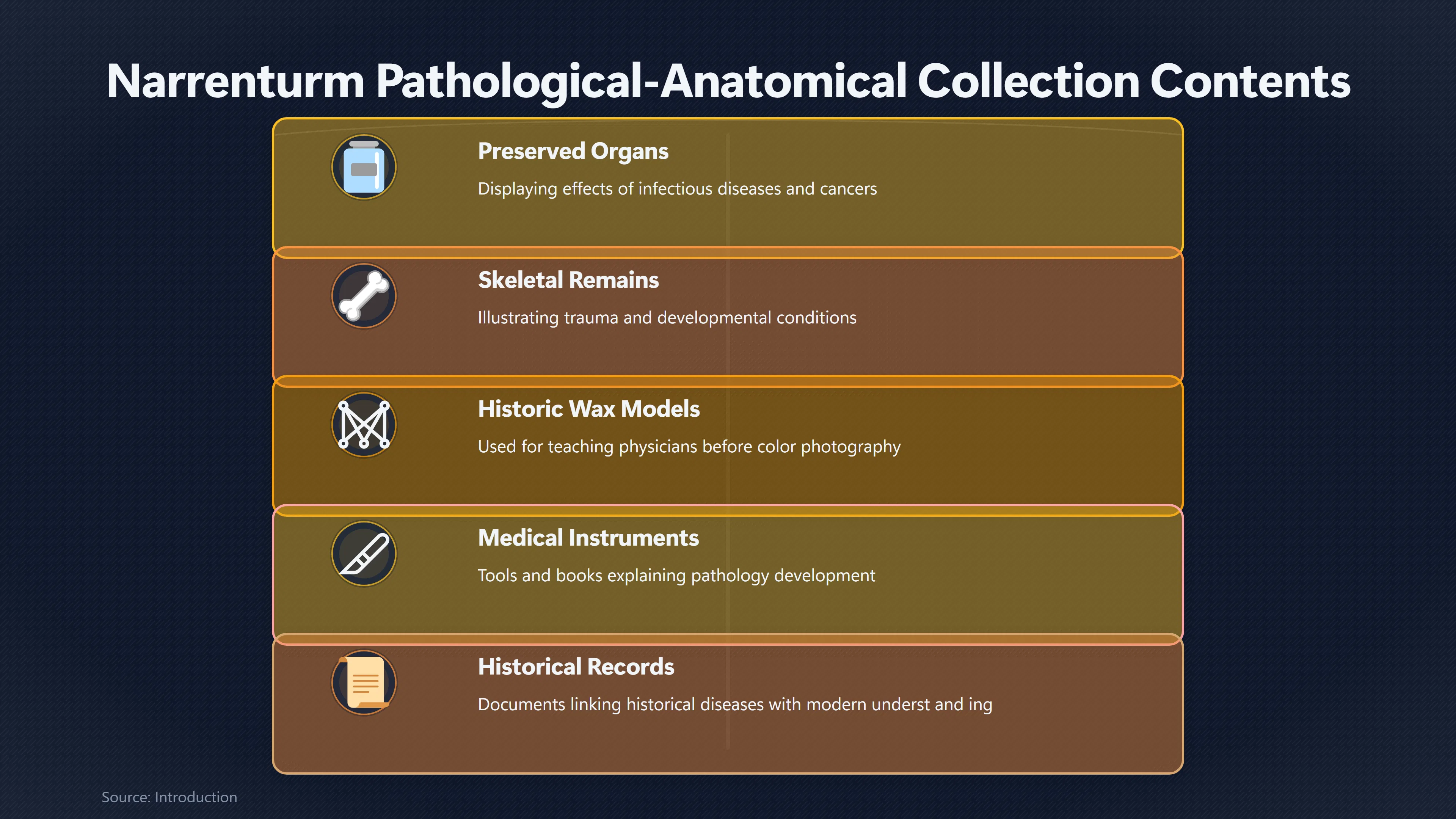
- Preserved organs showing the effects of infectious diseases, cancers and other illnesses.
- Skeletal remains illustrating trauma, deformities and developmental conditions.
- Historic wax models used to teach physicians before colour photography existed.
- Medical instruments, books and documents explaining how pathology developed as a scientific discipline.
- Exhibits linking historical diseases with present-day medical understanding.
The architecture contributes to the experience. Former patient cells have been adapted into exhibition spaces, reminding visitors that the building itself reflects changing attitudes towards mental illness as well as medical history. Following a major renovation completed in 2020, the displays were redesigned specifically to avoid sensational presentation while remaining accessible to non-specialist visitors. The museum states that the exhibition was developed with medical experts and deliberately follows contemporary international guidance on displaying human remains rather than encouraging shock value.[nhm.at]nhm.atNaturhistorisches Museum WienPathological-anatomical collection in the Narrenturm…
How the collection supported medical teaching
The preserved specimens were never assembled as a cabinet of curiosities. They were created as teaching material during the development of the Vienna Medical School, which became internationally influential during the eighteenth and nineteenth centuries.
Before modern imaging techniques, pathology depended on direct observation. Comparing diseased organs, bones and tissues allowed physicians to connect symptoms experienced during life with physical changes discovered during autopsy. The collection therefore became a reference library of disease rather than an artistic or religious display.
Many specimens preserve conditions that are now rare because of antibiotics, vaccination, improved nutrition or modern surgery. Others document congenital disorders or tumours that remain medically relevant. Some historical specimens continue to support scientific research because they preserve evidence of diseases that no longer occur frequently in Europe.
This educational purpose explains why the museum continues to display specimens today. Instead of treating them as relics, the exhibition interprets them as historical medical records that reveal how disease affected real people before contemporary healthcare became available.[nhm.at]nhm.atNaturhistorisches Museum WienPathological-anatomical collection in the Narrenturm…

Consent, dignity and the limits of public display
The educational value of the collection does not remove its ethical problems.
Many individuals represented in nineteenth-century pathological collections could not have imagined their remains becoming museum exhibits centuries later. Modern ideas of informed consent scarcely existed when much of the collection was assembled. Some specimens originated from compulsory hospital autopsies or historical medical practices that would now be governed by far stricter legal and ethical standards.
This creates several continuing questions.
Can educational benefit justify public display? Museums increasingly argue that displaying human remains should serve a clear educational or scientific purpose rather than simply attracting visitors.
How much personal identity should be revealed? Modern practice generally avoids unnecessary personal information, encouraging visitors to understand diseases while preserving the dignity of the individuals concerned.
Should every specimen be displayed? Many institutions now distinguish between research collections, which remain accessible primarily to specialists, and carefully selected public displays that provide sufficient context.
How should difficult histories be acknowledged? Rather than ignoring problematic collecting practices, museums increasingly explain how historical medicine operated and how ethical standards have changed over time.
The Narrenturm addresses these questions by embedding specimens within medical interpretation rather than presenting them as isolated curiosities. Labels explain diseases, diagnostic history and scientific significance, encouraging visitors to focus on pathology rather than spectacle.[nhm.at]nhm.atNaturhistorisches Museum WienPathological-anatomical collection in the Narrenturm…
Why the museum still attracts debate
Even carefully curated displays produce different reactions.
Some visitors see the collection primarily as an educational resource that demonstrates the realities of disease before modern medicine. Others find any public display of human remains uncomfortable regardless of context. The emotional response is often strongest because the specimens represent identifiable human bodies rather than archaeological fragments or artistic representations.
The debate has become broader across museums worldwide. Professional guidance increasingly emphasises that human remains deserve treatment different from ordinary museum objects. Institutions are encouraged to consider provenance, cultural sensitivities, descendant communities where relevant, and the purpose of public display before exhibiting such material. Human remains are increasingly understood as individuals rather than simply scientific specimens.[Natural History Museum]nhm.ac.ukNatural History Museum Human remains in the collection | Natural History MuseumNatural History Museum Human remains in the collection | Natural History Museum
For pathology museums, another challenge is avoiding what critics describe as “medical voyeurism”—visitors seeking shocking images rather than historical understanding. Exhibition design therefore becomes an ethical tool. Lighting, interpretation, photography restrictions and careful object selection all influence whether visitors leave with greater knowledge or merely stronger emotional reactions.
Why the Narrenturm matters within Austria’s curiosity culture
Austria contains several unusual collections, but the Narrenturm stands apart because its central curiosity is not mystery, folklore or eccentric collecting. Instead, it confronts visitors with the physical reality of disease and asks them to think about medicine’s relationship with humanity.
Its specimens are undeniably extraordinary, yet their significance lies less in rarity than in interpretation. They document centuries of changing medical knowledge while exposing equally important changes in social values. Ideas about patient rights, informed consent, mental illness and the dignity of the dead have evolved dramatically since many of the specimens entered the collection.
For that reason, the Narrenturm is best understood not as a museum of horrors but as a museum of ethical questions. The preserved bodies remind visitors that scientific progress often depended upon practices that modern society now examines critically. Rather than resolving those tensions, the museum makes them visible, inviting reflection on how knowledge, compassion and public education should coexist when the subjects on display were once living people.[nhm.at]nhm.atNaturhistorisches Museum WienPathological-anatomical collection in the Narrenturm…
Amazon book picks
Further Reading
Books and field guides related to Should Human Specimens Be Shown in Museums?. Use these as the next step if you want deeper reading beyond the article.
Cabinets of Curiosities
"Maurie`s' tour of strange objects is entertaining and fascinating." --Antiques And The Arts Weekly
The Ethics of Collecting Cultural Property
First published 1991. Subjects: Cultural property, protection, Antiquities, collection and preservation.
eBay marketplace picks
Marketplace Samples
Live-tested eBay searches with available results related to this page.
Selected fromanatomical model oneBay.co.uk.
Endnotes
1.
Source: nhm.at
Title: Naturhistorisches Museum Wien
Link:https://www.nhm.at/en/narrenturm
Source snippet
Pathological-anatomical collection in the Narrenturm...
2.
Source: nhm.at
Title: Naturhistorisches Museum Wien
Link:https://www.nhm.at/en/information
3.
Source: shop.nhm.at
Title: entrance narrenturm
Link:https://shop.nhm.at/en/entrance_narrenturm
4.
Source: nhm.at
Title: Naturhistorisches Museum Wien
Link:https://www.nhm.at/forschung/anthropologie/pathologisch-anatomische_sammlung_im_narrenturm
5.
Source: shop.nhm.at
Title: themenfuehrung narrenturm
Link:https://shop.nhm.at/en/themenfuehrung_narrenturm
6.
Source: nhm.at
Title: Naturhistorisches Museum Wien
Link:https://www.nhm.at/en/tours__activities/narrenturm
7.
Source: shop.nhm.at
Title: eintritt narrenturm
Link:https://shop.nhm.at/eintritt_narrenturm
8.
Source: nhm.ac.uk
Title: Natural History Museum Human remains in the collection | Natural History Museum
Link:https://www.nhm.ac.uk/about-us/governance/human-remains-in-the-collection.html
9.
Source: nhm.ac.uk
Title: Natural History Museum Code of ethics | Natural History Museum
Link:https://www.nhm.ac.uk/about-us/governance/code-of-ethics.html
Source snippet
We use our unique collections and unrivalled expertise to tackle the biggest challenges facing the...
Additional References
10.
Source: ft.com
Title: Financial Times Death in Vienna
Link:https://www.ft.com/content/6708104e-9312-4a54-987b-c2a9837b4fa5
Source snippet
Zentralfriedhof cemetery features merchandise like Grim Reaper energy drinks and funerary Lego sets, reflecting a blend of respect and hu...
11.
Source: youtube.com
Link:https://www.youtube.com/watch?v=rKYpj7_t3fM
Source snippet
Plastination Exhibitions Explained: Body Worlds, Ethics, and Human Rights...
12.
Source: youtube.com
Title: Ethical considerations for caring and managing human remains in museums
Link:https://www.youtube.com/watch?v=lml7S5-teqc
Source snippet
Medical museum in Philadelphia overhauls policies on human remains to meet modern ethical standards...
13.
Source: nhm-wien.ac.at
Title: Naturhistorisches Museum Wien
Link:https://nhm-wien.ac.at/en/information
Source snippet
* * * OPENING HOURS Thursday-Monday: 9 a.m. - 6.00 p.m. Wednesday: 9 a.m. - 8 p.m. Tuesda...
14.
Source: youtube.com
Title: The Museum of Death, Disease & Deformity
Link:https://www.youtube.com/watch?v=dVqbdlAbS38
Source snippet
Ethical considerations for caring and managing human remains in museums...
15.
Source: youtube.com
Title: RARE Skeletal Collection | “The Fool’s Tower” Book Tour
Link:https://www.youtube.com/watch?v=MQ61HKB005E
Source snippet
The Museum of Death, Disease & Deformity - Narrenturm...
16.
Source: wien.info
Title: Collection of Anatomical Pathology in the Madhouse Tower – NHM
Link:https://www.wien.info/en/see-do/sights-from-a-to-z/pathological-museum-355212
17.
Source: youtube.com
Title: Plastination Exhibitions Explained: Body Worlds, Ethics, and Human Rights
Link:https://www.youtube.com/watch?v=1xXO8-HVyHE
18.
Source: nhm-wien.ac.at
Title: Naturhistorisches Museum Wien
Link:https://www.nhm-wien.ac.at/narrenturm
Source snippet
Jahrhundert. Gegründet wurde er 178...
19.
Source: nhm-wien.ac.at
Title: Naturhistorisches Museum Wien
Link:https://www.nhm-wien.ac.at/en/research/anthropology
Source snippet
Since its founding as the Depart...