Within Strange South Africa
Museum, Medicine Shop or Curiosity Cabinet?
Johannesburg's Museum of Man and Science blurs shop, collection and cultural encounter while raising questions about interpretation, wildlife and trade.
On this page
- What visitors encounter in the commercial collection
- Why ritual and medicinal objects resist outsider labels
- Wildlife sourcing, commerce and responsible interpretation
Page outline Jump by section
Introduction
South Africa’s most unusual visitor experiences are not always found in formal museums. Some are working businesses embedded in living traditions, where medicinal plants, ritual objects and cultural knowledge are still bought and used rather than displayed behind glass. Johannesburg’s long-running Museum of Man and Science is the best-known example: despite its name, it is primarily a traditional medicine shop serving practising healers and their clients, while also attracting curious tourists.[The Silo Package-Free Pantry]southafrica.infoThe Silo Package-Free Pantry Joburg's king of muti museumThe Silo Package-Free PantryJoburg's king of muti museumApril 8, 2004…

That dual identity creates unusual ethical questions. Visitors are entering an active commercial and cultural space rather than a neutral exhibition. Objects may have spiritual significance, practical medicinal uses or contested conservation implications. Understanding those limits is part of appreciating the collection. The experience becomes less about consuming the exotic and more about recognising how living traditions resist being packaged as conventional museum displays.
Museum, Medicine Shop or Curiosity Cabinet?
The Museum of Man and Science occupies an unusual position within South Africa’s landscape of curiosity collections. Founded in 1938 and operated by generations of the Naidoo family, it combines elements of an ethnographic display, herbal dispensary, cultural retail business and consultation space. The name has survived even though it functions principally as a traditional medicine supplier rather than an accredited museum.[The Silo Package-Free Pantry]southafrica.infoThe Silo Package-Free Pantry Joburg's king of muti museumThe Silo Package-Free PantryJoburg's king of muti museumApril 8, 2004…
For many visitors, the immediate impression resembles a historical curiosity cabinet. Dried herbs fill shelves, animal horns and hides hang overhead, alongside walking sticks, beadwork, ritual containers and other objects associated with traditional healing practices. The density of material encourages visual exploration, yet almost every object remains part of a commercial supply chain rather than a static exhibit.[The Silo Package-Free Pantry]southafrica.infoThe Silo Package-Free Pantry Joburg's king of muti museumThe Silo Package-Free PantryJoburg's king of muti museumApril 8, 2004…
Importantly, the primary customers are not tourists. Traditional healers, often working with clients elsewhere, purchase herbs, bark, roots and ritual materials prescribed for particular treatments. Tourists are visitors to an existing business rather than its main purpose.[The Silo Package-Free Pantry]southafrica.infoThe Silo Package-Free Pantry Joburg's king of muti museumThe Silo Package-Free PantryJoburg's king of muti museumApril 8, 2004…
This distinction changes expectations. Rather than asking whether the displays are professionally curated in the museum sense, visitors should recognise that the organisation of the shop reflects practical use, long-established trade networks and the requirements of living healing traditions.
What visitors encounter in the commercial collection
Unlike many heritage attractions, the experience is deliberately sensory rather than interpretive. The smell of dried herbs, densely packed displays and ceiling-hung materials create an environment that feels immersive rather than carefully explained. Historical articles describe the arrangement itself as culturally meaningful, with low-hanging displays intended to encourage respectful posture when entering.[The Silo Package-Free Pantry]southafrica.infoThe Silo Package-Free Pantry Joburg's king of muti museumThe Silo Package-Free PantryJoburg's king of muti museumApril 8, 2004…
Visitors may encounter:
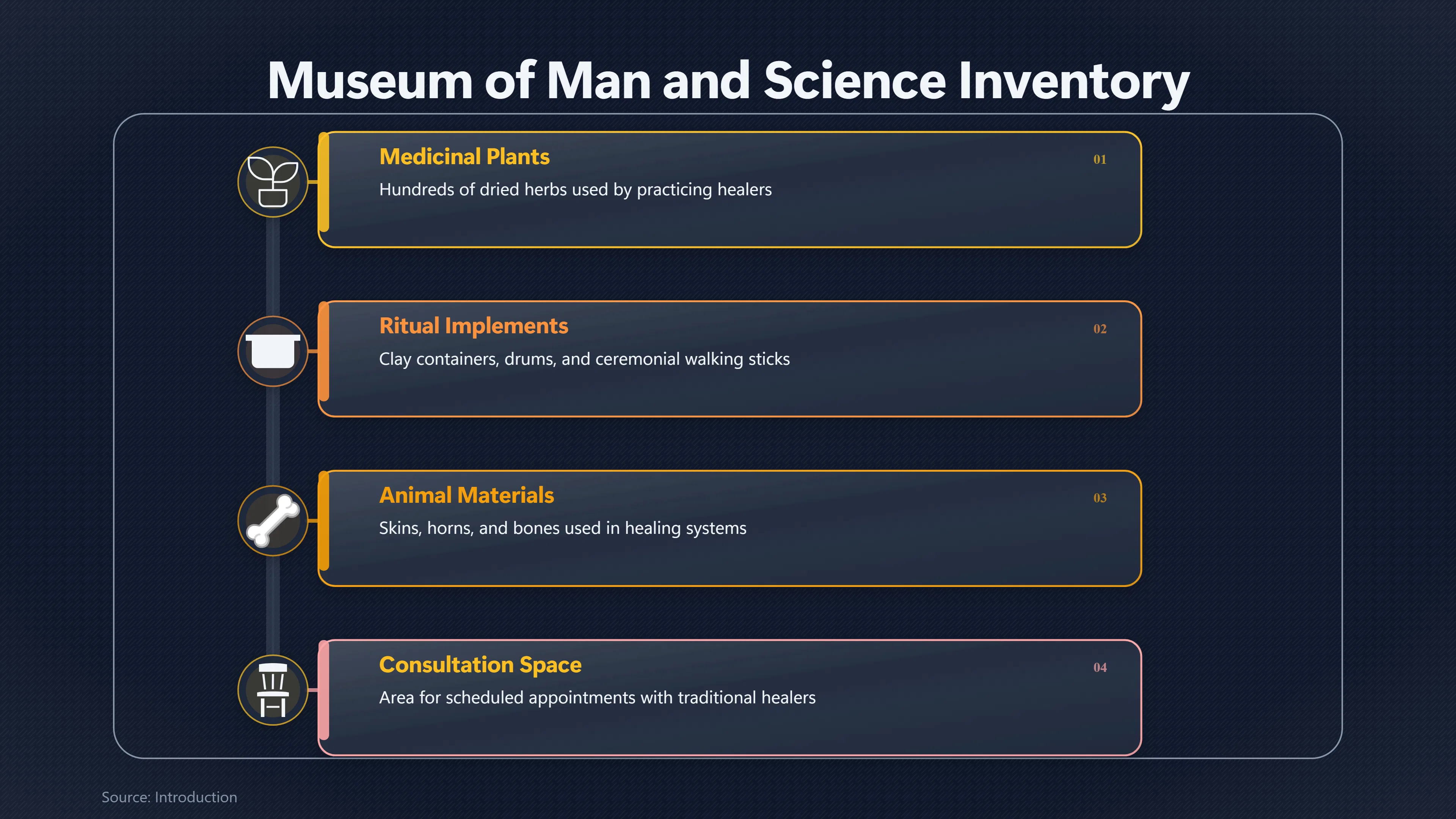
- Hundreds of medicinal herbs and plant products used by practising healers.
- Ritual implements including clay containers, walking sticks, drums and ceremonial objects.
- Animal-derived materials used within some traditional healing systems.
- Opportunities, by appointment, to consult a traditional healer rather than simply browse merchandise.[The Silo Package-Free Pantry]southafrica.infoThe Silo Package-Free Pantry Joburg's king of muti museumThe Silo Package-Free PantryJoburg's king of muti museumApril 8, 2004…
This combination of commerce, consultation and display explains why the site often appears in guides to unusual museums while simultaneously resisting that label. The collection is active rather than archival.
Why ritual and medicinal objects resist outsider labels
Many international visitors instinctively divide objects into categories such as medicine, religion, folklore or magic. Traditional South African healing practices often do not follow those distinctions so neatly.
Medicinal plants may be valued for pharmacological properties, ancestral associations or both. Ritual objects can carry cultural meaning that extends beyond their physical materials. Some remedies are intended for bodily illness, while others relate to protection, misfortune, social harmony or communication with ancestors. Presenting every item as either “scientific” or “superstitious” oversimplifies systems of knowledge that developed over centuries.[The Silo Package-Free Pantry]southafrica.infoThe Silo Package-Free Pantry Joburg's king of muti museumThe Silo Package-Free PantryJoburg's king of muti museumApril 8, 2004…
This is why respectful interpretation matters. A visitor looking only for bizarre curiosities risks misunderstanding the purpose of the collection. Conversely, romanticising every traditional practice as timeless wisdom is equally misleading. South African healthcare today commonly involves interaction between biomedical treatment and traditional healing, with individual choices varying by family, culture, location and personal belief.[Reddit]reddit.comAre these practices really this prevalent in South Africa? How does this spiritual approach to medicine compare to a western approach in…
For comparison, the Adler Museum of Medicine at the University of the Witwatersrand presents reconstructed traditional healing displays within a conventional museum setting, where interpretation is separated from commercial practice. That contrast highlights how unusual the Museum of Man and Science remains: one institution interprets traditional medicine historically, while the other continues to participate in it.[joburg.org.za]joburg.org.zaAdler Museum of MedicineAdler Museum of Medicine
Wildlife sourcing, commerce and responsible interpretation
Perhaps the most difficult ethical issue concerns animal-derived materials.
Historical descriptions of the Museum of Man and Science note the presence of skins, horns, bones and preserved animal remains alongside botanical medicines. Such displays inevitably raise questions about wildlife conservation, legal sourcing and the historical relationship between traditional medicine markets and threatened species.[The Silo Package-Free Pantry]southafrica.infoThe Silo Package-Free Pantry Joburg's king of muti museumThe Silo Package-Free PantryJoburg's king of muti museumApril 8, 2004…
It is important not to assume that every displayed object is illegal or obtained in the same way. Traditional medicine markets use a wide variety of plant and animal materials, many of which come from domestic livestock or legally traded species. At the same time, conservation organisations and researchers have documented cases in southern Africa where demand for certain wildlife products has contributed to pressure on protected species. Ethical evaluation therefore depends on the specific material, its provenance and current conservation law rather than on broad generalisations.
Responsible visitors should therefore avoid treating animal materials as photographic curiosities or souvenirs detached from their ecological context. Questions about provenance, legality and sustainability are legitimate, but should be approached respectfully rather than confrontationally.
Ethical visitor limits
Traditional-healing collections ask more of visitors than ordinary museums because they remain connected to living communities.
Good practice includes:
- Recognising that many customers are seeking healthcare or ritual services rather than performing culture for tourists.
- Asking permission before photographing people, consultations or sensitive objects.
- Avoiding assumptions that every unfamiliar object represents witchcraft or the occult.
- Respecting requests not to handle ritual items.
- Avoiding purchases that may encourage trade in protected wildlife products if provenance cannot be established.
- Remembering that commercial activity does not automatically diminish cultural authenticity; living traditions often survive precisely because they remain economically active.
The most rewarding visit usually comes from curiosity balanced with restraint. Treating the space as a functioning cultural institution rather than an exotic spectacle allows its unusual character to emerge naturally.
Why this matters within South Africa’s curiosity landscape
Among South Africa’s strange collections, the Museum of Man and Science occupies a distinctive position because it blurs categories that museums normally keep separate. It is simultaneously a shop, a repository of traditional knowledge, a tourist attraction and a place where healing practices continue to evolve.
That ambiguity is precisely what makes it valuable within the country’s wider curiosity culture. Unlike preserved historic interiors or carefully curated galleries, it demonstrates that some remarkable collections are still part of everyday social life. Visitors leave not simply having viewed unusual objects, but having confronted larger questions about cultural interpretation, commercialisation, conservation and the ethics of looking at living traditions through the lens of curiosity.
Amazon book picks
Further Reading
Books and field guides related to Museum, Medicine Shop or Curiosity Cabinet?. Use these as the next step if you want deeper reading beyond the article.
The Practice of Traditional Western Herbalism
The Practice of Traditional Western Herbalism places the function of western herbs in their true historical context, apart from homeopath...
The Secret Life of Groceries: The Dark Miracle of the America...
In this page-turning exposé, author Benjamin Lorr pulls back the curtain on the highly secretive grocery industry. Combining deep sourcin...
The Sixth Extinction: An Unnatural History
Draws on the work of geologists, botanists, marine biologists and other researchers to discuss the five devastating mass extinctions on E...
Plants, People, and Culture: The Science of Ethnobotany
First published 1997. Subjects: Ethnobotany.
eBay marketplace picks
Marketplace Samples
Live-tested eBay searches with available results related to this page.
Selected fromtraditional medicine decor oneBay.co.uk.
Endnotes
1.
Source: joburg.org.za
Title: Museum of Man and Science
Link:https://joburg.org.za/play_/Pages/Play%20in%20Joburg/Things%20to%20do/ATTRACTIONS/ATTRACTIONS%202/Museum-of-Man-and-Science.aspx
2.
Source: reddit.com
Link:https://www.reddit.com/r/southafrica/comments/sx6cng
Source snippet
Are these practices really this prevalent in South Africa? How does this spiritual approach to medicine compare to a western approach in...
3.
Source: joburg.org.za
Title: Adler Museum of Medicine
Link:https://joburg.org.za/play_/Pages/Play%20in%20Joburg/Culture%20and%20Heritage/Links/Museums/Specialist%20museum/Adler-Museum-of-Medicine.aspx
4.
Source: joburg.org.za
Link:https://joburg.org.za/play_/Pages/Play%20in%20Joburg/Out%20and%20about/Links/Great%20shops/Great-shops-in-Joburg.aspx
5.
Source: southafrica.info
Title: The Silo Package-Free Pantry Joburg’s king of muti museum
Link:https://www.southafrica.info/travel/cultural/mutimuseum
Source snippet
The Silo Package-Free PantryJoburg's king of muti museumApril 8, 2004...
Published: April 8, 2004
6.
Source: southafrica.info
Title: Mai Mai: muti capital of Jo’burg
Link:https://www.southafrica.info/travel/cities/maimaimutimarket.htm
Additional References
7.
Source: illegalwildlifetrade.net
Title: Traditional medicine and IWT in Southern Africa: a roaring trade?
Link:https://illegalwildlifetrade.net/2019/04/08/traditional-medicine-and-iwt-in-southern-africa-a-roaring-trade/
Source snippet
Oxford Martin Programme on the Wildlife TradeApril 8, 2019 — TRADITIONAL MEDICINE AND IWT IN SOUTHERN AFRICA: A ROARING TRADE? April 8, 2...
Published: April 8, 2019
8.
Source: legacy.visitdurban.travel
Title: travel Durban Muthi Market
Link:https://legacy.visitdurban.travel/destination/durban-muthi-market/
Source snippet
Muthi Market - Durban TourismMay 5, 2018 — DURBAN MUTHI MARKET Home Durban Muthi Market Search for: [Input: Search...] Hit Enter to searc...
Published: May 5, 2018
9.
Source: youtube.com
Title: What is the role of traditional healers in South Africa? | The Take
Link:https://www.youtube.com/watch?v=9HVeruv2pPw
Source snippet
Traditional medicine perspective from Ethiopia, South Africa & Ghana; WHO's Restoring Balance series...
10.
Source: youtube.com
Title: Muthi: Inside South Africa’s mystical healing tradition
Link:https://www.youtube.com/watch?v=ig-hqT8JnV8
Source snippet
What is the role of traditional healers in South Africa? | The Take...
11.
Source: youtube.com
Title: Oldest “Traditional Medicine” Muthi Market In Johannesburg
Link:https://www.youtube.com/watch?v=JRBWweL1MTM
Source snippet
Muthi: Inside South Africa's mystical healing tradition...
12.
Source: youtube.com
Title: The Muti Market
Link:https://www.youtube.com/watch?v=26C0dYojDiE
Source snippet
Oldest "Traditional Medicine" Muthi Market In Johannesburg...
13.
Source: mos.org
Link:https://www.mos.org/ethics?campaign=781609
14.
Source: nhm.ac.uk
Link:https://www.nhm.ac.uk/about-us/governance/code-of-ethics.html
15.
Source: sciencedirect.com
Link:https://www.sciencedirect.com/science/article/pii/S0254629919304776
16.
Source: goldenmetro.co.za
Title: Golden Metro Science Museum – The City of Johannesburg Metropolitan Municipality
Link:https://goldenmetro.co.za/science-museum/