Within Saudi Curiosities
Can Saudi Arabia's Private Museums Be Trusted?
Saudi private museums preserve vanished everyday life, but crowded displays can blur the line between documented antiquities and inherited curios.
On this page
- How personal collections become public museums
- What visitors find in reconstructed heritage rooms
- Licensing, authenticity and missing provenance
Page outline Jump by section
Introduction
Saudi Arabia’s private heritage museums are among the country’s most distinctive cultural attractions, but they also raise one of the most important questions a visitor can ask: how much do we know about the history of the objects on display?
The short answer is that many of these museums are genuine efforts to rescue disappearing material culture, yet the documentation behind individual objects often varies. A licensed private museum is not automatically equivalent to a research museum with fully published catalogues, conservation records and acquisition histories. Instead, visitors are often encountering collections built over decades by passionate individuals who acquired objects from family inheritances, local markets, donations and antiques dealers. That combination makes these museums both fascinating and challenging. They preserve everyday life that might otherwise have vanished, while also illustrating why provenance—the documented history of an object’s ownership and origin—matters for understanding heritage.
How personal collections become public museums
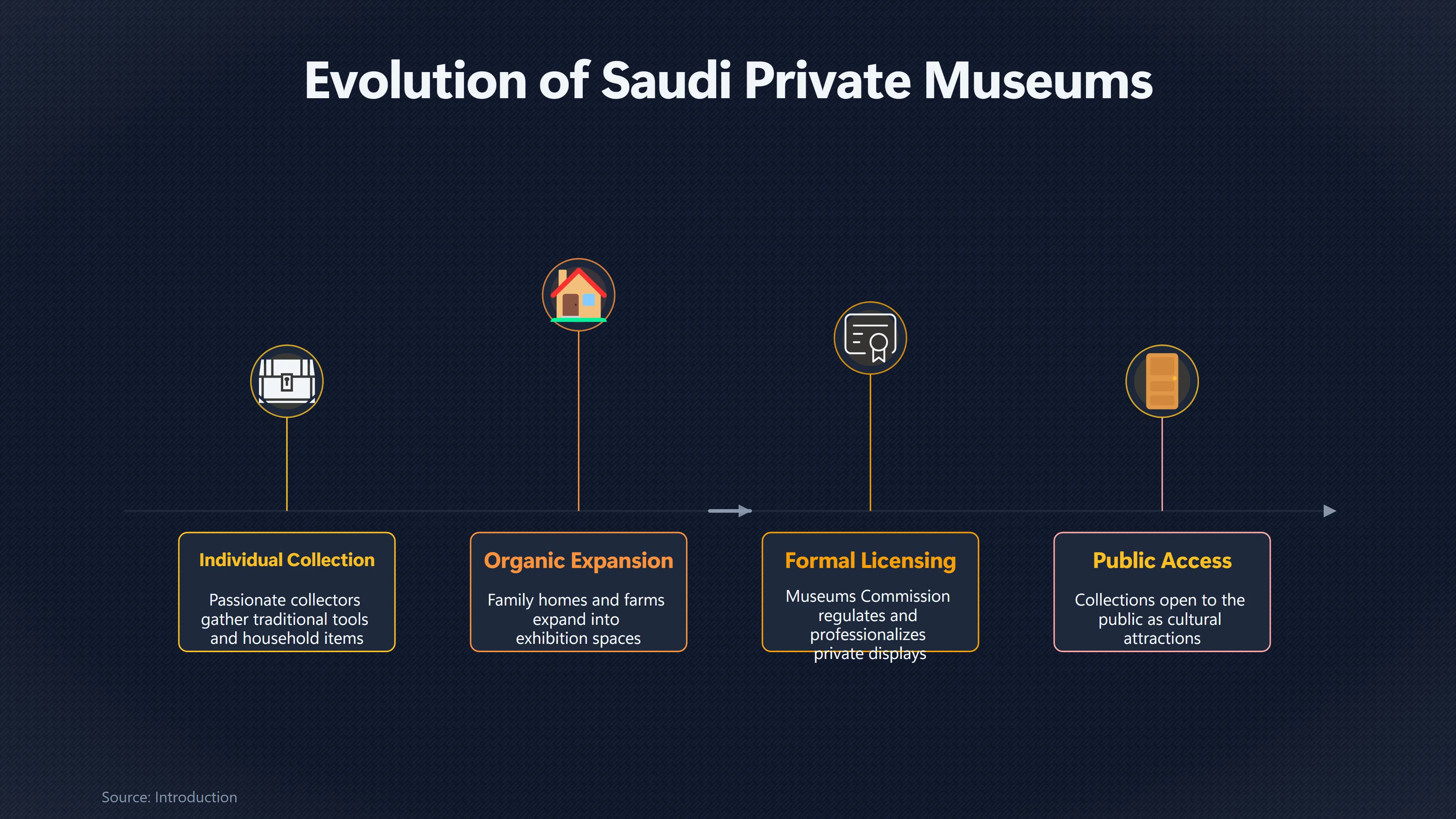
Across Saudi Arabia, private heritage museums frequently begin with a single collector rather than a government institution. Owners spend decades gathering traditional tools, clothing, domestic utensils, coffee pots, coins, manuscripts, weapons, radios, agricultural equipment and household furnishings before eventually opening their collections to the public.
Unlike national museums built around formal archaeological excavations or state collections, these museums usually grow organically. A family house expands into exhibition rooms. A farm acquires reconstructed village buildings. Large halls become densely packed with thousands of artefacts arranged to evoke everyday life before rapid urbanisation transformed much of the Kingdom.
This collector-led tradition has become sufficiently significant that Saudi Arabia now operates a formal licensing system for private museums through the Museums Commission. Museums are classified according to approved standards rather than simply opening as informal displays, reflecting the government’s effort to professionalise the sector while encouraging private cultural preservation.[MyGov]my.gov.saMy Gov Private Museums | National Platform (National PortalPrivate Museums | National Platform (National Portal)June 2, 2026…
That licensing framework should not be confused with certification of every individual object. The licence recognises the museum as an institution meeting regulatory requirements; it does not automatically authenticate the origin or history of every exhibit.
What visitors actually find inside
The appeal of Saudi private museums lies less in spectacular individual masterpieces than in overwhelming accumulation.
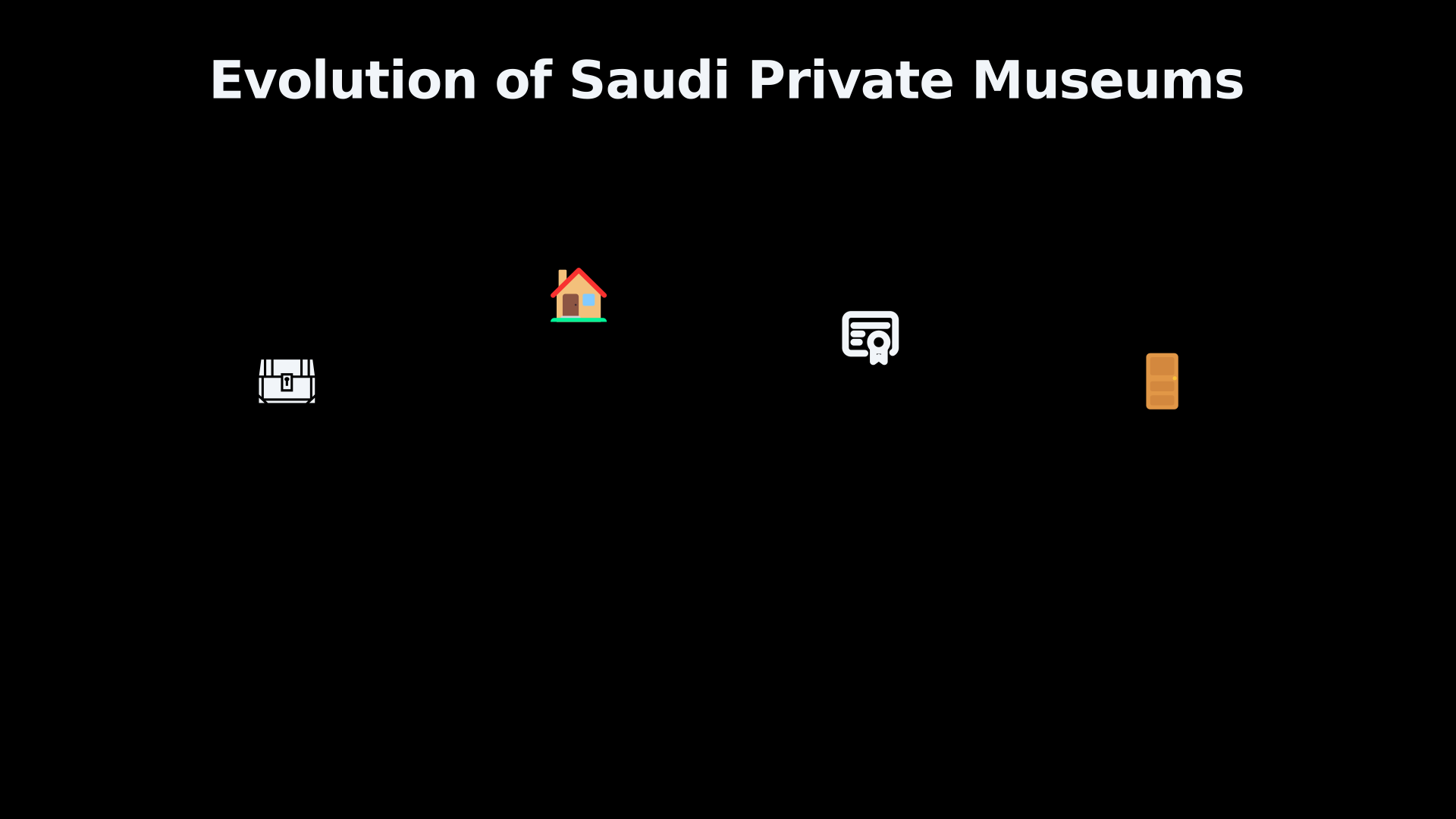
Rather than presenting isolated display cases, many museums recreate complete environments. Visitors commonly encounter:
- Traditional reception rooms furnished with original carpets, cushions and coffee equipment.
- Bridal rooms displaying clothing, jewellery and cosmetics.
- Kitchens filled with cooking vessels, grinding stones and storage jars.
- Workshops containing agricultural and craft tools.
- Small shops stocked with obsolete commercial packaging, scales and household goods.
These reconstructed interiors help explain how objects functioned together in daily life instead of treating them as isolated antiques. For many Saudi visitors, the emotional value lies in recognising objects remembered from parents’ or grandparents’ homes rather than viewing famous archaeological treasures.
This approach also explains why private museums often contain many apparently ordinary objects. An old sewing machine, kerosene lamp or radio may have little market value individually but becomes culturally significant when displayed as part of a disappearing way of life.
Why provenance becomes difficult
The provenance problem appears because these collections usually combine objects acquired through very different routes.
A single display may include:
- Family heirlooms passed down through generations.
- Items donated by local residents.
- Purchases from antiques markets.
- Objects exchanged between collectors.
- Material said to originate from archaeological contexts.
- Later reproductions made for demonstration or decoration.
Unless each object has been individually documented, visitors cannot always distinguish between these categories.
Crowded displays can unintentionally blur important differences. A nineteenth-century domestic coffee pot inherited within one family may sit beside a reproduction made for educational purposes or an archaeological object whose discovery history is only partially recorded. Visually, they appear equally authentic, even though their evidential value differs considerably.
This is not necessarily evidence of deception. Many private collectors were motivated primarily by preservation rather than academic documentation, particularly when they began collecting decades before today’s museum standards became widespread.
Licensing does not eliminate authenticity questions
Saudi Arabia has strengthened regulation of museums through the Museums Commission while maintaining broader heritage protections under the Law of Antiquities, Museums and Urban Heritage.
The legal framework defines antiquities, establishes state interests in archaeological heritage and regulates museums, licensing and cultural property. Heritage authorities also provide mechanisms for reporting archaeological finds and documenting heritage resources.[unesco.org]unesco.org1436 ahLaw of Antiquities, Museums and Urban Heritage/ Royal Decree No. M/3 dated 9/1/1436 AH - UNESCO Database of National Cultural Herit…
Even within this framework, however, provenance remains an object-by-object question.
A museum may be entirely legitimate while containing exhibits with differing levels of documentation. For example:
- Some artefacts may have complete acquisition records.
- Others may rely on family oral history.
- Some may be confidently identified as traditional household items without precise dating.
- Others may resemble archaeological material but lack published excavation records.
Professional museums face similar issues worldwide, but private collections often have fewer curatorial staff and smaller documentation budgets, making these differences more visible.
Everyday heritage versus archaeological evidence
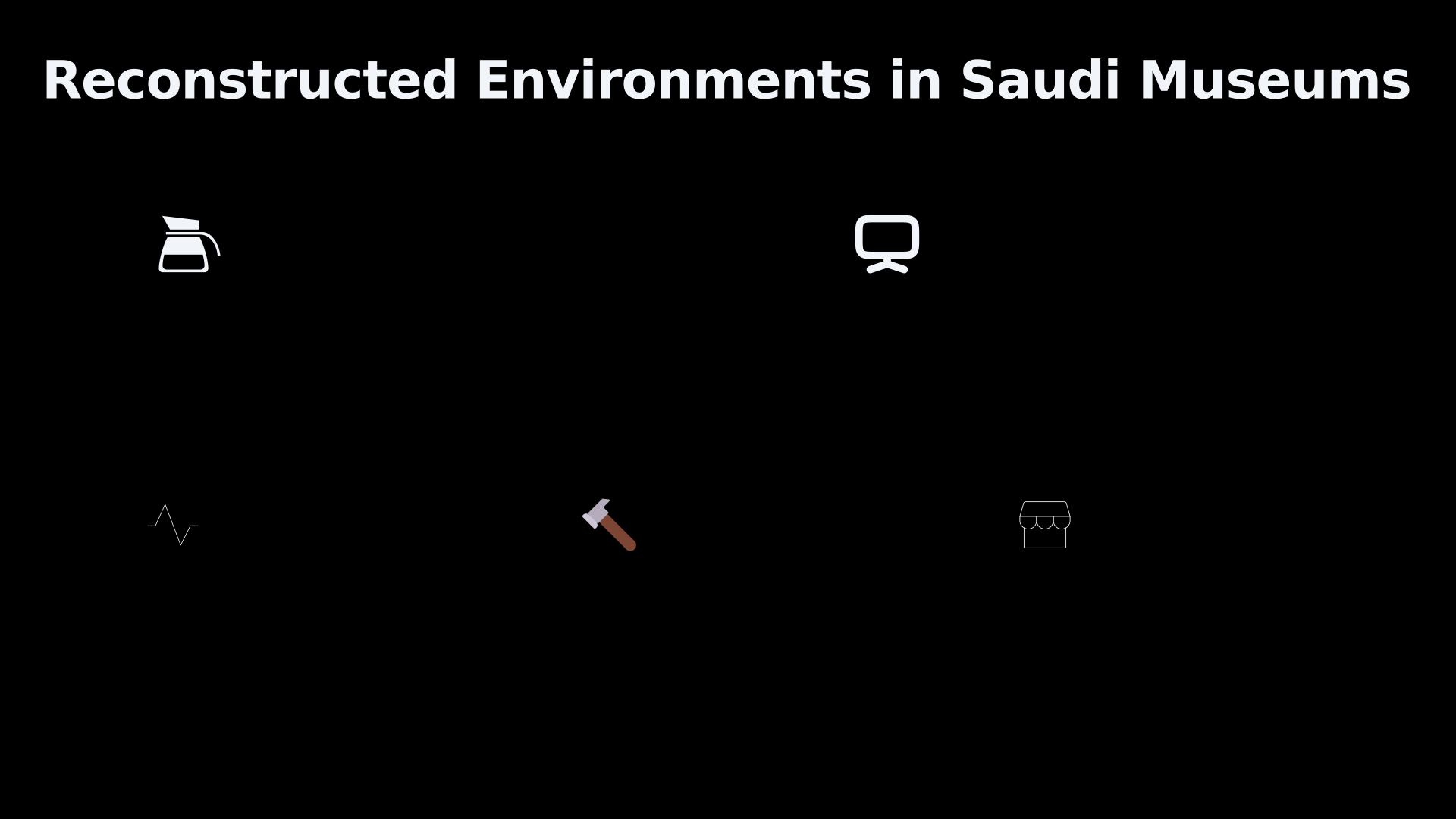
One of the easiest mistakes visitors make is assuming every old object is equally important as historical evidence.
For everyday heritage collections, precise provenance is sometimes less critical than preserving representative examples of domestic life. A traditional water vessel or hand mill can still illustrate historical lifestyles even if its complete ownership chain has not survived.
The situation changes for archaeological objects.
When an artefact is presented as originating from an ancient settlement, burial site or historic trade route, archaeologists need considerably stronger documentation. Provenance helps establish:
- Where the object was found.
- Whether it was excavated legally.
- Its relationship to nearby discoveries.
- Its approximate date.
- Its archaeological context.
Without that information, much of an object’s research value can be lost even if the object itself is genuine.
How visitors can assess a private museum critically
Visitors do not need specialist training to appreciate these museums while remaining evidence-aware.
Useful questions include:
- Are labels specific? Displays that explain where objects came from and how they entered the collection generally inspire greater confidence than vague descriptions.
- Is the museum clear about uncertainty? Responsible museums often acknowledge when dates or origins are approximate.
- Does the collection focus mainly on social history? Domestic heritage collections usually involve fewer provenance disputes than archaeological material.
- Are reconstructed rooms clearly identified? Good interpretation distinguishes original historic interiors from modern reconstructions.
- Does the museum present stories as established fact or family tradition? Oral history can be valuable, but it should be identified as such.
These questions help visitors appreciate the collection without assuming every label represents the final scholarly consensus.
Why these museums still matter
Despite legitimate questions about provenance, Saudi Arabia’s private heritage museums perform an important cultural role.
Many preserve objects that larger institutions historically overlooked because they were too common, too recent or insufficiently prestigious. Household equipment, shop signs, school materials, agricultural tools and early consumer goods often survive today because individual collectors recognised their importance before museums did.
Their greatest contribution may therefore be documenting ordinary life rather than displaying exceptional treasures.
As Saudi Arabia continues expanding its museum sector under Vision 2030, increasing professional cataloguing, conservation and digital documentation are likely to narrow the gap between passionate private collecting and modern museum practice. The challenge is not choosing between collectors and scholarship, but combining both. Personal collections preserve memories and material that might otherwise disappear, while careful provenance research allows future generations to understand not only what survives, but where it came from, how it was used and why its history can be trusted.
Amazon book picks
Further Reading
Books and field guides related to Can Saudi Arabia's Private Museums Be Trusted?. Use these as the next step if you want deeper reading beyond the article.
The Museum of Innocence
The Museum of Innocence - set in Istanbul between 1975 and today - tells the story of Kemal, the son of one of Istanbul's richest familie...
A History of the Arab Peoples
Hourani, the distinguished historian and interpreter, has written a masterwork--a panoramic view encompassing twelve centuries of Arab hi...
On Collecting: An Investigation into Collecting in the Europe...
On Collectingexamines the nature of collecting both in Europe and among people living within the European tradition elsewhere. Susan Pear...
The Ottoman Empire,
This major new survey treats the most important trends during the latter years of the Ottoman Empire. In this second edition, Donald Quat...
eBay marketplace picks
Marketplace Samples
Live-tested eBay searches with available results related to this page.
Selected fromArabian collectible oneBay.co.uk.
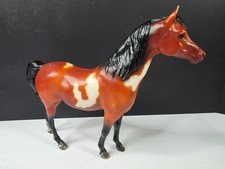
Current eBay listing
Breyer Model Horse Bay Red Overo Arabian Collectible Figurine
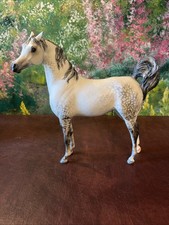
Current eBay listing
Arabian Horse Figurine Collectible is called Bint Al Sahra
Endnotes
1.
Source: unesco.org
Title: 1436 ah
Link:https://www.unesco.org/en/cultnatlaws/law-antiquities-museums-and-urban-heritage/royal-decree-no-m/3-dated-9/1/1436-ah
Source snippet
Law of Antiquities, Museums and Urban Heritage/ Royal Decree No. M/3 dated 9/1/1436 AH - UNESCO Database of National Cultural Herit...
2.
Source: unesco.org
Title: statute museums commission council ministers resolution no 1012
Link:https://www.unesco.org/en/cultnatlaws/statute-museums-commission-council-ministers-resolution-no-1012
3.
Source: whc.unesco.org
Link:https://whc.unesco.org/en/statesparties/sa/laws/
4.
Source: youtube.com
Title: Probing Provenance: The Senusret Collection
Link:https://www.youtube.com/watch?v=lyyGat9RzC8
Source snippet
Provenance Research - A Personal Concern...
5.
Source: youtube.com
Title: Provenance Research
Link:https://www.youtube.com/watch?v=iJ8be7me44c
6.
Source: my.gov.sa
Title: My Gov Private Museums | National Platform (National Portal)
Link:https://my.gov.sa/en/services/789093
Source snippet
Private Museums | National Platform (National Portal)June 2, 2026...
Published: June 2, 2026
7.
Source: museums.moc.gov.sa
Title: هيئة المتحفMuseums Commission | MOC
Link:https://museums.moc.gov.sa/en
8.
Source: heritage.moc.gov.sa
Title: هيئة التراثHeritage Commission
Link:https://heritage.moc.gov.sa/en
9.
Source: arabnews.pk
Title: saudi arabia
Link:https://www.arabnews.pk/node/2638069/saudi-arabia
Source snippet
Inside a Jeddah home turned museum | Arab News PKMarch 29, 2026 — Inside a Jeddah home turned museum /node/2638069/saudi-arabia INSIDE A...
Published: March 29, 2026
10.
Source: my.gov.sa
Link:https://my.gov.sa/en/news/3790
Source snippet
November 5, 2024 — First: The Council of Ministers approved a draft model of a memorandum of understanding regarding the political consul...
Published: November 5, 2024
11.
Source: saudipedia.com
Title: Museums Commission
Link:https://saudipedia.com/en/museums-commission
12.
Source: heritage.moc.gov.sa
Link:https://heritage.moc.gov.sa/
13.
Source: heritage.moc.gov.sa
Link:https://heritage.moc.gov.sa/en/Law-of-Antiquities
14.
Source: abdea.moc.gov.sa
Title: moc.gov.saأبدع منصّة التراخيص الثقافية
Link:https://abdea.moc.gov.sa/
15.
Source: heritage.moc.gov.sa
Link:https://heritage.moc.gov.sa/en/Services
16.
Source: museums.moc.gov.sa
Title: moc.gov.sa Cultural Licenses Platform
Link:https://museums.moc.gov.sa/en/Cultural-License
17.
Source: museums.moc.gov.sa
Title: moc.gov.sa About Us
Link:https://museums.moc.gov.sa/en/AboutUs
18.
Source: museums.moc.gov.sa
Title: moc.gov.sa FA Qs
Link:https://museums.moc.gov.sa/en/FAQ
19.
Source: museums.moc.gov.sa
Title: moc.gov.sa Terms of use
Link:https://museums.moc.gov.sa/en/Terms-of-use
20.
Source: heritage.moc.gov.sa
Link:https://heritage.moc.gov.sa/en/AboutUs
21.
Source: abdea.moc.gov.sa
Title: moc.gov.saأبدع منصّة التراخيص الثقافية
Link:https://abdea.moc.gov.sa/licenses
Additional References
22.
Source: saudigazette.com.sa
Link:https://saudigazette.com.sa/article/661066
Source snippet
Latest News from Saudi Arabia and the WorldMay 4, 2026 — HERITAGE COMMISSION SLAPS FINES ON 11 PERSONS FOR UNLICENSED TRADE IN PORTABLE A...
Published: May 4, 2026
23.
Source: gulfnews.com
Link:https://gulfnews.com/world/gulf/saudi/saudi-arabia-fines-11-people-for-unlicensed-trade-in-antiquities-1.500529253
Source snippet
May 5, 2026 — Saudi Arabia fines 11 people for unlicensed trade in antiquities World / Gulf / Saudi SAUDI ARABIA FINES 11 PEOPLE FOR UNLI...
Published: May 5, 2026
24.
Source: saudipress.com
Title: Private Museums’ Contribution to Society Discussed by Saudi Commission
Link:https://saudipress.com/private-museums-contribution-to-society-discussed-by-saudi-commission
Source snippet
Saudi PressJune 3, 2026 — SAUDI PRESS Saudi Arabia and the world Wednesday, Jun 03, 2026 PRIVATE MUSEUMS' CONTRIBUTION TO SOCIETY DISCUSS...
Published: June 3, 2026
25.
Source: youtube.com
Title: Depths of History: Provenance and Asian and Islamic Art Collections
Link:https://www.youtube.com/watch?v=pEh0DkMpHJ8
Source snippet
Provenance Research in Global Museum Collections with the Denver Art Museum...
26.
Source: youtube.com
Title: Provenance Research in Global Museum Collections with the Denver Art Museum
Link:https://www.youtube.com/watch?v=rnYNEauvW-k
Source snippet
The Art of Provenance Research: Art Detectives in Conversation...
27.
Source: youtube.com
Title: Expert Series: Who Owns History? Issues of Provenance and Restitution
Link:https://www.youtube.com/watch?v=GMXnIlpyvwI
Source snippet
Depths of History: Provenance and Asian and Islamic Art Collections...
28.
Source: youtube.com
Title: The Art of Provenance Research: Art Detectives in Conversation
Link:https://www.youtube.com/watch?v=Eb8oWlJpnPk
Source snippet
Probing Provenance: The Senusret Collection...
29.
Source: arabnews.com
Link:https://www.arabnews.com/node/2430781/amp
30.
Source: arabnews.com
Title: Saudi tourism commission launches program for private museum owners | Arab News
Link:https://www.arabnews.com/node/1410931/%7B%7B
31.
Source: arabnews.com
Title: Govt aims private museums for tourism, national economy | Arab News
Link:https://www.arabnews.com/node/945096/saudi-arabia