Within Strange Portugal
Why Portugal Displays Bones and Holy Relics
Portugal's bone chapels and reliquaries turn human remains into lessons about mortality, sainthood, belief and sacred authority.
On this page
- The Chapel of Bones as a Sermon on Mortality
- Reliquaries and the Sacred Power of Fragments
- Tourism, Authenticity and Respectful Viewing
Page outline Jump by section
Introduction
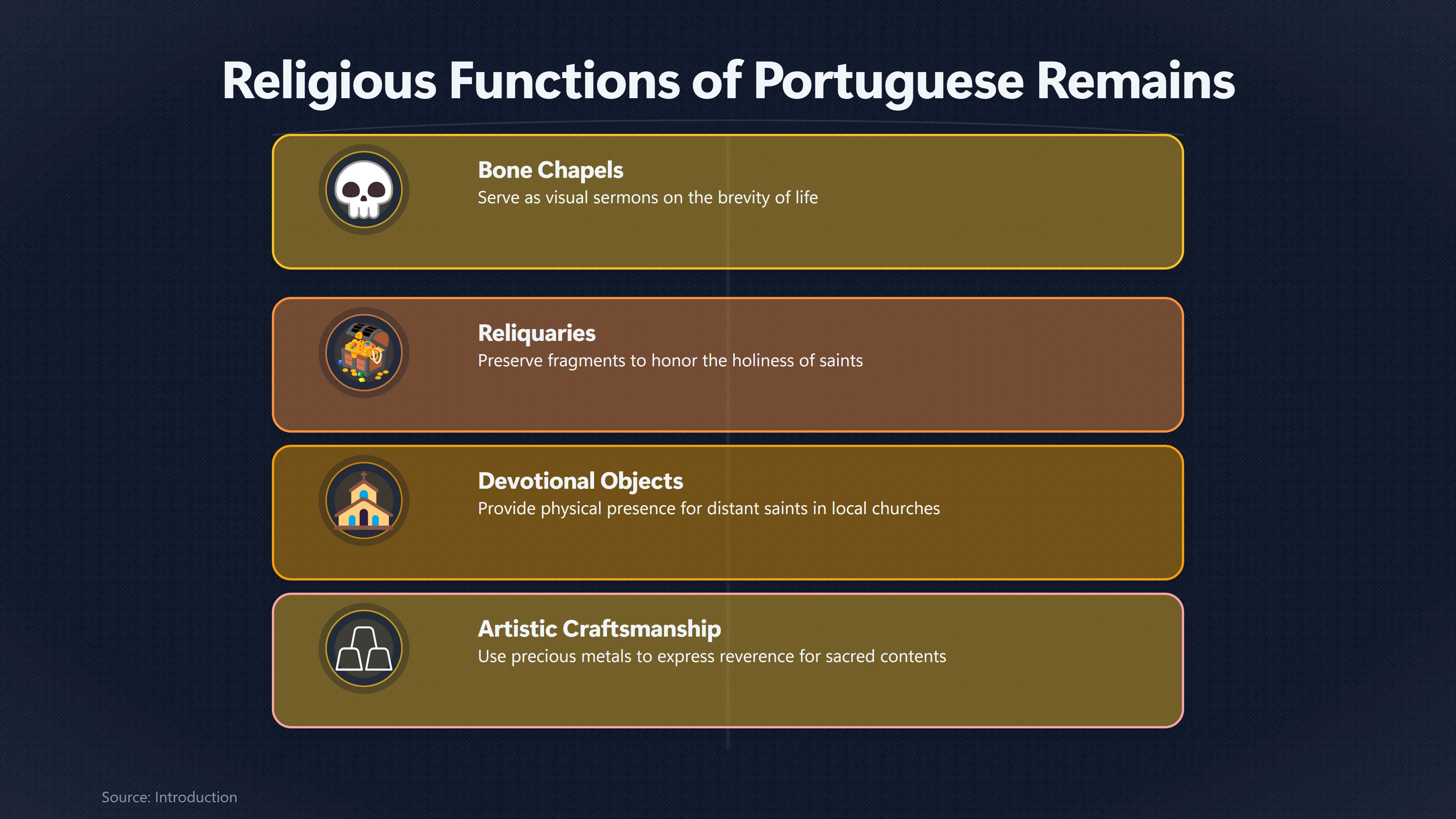
Portugal’s best-known displays of human remains are not horror attractions but expressions of Catholic belief. Bone chapels and richly decorated reliquaries were created to teach different spiritual lessons: the chapels remind visitors that death comes to everyone, while reliquaries honour the saints by preserving and displaying fragments of their bodies or possessions. Both traditions reflect a Catholic understanding that the physical body can carry religious meaning even after death.
For modern visitors, these sites are among Portugal’s most striking cultural experiences because they combine art, theology and mortality in ways that can feel unfamiliar today. Understanding why bones and relics were displayed helps explain why these places remain active heritage sites rather than macabre curiosities.
The Chapel of Bones as a Sermon on Mortality
The most famous example is the Chapel of Bones (Capela dos Ossos) in Évora, attached to the Church of São Francisco. Created by Franciscan friars during the seventeenth century, its walls and pillars are covered with thousands of human bones and skulls recovered from overcrowded cemeteries around the city. Rather than concealing death, the friars transformed it into a permanent visual sermon about the brevity of earthly life.[Cm Evora]cm-evora.ptCm Evora Igreja de São Francisco e Capela dos OssosCm EvoraIgreja de São Francisco e Capela dos Ossos - Portal InstitucionalJuly 21, 2023…
The chapel’s famous inscription, commonly translated as “We bones that are here await yours”, is often misunderstood by modern visitors as an attempt to shock. In its original religious setting it was intended as a memento mori—a reminder that every person faces death and should prepare spiritually rather than becoming absorbed by worldly concerns. The display reflects Franciscan preaching on humility, repentance and the equality of all people before God.[Cm Evora]cm-evora.ptCm Evora Igreja de São Francisco e Capela dos OssosCm EvoraIgreja de São Francisco e Capela dos Ossos - Portal InstitucionalJuly 21, 2023…
The arrangement itself is highly deliberate. Bones are organised into decorative patterns instead of being piled together randomly. White vaulted ceilings contrast with dark bands of skulls and long bones, creating a carefully designed devotional interior rather than a charnel house. The artistic order reinforces the religious message that death itself belongs within God’s order rather than existing as meaningless decay.[Wikipedia]WikipediaCapela dos OssosCapela dos Ossos
Évora is the best-known Portuguese example, but it is not unique. Other bone chapels exist, including those at Faro and Campo Maior. Although they share similar imagery, each developed within its own local history. Campo Maior, for example, became associated with a legend linking the bones to the devastating eighteenth-century explosion of the town’s armoury. Archaeological and anthropological study has found no evidence supporting that tradition, suggesting instead that the remains probably came from an ordinary church cemetery. The contrast illustrates how folklore can grow around genuine devotional monuments without replacing historical evidence.[Campo Maior]campomaior.ptCampo Maior Bones´s Chapel – Campo MaiorCampo Maior Bones´s Chapel – Campo Maior
Reliquaries and the Sacred Power of Fragments
If bone chapels speak about the mortality shared by everyone, reliquaries express almost the opposite idea: that the remains of exceptionally holy people possess enduring spiritual significance.
Catholic tradition distinguishes ordinary human remains from relics associated with recognised saints. Fragments of bone, teeth, hair or clothing were preserved because they were believed to retain a special connection with the saint’s holiness. Reliquaries therefore served both devotional and symbolic purposes, making distant saints physically present within local churches and reinforcing the authority of religious institutions.
Portugal preserves numerous historic reliquaries, but one of the country’s finest collections is displayed at Lisbon’s Museum of São Roque. Many pieces entered the Jesuit church through the sixteenth-century donation of João de Borja and include ornate caskets, monstrance-shaped reliquaries, reliquary arms and chests fashioned from precious metals, gemstones and carved wood. The emphasis falls as much on artistic craftsmanship as on the sacred fragments housed inside.[Museu de São Roque]museusaoroque.scml.ptMuseu de São Roque RELIQUARIESMuseu de São RoqueRELIQUARIES - Museu de São Roque…
These objects demonstrate an important feature of Catholic visual culture. The container was deliberately magnificent because it honoured what it enclosed. Gold, silver, crystal and enamel were not decorative excesses but expressions of reverence for the saint represented within the object.
A particularly significant Portuguese example is the reliquary bust of Saint Pantaleon, now preserved in Porto’s National Museum Soares dos Reis. Dating from the fifteenth or sixteenth century, the silver bust contains a fragment of the saint’s skull. Historical accounts connect the relic’s arrival in Porto with Armenian Christians during the late Middle Ages, after which it became closely associated with Porto Cathedral and the city’s patron saint. The bust was even carried during visits to the sick, demonstrating that reliquaries were intended for active religious use rather than passive display.[Museu Nacional Soares dos Reis]museusoaresdosreis.gov.ptMuseu Nacional Soares dos Reis Reliquary bust of St PantaleonMuseu Nacional Soares dos ReisReliquary bust of St Pantaleon - Museu Nacional Soares dos Reis…
Tourism, Authenticity and Respectful Viewing
Modern tourism inevitably changes how these places are experienced. Many visitors approach the Chapel of Bones expecting something comparable to a haunted attraction or horror exhibition because photographs emphasise rows of skulls. The historical purpose, however, remains fundamentally devotional. Even where visitor numbers are high, the buildings continue to function as religious heritage rather than themed entertainment.[Visit Portugal]visitportugal.comVisit Portugal Igreja de São Francisco / Capela dos OssosVisit PortugalIgreja de São Francisco / Capela dos Ossos - Évora | www.visitportugal.com…
Reliquaries present a different challenge. Museum displays often encourage visitors to admire exceptional craftsmanship while giving less attention to the devotional practices that originally surrounded these objects. Without that context, they can appear simply as luxurious containers rather than instruments of prayer, pilgrimage and healing.
Questions of authenticity also deserve careful attention. Portugal’s major bone chapels are well documented historically, and the human remains genuinely derive from former cemeteries rather than later theatrical additions. By contrast, local legends surrounding particular sites sometimes become more dramatic over time, as seen in Campo Maior, where archaeological investigation has challenged the popular explanation for the chapel’s bones. Distinguishing documented history from later storytelling helps preserve both historical accuracy and the cultural value of the traditions themselves.[Campo Maior]campomaior.ptCampo Maior Bones´s Chapel – Campo MaiorCampo Maior Bones´s Chapel – Campo Maior
Respectful behaviour remains important because many of these places continue to hold religious meaning. Photography may be permitted, but visitors are entering spaces created for reflection on mortality or devotion to saints, not museums designed solely for spectacle.
Why These Displays Matter in Portugal’s Curiosity Landscape
Portugal’s bone chapels and reliquaries occupy a distinctive place within the country’s culture of unusual collections because they were never assembled simply to provoke wonder. Their apparent strangeness arises from the fact that modern secular audiences often encounter them outside the religious worldview that originally gave them meaning.
Seen within that historical framework, the displays become less about death itself than about two complementary Catholic ideas. Bone chapels insist that every human life is temporary and should be lived with spiritual awareness. Reliquaries proclaim that holiness leaves a lasting legacy capable of inspiring later generations. Together they show how physical remains could become powerful instruments of teaching, remembrance and devotion—making Portugal’s sacred collections among the country’s most compelling intersections of faith, history and the unusual.
Amazon book picks
Further Reading
Books and field guides related to Why Portugal Displays Bones and Holy Relics. Use these as the next step if you want deeper reading beyond the article.
The Cult of the Saints: Its Rise and Function in Latin Christ...
A new edition of the "brilliantly original and highly sophisticated" study of saint worship after the fall of the Roman Empire ( Library...
The Oxford Handbook of the Archaeology of Death and Burial
The Oxford Handbook of the Archaeology of Death and Burial reviews the current state of mortuary archaeology and its practice, highlighti...
Catholicism
“Catholicism takes a path less traveled in leading us to explore the faith through stories, biographies, and images.”—Timothy M. Dolan, A...
Death, Burial, and the Afterlife
The essays incorporated into this volume share an ambitious interest in investigating death as an individual, social and metaphorical phe...
eBay marketplace picks
Marketplace Samples
Live-tested eBay searches with available results related to this page.
Selected fromreligious art print oneBay.co.uk.

Endnotes
1.
Source: cm-evora.pt
Title: Cm Evora Igreja de São Francisco e Capela dos Ossos
Link:https://www.cm-evora.pt/locais/igreja-de-sao-francisco-e-capela-dos-ossos/
Source snippet
Cm EvoraIgreja de São Francisco e Capela dos Ossos - Portal InstitucionalJuly 21, 2023...
Published: July 21, 2023
2.
Source: Wikipedia
Title: Capela dos Ossos
Link:https://en.wikipedia.org/wiki/Capela_dos_Ossos
3.
Source: visitportugal.com
Title: Visit Portugal Igreja de São Francisco / Capela dos Ossos
Link:https://www.visitportugal.com/en/content/igreja-de-sao-francisco-capela-dos-ossos
Source snippet
Visit PortugalIgreja de São Francisco / Capela dos Ossos - Évora | www.visitportugal.com...
4.
Source: campomaior.pt
Title: Campo Maior Bones´s Chapel – Campo Maior
Link:https://campomaior.pt/en/boness-chapel/
5.
Source: museusaoroque.scml.pt
Title: Museu de São Roque RELIQUARIES
Link:https://museusaoroque.scml.pt/en/collections/reliquaries/
Source snippet
Museu de São RoqueRELIQUARIES - Museu de São Roque...
6.
Source: museusoaresdosreis.gov.pt
Title: Museu Nacional Soares dos Reis Reliquary bust of St Pantaleon
Link:https://museusoaresdosreis.gov.pt/colecao/reliquary-bust-of-saint-pantaleon/?lang=en
Source snippet
Museu Nacional Soares dos ReisReliquary bust of St Pantaleon - Museu Nacional Soares dos Reis...
7.
Source: museusoaresdosreis.gov.pt
Link:https://museusoaresdosreis.gov.pt/st-pantaleon-patron-saint-of-porto-for-several-centuries/?lang=en
Source snippet
Museu Nacional Soares dos ReisSt Pantaleon, patron saint of Porto for several centuries - Museu Nacional Soares dos Reis...
8.
Source: museusoaresdosreis.gov.pt
Title: São Pantaleão, padroeiro do Porto durante vários séculos
Link:https://museusoaresdosreis.gov.pt/sao-pantaleao-padroeiro-do-porto-durante-varios-seculos/
9.
Source: museusaoroque.scml.pt
Title: pt Relics?
Link:https://museusaoroque.scml.pt/en/exhibitions/relics/
10.
Source: scml.pt
Title: Relicários e relíquias: um tesouro escondido no coração de Lisboa
Link:https://scml.pt/media/noticias/relicarios-e-reliquias-um-tesouro-escondido-no-coracao-de-lisboa/
11.
Source: museusoaresdosreis.gov.pt
Title: Busto relicário de São Pantaleão
Link:https://museusoaresdosreis.gov.pt/colecao/busto-relicario/
12.
Source: panteaonacional.gov.pt
Link:https://www.panteaonacional.gov.pt/en/historia
13.
Source: museusaoroque.scml.pt
Title: pt MUSEU M / CHURCH
Link:https://museusaoroque.scml.pt/en/museum-church/
14.
Source: museualbertosampaio.gov.pt
Title: reliquary chest
Link:https://www.museualbertosampaio.gov.pt/museum/collection/silverware-pagina-original/reliquary-chest/?lang=en
15.
Source: visitportugal.com
Link:https://visitportugal.com/en/content/museu-de-sao-roque
16.
Source: allaboutportugal.pt
Title: Capela dos Ossos
Link:https://www.allaboutportugal.pt/en/evora/monuments/capela-dos-ossos-2
Additional References
17.
Source: historicquarters.com
Title: Capela dos Ossos Évora: A Guide to Portugal’s Bone Chapel | Historic Quarters
Link:https://historicquarters.com/portugal/evora/capela-dos-ossos-evora
Source snippet
December 10, 2025 — CAPELA DOS OSSOS ÉVORA: A GUIDE TO PORTUGAL'S BONE CHAPEL December 10, 2025 By Historic Quarters Editorial Team Last...
Published: December 10, 2025
18.
Source: tapaaosal.pt
Title: Capela dos Ossos em Évora
Link:https://www.tapaaosal.pt/capela-ossos-evora/
Source snippet
Um dos monumentos mais conhecidos de Évora, situada na praça 1º de Maio, no centro histórico de Évora fazendo parte da igre...
19.
Source: youtube.com
Title: ÉVORA: The UNESCO City Built From 5,000 Skulls (Portugal)
Link:https://www.youtube.com/watch?v=qfYvfVbNquc
Source snippet
What's Inside Faro's Chapel of Bones? | Must-See Algarve Attraction...
20.
Source: youtube.com
Title: What’s Inside Faro’s Chapel of Bones? | Must-See Algarve Attraction
Link:https://www.youtube.com/watch?v=39tXxQg6K6s
Source snippet
Eucharistic Miracle-- Santarem Portugal--ASL...
21.
Source: youtube.com
Title: Eucharistic Miracle– Santarem Portugal–ASL
Link:https://www.youtube.com/watch?v=0yZlkzkjm0w
Source snippet
The Chapel of Bones, Portugal: All The Details You Were Afraid To Ask...
22.
Source: youtube.com
Title: Inside the EERIE Chapel of Bones | Évora, Portugal
Link:https://www.youtube.com/watch?v=JAJq02jyZ6M
Source snippet
ÉVORA: The UNESCO City Built From 5,000 Skulls (Portugal)...
23.
Source: igrejadesaofrancisco.pt
Link:https://igrejadesaofrancisco.pt/capela-dos-ossos/
24.
Source: portugaltravel.org
Link:https://www.portugaltravel.org/capela-dos-ossos-evora
25.
Source: museusemonumentos.pt
Link:https://www.museusemonumentos.pt/en/museus-e-monumentos/panteao-nacional
26.
Source: youtube.com
Title: The Chapel of Bones, Portugal: All The Details You Were Afraid To Ask
Link:https://www.youtube.com/watch?v=SMtDHmZDjpY
Source snippet
You stopped this response...