Within Strange Russia
What Makes the Kunstkamera So Unsettling?
Russia's oldest museum links scientific curiosity with imperial collecting and difficult questions about human remains.
On this page
- Peter the Great's cabinet of curiosities
- Anatomical specimens and Enlightenment science
- Empire, provenance and modern museum ethics
Page outline Jump by section
Introduction
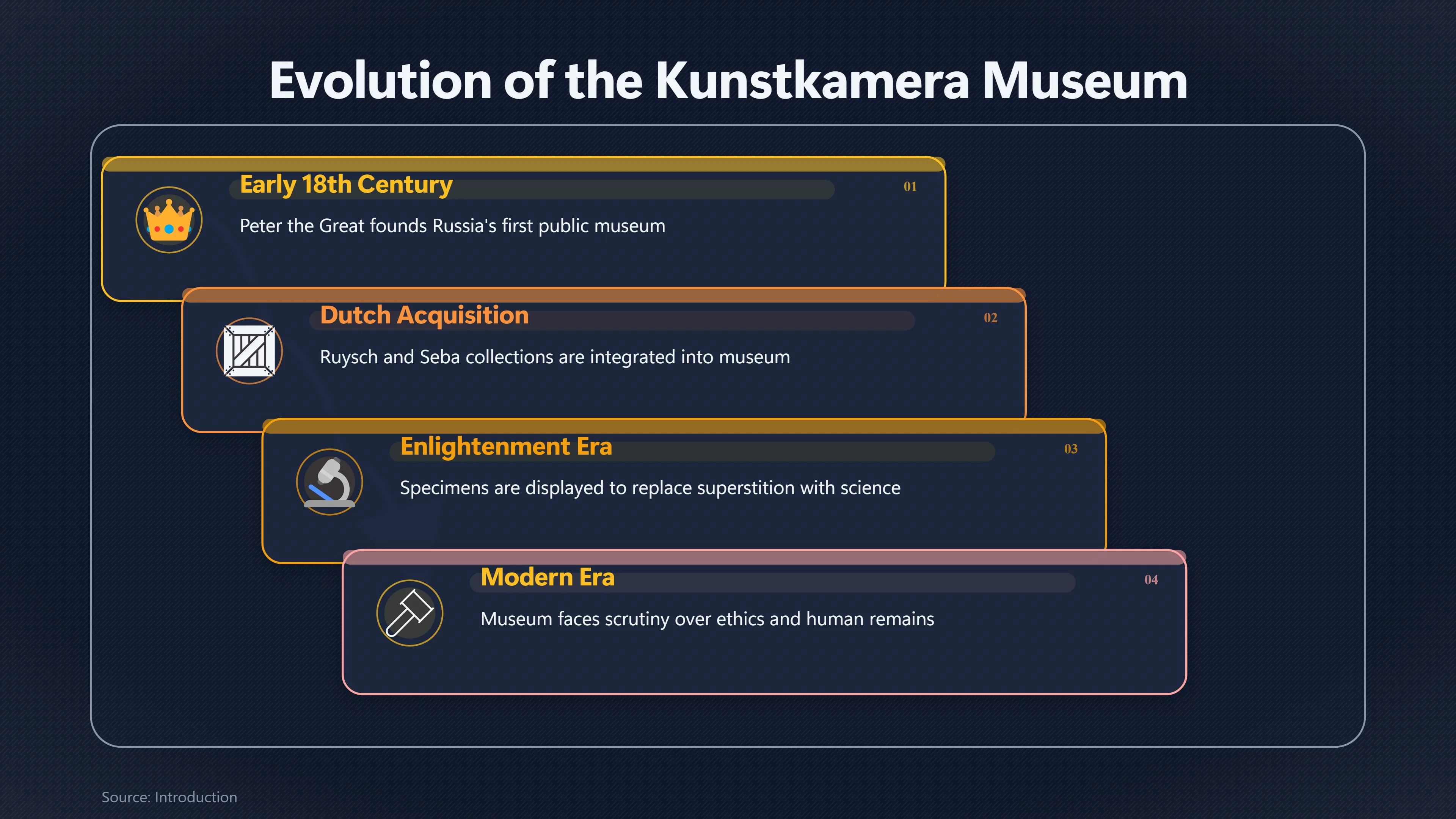
The Kunstkamera in Saint Petersburg is often described as Russia’s strangest museum, but its most unsettling feature is not simply its collection of preserved human bodies and congenital anomalies. The deeper question is whether these remains should be displayed at all, and if so, under what ethical conditions. Founded by Peter the Great in the early eighteenth century as Russia’s first public museum, the Kunstkamera was intended to replace superstition with scientific observation. Today, however, the same specimens that once symbolised Enlightenment thinking also prompt difficult debates about consent, dignity, colonial collecting and the responsibilities of modern museums. Understanding the Kunstkamera therefore means looking beyond its famous anatomical displays to the changing ethics of collecting and exhibiting human remains.[Natural History Museum]nhm.ac.ukNatural History Museum Human remains in the collection | Natural History MuseumNatural History Museum Human remains in the collection | Natural History Museum
What Makes the Kunstkamera So Unsettling?
Unlike many curiosity museums that rely on theatrical presentation, the Kunstkamera remains an active academic institution. Officially known as the Peter the Great Museum of Anthropology and Ethnography, it belongs to the Russian Academy of Sciences and combines extensive ethnographic collections with anatomical preparations that have made it internationally famous.
Many visitors arrive expecting a museum of medical oddities. Instead, they encounter a much broader institution whose reputation has become closely tied to a relatively small group of preserved human and animal specimens. These include foetuses and infants with congenital conditions, anatomical preparations acquired from Dutch collections and specimens assembled during the reign of Peter the Great. Their preservation reflects early modern scientific practice rather than modern medical collecting. The contrast between their original scientific purpose and modern expectations about privacy and bodily dignity explains why these displays continue to provoke strong reactions.
Peter the Great’s Cabinet of Curiosities
Peter the Great admired scientific collections he encountered during his travels in western Europe, particularly in the Dutch Republic. Rather than treating unusual births as supernatural signs, he wanted them studied as natural phenomena. He acquired important anatomical collections from the Dutch anatomist Frederik Ruysch, whose preservation techniques were considered remarkable, alongside natural history collections assembled by Albertus Seba. These purchases became part of the foundation of the Kunstkamera. Their purpose was educational: to encourage observation instead of fear or religious superstition.
Peter also introduced policies encouraging unusual human and animal births to be reported rather than hidden. Contemporary accounts describe rewards for specimens considered scientifically valuable. Although these policies reflected Enlightenment ideals about empirical investigation, they also reveal an era in which individual consent played little role in museum collecting. Bodies became evidence for science before they were considered people with posthumous rights in the modern sense.
The museum therefore preserves two histories simultaneously. It documents the birth of public scientific education in Russia while also preserving collecting practices that many museums would now regard as ethically problematic.[Natural History Museum]nhm.ac.ukNatural History Museum Human remains in the collection | Natural History MuseumNatural History Museum Human remains in the collection | Natural History Museum
Anatomical Specimens and Enlightenment Science
The anatomical displays were never intended simply to shock visitors. Their original educational purpose was to demonstrate that congenital differences resulted from natural developmental processes rather than demonic influence, witchcraft or divine punishment.
That distinction mattered in early eighteenth-century Russia. Public exhibition of preserved specimens formed part of a broader Enlightenment programme encouraging observation, classification and anatomical study. In this respect, the Kunstkamera resembles other early European cabinets of curiosity that gradually evolved into scientific museums.
Modern audiences, however, rarely experience these displays through the same intellectual framework. Visitors often see preserved infants and anatomical preparations first as human remains and only second as scientific specimens. This reversal changes the ethical balance. What once represented progress in scientific thinking can now appear emotionally disturbing, particularly because the individuals displayed never had the opportunity to consent to public exhibition.
The tension illustrates how museum objects do not possess fixed meanings. Their interpretation changes alongside wider cultural values concerning disability, medical history and the treatment of the dead.
Empire, Provenance and Modern Museum Ethics
The ethical debate extends beyond anatomy. The Kunstkamera’s ethnographic collections were assembled during centuries of Russian exploration, imperial expansion and scientific expeditions across Siberia, Central Asia, the Arctic and other regions. Like many large museums founded during imperial expansion, it contains material collected under political relationships that were often unequal.
This does not mean every object was improperly acquired. Provenance varies enormously between collections, acquisitions and historical periods. Nevertheless, modern museums increasingly examine how objects and human remains entered their collections, whether communities were consulted, and whether continued display remains appropriate.
Human remains raise especially sensitive questions because they cannot easily be treated as ordinary museum artefacts. Contemporary museum ethics increasingly distinguish between preserving remains for legitimate research and displaying them publicly for educational purposes. The two activities require separate ethical justification.
International museum guidance has steadily moved towards greater emphasis on provenance, consultation and respect. Current ethical standards recommend collaboration with descendant communities whenever possible, careful consideration of cultural or spiritual concerns, transparent documentation of acquisition histories and, where appropriate, discussion of restricted access or repatriation.[International Council of Museums]icom.museumCode of Ethics 2026 EN 1International Council of MuseumsICOM STANDING COMMITTEE ON ETHICSMay 7, 2026…
Why Consent Is So Difficult in Historic Collections
One reason the Kunstkamera remains controversial is that applying modern ethical principles to eighteenth-century collections is inherently difficult.
Many individuals represented in historical anatomical collections were never identified by name. Records may be incomplete or lost altogether. Descendant communities are often impossible to identify, particularly in collections assembled centuries ago. Legal ownership may be clear while moral authority remains uncertain.
As a result, museums generally face several overlapping responsibilities:
- preserving scientifically important collections for future research;
- treating human remains with dignity rather than spectacle;[metmuseum.org]metmuseum.orgStewardship of Human RemainsPress the down key to skip to the last item. Ir a: POLICY The Metropolitan Museum of Art’s mission is to collect, study, conserve, and pr…
- explaining honestly how collections were assembled;
- acknowledging historical inequalities rather than presenting collecting as politically neutral; and
- reconsidering display practices as ethical expectations evolve.
These responsibilities sometimes conflict. Removing all human remains from public view may erase important evidence about medical history and museum history. Displaying them without interpretation, however, risks reducing individuals to curiosities.
How the Kunstkamera Fits International Debates
The questions raised by the Kunstkamera are no longer unique to Russia. Museums throughout Europe, North America and elsewhere are reassessing collections assembled during the age of empire, scientific expansion and colonial anthropology.
Institutions increasingly publish human-remains policies, undertake provenance research and review requests for repatriation or restricted access. International museum organisations now stress that human remains deserve particular respect because they retain cultural, spiritual and personal significance beyond their scientific value. Decisions are increasingly expected to involve consultation rather than relying solely on curatorial authority.[International Council of Museums]icom.museumCode of Ethics 2026 EN 1International Council of MuseumsICOM STANDING COMMITTEE ON ETHICSMay 7, 2026…
The Kunstkamera sits within this wider international shift. Rather than being viewed simply as an eccentric cabinet of curiosities, it has become part of a broader conversation about how museums should balance scientific knowledge, historical transparency and respect for the dead.
Why the Museum Still Matters
The Kunstkamera remains one of the world’s most historically significant curiosity collections precisely because it embodies competing ideas that continue to shape museums today. It represents the optimism of the Enlightenment, when scientific observation challenged superstition. It also reflects imperial collecting practices that modern institutions increasingly scrutinise.
Its anatomical displays are therefore more than historical oddities. They ask visitors to confront a difficult question: when does preserving human remains serve education, and when does it risk turning people into exhibits? There is no universally accepted answer. Instead, the Kunstkamera has become a place where the history of science and the ethics of museum collecting meet, reminding visitors that museums preserve not only objects and bodies, but also the changing values of the societies that created them.
Amazon book picks
Further Reading
Books and field guides related to What Makes the Kunstkamera So Unsettling?. Use these as the next step if you want deeper reading beyond the article.
The Cabinet of Curiosities
In one of NPR's 100 Best Thrillers Ever, FBI agent Pendergast discovers thirty-six murdered bodies in a New York City charnel house . . ....
Stuff: Compulsive Hoarding and the Meaning of Things
The New York Times bestseller. "Gripping . . . By turns fascinating and heartbreaking . . . Stuff invites readers to reevaluate their des...
The Enlightenment: And Why It Still Matters
The Enlightenment and Why It Still Matters tells nothing less than the story of how the modern, Western view of the world was born. Cultu...
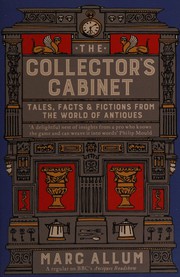
The Collector's Cabinet: Tales, Facts & Fictions from the Wor...
First published 2015. Subjects: Antiques, Collectibles.
eBay marketplace picks
Marketplace Samples
Live-tested eBay searches with available results related to this page.
Selected fromscience collectible oneBay.co.uk.

Endnotes
1.
Source: collection.kunstkamera.ru
Title: ru Frederik Ruysch’s anatomic collection
Link:https://collection.kunstkamera.ru/en/entity/ALBUM/1242134606
2.
Source: collection.kunstkamera.ru
Link:https://collection.kunstkamera.ru/en/about
3.
Source: collection.kunstkamera.ru
Link:https://collection.kunstkamera.ru/en
4.
Source: collection.kunstkamera.ru
Link:https://collection.kunstkamera.ru/en/terms-of-use
5.
Source: journal.kunstkamera.ru
Link:https://journal.kunstkamera.ru/en
6.
Source: journal.kunstkamera.ru
Link:https://journal.kunstkamera.ru/en/archive/2024_issue_4_26/kopaneva_n_the_first_catalogues_of_the_anatomical_collection_of_the_kunstkamera
7.
Source: journal.kunstkamera.ru
Link:https://journal.kunstkamera.ru/en/archive/issue_1/kopaneva_chistov/
8.
Source: journal.kunstkamera.ru
Link:https://journal.kunstkamera.ru/en/archive/2024_issue_4_26/radziun_a_a_new_look_at_an_old_collection
9.
Source: nhm.ac.uk
Title: Natural History Museum Human remains in the collection | Natural History Museum
Link:https://www.nhm.ac.uk/about-us/governance/human-remains-in-the-collection.html
10.
Source: icom.museum
Title: International Council of Museums Code of Ethics
Link:https://icom.museum/en/resources/standards-guidelines/code-of-ethics/
Source snippet
International Council of MuseumsCode of Ethics - International Council of Museums - International Council of Museums...
11.
Source: icom.museum
Title: Code of Ethics 2026 EN 1
Link:https://icom.museum/wp-content/uploads/2026/06/Code-of-Ethics_2026_EN-1.pdf
Source snippet
International Council of MuseumsICOM STANDING COMMITTEE ON ETHICSMay 7, 2026...
Published: May 7, 2026
12.
Source: metmuseum.org
Title: Stewardship of Human Remains
Link:https://www.metmuseum.org/es/policies/human-remains-guidelines
Source snippet
Press the down key to skip to the last item. Ir a: POLICY The Metropolitan Museum of Art’s mission is to collect, study, conserve, and pr...
13.
Source: biomedical-sciences.ed.ac.uk
Link:https://biomedical-sciences.ed.ac.uk/anatomy/anatomical-museum/collection
Source snippet
Collection | Anatomical Museum | Biomedical SciencesAugust 5, 2024 — THE COLLECTION The collection of the Anatomical Museum consists of a...
Published: August 5, 2024
14.
Source: biomedical-sciences.ed.ac.uk
Title: ed.ac.uk Anatomical Museum | Biomedical Sciences
Link:https://biomedical-sciences.ed.ac.uk/anatomy/anatomical-museum
Source snippet
Museum | Biomedical SciencesAugust 5, 2024 — Anatomical Museum Anatomy@Edinburgh OUR HISTORY The University of Edinburgh's Anatomical Mus...
Published: August 5, 2024
15.
Source: rmo.nl
Title: Human Remains | Rijksmuseum van Oudheden
Link:https://www.rmo.nl/en/collection/provenance/human-remains/
16.
Source: icom.museum
Title: International repatriation of human remains of indigenous peoples
Link:https://icom.museum/en/news/international-repatriation-of-human-remains-of-indigenous-peoples/
17.
Source: britishmuseum.org
Link:https://www.britishmuseum.org/our-work/departments/human-remains
18.
Source: icom.nl
Title: Code of Ethics
Link:https://icom.nl/en/about-icom/code-of-ethics
19.
Source: horniman.ac.uk
Title: Human Remains
Link:https://www.horniman.ac.uk/explore-the-collections/about-the-collections/human-remains/
20.
Source: nhm.ac.uk
Link:https://www.nhm.ac.uk/about-us/governance/code-of-ethics.html
Additional References
21.
Source: mynewsdesk.com
Link:https://www.mynewsdesk.com/icom/pressreleases/icom-adopts-its-revised-code-of-ethics-for-museums-3455988
Source snippet
ICOM adopts its revised Code of Ethics for Museums | International Council of Museums (ICOM)June 25, 2026 — Press release — 25 June 2026...
Published: June 25, 2026
22.
Source: youtube.com
Title: Should DEAD BODIES be on display? Should human remains be in museums?
Link:https://www.youtube.com/watch?v=VEqvin_zMpQ
Source snippet
Kunstkamera Saint Petersburg museum History, horror, Museum - Kunstkammer / Travel Saint Petersburg Adventures in Russia: A Traveler's Pe...
23.
Source: ed.ac.uk
Title: About one third of the museum’s col
Link:https://www.ed.ac.uk/visit/museums-galleries/anatomical
Source snippet
Anatomical Museum | Museums and galleries | The University of EdinburghNovember 12, 2024 — ANATOMICAL MUSEUM The collection consists of 1...
Published: November 12, 2024
24.
Source: youtube.com
Title: Exploring the Kunstkamera—A Journey Through St. Petersburg’s Museum
Link:https://www.youtube.com/watch?v=lUZC2lLFl_U
Source snippet
History, horror, Museum - Kunstkammer / Travel Saint Petersburg...
25.
Source: youtube.com
Title: Do Human Remains Belong in Museum Collections?
Link:https://www.youtube.com/watch?v=3iCK-DfdIMY
Source snippet
Should DEAD BODIES be on display? Should human remains be in museums?...
26.
Source: obs-traffic.museum
Link:https://www.obs-traffic.museum/ethical-standards-codes-ethics
27.
Source: penn.museum
Link:https://www.penn.museum/about/statements-and-policies/statement-on-human-remains
28.
Source: ucl.ac.uk
Link:https://www.ucl.ac.uk/social-historical-sciences/archaeology/research/human-remains-policy
29.
Source: icom-cc-publications-online.org
Link:https://www.icom-cc-publications-online.org/1873/Towards-a-binding-code-of-ethics-for-the-conservation-and-display-of-human-remains
30.
Source: smb.museum
Link:https://www.smb.museum/en/museums-institutions/ethnologisches-museum/about-us/restitutions/