Within Strange Singapore
What Can a Million Preserved Animals Reveal?
More than a million preserved animals form a research archive that records species, habitats and environmental change.
On this page
- Inside the Zoological Reference Collection
- How Labels Turn Bodies into Evidence
- Saving Singapore's Natural History Archive
Page outline Jump by section
Introduction
Singapore’s most remarkable scientific curiosity is not a single spectacular skeleton or preserved animal on public display, but an immense research archive hidden behind the galleries of the Lee Kong Chian Natural History Museum. More than one million zoological specimens, collected over well over a century, form one of Southeast Asia’s most important biodiversity collections. Individually, many specimens appear ordinary: a fish in alcohol, a pinned insect, a bird skin or a crab in a jar. Collectively, however, they become scientific evidence. Every specimen links a physical organism to information about where, when and how it was collected, allowing researchers to reconstruct changing ecosystems, verify species identities, describe new species and measure environmental change across decades. Rather than preserving curiosities for their own sake, Singapore’s zoological archive demonstrates how carefully documented collections transform dead animals into enduring records of the natural world.[NUS LKCNHM]lkcnhm.nus.edu.sgNUS LKCNHMAbout the Zoological Reference CollectionNUS LKCNHM…

What Can a Million Preserved Animals Reveal?
The Lee Kong Chian Natural History Museum is best known to visitors for its dinosaur skeletons and dramatic whale display, yet these exhibits represent only a tiny fraction of its holdings. Behind the public galleries lies the Zoological Reference Collection (ZRC), an internationally recognised research archive containing more than one million specimens representing at least 10,000 species, the majority originating from Southeast Asia. Many collections—including freshwater fishes, birds and decapod crustaceans—are regarded as among the strongest regional reference collections available to scientists.[NUS LKCNHM]lkcnhm.nus.edu.sgNUS LKCNHMAbout the Zoological Reference CollectionNUS LKCNHM…
Unlike display specimens chosen to impress visitors, reference collections exist to answer scientific questions. Researchers use them to:
- confirm the identity of species;
- compare newly collected animals with historical examples;
- document the geographical distribution of wildlife;
- detect environmental and ecological change over long periods;
- describe species previously unknown to science;
- preserve evidence that can be re-examined as scientific methods improve.
The collection therefore functions less like a traditional museum gallery than a continuously expanding scientific database built from physical evidence. Even specimens collected more than a century ago remain valuable because they can be revisited using techniques—including DNA analysis and advanced imaging—that were unimaginable when they were first preserved.[NUS LKCNHM]lkcnhm.nus.edu.sgNUS LKCNHMAbout the Zoological Reference CollectionNUS LKCNHM…
Inside the Zoological Reference Collection
The archive contains a remarkable diversity of preserved material rather than one dominant collection type. Wet specimens stored in alcohol preserve soft tissues and internal anatomy. Bird skins and mammal specimens retain external features useful for comparison. Skeletons reveal anatomical structure, while microscopic organisms, insects, crustaceans, molluscs and fishes are stored using preservation methods suited to each group. Together they create a comprehensive reference library of Southeast Asian biodiversity.[NUS LKCNHM]lkcnhm.nus.edu.sgNUS LKCNHMAbout the Zoological Reference CollectionNUS LKCNHM…
Many of these specimens are historically irreplaceable. Some were collected before extensive urbanisation transformed Singapore’s landscape, recording habitats that have since disappeared or changed dramatically. Others come from scientific expeditions across Southeast Asia, documenting ecosystems that are now under pressure from development, pollution or climate change. Because specimens are permanent records, researchers can repeatedly extract new information without needing to relocate the original populations.[NUS LKCNHM]lkcnhm.nus.edu.sgNUS LKCNHMAbout the Zoological Reference CollectionNUS LKCNHM…
The collection also contains many unsorted or partially processed holdings gathered during biodiversity surveys. Although these lack the immediate visibility of catalogue specimens, they represent future research potential as taxonomists continue identifying and describing material collected from across the region.[NUS LKCNHM]lkcnhm.nus.edu.sgNUS LKCNHMAbout the Zoological Reference CollectionNUS LKCNHM…

How Labels Turn Bodies into Evidence
A preserved animal without documentation has limited scientific value. The evidence comes from the information attached to it.
Each research specimen ideally carries detailed metadata including:
- precise collection locality;
- collection date;
- collector’s identity;
- habitat description;
- preservation method;
- taxonomic identification;
- catalogue number linking the specimen to museum records.
This documentation allows scientists to verify claims rather than relying on memory or published descriptions alone. If taxonomic classifications change—as they frequently do—the original specimen can be re-examined. If researchers question where a species once occurred, the specimen’s locality data provide independently verifiable evidence.
The importance of systematic documentation has been recognised in Singapore for well over a century. Curators of the former Raffles Library and Museum argued during the late nineteenth century that specimens required clear collecting objectives and accurate records rather than being assembled simply as cabinets of interesting objects. That philosophy remains fundamental to the museum’s scientific role today.[Roots]roots.gov.sgLearning Through Looking: The Natural History Collection of the Former Raffles Library and MuseumOctober 15, 2020…

Saving Singapore’s Natural-History Archive
The scientific collection has survived repeated institutional changes that could easily have dispersed or destroyed it.
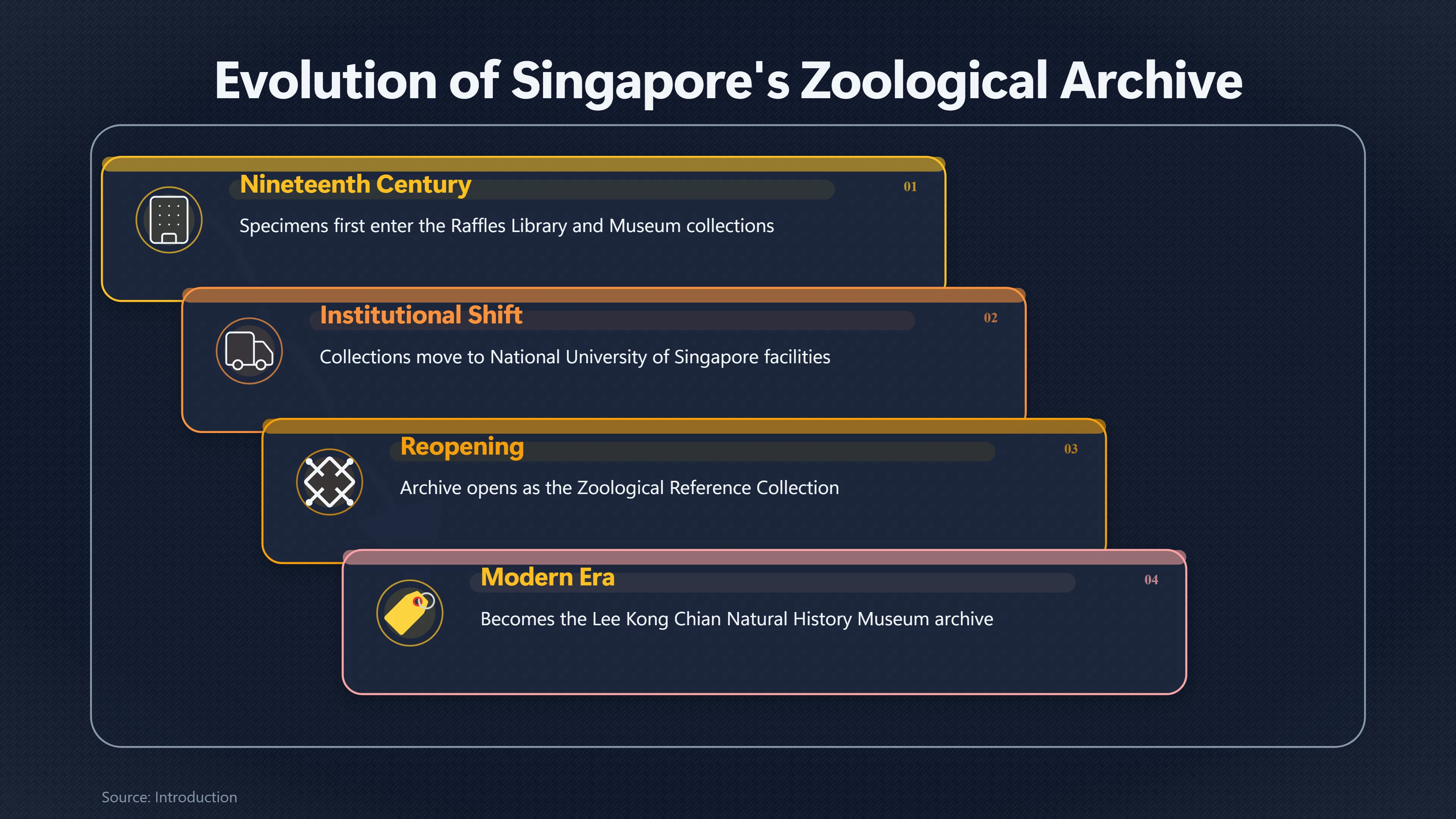
Natural history specimens first entered the collections of the Raffles Library and Museum during the nineteenth century, where mounted animals, skeletons and preserved specimens formed the institution’s dominant displays. As Singapore’s museum landscape evolved, the zoological collections eventually moved to what is now the National University of Singapore, reopening in 1988 as the Zoological Reference Collection before becoming the foundation of today’s Lee Kong Chian Natural History Museum.[edu.sg]lkcnhm.nus.edu.sgNUS LKCNHMMuseum HistoryNUS LKCNHM…
The continuity of the collection is scientifically significant. Long-running archives gain value precisely because they preserve consistent records across generations. A specimen collected in the early twentieth century can now be compared directly with material gathered from the same locality today, allowing researchers to detect shifts in species ranges, body size, genetic diversity or habitat condition that would otherwise remain invisible.[NUS LKCNHM]lkcnhm.nus.edu.sgNUS LKCNHMAbout the Zoological Reference CollectionNUS LKCNHM…
Equally important are the museum’s supporting archives. Field notebooks, accession registers, catalogue cards, photographs and correspondence preserve the context in which specimens were collected. These documentary collections help modern researchers interpret older material whose significance might otherwise be lost, linking biological evidence with the history of scientific exploration in Singapore and Southeast Asia.[NUS LKCNHM]lkcnhm.nus.edu.sgNUS LKCNHMLibrary and Archive Sub-collectionNUS LKCNHM…
Why This Archive Matters Beyond the Museum
Natural-history collections are sometimes mistaken for static warehouses of preserved animals. In reality, they function as active scientific infrastructure.
Specimens support biodiversity surveys, conservation planning, environmental impact studies and taxonomic research. Historical records help establish whether species are native, introduced or locally extinct, while authenticated reference material allows scientists worldwide to compare newly collected animals against verified examples. Because the collection is internationally recognised, researchers throughout Southeast Asia regularly use it as a benchmark for identifying regional fauna.[NUS LKCNHM]lkcnhm.nus.edu.sgNUS LKCNHMAbout the Zoological Reference CollectionNUS LKCNHM…
For visitors, this changes the way the museum can be understood. The dinosaurs and whale skeletons provide memorable entry points, but the institution’s greatest curiosity lies behind the scenes. Rows of labelled jars, drawers and cabinets may lack theatrical drama, yet they represent something rarer: a continuously growing archive that records the biological history of Singapore and its neighbouring countries through physical evidence rather than memory alone. In a nation where many unusual collections are valued for folklore, morality or spectacle, the Zoological Reference Collection stands apart because every preserved specimen is intended to answer scientific questions that future generations have not yet thought to ask.[NUS LKCNHM]lkcnhm.nus.edu.sgNUS LKCNHMAbout the Zoological Reference CollectionNUS LKCNHM…
Amazon book picks
Further Reading
Books and field guides related to What Can a Million Preserved Animals Reveal?. Use these as the next step if you want deeper reading beyond the article.
Stuff
The New York Times bestseller. "Gripping . . . By turns fascinating and heartbreaking . . . Stuff invites readers to reevaluate their des...
The Diversity of Life
View a collection of videos on Professor Wilson entitled "On the Relation of Science and the Humanities" "In the Amazon Basin the greates...
The Sixth Extinction: An Unnatural History
"Over the last half billion years, there have been five major mass extinctions, when the diversity of life on Earth suddenly and dramatic...
The Species Seekers: Heroes, Fools, and the Mad Pursuit of Li...
Conniff tells the story of bold adventurers who risked death to discover strange life forms in the farthest corners of planet Earth.
eBay marketplace picks
Marketplace Samples
Live-tested eBay searches with available results related to this page.
Selected fromnatural history poster oneBay.co.uk.
Current eBay listing
Natural History Museum Framed Wall Art Poster Canvas Print Picture
Current eBay listing
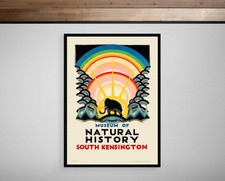
Museum of Natural History Art Deco Travel Poster: Fine Art Print
Endnotes
1.
Source: lkcnhm.nus.edu.sg
Title: NUS LKCNHMAbout the Zoological Reference Collection
Link:https://lkcnhm.nus.edu.sg/research/our-collections/
Source snippet
NUS LKCNHM...
2.
Source: lkcnhm.nus.edu.sg
Title: NUS LKCNHMMuseum History
Link:https://lkcnhm.nus.edu.sg/our-story/museum-history/
Source snippet
NUS LKCNHM...
3.
Source: lkcnhm.nus.edu.sg
Title: NUS LKCNHMLibrary and Archive Sub-collection
Link:https://lkcnhm.nus.edu.sg/research/library-and-archive-sub-collection-2/
Source snippet
NUS LKCNHM...
4.
Source: lkcnhm.nus.edu.sg
Title: NUS LKCNHMAbout Biodiversity Histories Collection
Link:https://lkcnhm.nus.edu.sg/research/about-biodiversity-histories-collection/
Source snippet
NUS LKCNHM...
5.
Source: m.singapore.biodiversity.online
Link:https://m.singapore.biodiversity.online/about.html
6.
Source: singapore.biodiversity.online
Link:https://singapore.biodiversity.online/credits.html
7.
Source: news.nus.edu.sg
Title: NUS Newsroom NUS Launches Singapore’s First and Only Natural History Museum
Link:https://news.nus.edu.sg/nus-launches-singapores-first-and-only-natural-history-museum/
8.
Source: news.nus.edu.sg
Title: NUS Newsroom Natural History Museum opens
Link:https://news.nus.edu.sg/natural-history-museum-opens/
9.
Source: roots.gov.sg
Link:https://www.roots.gov.sg/stories-landing/stories/learning-through-looking-the-natural-history-collection-of-the-former-raffles-library-and-museum/story
Source snippet
Learning Through Looking: The Natural History Collection of the Former Raffles Library and MuseumOctober 15, 2020...
Published: October 15, 2020
10.
Source: roots.gov.sg
Title: Roots Zoological section of the Raffles Library and Museum
Link:https://www.roots.gov.sg/Collection-Landing/listing/1062247
11.
Source: reference.nlb.gov.sg
Title: nlb.gov.sg About the Lee Kong Chian Reference Library
Link:https://reference.nlb.gov.sg/about-us/lkcrl/
Source snippet
the Lee Kong Chian Reference LibraryJuly 13, 2026 — ABOUT THE LEE KONG CHIAN REFERENCE LIBRARY IMAGE: LEE KONG CHIAN REFERENCE LIBRARY Th...
Published: July 13, 2026
12.
Source: reference.nlb.gov.sg
Title: nlb.gov.sg About National Library Singapore
Link:https://reference.nlb.gov.sg/about-us/national-library/
Source snippet
National Library SingaporeJuly 13, 2026 — ABOUT NATIONAL LIBRARY SINGAPORE Image Image: National Library The National Library is a nation...
Published: July 13, 2026
13.
Source: lkcnhm.nus.edu.sg
Title: the lee kong chian natural history museums e annual report ay2024 2025 is out
Link:https://lkcnhm.nus.edu.sg/the-lee-kong-chian-natural-history-museums-e-annual-report-ay2024-2025-is-out/
14.
Source: news.nus.edu.sg
Link:https://news.nus.edu.sg/from-catching-longkang-fish-to-heading-singapores-only-natural-history-museum/
15.
Source: nus.edu.sg
Title: Up Close with the NUS Lee Kong Chian Natural History Museum
Link:https://nus.edu.sg/nusgiving/news-article/2022/02/09/up-close-with-the-nus-lee-kong-chian-natural-history-museum
16.
Source: roots.gov.sg
Title: Zoological specimens at the Raffles Library and Museum
Link:https://www.roots.gov.sg/Collection-Landing/listing/1063495
17.
Source: roots.gov.sg
Title: Zoological display at the Raffles Library and Museum
Link:https://www.roots.gov.sg/Collection-Landing/listing/1061174
18.
Source: roots.gov.sg
Title: Lee Kong Chian Natural History Museum
Link:https://www.roots.gov.sg/places/places-landing/Places/museums/lee-kong-chian-natural-history-museum
19.
Source: fass.nus.edu.sg
Link:https://fass.nus.edu.sg/srn/2020/05/18/the-raffles-museum-and-the-fate-of-natural-history-in-singapore/
20.
Source: nuspress.nus.edu.sg
Link:https://nuspress.nus.edu.sg/collections/critical-heritage-studies/products/of-whales-and-dinosaurs
21.
Source: museum.nus.edu.sg
Link:https://museum.nus.edu.sg/explore/collections/
22.
Source: lkcnhm.nus.edu.sg
Title: the zoological reference collection 1972 1989 report
Link:https://lkcnhm.nus.edu.sg/rbz/the-zoological-reference-collection-1972-1989-report/
23.
Source: lkcnhm.nus.edu.sg
Title: nus.edu.sg Our Story
Link:https://lkcnhm.nus.edu.sg/our-story/
24.
Source: science.nus.edu.sg
Link:https://www.science.nus.edu.sg/annual-report-2021/lkcnhm/
25.
Source: law.nus.edu.sg
Title: nus.edu.sg Of Whales and Dinosaurs: Singapore’s Natural History Museum
Link:https://law.nus.edu.sg/publications/of-whales-and-dinosaurs-singapores-natural-history-museum/
Additional References
26.
Source: youtube.com
Link:https://www.youtube.com/watch?v=BbQQmeMV8ys
Source snippet
Researchers from Lee Kong Chian Natural History Museum identify new species of firefly...
27.
Source: youtube.com
Link:https://www.youtube.com/watch?v=UDqklX5DDX8
Source snippet
Lee Kong Chian Natural History Museum creates virtual catalogue of butterflies...
28.
Source: youtube.com
Title: Explore With Us: 10 Years of the Lee Kong Chian Natural History Museum
Link:https://www.youtube.com/watch?v=Yk0EpVbFBKo
Source snippet
'Siglap': The Lee Kong Chian Natural History Museum's first and only leatherback turtle specimen...
29.
Source: youtube.com
Title: Guarding Singapore’s Natural History Treasures: It’s A Wild Life
Link:https://www.youtube.com/watch?v=2Qgrpp6d4Qs
Source snippet
Explore With Us: 10 Years of the Lee Kong Chian Natural History Museum...
30.
Source: youtube.com
Title: Lee Kong Chian Natural History Museum creates virtual catalogue of butterflies
Link:https://www.youtube.com/watch?v=T227TGxuuf4
Source snippet
LKCNHM5 e-Celebrations: Museum Milestones...
31.
Source: familiesforlife.sg
Link:https://familiesforlife.sg/play-as-a-family/Pages/Lee-Kong-Chian-Natural-History-Museum.aspx
32.
Source: youtube.com
Title: LKCNHM5 e-Celebrations: Museum Milestones
Link:https://www.youtube.com/watch?v=RJBDAR_aNBk
33.
Source: signifynaturalhistory.sg
Link:https://signifynaturalhistory.sg/about
34.
Source: artsandculture.google.com
Title: lkc natural history museum
Link:https://artsandculture.google.com/partner/lkc-natural-history-museum