Within Sweden Curiosities
What Viking Artefacts Reveal About Ancient Beliefs
Sweden's archaeological collections reveal Viking beliefs, burial customs and ancient practices through objects studied by modern researchers.
On this page
- Objects from Viking religion and rituals
- How archaeologists interpret mysterious finds
- Myth, evidence and the limits of certainty
Page outline Jump by section
Introduction
Sweden’s Viking artefacts reveal a world where objects were not simply possessions but carriers of belief, identity and ritual meaning. From silver pendants linked to gods and fertility, to weapon deposits, decorated helmets and unusual burial goods, archaeological collections show that Viking-age people connected everyday life with ideas about protection, fate, ancestors and the unseen world. The evidence is especially valuable because much of what is known about Old Norse religion comes from a combination of objects, graves, place names and later written traditions, each of which must be interpreted carefully.[Historiska Museet]historiska.seMuseet Norse religion in the Viking AgeHistoriska MuseetNorse religion in the Viking Age - Historiska museetNovember 10, 2025…

For visitors exploring Sweden’s unusual history collections, these artefacts are among the closest things to a physical record of ancient mysteries. The Swedish History Museum in Stockholm preserves thousands of Viking-age objects and presents them alongside research into mythology, rituals and changing interpretations of the past.[Historiska Museet]historiska.seMuseet The Swedish History MuseumHistoriska MuseetThe Swedish History Museum… The mystery is not that the objects are unexplained; rather, it lies in how archaeologists reconstruct beliefs from fragments left behind by people whose own voices are mostly lost.
Objects from Viking religion and rituals
Thor’s hammers, gods and protective objects
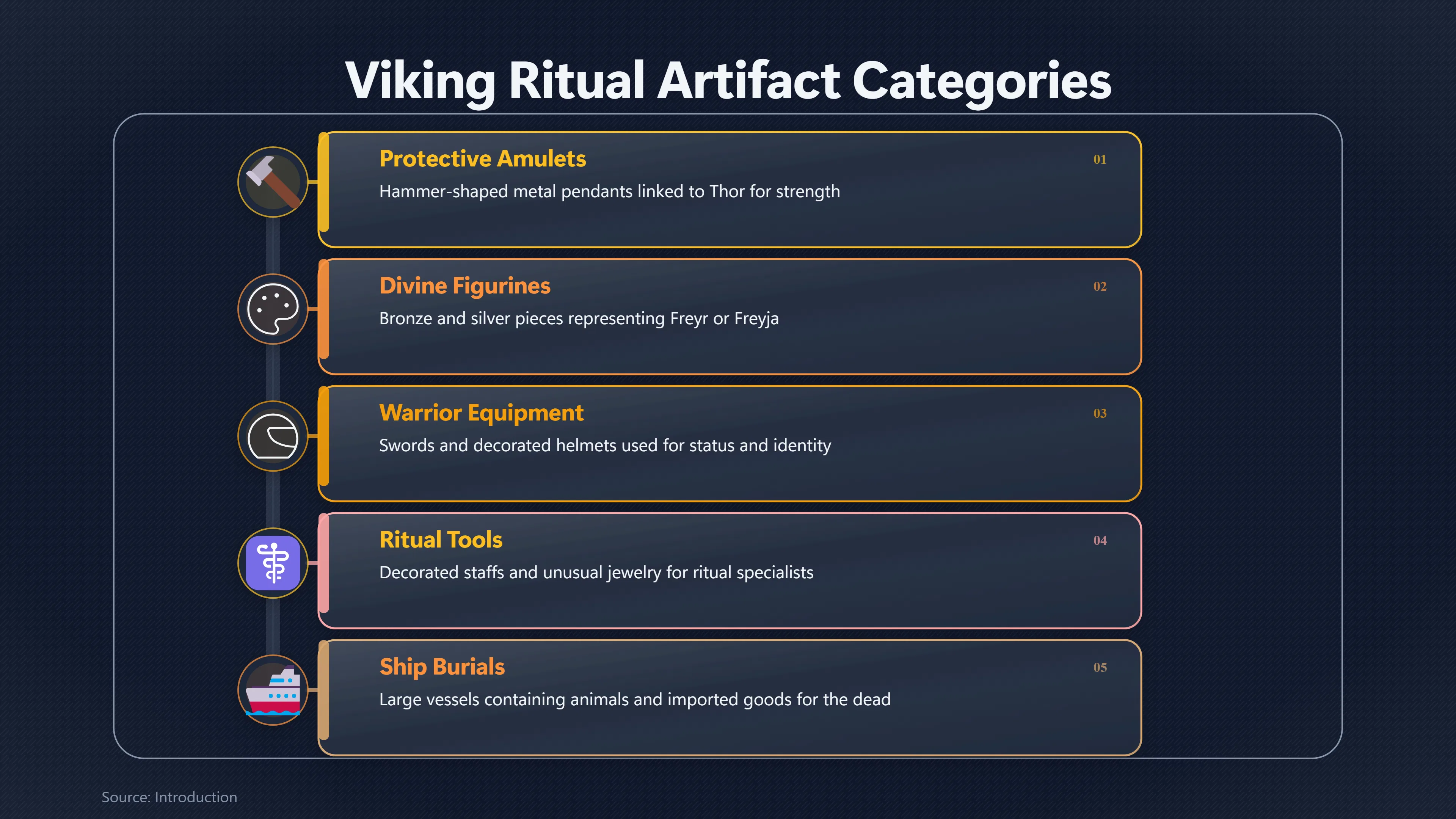
Small metal pendants are among the most recognisable objects connected with Viking belief. Hammer-shaped amulets are commonly interpreted as symbols of Thor, the thunder god associated in later mythology with protection and strength. Their appearance in Viking-age contexts has often been linked to a period when Christianity was spreading through Scandinavia and crosses were also becoming common symbols of identity.[Historiska Museet]historiska.seMuseet Norse religion in the Viking AgeHistoriska MuseetNorse religion in the Viking Age - Historiska museetNovember 10, 2025…
However, archaeologists avoid treating every hammer pendant as a simple statement of religious allegiance. An object worn on the body could have carried several meanings at once: personal protection, family identity, social status or participation in a wider tradition. The same object type might have been understood differently in different regions and generations.
The Swedish History Museum’s collections also include small figurines and pendants connected with possible divine figures. A bronze figurine interpreted as the fertility god Freyr and silver objects associated with Freyja demonstrate how archaeological evidence can illuminate religious ideas, while still leaving questions about exactly how individuals used these items in daily life.[Historiska Museet]historiska.seMuseet Norse religion in the Viking AgeHistoriska MuseetNorse religion in the Viking Age - Historiska museetNovember 10, 2025…
Burial goods: messages for the living and the dead
Viking graves are among the richest sources for understanding ritual practice. Weapons, jewellery, tools, animals and imported goods were sometimes placed with the dead, suggesting beliefs about status, memory and continued existence beyond life. Yet the meaning of grave goods is debated: a sword might represent a warrior identity, a family heirloom, social prestige or a symbolic offering rather than a practical item for an afterlife journey.
Ship burials are among the most dramatic examples of this tradition. Although Sweden has important ship-burial discoveries from the wider Scandinavian world, the interpretation of these graves depends on comparing different regions rather than assuming one universal Viking ritual. Archaeologists studying ship burials examine the arrangement of objects, construction methods and traces of ceremony to understand how communities created powerful statements about people after death.[Viking]viking.archeurope.comViking The Oseberg Ship Burial and its Finds | Viking ArchaeologyViking The Oseberg Ship Burial and its Finds | Viking Archaeology
The strange objects of ritual specialists
Some artefacts raise questions about people who may have held special religious roles. Objects such as decorated staffs, unusual jewellery and carefully arranged burial items have sometimes been connected with ritual specialists, including women associated with forms of magic or prophecy. These interpretations remain cautious because archaeology rarely provides a direct label for an individual’s role.
A notable Swedish example is the Aska pendant, a silver object from Östergötland showing a female figure. Some researchers have suggested links with Freyja and fertility symbolism, while the broader burial context has led to discussion about whether the woman may have held a ritual or elite status. Such interpretations remain possibilities rather than proven facts, showing how archaeological mysteries often develop from competing explanations rather than single answers.[Live Science]livescience.comLive Science Ash Pendant: The only known depiction of a pregnant Viking womanArne. Measuring around 4 centimeters in diameter, the gilded pendant features the only known depiction of a pregnant Viking woman. The fi…
How archaeologists interpret mysterious finds
Reading objects without written instructions
The challenge of Viking archaeology is that artefacts rarely explain themselves. A carved image, pendant or unusual deposit must be interpreted through context: where it was found, what surrounded it, how it was made and how similar objects were used elsewhere.
Archaeologists combine several types of evidence:
- Burial context: The location and arrangement of objects can reveal whether something was personal equipment, a status symbol or part of a ceremony.
- Manufacturing evidence: Materials and craftsmanship show whether an object was everyday equipment, luxury display or a special-purpose item.
- Comparisons: Similar finds across Scandinavia help identify patterns, but differences between regions are equally important.
- Written sources: Medieval texts describing Norse gods and rituals can help interpretation, but many were written after Christianisation and must be treated critically.[Historiska Museet]historiska.seMuseet Norse religion in the Viking AgeHistoriska MuseetNorse religion in the Viking Age - Historiska museetNovember 10, 2025…
This method changes how visitors should look at museum displays. A mysterious object is not necessarily one that nobody understands; often it is an object where several reasonable interpretations compete.

Uppåkra and the search for sacred spaces
The settlement of Uppåkra in southern Sweden demonstrates how archaeology can reveal possible ritual landscapes rather than isolated magical objects. Excavations at the site uncovered a large settlement with evidence of long-term activity, including a building often discussed as a possible cult structure. Researchers have debated exactly how this building functioned because there is no single archaeological pattern for a Viking temple.[Viking]viking.archeurope.comViking Uppåkra | Viking ArchaeologyViking Uppåkra | Viking Archaeology
Uppåkra is important because it shows that religious activity was not separate from ordinary life. Trade, politics, craft production and ritual could exist in the same place. Rather than a hidden world of priests and temples alone, Viking belief appears to have been woven into communities, landscapes and social power.
The Torslunda plates and warrior mythology
The Torslunda plates from Öland provide another example of objects that sit between art, ritual and mythology. These bronze moulds from the Vendel period, before the Viking Age, show mythological scenes and were used to create decorative metal coverings for high-status helmets. One image has often been interpreted as a figure resembling Odin, based partly on the missing eye motif associated with the god’s sacrifice for wisdom.[Vendel]vendel.archeurope.comVendel Torslunda helmet plates – Archaeology of the Vendel PeriodVendel Torslunda helmet plates – Archaeology of the Vendel Period
The plates demonstrate how elite objects could communicate ideas about warriors, supernatural power and identity. They also warn against simple interpretations: a mythological image on a helmet does not necessarily prove the exact beliefs of the wearer. It shows that stories and symbols were important cultural resources used to express authority.
Myth, evidence and the limits of certainty
Viking artefacts are fascinating because they sit between known history and unanswered questions. Museums can show the objects themselves, but the beliefs behind them must be reconstructed from incomplete evidence.
Several common ideas about Vikings require careful handling:
- Not every unusual object was magical. A decorated item may have been symbolic, fashionable, practical or all three.
- Not every grave was a religious ceremony. Burial practices could express family relationships, politics and social competition as well as spiritual beliefs.
- Norse mythology is not a complete instruction manual for Viking life. Many famous stories were written down centuries later, after Christianity had transformed Scandinavian society.[Historiska Museet]historiska.seMuseet Norse religion in the Viking AgeHistoriska MuseetNorse religion in the Viking Age - Historiska museetNovember 10, 2025…
The most valuable lesson from Sweden’s Viking collections is therefore not a list of confirmed mysteries, but a method of understanding the past. Archaeological objects preserve traces of choices made by real people: what they valued, what they feared, what they displayed and what they chose to bury.
For visitors interested in unusual collections, Viking artefacts are compelling because they combine genuine historical evidence with unanswered human questions. A small pendant, a decorated object or a carefully arranged burial can reveal a great deal about ancient Scandinavian society while still leaving room for debate about the meanings its makers intended. Sweden’s museums preserve these objects not as relics of a lost fantasy world, but as evidence of a complex culture where belief, politics, trade and everyday life were closely connected.[shm.se]shm.seThe Swedish History Museum | SHMThe Swedish History Museum | SHM

Amazon book picks
Further Reading
Books and field guides related to What Viking Artefacts Reveal About Ancient Beliefs. Use these as the next step if you want deeper reading beyond the article.
The Viking World
'The Viking World' is a one-stop authoritative introduction to the latest research in the field and covers such wide-ranging topics as so...
Children of Ash and Elm: A History of the Vikings
"The Viking Age--between 750 and 1050--saw an unprecedented expansion of the Scandinavian peoples. As traders and raiders, explorers and...
The Viking Way
Magic, sorcery and witchcraft are among the most common themes of the great medieval Icelandic sagas and poems, the problematic yet vital...
The Norse Myths
Here are thirty-two classic myths that bring the Viking world vividly to life. The mythic legacy of the Scandinavians includes a cycle of...
eBay marketplace picks
Marketplace Samples
Live-tested eBay searches with available results related to this page.
Selected fromNorse art print oneBay.co.uk.
Endnotes
1.
Source: historiska.se
Title: Museet Norse religion in the Viking Age
Link:https://historiska.se/en/explore-history/history-hub/norse-religion-in-the-viking-age/
Source snippet
Historiska MuseetNorse religion in the Viking Age - Historiska museetNovember 10, 2025...
Published: November 10, 2025
2.
Source: historiska.se
Title: Museet The Swedish History Museum
Link:https://historiska.se/en/
Source snippet
Historiska MuseetThe Swedish History Museum...
3.
Source: historiska.se
Title: Museet The Viking World
Link:https://historiska.se/en/exhibitions/the-viking-world/
Source snippet
Historiska MuseetThe Viking World - Historiska museet...
4.
Source: shm.se
Title: The Swedish History Museum | SHM
Link:https://shm.se/en/museeum/the-swedish-history-museum/
5.
Source: historiska.se
Title: See real Viking objects at the Swedish History Museum
Link:https://historiska.se/en/visit/see-real-viking-objects-at-the-swedish-history-museum/
6.
Source: historiska.se
Title: Thor’s hammer rings
Link:https://historiska.se/en/explore-history/history-hub/thors-hammer-rings/
7.
Source: historiska.se
Title: The Lackalänga Viking hoard
Link:https://historiska.se/en/explore-history/history-hub/the-lackalanga-viking-hoard/
8.
Source: historiska.se
Title: Old Norse religion
Link:https://historiska.se/en/explore-history/history-hub/old-norse-religion/
9.
Source: historiska.se
Title: Explore history
Link:https://historiska.se/en/explore-history/
10.
Source: vikingar.historiska.se
Link:https://vikingar.historiska.se/index.php?l=en
11.
Source: vikingar.historiska.se
Link:https://vikingar.historiska.se/
12.
Source: historiska.se
Title: The collections of the Swedish History Museum
Link:https://historiska.se/en/about-the-museum/the-collections/
13.
Source: shm.se
Link:https://shm.se/en/
14.
Source: shm.se
Link:https://shm.se/en/about-the-agency/the-collections/
15.
Source: samlingar.shm.se
Title: se Torslundaplåtarna
Link:https://samlingar.shm.se/object/BFA9D7DE-2931-44E2-8CFC-C656C38D3D21
16.
Source: samlingar.shm.se
Title: se Torslundaplåtarna
Link:https://samlingar.shm.se/object/32C77A31-D658-4BB5-9DEA-D6D58EDCD0D4
17.
Source: viking.archeurope.com
Title: Viking The Oseberg Ship Burial and its Finds | Viking Archaeology
Link:https://viking.archeurope.com/religion/pagan-religion/ship-burials/the-oseberg-ship-burial/the-oseberg-ship-burial-and-its-finds/
18.
Source: livescience.com
Title: Live Science Ash Pendant: The only known depiction of a pregnant Viking woman
Link:https://www.livescience.com/archaeology/vikings/ash-pendant-the-only-known-depiction-of-a-pregnant-viking-woman
Source snippet
Arne. Measuring around 4 centimeters in diameter, the gilded pendant features the only known depiction of a pregnant Viking woman. The fi...
19.
Source: viking.archeurope.com
Title: Viking Uppåkra | Viking Archaeology
Link:https://viking.archeurope.com/religion/pagan-religion/pagan-cult-sites/uppakra/
20.
Source: vendel.archeurope.com
Title: Vendel Torslunda helmet plates – Archaeology of the Vendel Period
Link:https://vendel.archeurope.com/religion/vendel-period-cemeteries/helmets-from-the-vendel-period/torslunda-helmet-plates/
21.
Source: uppakra.se
Title: Uppåkra – Maktens centrum – Uppåkra Arkeologiska Center
Link:https://www.uppakra.se/faktasidor/uppakra-maktens-centrum/
22.
Source: uppakra.se
Title: Uppåkras historia UPPÅKRA
Link:https://uppakra.se/uppakras-historia
23.
Source: vendel.archeurope.com
Title: helmets from the vendel period
Link:https://vendel.archeurope.com/religion/vendel-period-cemeteries/helmets-from-the-vendel-period/
24.
Source: viking.archeurope.com
Title: helmets from the vendel period
Link:https://viking.archeurope.com/when-did-the-viking-age-begin/helmets-from-the-vendel-period/
Additional References
25.
Source: reddit.com
Title: Thor’s hammer in gold and silver
Link:https://www.reddit.com/r/ArtefactPorn/comments/c935nk
Source snippet
Thor's hammer in gold and silver - one of the most intricate specimens ever found. Found in Ödeshög parish, Ödeshög municipality, Ö...
26.
Source: osebergvikingarv.no
Link:https://osebergvikingarv.no/eng/the-oseberg-ship/the-oseberg-find-in-short/companions-in-death/
Source snippet
Companions in death - Oseberg Viking HeritageJuly 18, 2026 — * Saturday, July 18, 2026 COMPANIONS IN DEATH Animals have been buried with...
Published: July 18, 2026
27.
Source: youtube.com
Title: Exploring the Viking Age #23: The conversion of Viking Age Scandinavia
Link:https://www.youtube.com/watch?v=JahX8pbF7Mw
Source snippet
THE VIKING PILGRIMAGE CENTER! UPPSALA! Center of Sacrifices, Gods and Kings Sweden Sweden...
28.
Source: youtube.com
Title: Norse Pagan Ship Burials
Link:https://www.youtube.com/watch?v=VbaXjnDpWgw
Source snippet
Exploring the Viking Age #23: The conversion of Viking Age Scandinavia...
29.
Source: youtube.com
Title: Life and Afterlife: Dealing with the Dead in the Viking Age
Link:https://www.youtube.com/watch?v=uu2gN8n15_A
Source snippet
Pagan holy sites in Sweden History documentary...
30.
Source: cambridge.org
Link:https://www.cambridge.org/core/journals/archaeological-dialogues/article/connectedness-with-things-animated-objects-of-viking-age-scandinavia-and-early-medieval-europe/D4D49A5420AAE56A07602D70903A74DC
31.
Source: cambridge.org
Link:https://www.cambridge.org/core/journals/cambridge-archaeological-journal/article/abs/protecting-against-the-dead-on-the-possible-use-of-apotropaic-magic-in-the-oseberg-burial/339525377560EAFF8C72B27BDD03958C
32.
Source: researchgate.net
Link:https://www.researchgate.net/publication/292617043_Protecting_Against_the_Dead_On_the_Possible_Use_of_Apotropaic_Magic_in_the_Oseberg_Burial
33.
Source: growkudos.com
Link:https://www.growkudos.com/publications/10.1017%25252Fs0959774315000438/reader
34.
Source: cambridge.org
Link:https://www.cambridge.org/core/journals/proceedings-of-the-prehistoric-society/article/abs/ritual-structures-in-south-scandinavian-prehistory/623A2209E662E7B6219EAF1B91742C3B