Within Myanmar Curiosities
What Do Nyaung gan's Burials Reveal?
At Nyaung-gan, exposed skeletons and grave goods remain in the ground, turning the excavation itself into the museum's central exhibit.
On this page
- How the prehistoric cemetery was uncovered
- Bones, bronze objects and burial relationships
- Displaying human remains with care
Page outline Jump by section
Introduction
Nyaung-gan is one of Myanmar’s most unusual archaeological attractions because the excavation itself is the exhibit. Instead of lifting every skeleton into display cases, archaeologists deliberately left a number of prehistoric burials exposed where they were found, allowing visitors to look directly into a Bronze Age cemetery. The result is closer to walking through an active archaeological trench than a conventional museum, making Nyaung-gan a rare example of an in-situ site museum where the original context of human remains is preserved rather than reconstructed. This approach makes the site especially valuable for understanding how archaeologists interpret ancient lives through the relationship between bones, pottery and metal objects, rather than treating individual artefacts as isolated curiosities.[cambridge.org]cambridge.orgCambridge University Press & AssessmentA first absolute chronology for Late Neolithic to Early Bronze Age Myanmar: new AMS 14C dates from…
How the prehistoric cemetery was uncovered
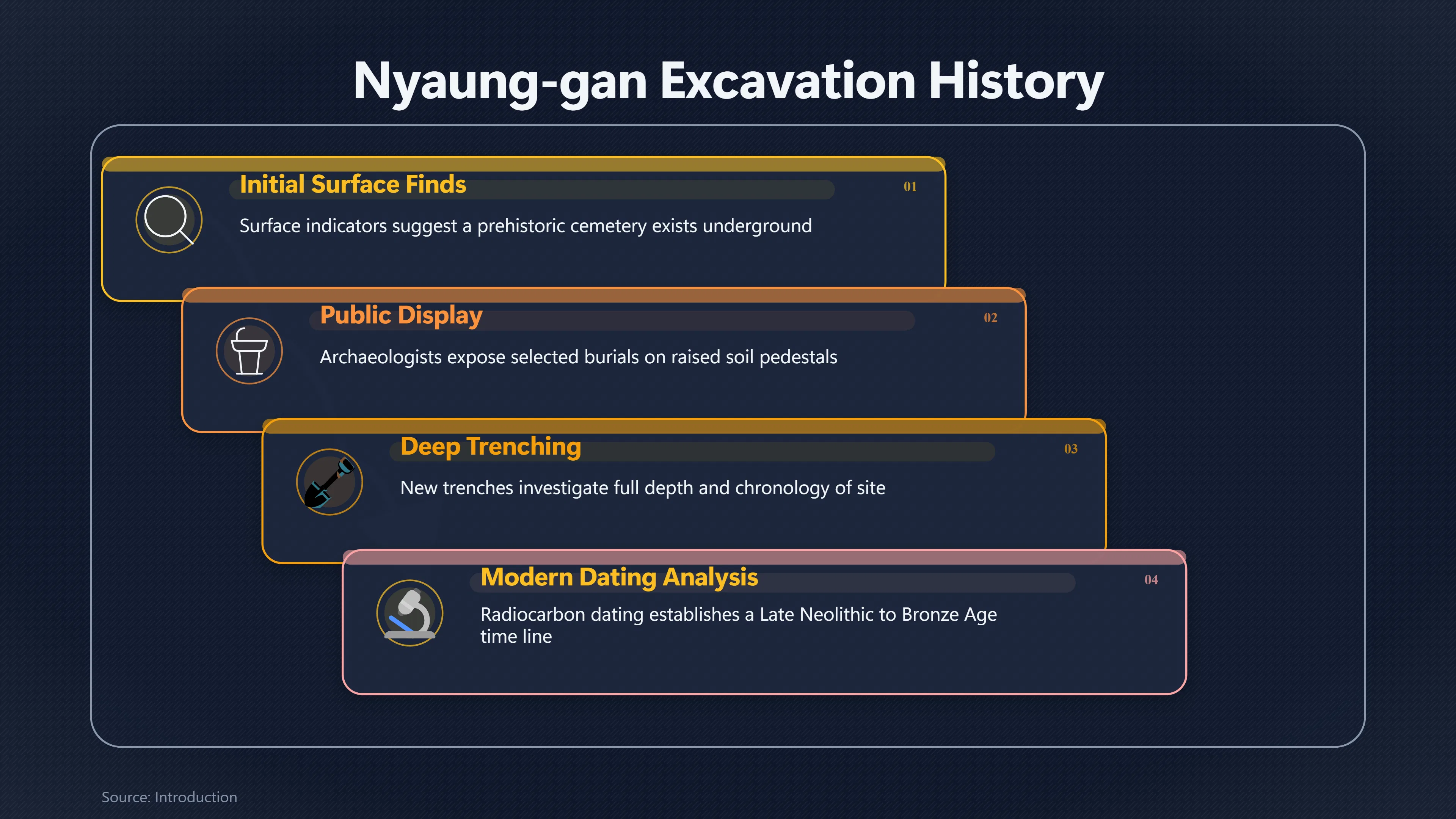
Nyaung-gan lies in central Myanmar near a volcanic crater landscape with nearby copper sources, an environment that probably helped support early metalworking communities. Archaeological investigations began in 1998 after surface finds suggested that an important prehistoric cemetery might survive beneath the ground. Excavations quickly revealed a burial ground containing dozens of individuals together with pottery, stone ornaments and bronze objects, establishing Nyaung-gan as the first excavated site in Myanmar to provide clear evidence of a Bronze Age cemetery.[Burma Library]burmalibrary.orgOpen source on burmalibrary.org.
The original excavation was designed with public display in mind. Rather than excavating every grave to completion and transferring the contents elsewhere, archaeologists exposed selected burials, left them standing on raised soil pedestals and built protective structures around them. This unusual decision created a site museum where the landscape and excavation remain inseparable. Visitors therefore encounter archaeology as a process rather than simply viewing cleaned and rearranged artefacts behind glass.[Cambridge University Press & Assessment]cambridge.orgCambridge University Press & AssessmentA first absolute chronology for Late Neolithic to Early Bronze Age Myanmar: new AMS 14C dates from…
Later excavations, beginning in 2016, adopted a different strategy. Researchers opened new trenches to investigate the full depth and chronology of the cemetery, carefully excavating and recording burials that had remained untouched beneath the earlier display area. These newer investigations produced improved radiocarbon dates and showed that the visible burials represent only part of a much larger prehistoric cemetery.[Cambridge University Press & Assessment]cambridge.orgCambridge University Press & AssessmentA first absolute chronology for Late Neolithic to Early Bronze Age Myanmar: new AMS 14C dates from…
Bones, bronze objects and burial relationships
The significance of Nyaung-gan lies less in spectacular treasure than in the relationships preserved between people and objects. Archaeologists documented extended burials accompanied by carefully arranged grave goods including ceramic vessels, bronze spearheads, bracelets, beads, stone rings and other ornaments. Animal bones placed within pottery vessels also formed part of some burial assemblages. Because many skeletons remained undisturbed until excavation, researchers could examine how particular objects were positioned around different individuals.[Burma Library]burmalibrary.orgOpen source on burmalibrary.org.
The cemetery has yielded the remains of more than forty individuals, allowing physical anthropologists to study age, sex, health and patterns of burial across the community. These skeletal studies suggest that Nyaung-gan belonged to a settled Bronze Age population whose mortuary practices share broad similarities with other mainland Southeast Asian prehistoric cemeteries while retaining distinctive local characteristics.[Cambridge University Press & Assessment]cambridge.orgCambridge University Press & AssessmentBronze Age Myanmar (Burma): a report on the people from the cemetery of Nyaunggan, Upper Myanmar |…
An equally important finding is what was not discovered. Iron objects were absent from the excavated graves, helping researchers place the cemetery before widespread iron technology reached the region. Combined with modern radiocarbon dating, this has made Nyaung-gan an important chronological benchmark for understanding Myanmar’s transition from the Late Neolithic into the Early Bronze Age.[Cambridge University Press & Assessment]cambridge.orgCambridge University Press & AssessmentA first absolute chronology for Late Neolithic to Early Bronze Age Myanmar: new AMS 14C dates from…
Because the burials remain visible within their original archaeological layers, visitors can appreciate details that disappear once objects are removed to museum cases. Pottery can be seen beside skulls or limbs, beads remain associated with particular bodies and the spacing between graves becomes part of the story. The excavation itself communicates evidence about family relationships, ritual practice and cemetery organisation that isolated artefacts could never show on their own.[Cambridge University Press & Assessment]cambridge.orgCambridge University Press & AssessmentA first absolute chronology for Late Neolithic to Early Bronze Age Myanmar: new AMS 14C dates from…

Displaying human remains with care
Nyaung-gan occupies an unusual place within Myanmar’s heritage landscape because it asks visitors to look directly at prehistoric human remains rather than artistic reconstructions. The exposed skeletons are not presented as sensational curiosities but as archaeological evidence, with the emphasis placed on preserving the original burial context as accurately as possible.[Cambridge University Press & Assessment]cambridge.orgCambridge University Press & AssessmentA first absolute chronology for Late Neolithic to Early Bronze Age Myanmar: new AMS 14C dates from…
This approach also reflects a broader debate within archaeology and museums. Removing skeletons to galleries can improve conservation and permit detailed scientific analysis, but it also separates people from the places where they were buried. Leaving selected burials in situ preserves their archaeological relationships and allows visitors to understand how excavators interpret graves, although it requires careful protection from weathering and limits how much of the cemetery can remain permanently exposed. Nyaung-gan demonstrates this trade-off in a particularly visible way, because both display and excavation have shaped the site’s history.[Cambridge University Press & Assessment]cambridge.orgCambridge University Press & AssessmentA first absolute chronology for Late Neolithic to Early Bronze Age Myanmar: new AMS 14C dates from…
For visitors interested in Myanmar’s more unusual heritage, the site stands apart from conventional museums. Its main exhibit is not a rare bronze object or an elaborate reconstruction, but an authentic prehistoric cemetery left largely where it was discovered. That decision transforms the excavation into a permanent window onto Bronze Age life and death, making Nyaung-gan one of the country’s most distinctive archaeological experiences.[Cambridge University Press & Assessment]cambridge.orgCambridge University Press & AssessmentA first absolute chronology for Late Neolithic to Early Bronze Age Myanmar: new AMS 14C dates from…
Amazon book picks
Further Reading
Books and field guides related to What Do Nyaung gan's Burials Reveal?. Use these as the next step if you want deeper reading beyond the article.
The Archaeology of Death and Burial
The archaeology of death and burial is central to our attempts to understand vanished societies. Through the remains of funerary rituals...
Written in Bones: How Human Remains Unlock the Secrets of the...
First published 2003. Subjects: Human remains (archaeology), Social archaeology.
Archaeology: Theories, Methods and Practice
The most authoritative and up-to-date archaeology textbook, revised and updated, and now in full color.
The Human Bone Manual
Building on the success of their previous book, White and Folkens' The Human Bone Manual is intended for use outside the laboratory and c...
eBay marketplace picks
Marketplace Samples
Live-tested eBay searches with available results related to this page.
Selected fromarchaeology excavation kit oneBay.co.uk.
Endnotes
1.
Source: cambridge.org
Link:https://www.cambridge.org/core/journals/antiquity/article/first-absolute-chronology-for-late-neolithic-to-early-bronze-age-myanmar-new-ams-14c-dates-from-nyaunggan-and-oakaie/B07D5550EA305C72B89A52D4DFBB108C
Source snippet
Cambridge University Press & AssessmentA first absolute chronology for Late Neolithic to Early Bronze Age Myanmar: new AMS 14C dates from...
2.
Source: cambridge.org
Link:https://www.cambridge.org/core/journals/antiquity/article/abs/bronze-age-myanmar-burma-a-report-on-the-people-from-the-cemetery-of-nyaunggan-upper-myanmar/E9DA61A1F3A2B36D3AECDBC258C7A07B
Source snippet
Cambridge University Press & AssessmentBronze Age Myanmar (Burma): a report on the people from the cemetery of Nyaunggan, Upper Myanmar |...
3.
Source: cambridge.org
Link:https://www.cambridge.org/core/journals/advances-in-archaeological-practice/article/excavation-and-conservation-recommendations-in-handling-human-skeletal-remains-case-studies-from-desert-oases-cave-shelters-and-permafrost-in-china-and-mongolia/DAAE5EDE91441F7448D78A58F53F8ACE
Source snippet
Excavation and Conservation Recommendations in Handling Human Skeletal Remains: Case Studies from Desert Oases, Cave Shelters, and Permaf...
4.
Source: burmalibrary.org
Link:https://www.burmalibrary.org/en/nyaung-gan-a-preliminary-note-on-a-bronze-age-cemetery-near-mandalay-myanmar-burma
5.
Source: burmalibrary.org
Link:https://www.burmalibrary.org/en/category/archaeology-pyu
Source snippet
Pyu | Online Burma/Myanmar LibraryDecember 5, 2019 — Date of publication: 2001-10-00 Date of entry/update: 2003-06-03 Grouping: Individua...
Published: 2001-10-00
Additional References
6.
Source: architexturez.net
Title: “Nyaung-gan: A Preliminary Note on a Bronze Age Cemetery near Mandalay, Myanma
Link:https://architexturez.net/doc/az-cf-193954
Source snippet
Nyaung-gan: A Preliminary Note on a Bronze Age Cemetery near Mandalay, Myanmar (Burma) | Aζ South AsiaJune 12, 2020 — NYAUNG-GAN: A PRELI...
Published: June 12, 2020
7.
Source: youtube.com
Link:https://www.youtube.com/watch?v=WbgmsStBkzY
Source snippet
The $600 Dinosaur Tail That Proved Warm-Blooded Dinosaurs...
8.
Source: youtube.com
Title: Illicit Fossils: The Ethical Dilemma in Protecting the World’s Natural History
Link:https://www.youtube.com/watch?v=PnssaLktiXw
Source snippet
A tale of two papers: ethics of Burmese amber...
9.
Source: yu.ac.kr
Link:https://www.yu.ac.kr/museum/gallery/gallery.do?articleNo=227945724&mode=view
Source snippet
(학술조사보고 제65책)『慶山林堂地域古墳群ⅩⅧ-林堂1A·1C地域-』-발간 안내 | 영남대학교 박물관December 24, 2025 — (학술조사보고 제65책)『慶山林堂地域古墳群ⅩⅧ-林堂1A·1C地域-』-발간 안내 N No.227945724 * 작...
Published: December 24, 2025
10.
Source: researchgate.net
Link:https://www.researchgate.net/publication/46734861_Nyaung-gan_A_Preliminary_Note_on_a_Bronze_Age_Cemetery_near_Mandalay_Myanmar_Burma
11.
Source: journals.lib.washington.edu
Link:https://journals.lib.washington.edu/index.php/JIPA/article/view/14902
12.
Source: researchonline.jcu.edu.au
Link:https://researchonline.jcu.edu.au/48113/
13.
Source: naju.museum.go.kr
Link:https://naju.museum.go.kr/kor/sub02_01_02_01.do
14.
Source: kci.go.kr
Link:https://www.kci.go.kr/kciportal/ci/sereArticleSearch/ciSereArtiView.kci?sereArticleSearchBean.artiId=ART001563117
15.
Source: youtube.com
Title: Episode 135: Burmese Amber Pt2
Link:https://www.youtube.com/watch?v=ABC736Ron80
Source snippet
Illicit Fossils: The Ethical Dilemma in Protecting the World's Natural History...