Within Strange Finland
Who Should Hold Finland's Sami Sacred Objects?
Sami drums and ceremonial objects raise difficult questions about sacred meaning, colonial collecting and who should control Indigenous heritage.
On this page
- What Sami drums and sacred objects represented
- How confiscation and unequal collecting shaped museums
- Repatriation, stewardship and Siida's community role
Page outline Jump by section
Introduction
Finland’s Sámi sacred collections are unusual not because they contain mysterious objects, but because they raise difficult questions about who should care for them, interpret them and decide their future. Ceremonial drums, ritual objects and other culturally significant items are not simply historical artefacts. For many Sámi people they remain part of a living Indigenous tradition whose cultural and spiritual meanings did not end when the objects entered museum stores.
Modern museum practice in Finland has therefore shifted away from treating these collections as ethnographic curiosities. Instead, the central issue is museum responsibility: recognising how collections were assembled, acknowledging unequal power between collectors and Indigenous communities, and ensuring that Sámi people play the leading role in decisions about their own cultural heritage. This approach has made Finland an important case study in Indigenous stewardship rather than simply another country displaying unusual sacred objects.[siida.fi]siida.fiOpen source on siida.fi.
What Sámi drums and sacred objects represented
Among the best-known sacred objects are Sámi ceremonial drums. Historically these were used by ritual specialists during ceremonies involving healing, divination and communication with the spiritual world. Their painted surfaces represented relationships between people, animals, landscapes and spiritual beings rather than functioning as decorative art.
The drums were only one part of a wider sacred landscape. Clothing, ritual tools, offerings, carved objects and places of worship all formed part of interconnected cultural practices tied to seasonal movement, reindeer herding, fishing and local environments. Removing a single object from this setting often stripped away much of its original meaning.
For that reason, contemporary museums increasingly avoid presenting drums as exotic “shamanic curiosities”. Instead, they explain that these objects belonged to complex systems of knowledge and belief that survived despite centuries of religious pressure and cultural change. The object alone is only part of the story; equally important are the memories, language and community knowledge associated with it.[siida.fi]siida.fiOpen source on siida.fi.
How confiscation and unequal collecting shaped museum collections
Many surviving sacred objects entered museum collections during periods when Sámi communities had little control over the process.
From the seventeenth century onwards, missionaries, state officials, travellers and researchers collected Sámi material across northern Scandinavia. During Christianisation, ceremonial drums were frequently confiscated because church authorities regarded them as symbols of non-Christian religious practice. Other objects entered museums through scientific expeditions, private collecting or unequal exchanges that reflected the political power of states rather than the wishes of Indigenous communities.[siida.fi]siida.fiOpen source on siida.fi.
This history matters because it changes how museums understand ownership. A collection catalogue may record when an object was acquired, yet reveal little about whether the original community freely consented to its removal or whether the object had continuing ceremonial significance.
Museums today therefore distinguish between legal possession and ethical responsibility. Even where acquisition complied with the standards of its time, many institutions acknowledge that those standards often ignored Indigenous rights, cultural authority and spiritual values.[siida.fi]siida.fiOpen source on siida.fi.

Why stewardship matters more than display
For visitors interested in unusual collections, it can be tempting to think of sacred artefacts primarily as exhibits. Finnish museum practice increasingly argues the opposite.
Some sacred items are displayed only selectively, while others remain in collections where access is carefully managed. The decision is not necessarily about secrecy but about respect. Certain objects carry meanings that cannot be fully communicated through a display label or behind glass in a gallery.
Museum responsibility therefore extends beyond conservation. It includes questions such as:
- Who decides whether an object should be exhibited?
- Which language should describe it?
- Should photographs be taken or published?
- Which traditional knowledge accompanies the object?
- Can community members determine restrictions on access?
These questions have become central to Indigenous museology internationally, and Finland has increasingly adopted this community-led approach in relation to Sámi heritage.[siida.fi]siida.fiOpen source on siida.fi.
Repatriation and Siida’s community role
The clearest example of this change is the work of the Sámi Museum Siida in Inari.
Rather than functioning simply as a regional museum, Siida serves as Finland’s national specialist museum for Sámi culture. Its collections are intended to support Sámi identity, language and cultural continuity, not merely preserve historical artefacts for outside audiences.[siida.fi]siida.fiOpen source on siida.fi.
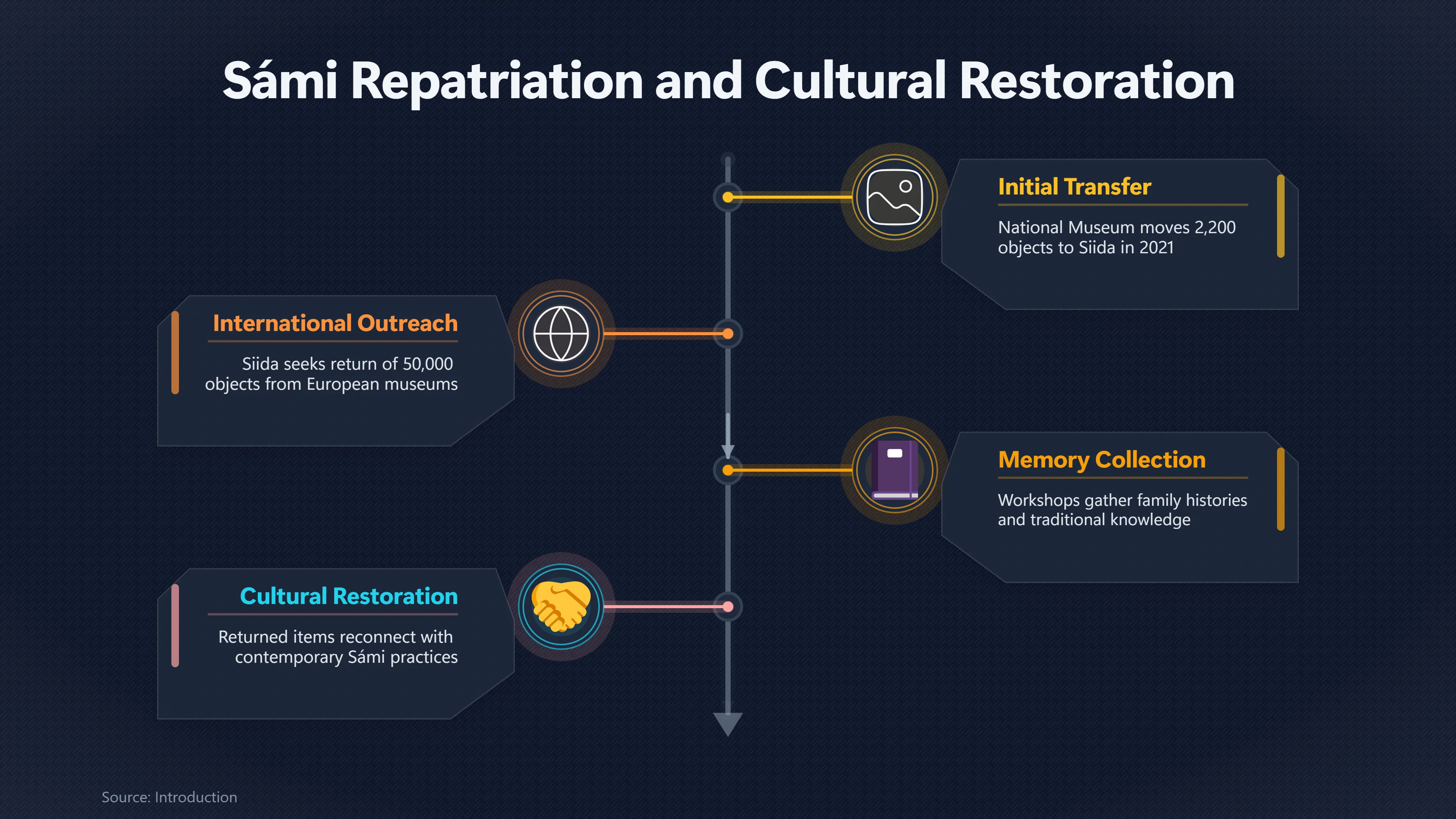
A landmark moment came in 2021 when the National Museum of Finland transferred more than 2,200 Sámi objects to Siida following years of cooperation. Although the collections remained within Finland, the move represented a significant shift in authority by placing the material under the stewardship of the Indigenous institution best placed to interpret and care for it.[siida.fi]siida.fiHomecoming Jubilee celebrates the repatriation of museum artefacts – SiidaAugust 20, 2021…
Siida’s work has not stopped with this transfer. The museum is also engaged in international efforts to encourage the return of Sámi collections held elsewhere in Europe. Estimates suggest that around 50,000 Sámi objects remain in museums and research institutions outside Sámi control, reflecting centuries of collecting across national borders.[siida.fi]siida.fiOpen source on siida.fi.
Recent projects have expanded the idea of repatriation beyond simply transporting objects home. Siida’s Ellos min árbi (“Long Live Our Cultural Heritage”) programme works with Sámi communities to reconnect returned artefacts with family histories, traditional knowledge and contemporary cultural practice. Workshops collect memories, identify previous owners where possible and restore cultural meaning alongside physical custody. The museum describes this as both material and cultural restoration rather than merely moving museum property between institutions.[siida.fi]siida.fiEllos min árbi – SiidaEllos min árbi – Siida
Why this changes how visitors should see these collections
For travellers exploring Finland’s unusual heritage, Sámi sacred collections require a different mindset from curiosity cabinets or folklore museums.
The objects themselves can certainly appear visually striking, particularly ceremonial drums with their painted symbols. Yet their significance lies less in their appearance than in the responsibilities surrounding them. The most important story is not the survival of an ancient ritual object but the continuing efforts of a living Indigenous community to determine how that object should be interpreted, preserved and, where appropriate, returned.
This makes Finland’s Sámi collections distinctive within the country’s wider landscape of unusual museums. They demonstrate that museum ethics can be as historically significant as the artefacts themselves. Rather than celebrating rare objects for their strangeness, modern interpretation increasingly asks who has the right to tell their stories, who benefits from their preservation and how museums can move from being collectors of Indigenous culture to partners in its continuation.[siida.fi]siida.fiOpen source on siida.fi.
Amazon book picks
Further Reading
Books and field guides related to Who Should Hold Finland's Sami Sacred Objects?. Use these as the next step if you want deeper reading beyond the article.
Decolonizing Museums
Museum exhibitions focusing on Native American history have long been curator controlled. However, a shift is occurring, giving Indigenou...
Kalevala
Kalevala is the soaring epic poem of Finland's people, a work rich in magic and myth which tells the story of a nation through the ages f...
The Golden Bough
The work of Sir James G. Frazer (1854-1941) ranged widely across classics, cultural history, folklore and literary criticism as well as a...
The Cold War
Rating: 4.0/5 from 10 Google Books ratings
Beginning with World War II and ending with the collapse of the Soviet Union, the author provides a thrilling account of the strategic dy...
eBay marketplace picks
Marketplace Samples
Live-tested eBay searches with available results related to this page.
Selected fromIndigenous collectible oneBay.co.uk.
Endnotes
1.
Source: siida.fi
Link:https://siida.fi/en/
2.
Source: siida.fi
Link:https://siida.fi/en/releases/sami-museum-objects-returning-home-repatriation-work-with-sami-communities-awarded-a-grant-of-e850000/
3.
Source: siida.fi
Title: Ellos min árbi – Siida
Link:https://siida.fi/en/ellos-min-arbi/
4.
Source: siida.fi
Title: Homecoming Jubilee celebrates the repatriation of museum artefacts – Siida
Link:https://siida.fi/en/releases/homecoming-jubilee-celebrates-the-repatriation-of-museum-artefacts/
Source snippet
August 20, 2021...
Published: August 20, 2021
5.
Source: siida.fi
Link:https://siida.fi/en/the-sami-museum/project-activities/
6.
Source: siida.fi
Title: anni guttormsamimuseum fi
Link:https://siida.fi/en/author/anni-guttormsamimuseum-fi/
7.
Source: siida.fi
Link:https://siida.fi/en/the-sami-museum/
8.
Source: siida.fi
Link:https://siida.fi/en/the-sami-museum/cultural-environment-services/
9.
Source: youtube.com
Link:https://www.youtube.com/watch?v=-jEdleYUzf8
Source snippet
Homecoming - Máhccan | OFFICIAL TRAILER...
10.
Source: youtube.com
Link:https://www.youtube.com/watch?v=U5Y9EXqLzFc
Source snippet
The Sámi People Are Fighting To Have Their Ancestral Artefacts Returned by European Museums...
11.
Source: siida.finna.fi
Title: Search Home | Finna
Link:https://siida.finna.fi/?lng=en-gb
Source snippet
Saamelaismuseo Siida...
12.
Source: siida.finna.fi
Title: fi| Finna
Link:https://siida.finna.fi/Content/about?lng=en-gb
Additional References
13.
Source: theguardian.com
Link:https://www.theguardian.com/commentisfree/2022/apr/15/the-guardian-view-on-returning-a-sami-shamans-drum-a-sign-of-hope
Source snippet
The drum, confiscated in 1691 during a period of forced Christianization, belonged to a shaman named Poala-Ánde, who used it for spiritua...
14.
Source: researchportal.helsinki.fi
Link:https://researchportal.helsinki.fi/en/publications/le-rapatriement-dun-tambour-s%C3%A1mi-du-xviie-si%C3%A8cle-dans-un-mus%C3%A9e-au/
Source snippet
rapatriement d’un tambour sámi du XVIIe siècle dans un musée autochtone sámi: An Indigenous Sámi museum and repatriation of a Sámi drum f...
15.
Source: sttinfo.fi
Link:https://www.sttinfo.fi/tiedote/70640303/the-national-museum-of-finland-launches-a-repatriation-to-benin?lang=en&publisherId=69818028
Source snippet
November 4, 2024 — * # The National Museum of Finland launches a repatriation to Benin 4.11.2024 11:00:01 EET | Suomen kansallismuseo | P...
Published: November 4, 2024
16.
Source: smb.museum
Title: Provenance Research: The MEK’s Sámic Collection
Link:https://www.smb.museum/en/whats-new/detail/museum-europaeischer-kulturen-provenance-research-project-on-samic-collection-starting-in-december-2022/
Source snippet
October 21, 2022 — Image: View into the sámic collection of the Museum Europäischer Kulturen View into the sámic collection of the Museum...
Published: October 21, 2022
17.
Source: youtube.com
Link:https://www.youtube.com/watch?v=Dd0Lft-3oVI
Source snippet
In conversation with the Finnish Institutes: Returning home...
18.
Source: nordlandsmuseet.no
Link:https://www.nordlandsmuseet.no/en/samling-1/samisk-tromme
19.
Source: kansallismuseo.fi
Link:https://www.kansallismuseo.fi/en/articles/homecoming-celebrates-repatriation-of-sami-artefacts
20.
Source: smb.museum
Link:https://www.smb.museum/en/museums-institutions/museum-europaeischer-kulturen/collections-research/collection/sami-collection/
21.
Source: britishmuseum.org
Link:https://www.britishmuseum.org/collection/object/H_Eu-4344
22.
Source: britishmuseum.org
Link:https://www.britishmuseum.org/collection/object/H_Eu-5263