Where Did Equatorial Guinea's Strangest Objects Go?
Equatorial Guinea does not have a well-documented circuit of witchcraft museums, cryptid exhibitions or commercial cabinets of curiosity. Its strange-collection landscape is quieter and more fragmented.
Page outline Jump by section
Introduction
That absence is itself revealing. Objects associated with ancestor veneration, ritual protection, healing, colonial science and missionary encounters certainly survive, but many are poorly catalogued, difficult to visit or geographically displaced. For readers interested in uncanny heritage, the central story is therefore not a single spectacular attraction. It is the tension between sacred objects and museum exhibits, between local memory and colonial collecting, and between what remains publicly visible in Equatorial Guinea and what now sits in European or American stores and galleries.
What can visitors actually see?
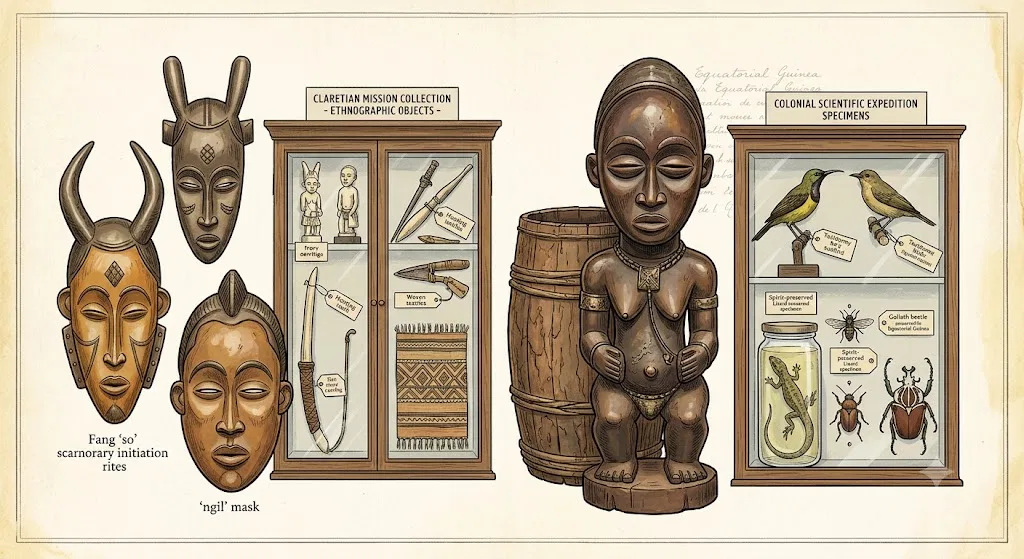
Reliable public information about museums in Equatorial Guinea is unusually limited. Most directories repeatedly identify only two established institutions: the Claretian Mission Ethnological Museum and the Museum of Modern Art of Equatorial Guinea, both associated with Malabo. A 2021 survey of African knowledge institutions found information on those same two museums, while noting that it could not establish whether the Claretian museum was operational. That uncertainty remains more trustworthy than tourism pages that confidently publish admission prices or opening hours without clear institutional confirmation.[africaknows.eu]africaknows.euKnowledge Institutions in Africa and their developmentMuseum of Modern Art Equatorial Guinea is located in Malabo. It is unclear it the other museum, the Claretian Mission Ethnological Museum…
The Claretian collection
The Claretian Mission Ethnological Museum is the country’s clearest candidate for a traditional cabinet of curiosity. Older reference works describe the Claretian mission in Malabo as holding an archaeological and ethnographic museum alongside a specialist library of material concerning Africa and Equatorial Guinea. The collection has been associated particularly with the cultures of Bioko and the mainland, although detailed modern catalogues are not readily available online.[Nations Encyclopedia]nationsencyclopedia.comNations EncyclopediaEquatorial GuineaThe Claretian Mission at Malabo has about 4,000 volumes of Africana and Guineana, and an archaeologi…
Its unusual character comes from the institution that formed it. Missionary museums were not neutral storehouses. Religious orders collected carvings, ritual objects, domestic tools, weapons, ornaments and archaeological finds while attempting to document—and frequently to change—the societies among whom they worked. An object connected with ancestors or spiritual protection could consequently be reclassified as evidence of a disappearing custom, “paganism” or missionary progress.
Visitors should therefore resist imagining a modern folklore attraction with theatrical displays about magic. The surviving evidence points instead towards an old-fashioned mission collection: potentially fascinating, historically important and entangled with evangelisation. Recent social-media references to rehabilitation work around the ethnographic museum and Claretian library suggest continuing interest in the site, but do not provide dependable visitor arrangements. Its current accessibility should be confirmed locally rather than assumed.[Instagram]instagram.comInstagram@museoetnograficodemalabo Gracias por la iniciativa. Se me…… guineaecuatorial #museo #etnologico… Apoyamos a los misione…

Modern art rather than an oddity museum
The Museum of Modern Art of Equatorial Guinea has been described as displaying both contemporary work and traditional African art. It appears to be the country’s principal named art museum, but its collection, governance and current programme are sparsely documented by authoritative public sources.[experience-africa.de]experience-africa.de#Equatorial Guinea | Culture#EquatorialGuinea | Culture - Experience AfricaThe Museum of Modern Art in Malabo shows works of traditional and contemporary art from al…
Its relevance to strange collections lies less in overtly supernatural material than in the meeting of categories. A traditional ritual sculpture displayed beside modern art can be interpreted as an aesthetic masterpiece rather than a spiritually active object. Contemporary Equatoguinean artists may also quote, reject or transform forms once labelled “tribal” by European collectors. This makes the museum potentially useful for understanding how objects move between devotion, ethnography, national heritage and the international art market.
The country’s most prominent modern sculptor, Leandro Mbomio Nsue, worked across Equatoguinean and European artistic worlds. His art is held outside the country as well as within it, and official Equatoguinean cultural material presents him as a major national figure. The former building associated with him was later adapted for the National Library, illustrating how the country’s cultural institutions often overlap rather than fitting into neat museum categories.[guineainfomarket.com]embassyofequatorialguinea.guineainfomarket.comOpen source on guineainfomarket.com.
The uncanny objects are often elsewhere
The largest clearly documented museum collection from Equatorial Guinea may not be in Equatorial Guinea at all. Research on the Museum of Ethnology and World Cultures in Barcelona identified 1,105 Equatoguinean pieces in the museum’s own holdings as of 2024. A separate group of more than 2,000 African objects from the Folch Foundation was loaned to the institution in 2011, adding further material associated with Spanish collecting networks.[trafricants.org]trafricants.orgcol·leccio equatoguineana del mueccol·leccio equatoguineana del muec
These holdings include material gathered during the period when Equatorial Guinea was under Spanish colonial rule. The collection history involves missionaries, colonial officials, expeditions, private collectors and dealers. Such sources matter because a museum label may identify an object’s material or ethnic attribution while saying little about whether it was purchased fairly, surrendered under religious pressure, removed from a sacred setting or separated from a community that still remembers its purpose.
The scale may be greater than older published counts suggest. A 2025 report on Equatorial Guinea’s efforts to trace its colonial heritage cited Barcelona documentation listing 2,204 Equatoguinean cultural objects in the museum’s databases. Most were attributed to Fang communities, with other material connected to Bubi, Hausa and Annobonese people. The difference between totals appears to reflect distinct collection groups and continuing inventory work rather than a simple contradiction.[trafricants.org]trafricants.orgOpen source on trafricants.org.
This dispersed heritage changes what an Equatoguinean curiosity map looks like. Instead of a route wholly contained within Malabo or Bata, it extends into European museum stores, natural-history collections and archives. The country’s material history is partly a history of absence.
Ancestor guardians and sacred remains
The objects most likely to satisfy a reader’s expectation of uncanny museum material are Fang reliquary figures. These carved wooden figures or heads once guarded containers holding ancestral remains. They were not idols in the simplistic sense often used by early collectors. They formed part of a system in which selected bones linked living families to influential ancestors and helped protect lineage identity, authority and wellbeing.[Smithsonian Institution]si.eduOpen source on si.edu.
Examples attributed to Fang communities in Equatorial Guinea or neighbouring Gabon now appear in major world museums. The Metropolitan Museum of Art, for example, catalogues a nineteenth-century guardian figure as originating from Gabon or Equatorial Guinea. The Smithsonian explains that European explorers and colonial officials began collecting such figures in the late nineteenth century, often separating the sculpted guardian from the bark container and human remains that gave it meaning.[The Metropolitan Museum of Art]metmuseum.orgThe Metropolitan Museum of Art Okak-Fang artistThe Metropolitan Museum of Art Okak-Fang artist
That separation is crucial. Displayed alone under gallery lighting, the figure can look like an enigmatic piece of modern sculpture. In its original setting it belonged to a living relationship with the dead. Some ceremonies involved moving or presenting the figures dramatically, but this should not be turned into a tale of sinister puppets or primitive magic. The performance was part of teaching, initiation and ancestral remembrance.[Smarthistory]smarthistory.orgseated female reliquaryseated female reliquary
Missionary and colonial pressure contributed to the abandonment, concealment or destruction of many ancestor-related objects. Others entered Western collections just as European modernists and dealers were beginning to prize African sculpture for its formal power. The resulting museum object is therefore both an artwork and evidence of a disrupted religious system.
Colonial science as a second curiosity cabinet
Equatorial Guinea’s displaced collections are not limited to ritual art. Barcelona’s Natural Sciences Museum holds 509 catalogued chordate records from the country, most associated with a 1919 expedition. These include preserved animal specimens collected when European natural-history museums were building vast comparative archives from colonial territories.[trafricants.org]trafricants.orgOpen source on trafricants.org.
Such holdings belong to another tradition of strange collecting: jars, skins, skeletons, taxidermy and specimens transformed from living creatures into numbered scientific evidence. Their oddness is quieter than that of a sensational medical museum, but their history raises comparable questions. Who collected them? Under what authority? What local knowledge guided the expedition? Why were the specimens sent to Spain rather than preserved in an Equatoguinean institution?
Natural-history collections can support valuable research long after the original expedition. They can help establish historical species ranges or provide evidence for environmental change. Yet their usefulness does not erase the colonial structure that determined where knowledge and specimens accumulated. In Equatorial Guinea’s case, scientific heritage is again more visible abroad than at home.

Folklore without a folklore museum
Equatorial Guinea has rich traditions involving ancestors, spirits, healing, storytelling and the moral language of witchcraft, but these should not be flattened into a tourist catalogue of supernatural beliefs. The country includes distinct Fang, Bubi, Ndowe, Annobonese and other cultural histories, and practices vary by community, island, region and period.
Nor is every carved figure evidence of “witchcraft”. Ancestor guardians concerned kinship and protection; masks might relate to performance or social authority; medicinal objects could combine botanical knowledge with spiritual interpretation. Colonial ethnography often grouped these under broad labels such as fetish, superstition or magic. A careful modern display would explain who used an object, who was permitted to see it, what actions made it effective and whether its original community considers public exhibition appropriate.
At present, there is little dependable evidence of a dedicated visitor-facing witchcraft or occult museum in Equatorial Guinea. Claims that imply otherwise generally recycle thin tourism listings or confuse the country with the neighbouring Republic of Guinea. The more credible approach is to view ethnographic collections, ancestor sculptures and missionary archives as places where spiritual history may be encountered—while recognising that their interpretation is incomplete and sometimes inherited from colonial observers.
How credible is the museum record?
The documentary weaknesses are not trivial. Institution names are repeated across travel sites without official catalogues, current programmes or working visitor information. Some lists appear to multiply the same organisation under translated or unofficial titles. Other sources confuse Equatorial Guinea with Guinea, whose capital and museum network are entirely different.
A sensible credibility scale is therefore useful:
- Well supported: Equatoguinean collections in major foreign museums, where catalogues provide object records, acquisition histories and collection totals.
- Historically supported but operationally uncertain: the Claretian ethnographic collection in Malabo.
- Apparently established but thinly documented: the Museum of Modern Art of Equatorial Guinea.
- Unverified: precise opening hours, admission charges and claims about particular exhibits found only on generic tourism platforms.
- Misleading: assertions of dedicated occult, cryptid, UFO or medical-oddity museums without institutional evidence.
Even established museum catalogues require scrutiny. Ethnic labels may be broad, place names may reflect colonial geography, and phrases such as “collected in the field” can conceal unequal exchanges. Precise provenance—the documented chain of ownership and movement—matters as much as an object’s age or appearance.
Why the missing collections matter
Equatorial Guinea’s unusual museum culture is defined by displacement. The country produced objects now celebrated as masterpieces of African art, yet many of the best documented examples are interpreted in New York, Washington, Barcelona and other foreign cities. Local institutions appear comparatively small, unevenly documented and difficult for outsiders to assess.
That imbalance affects more than tourism. When collections leave their source communities, knowledge can leave with them. Names of makers disappear. Ritual context is compressed into a label. Human remains may be separated from their guardians. Colonial photographs become the principal visual archive of communities that had little control over how they were represented.
Current efforts to inventory Equatoguinean holdings in Spain are therefore significant. An inventory does not automatically produce restitution, but it establishes what exists, where it came from and which acquisitions require further investigation. It can also create opportunities for digital access, joint research, loans, community consultation and, where appropriate, return.[trafricants.org]trafricants.orgOpen source on trafricants.org.
The most honest visitor takeaway
Equatorial Guinea is not presently a destination where travellers can count on a polished trail of eccentric museums. Its strongest curiosity material lies in a small number of uncertain local institutions and in collections dispersed through former colonial networks.
The Claretian museum may offer the closest thing to a traditional missionary cabinet, provided access can be arranged. The modern art museum potentially shows how inherited forms are reinterpreted within a contemporary African setting. Beyond the country, Fang ancestor guardians and colonial natural-history specimens reveal a much larger, stranger and more contested museum landscape.
The essential question is not simply, “What bizarre objects can be seen?” It is, “How did these objects become museum pieces, and what disappeared when they did?” In Equatorial Guinea, that question leads from sacred family remains to missionary display cases, from rainforest expeditions to European storerooms, and from aesthetic admiration to unfinished debates over ownership and cultural memory.
Amazon book picks
Further Reading
Books and field guides related to Where Did Equatorial Guinea's Strangest Objects Go?. Use these as the next step if you want deeper reading beyond the article.
The State of Africa: A History of the Continent Since Indepen...
'Meredith has given a spectacularly clear view of the African political jungle' – Spectator 'This book is hard to beat... Elegantly writt...
The Brutish Museums: The Benin Bronzes, Colonial Violence and...
New York Times 'Best Art Books' 2020 'Essential' – Sunday Times 'Brilliantly enraged' - New York Review of Books 'A real game-changer'– E...
The Scramble For Africa
In 1880 the continent of Africa was largely unexplored by Europeans. Less than thirty years later, only Liberia and Ethiopia remained unc...
Africa's Struggle for Its Art: History of a Postcolonial Defeat
"A major new history of how, between 1965 and 1985, African nations sought the restitution of works of art stolen during the colonial per...
eBay marketplace picks
Marketplace Samples
Live-tested eBay searches with available results related to this page.
Selected fromtribal decor oneBay.co.uk.
Endnotes
1.
Source: africaknows.eu
Title: Knowledge Institutions in Africa and their development
Link:https://www.africaknows.eu/pdfs/copr15.pdf
Source snippet
Museum of Modern Art Equatorial Guinea is located in Malabo. It is unclear it the other museum, the Claretian Mission Ethnological Museum...
2.
Source: instagram.com
Link:https://www.instagram.com/reel/DZLG6u0N4Gq/
Source snippet
Instagram@museoetnograficodemalabo Gracias por la iniciativa. Se me...... guineaecuatorial #museo #etnologico... Apoyamos a los misione...
3.
Source: instagram.com
Link:https://www.instagram.com/p/DaDe_qLDGu3/
Source snippet
Guinea Ecuatorial en Malabo... Me ha tocado... #guineaecuatorial #museo #etnologico · View all...
4.
Source: experience-africa.de
Title: #Equatorial Guinea | Culture
Link:https://www.experience-africa.de/index.php?en_equatorial-guinea_culture=
Source snippet
#EquatorialGuinea | Culture - Experience AfricaThe Museum of Modern Art in Malabo shows works of traditional and contemporary art from al...
5.
Source: artindexafrica.substack.com
Link:https://artindexafrica.substack.com/p/6-must-visit-arty-locations-in-central
Source snippet
modern art museum. This museum prides itself in...
6.
Source: embassyofequatorialguinea.guineainfomarket.com
Link:https://embassyofequatorialguinea.guineainfomarket.com/art/
7.
Source: trafricants.org
Title: col·leccio equatoguineana del muec
Link:https://trafricants.org/es/colecciones-en-conflicto/col%C2%B7leccio-equatoguineana-del-muec/
8.
Source: trafricants.org
Link:https://trafricants.org/en/collections-in-conflict/equatorial-guinean-collection-of-the-museum-of-ethnology-and-world-cultures/
9.
Source: smarthistory.org
Title: seated female reliquary
Link:https://smarthistory.org/seated-female-reliquary/
10.
Source: trafricants.org
Link:https://trafricants.org/en/collections-in-conflict/equatorial-guinea-collection-of-the-natural-sciences-museum-of-barcelona-mcnb/
11.
Source: instagram.com
Title: DNxh SR6XODd
Link:https://www.instagram.com/p/DNxhSR6XODd/
12.
Source: instagram.com
Link:https://www.instagram.com/reel/DTeiicFAnHI/?hl=en
13.
Source: instagram.com
Link:https://www.instagram.com/p/DaK8bqskb1p/
14.
Source: instagram.com
Link:https://www.instagram.com/reel/DaVwnBxxnMT/
15.
Source: instagram.com
Link:https://www.instagram.com/reel/DaBgU6BRXRv/
16.
Source: nationsencyclopedia.com
Link:https://www.nationsencyclopedia.com/Africa/Equatorial-Guinea.html
Source snippet
Nations EncyclopediaEquatorial GuineaThe Claretian Mission at Malabo has about 4,000 volumes of Africana and Guineana, and an archaeologi...
17.
Source: bilbaomuseoa.eus
Link:https://bilbaomuseoa.eus/en/explore/art-work/man/60d003bc-f080-483c-86e7-1f18d1e9e3b4
18.
Source: si.edu
Link:https://www.si.edu/object/reliquary-guardian-figure%3Anmafa
19.
Source: metmuseum.org
Title: The Metropolitan Museum of Art Okak-Fang artist
Link:https://www.metmuseum.org/art/collection/search/310870
20.
Source: ich.unesco.org
Link:https://ich.unesco.org/en/lists
21.
Source: Wikipedia
Title: Leandro Mbomio Nsue
Link:https://en.wikipedia.org/wiki/Leandro_Mbomio_Nsue
22.
Source: bie-paris.org
Title: Equatorial Guinea
Link:https://bie-paris.org/site/en/guinee-equatoriale?view=memberstate
Additional References
23.
Source: youtube.com
Title: The STRANGEST city in West Africa: Malabo, Equatorial Guinea
Link:https://www.youtube.com/watch?v=ARUM8z48SDg
Source snippet
Top 10 Attractions in Malabo, Equatorial Guinea...
24.
Source: collection-lacharriere.quaibranly.fr
Link:https://collection-lacharriere.quaibranly.fr/en/eyema-byeri-reliquary-guardian
25.
Source: unesco.org
Link:https://www.unesco.org/en/legal-affairs/convention-means-prohibiting-and-preventing-illicit-import-export-and-transfer-ownership-cultural
26.
Source: facebook.com
Link:https://www.facebook.com/media/set/?set=a.215944931750797.62133.215940335084590
27.
Source: academia.edu
Link:https://www.academia.edu/84064376/Imagen_y_ciudadan%C3%ADa_en_Guinea_Ecuatorial_1861_1937_del_encuentro_fotogr%C3%A1fico_al_orden_colonial
28.
Source: askart.com
Link:https://www.askart.com/bio/Leandro_Mbomio/11053389/Leandro_Mbomio
29.
Source: icom.museum
Link:https://icom.museum/wp-content/uploads/2018/07/ICOM_ITC_handbook_autumn_2014.pdf
30.
Source: fieldmuseum.org
Link:https://www.fieldmuseum.org/project-narrative/science/melanesian-collections
31.
Source: momaa.org
Link:https://momaa.org/directory/museum-of-modern-art-equatorial-guinea/?srsltid=AfmBOopAuX3B2oK4ijPZ_y3yIW9TyX5FRO6q_At5YZAW-tNbdGqbG3e8
32.
Source: momaa.org
Link:https://momaa.org/directory/museum-of-modern-art-equatorial-guinea/?srsltid=AfmBOor7MbtGhQsK6NmVzNEr4g1M_cZ-NpBwKYZaSDXzxFzKE1YRsETe