Within Iran Curiosities
Inside Iran's Unusual Medical History Collections
Iran's medical heritage collections show how instruments, records and treatments shaped older understandings of the human body.
On this page
- Historic instruments and medical objects
- Persian approaches to healing
- Bodies, science and changing beliefs
Page outline Jump by section
Introduction
Iran’s medical history collections reveal a long transition in the way people understood the body, illness and recovery. Rather than being collections of “strange cures”, they preserve a changing conversation between herbal knowledge, manuscript medicine, surgery, pharmacy, anatomy and modern clinical science. The most important public collection is the Iranian National Museum of Medical Sciences History, which brings together historic instruments, medical documents, physicians’ records, nursing history, dentistry, veterinary medicine and traditional healing materials.[Wikipedia]WikipediaIranian National Museum of Medical Sciences HistoryIranian National Museum of Medical Sciences History
For visitors interested in unusual collections, Iranian medical heritage is fascinating because it sits between science and belief. A medieval physician’s manuscript, a traditional pharmacy object or a display about medicinal plants does not simply show what people used to treat disease; it shows what they believed a healthy human body was supposed to be. These collections trace a journey from ideas of balance and temperament towards laboratory medicine and modern healthcare.[Intangible Cultural Heritage UNESCO]ich.unesco.orgIntangible Cultural Heritage UNESCODecision of the Intergovernmental Committee: 8.COM 8.15 - UNESCO Intangible Cultural Heritage…
Historic instruments and medical objects
Tehran’s medical museum: where tools become historical evidence
The Iranian National Museum of Medical Sciences History in Tehran is the clearest place to explore Iran’s medical past through objects. Created through cooperation between cultural heritage authorities, the Ministry of Health, the Iranian Academy of Medical Sciences and Tehran University of Medical Sciences, the museum was designed to collect and display material connected with both traditional and modern medicine.[Wikipedia]WikipediaIranian National Museum of Medical Sciences HistoryIranian National Museum of Medical Sciences History
Its displays include historic medical instruments, manuscripts, prescriptions, pharmacy-related objects and sections devoted to dentistry, nursing, midwifery, veterinary medicine and herbal medicine. The collection is unusual because it does not present medicine as a simple story of progress from “old” to “new”. Instead, it shows different systems of knowledge existing alongside each other: the physician reading a manuscript, the pharmacist preparing compounds, and the modern doctor using scientific instruments.[Wikipedia]WikipediaIranian National Museum of Medical Sciences HistoryIranian National Museum of Medical Sciences History
Some objects are especially valuable because they connect medicine with everyday life. A medical tool can reveal how a procedure was performed, while a prescription or manuscript can reveal how illness was explained. A visitor is not only seeing equipment; they are seeing the assumptions behind it: what caused sickness, what counted as evidence, and what a healer was expected to know.
Manuscripts: medicine preserved as written memory
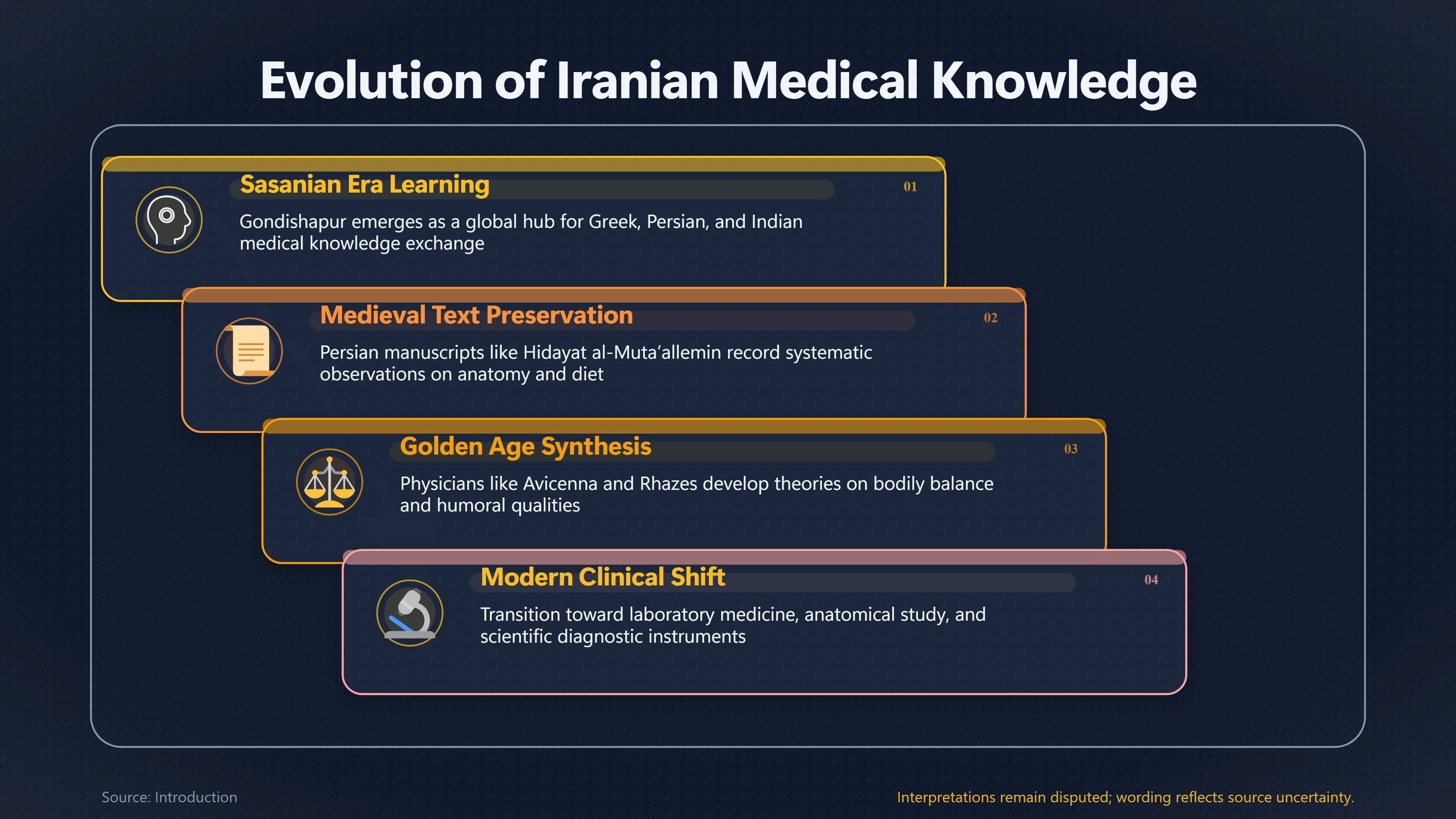
Iranian medical collections also depend heavily on written knowledge. Medieval Persian and Islamic medical texts preserved observations about anatomy, diagnosis, diet and remedies. One example is the medical treatise Hidayat al-Muta‘allemin fi al-Tibb (“A Guide for Medical Learners”), attributed to Akhawayni Bukhari, an early Persian-language medical work that provides insight into medical education more than a thousand years ago.[PMC]pmc.ncbi.nlm.nih.govOpen source on nih.gov.
Such manuscripts are important because they show that historical healing was not only based on folklore. Physicians recorded cases, debated treatments and organised knowledge systematically. At the same time, these texts belonged to a world where philosophy, religion, observation and theories about bodily balance were closely connected.
Persian approaches to healing
From balance of the body to treatment of disease
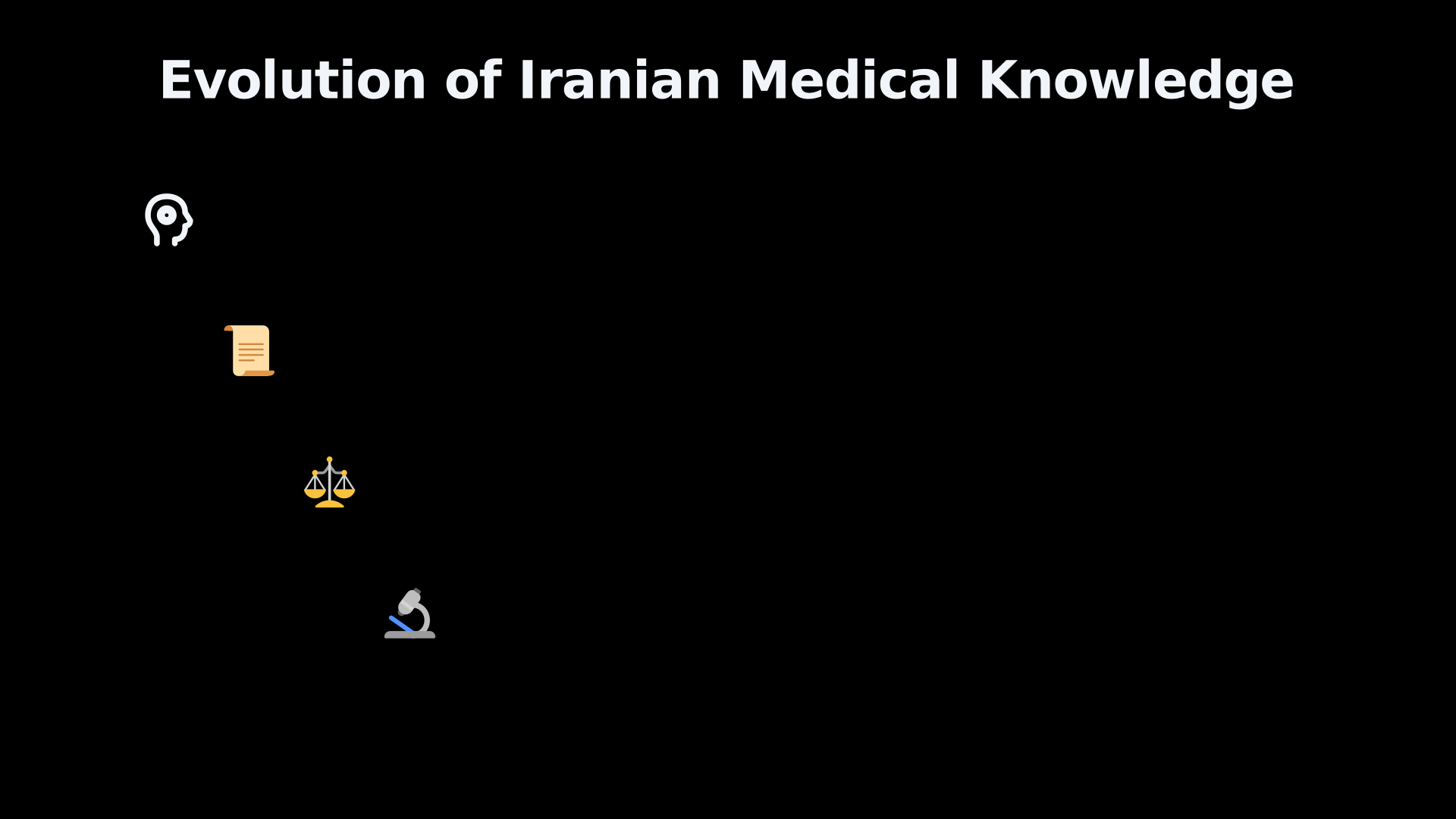
A major theme running through Iranian medical heritage is the idea that health depended on balance. Traditional Iranian medicine developed within the wider history of Greek, Persian and Islamic medical thought, including theories involving bodily qualities and the balance of elements or humours. The system influenced physicians such as Rhazes and Avicenna, whose works became widely studied far beyond Iran.[Wikipedia]WikipediaIranian traditional medicineIranian traditional medicine
This approach viewed illness less as an isolated mechanical problem and more as a disturbance affecting the whole person. Diet, climate, sleep, activity and emotional state were all considered relevant to maintaining health. UNESCO’s discussion of Iranian traditional medicine highlights this emphasis on preventive practices, lifestyle, remedies and the preservation of wellbeing as part of a transmitted cultural tradition.[Intangible Cultural Heritage UNESCO]ich.unesco.orgIntangible Cultural Heritage UNESCODecision of the Intergovernmental Committee: 8.COM 8.15 - UNESCO Intangible Cultural Heritage…
For modern visitors, this is one of the most interesting parts of Iran’s medical collections because it challenges a common assumption: that earlier medicine was simply a collection of failed treatments. The historical reality is more complex. Some traditional ideas have not survived modern testing, while others — particularly knowledge of plants, preparation methods and patient care traditions — remain subjects of historical and scientific interest.

Medicinal plants and the pharmacy tradition
Herbal medicine occupies an important place in Iranian medical memory. Collections connected with Iranian medicine often highlight plants, remedies and the long relationship between gardens, agriculture and healing. The Medicinal Herbs Garden Museum project in Alborz, for example, was designed to present Iranian medicinal plants, historical medical objects and the achievements of Iranian medical scholars.[Contemporary Architecture of Iran]caoi.irContemporary Architecture of Iran Medicinal Herbs Garden MuseumContemporary Architecture of IranMedicinal Herbs Garden Museum - Contemporary Architecture of IranMay 28, 2019…
Historically, plants were not simply ingredients but part of a wider medical theory. Physicians classified substances according to their perceived qualities and used combinations of ingredients to create treatments. This created a sophisticated tradition of pharmacy, even though the explanations behind some remedies differ from modern biomedical science.[actahort.org]actahort.orgTH E HISTORY OF TRADITIONAL MEDICINE AND HERBAL PLANTS IN IRANTH E HISTORY OF TRADITIONAL MEDICINE AND HERBAL PLANTS IN IRAN
The continued interest in these traditions also creates a modern debate. Supporters see traditional medicine as an important cultural inheritance and a source of possible therapeutic research. Critics argue that historical reputation alone cannot prove medical effectiveness and that traditional treatments require the same evidence standards applied to modern medicine. This tension is part of why medical collections matter: they preserve the history without requiring every old belief to be accepted as current science.
Bodies, science and changing beliefs
The legacy of Gondishapur
Iran’s medical heritage is often connected with the ancient centre of learning at Gondishapur in Khuzestan. During the Sasanian period, Gondishapur became an important place for medical education and the exchange of Greek, Persian and Indian knowledge. Historians continue to discuss the exact extent of its influence, but its reputation as a centre where medical learning, teaching and treatment came together remains a major part of Iranian scientific history.[PubMed]pubmed.ncbi.nlm.nih.govGondishapur School of Medicine: the most important medical center in antiquity - PubMedJanuary 1, 2008…
The importance of Gondishapur in museum storytelling is not just that it represents an ancient achievement. It represents a changing idea of what medicine could be: not only individual healing, but an organised field involving institutions, teachers, texts and trained practitioners.
Anatomy, observation and modern medicine
Later Iranian medical history shows a gradual movement towards anatomical study and modern scientific methods. Works associated with physicians such as Avicenna and Jorjani included detailed discussions of the body and disease, while later collections preserve the arrival of modern medical equipment and institutional healthcare.[PMC]pmc.ncbi.nlm.nih.govPMCThe history of anatomy in PersiaPMCThe history of anatomy in Persia
Medical museums make this transition visible. A visitor can move from manuscripts describing bodily processes to instruments designed for modern diagnosis and treatment. The contrast is not simply between superstition and science; it is a record of changing questions. Earlier physicians asked how balance could be restored, while modern medicine increasingly asks how biological mechanisms can be measured and altered.
What these collections reveal about healing in Iran
Iran’s medical collections are unusual because they preserve several layers of healing history at once:
- Ancient and medieval medicine shows a world of physicians, manuscripts and theories of balance.
- Pharmacy and herbal traditions reveal how plants, preparation methods and local knowledge shaped treatment.
- Medical instruments and modern equipment show the adoption of clinical science and changing ideas of evidence.
- Museum interpretation itself shows an ongoing conversation between cultural heritage and modern healthcare.
The result is not a museum story about replacing one system with another. Instead, Iran’s medical collections show how ideas about the human body are constantly rewritten. They preserve the objects of healing, but also the beliefs, questions and uncertainties that surrounded those objects.
Amazon book picks
Further Reading
Books and field guides related to Inside Iran's Unusual Medical History Collections. Use these as the next step if you want deeper reading beyond the article.
The History of Medicine: A Very Short Introduction
Against the backdrop of unprecedented concern for the future of health care, this i Very Short Introduction/i surveys the history of medi...
A History of Iran
The definitive history of Iran, from the ancient Persian empires to today Iran is a land of contradictions. It is an Islamic republic, bu...
Islamic Science and the Making of the European Renaissance
The rise and fall of the Islamic scientific tradition, and the relationship of Islamic science to European science during the Renaissance...
The Greatest Benefit to Mankind: A Medical History of Humanity
Winner of the Los Angeles Times Book Prize "A panoramic and perfectly magnificent intellectual history of medicine…This is the book that...
eBay marketplace picks
Marketplace Samples
Live-tested eBay searches with available results related to this page.
Selected fromanatomy poster oneBay.co.uk.
Endnotes
1.
Source: Wikipedia
Title: Iranian National Museum of Medical Sciences History
Link:https://en.wikipedia.org/wiki/Iranian_National_Museum_of_Medical_Sciences_History
2.
Source: ich.unesco.org
Link:https://ich.unesco.org/en/decisions/8.COM/8.15
Source snippet
Intangible Cultural Heritage UNESCODecision of the Intergovernmental Committee: 8.COM 8.15 - UNESCO Intangible Cultural Heritage...
3.
Source: pmc.ncbi.nlm.nih.gov
Link:https://pmc.ncbi.nlm.nih.gov/articles/PMC4154935/
4.
Source: Wikipedia
Title: Iranian traditional medicine
Link:https://en.wikipedia.org/wiki/Iranian_traditional_medicine
5.
Source: pmc.ncbi.nlm.nih.gov
Title: PMCThe history of anatomy in Persia
Link:https://pmc.ncbi.nlm.nih.gov/articles/PMC2100290/
6.
Source: actahort.org
Title: TH E HISTORY OF TRADITIONAL MEDICINE AND HERBAL PLANTS IN IRAN
Link:https://www.actahort.org/books/790/790_37.htm
7.
Source: unesco.org
Title: Medieval manuscripts on medicine and pharmacy
Link:https://www.unesco.org/en/memory-world/medieval-manuscripts-medicine-and-pharmacy
8.
Source: caoi.ir
Title: Contemporary Architecture of Iran Medicinal Herbs Garden Museum
Link:https://www.caoi.ir/en/projects/item/1054-medicinal-herbs-garden-museum.html
Source snippet
Contemporary Architecture of IranMedicinal Herbs Garden Museum - Contemporary Architecture of IranMay 28, 2019...
Published: May 28, 2019
9.
Source: pubmed.ncbi.nlm.nih.gov
Link:https://pubmed.ncbi.nlm.nih.gov/18154434/
Source snippet
Gondishapur School of Medicine: the most important medical center in antiquity - PubMedJanuary 1, 2008...
Published: January 1, 2008
10.
Source: livingintehran.com
Title: National Museum of Medical Sciences
Link:https://livingintehran.com/2023/05/27/national-museum-medical-sciences-tehran/
11.
Source: karnaval.ir
Title: iranian national museum of medical sciences history
Link:https://www.karnaval.ir/things-to-do/iranian-national-museum-of-medical-sciences-history
12.
Source: jns-journal.com
Link:https://www.jns-journal.com/article/S0022-510X%2819%2930674-4/fulltext
13.
Source: pubmed.ncbi.nlm.nih.gov
Link:https://pubmed.ncbi.nlm.nih.gov/31679376/
14.
Source: pmc.ncbi.nlm.nih.gov
Link:https://pmc.ncbi.nlm.nih.gov/articles/PMC6626609/
15.
Source: pubmed.ncbi.nlm.nih.gov
Link:https://pubmed.ncbi.nlm.nih.gov/25197537/
16.
Source: nlm.nih.gov
Title: E9 E10
Link:https://www.nlm.nih.gov/hmd/arabic/E9_E10.html
17.
Source: toiran.com
Link:https://www.toiran.com/en/city-tehran/museums
18.
Source: toiran.com
Link:https://www.toiran.com/index.php/en/city-tehran/museums
Additional References
19.
Source: en.mehrnews.com
Link:https://en.mehrnews.com/news/10420/On-the-Threshold-of-the-8th-Decade-of-Tehran-University-of-Medical
Source snippet
Mehr News AgencyOn the Threshold of the 8th Decade of Tehran University of Medical Sciences - Mehr News Agency...
20.
Source: youtube.com
Link:http://www.youtube.com/watch?v=fAeUow4A5_M
Source snippet
Iranian National Museum of Medical Sciences History Tehran The National Museum of Medical Sciences History (Iran) | Wikipedia audio artic...
21.
Source: youtube.com
Title: Welcome to Avicenna Secret | Rediscover the Forgotten Wisdom of Persian Medicine
Link:http://www.youtube.com/watch?v=LLnY8ENGAls
Source snippet
How Ancient Medicine Unlocks Your True Self | Persian, Ayurvedic & Chinese Wisdom...
22.
Source: youtube.com
Title: The National Museum of Medical Sciences History (Iran) | Wikipedia audio article
Link:http://www.youtube.com/watch?v=wkeud6Tk5ps
Source snippet
Welcome to Avicenna Secret | Rediscover the Forgotten Wisdom of Persian Medicine...
23.
Source: iranicaonline.org
Title: Iranica Online GONDĒŠĀPUR ii. History and medical school
Link:https://www.iranicaonline.org/articles/gondesapur/gondesapur-ii-history-and-medical-school/
Source snippet
Iranica OnlineGONDĒŠĀPUR ii. History and medical school - Encyclopaedia Iranica...
24.
Source: youtube.com
Link:http://www.youtube.com/watch?v=fKxlAQrFzBk
Source snippet
Unlocking Ancient Persian Herbal Medicine Secrets...
25.
Source: nature.com
Link:https://www.nature.com/articles/jp2010162
26.
Source: youtube.com
Title: Unlocking Ancient Persian Herbal Medicine Secrets
Link:http://www.youtube.com/watch?v=k2ggkFndvZw
Source snippet
The National Museum of Medical Sciences History (Iran) | Wikipedia audio article...
27.
Source: researchgate.net
Link:https://www.researchgate.net/publication/5695582_Gondishapur_School_of_Medicine_the_most_important_medical_center_in_antiquity
28.
Source: irannationalmuseum.ir
Link:https://irannationalmuseum.ir/en/%D9%85%D8%B9%D8%B1%D9%81%DB%8C-%D9%85%D9%88%D8%B2%D9%87-%D9%85%D9%84%DB%8C/