Within Strange America
Who Should Be Displayed in a Medical Museum?
America's medical collections preserve remarkable evidence while confronting difficult questions about consent, identity and display.
On this page
- From teaching collections to public attractions
- What authentic specimens can reveal
- Consent, provenance and changing display policies
Page outline Jump by section
Introduction
Medical museums occupy an unusual place in the United States’ landscape of curious collections. They preserve genuine anatomical specimens, preserved organs, skeletons, pathological preparations and surgical artefacts that have transformed medical education, while also raising difficult questions about whether the dead should become museum exhibits. Today, the debate is no longer simply whether these collections are scientifically valuable. Instead, it centres on consent, provenance, cultural respect and the responsibilities museums owe to the individuals whose bodies they preserve. Recent policy changes at major American institutions show that the question is no longer whether ethics matter, but how museums can balance education, research and public access with dignity and accountability.[Mutter Museum]muttermuseum.orgMutter Museum Human Remains and Image Policy | Mütter MuseumMutter Museum Human Remains and Image Policy | Mütter Museum
Rather than abandoning human remains altogether, many American institutions are rethinking why they are displayed, how they are interpreted and whether they should remain on view at all. This shift has made medical museums an important case study in how curiosity, science and ethics intersect.
From teaching collections to public attractions
Most American medical collections began as teaching resources rather than tourist destinations. During the nineteenth and early twentieth centuries, medical schools and hospitals assembled skeletons, preserved organs, foetal specimens and pathological preparations to train surgeons and physicians. At a time when photography and advanced imaging did not exist, studying real human anatomy was considered essential.
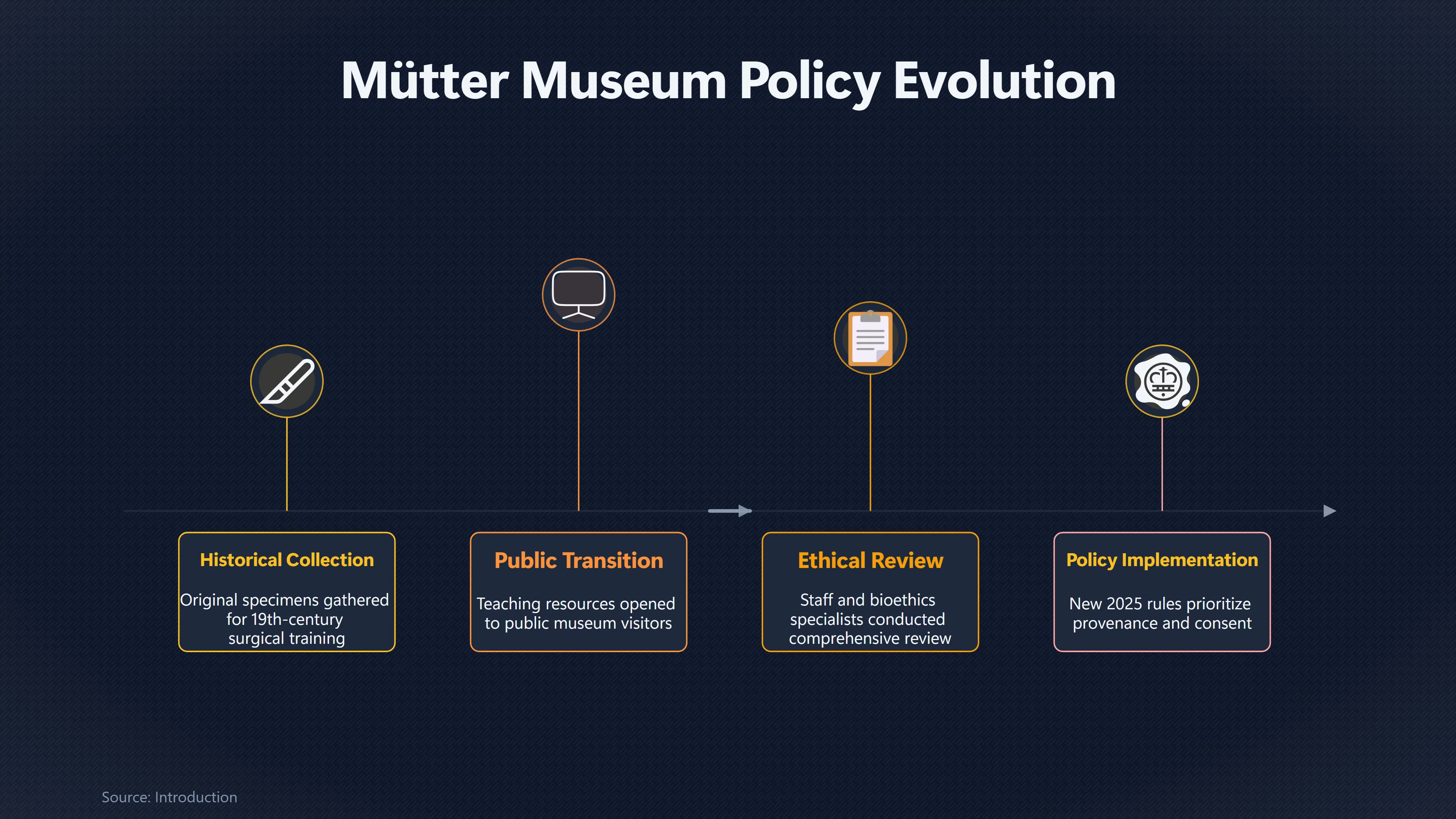
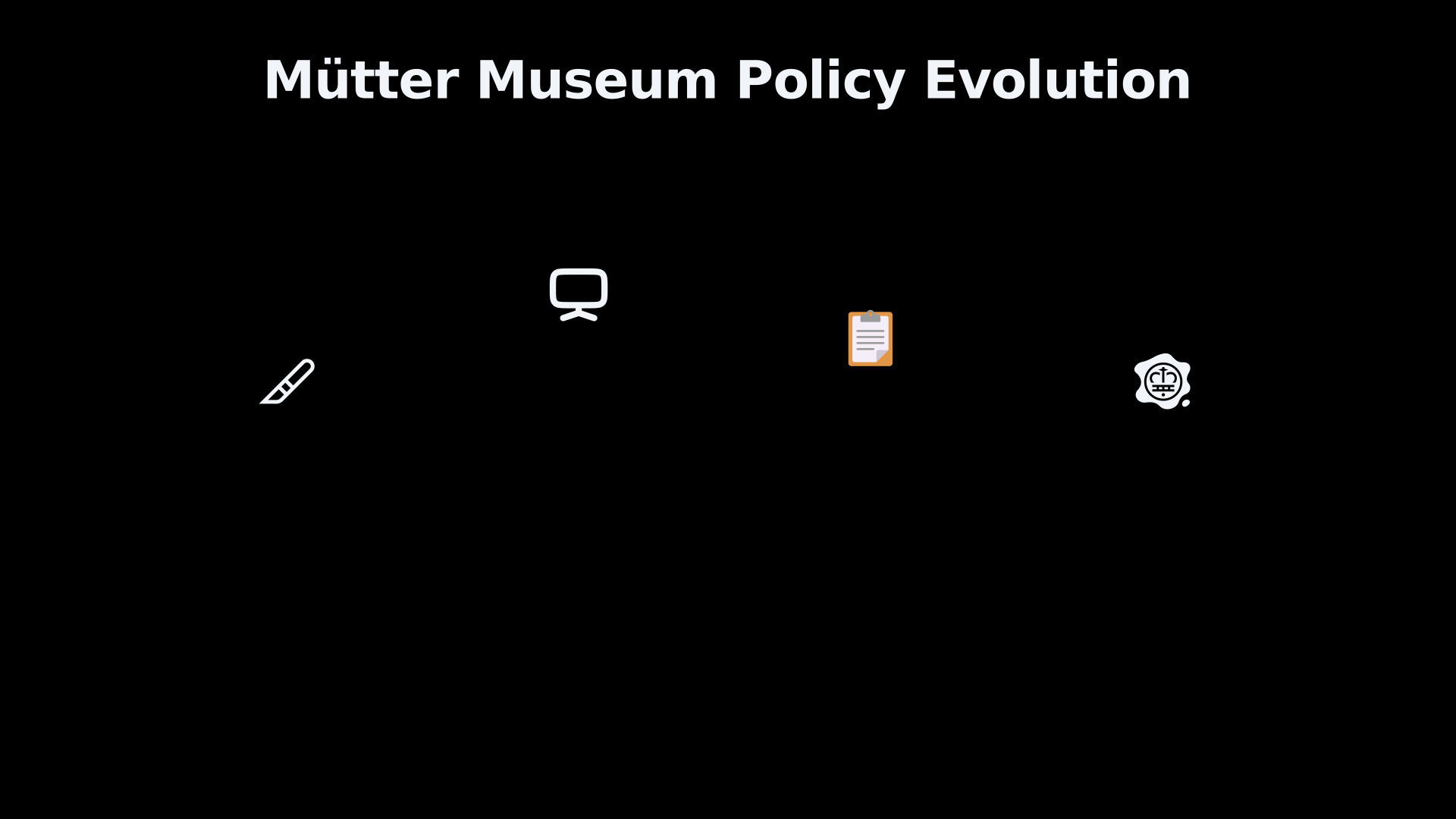
As medical history became a subject of public interest, some teaching collections gradually opened to visitors. The Mütter Museum in Philadelphia is the best-known example. Founded around the teaching collection donated by surgeon Thomas Dent Mütter, it presents thousands of authentic medical specimens illustrating disease, injury, congenital conditions and the history of surgery. Unlike horror attractions or fictional “cabinet of curiosities”, the museum has always presented itself as an educational institution connected to the College of Physicians of Philadelphia.[Mutter Museum]muttermuseum.orgMutter Museum Human Remains and Image Policy | Mütter MuseumMutter Museum Human Remains and Image Policy | Mütter Museum
That transition from classroom to public gallery fundamentally changes the ethical questions involved. Material originally collected for medical instruction may now be viewed by tourists, photographed for social media and interpreted outside its original educational setting.
What authentic specimens can reveal
Medical museums argue that genuine human remains can communicate ideas that models or digital reconstructions cannot.
Authentic specimens can help visitors understand:
- the physical effects of disease before modern treatment;
- congenital conditions and anatomical variation;
- the history of surgery and medical innovation;
- changing ideas about disability and bodily difference;
- the realities of epidemics and occupational disease.
Seeing genuine pathological material often reminds visitors that medicine is ultimately concerned with real human lives rather than abstract scientific concepts. Many educators argue that authentic specimens encourage empathy when carefully interpreted, particularly when exhibitions explain who an individual was rather than reducing them to an anonymous body part.[Mutter Museum]muttermuseum.orgMutter Museum Human Remains and Image Policy | Mütter MuseumMutter Museum Human Remains and Image Policy | Mütter Museum
Modern museums increasingly attempt to move beyond presenting specimens simply as medical anomalies. Labels are more likely to discuss patients’ biographies, historical context and the limitations of medical practice during their lifetimes.
Why consent has become the central ethical question
The greatest challenge facing American medical museums is that many historical collections were assembled before modern standards of informed consent existed.
Numerous nineteenth-century anatomical collections drew material from:
- hospital post-mortems;
- unclaimed bodies;
- poorhouses and prisons;
- dissecting rooms supplied under historical anatomy laws;
- donations made with limited documentation.
Practices that were legal at the time may not meet present-day ethical expectations. In many cases museums simply cannot establish whether individuals agreed to public display, scientific study or permanent preservation.
This uncertainty has shifted museum ethics away from asking, “Is this legal?” towards asking, “Is continued display justified?” Provenance—the documented history of how a specimen entered a collection—has therefore become almost as important as the specimen itself.[muttermuseum.org]muttermuseum.orgMutter Museum Human Remains and Image Policy | Mütter MuseumMutter Museum Human Remains and Image Policy | Mütter Museum
The Mütter Museum’s reassessment
The Mütter Museum illustrates how American medical museums are changing rather than simply closing displays.
Following an extensive review involving museum staff, outside bioethics specialists and community consultation, the College of Physicians introduced comprehensive human remains policies in 2025. These policies emphasise:
- careful documentation of provenance;
- respectful interpretation;
- stricter rules governing photography;
- significant restrictions on acquiring additional human remains;[britishmuseum.org]britishmuseum.orgSource details in endnotes.
- exhibition decisions guided by ethical review rather than historical custom.
The museum has also stated that future acquisitions of human remains will generally require informed consent through living donation or documented bequest, replacing older collecting practices that would no longer be considered acceptable. Rather than removing all specimens, the institution intends to provide fuller historical context, including acknowledging cases where consent is uncertain or impossible to verify.[Mutter Museum]muttermuseum.orgMutter Museum Human Remains and Image Policy | Mütter MuseumMutter Museum Human Remains and Image Policy | Mütter Museum
This reflects a broader trend across American museums: retaining educational value while recognising that collections themselves are products of historical inequalities and changing medical ethics.
Provenance matters as much as preservation
Modern museum practice increasingly treats provenance research as an ethical responsibility rather than simply a cataloguing exercise.
Questions now asked about individual specimens include:
- Who was this person?
- How did the remains enter the collection?
- Was consent documented?
- Are descendants or descendant communities identifiable?
- Does continued display serve a genuine educational purpose?
Sometimes provenance research reveals unexpected stories that reshape exhibitions. Anonymous specimens may become identifiable individuals with documented biographies. In other cases, investigations reveal that records are incomplete or that earlier collecting reflected discriminatory scientific practices.
Rather than diminishing scientific value, this additional context often makes exhibitions more historically honest by explaining how medicine itself has evolved.
Indigenous remains and repatriation
The strongest legal obligations concern Native American remains.
The Native American Graves Protection and Repatriation Act (NAGPRA) requires many federally funded museums and institutions to identify Native American human remains and, where appropriate, return them to affiliated tribes or descendants. The Smithsonian operates under separate legislation—the National Museum of the American Indian Act—but has pursued extensive repatriation alongside broader ethical reforms.[Smithsonian Institution]si.eduOpen source on si.edu.
The Smithsonian has acknowledged that parts of its historical collections were assembled during periods associated with scientific racism and colonial collecting. Recent institutional policy now emphasises:
- consultation with descendant communities;[penn.museum]penn.museumSource details in endnotes.
- ethical return alongside legal repatriation;
- restrictions on research;
- higher approval standards for display;
- documented informed consent for any future acquisition of human remains except in exceptional circumstances.[Smithsonian Natural History Museum]naturalhistory.si.eduSmithsonian Natural History MuseumSD 600 Chapter 16.3: Human Remains Not Subject to the NMAI Act | Smithsonian National Museum of Natural…
This distinction between legal repatriation and broader ethical return has become increasingly important. Museums may choose to return remains even when no legal requirement exists if continued retention is considered ethically unjustified.
Should museums still display human remains?
There is no universal answer, even among museum professionals.
Arguments supporting continued display include:
- preserving important medical evidence;
- educating healthcare professionals and the public;
- documenting diseases that are now rare;
- encouraging reflection on mortality and medical history.
Arguments for limiting or removing displays include:
- absence of meaningful consent;
- reducing people to anonymous objects;
- historical links to exploitation and discrimination;
- changing public expectations regarding dignity and respect.
Many American institutions are therefore adopting a middle position. Instead of displaying remains primarily because they are visually striking, museums increasingly require that each display have a clear educational purpose, careful interpretation and ethical justification that outweighs its potential to sensationalise the dead.[Mutter Museum]muttermuseum.orgMutter Museum Human Remains and Image Policy | Mütter MuseumMutter Museum Human Remains and Image Policy | Mütter Museum
A changing model for America’s medical museums
The debate surrounding human remains has altered how visitors experience America’s most unusual medical collections. What once appeared to be straightforward displays of anatomy are increasingly accompanied by discussions of consent, historical injustice, record-keeping and museum responsibility.
For visitors interested in unusual museums, this shift is significant. The fascination no longer lies solely in seeing rare pathological specimens, but in understanding how museums themselves are confronting uncomfortable aspects of their own history. In the United States, medical museums remain places where remarkable scientific collections survive, yet they are also becoming spaces in which institutions publicly examine the ethics of collecting, displaying and interpreting the human body.
Amazon book picks
Further Reading
Books and field guides related to Who Should Be Displayed in a Medical Museum?. Use these as the next step if you want deeper reading beyond the article.
The Island of Doctor Moreau
H. G. Wells called it "an exercise in youthful blasphemy". "The Island of Doctor Moreau" is the account of a Mr. Edward Prendick, a shipw...
Medical Apartheid
Examines the history of medical experimentation on African Americans, from the colonial era to the present day, revealing the exploitatio...
Body Worlds: The Anatomical Exhibition of Real Human Bodies
Catalog of Gunther von Hagen's exhibition of human bodies preserved by "plastination"and presented as "natural art" (p. 13).
eBay marketplace picks
Marketplace Samples
Live-tested eBay searches with available results related to this page.
Selected fromscience museum print oneBay.co.uk.

Endnotes
1.
Source: muttermuseum.org
Title: Mutter Museum Human Remains and Image Policy | Mütter Museum
Link:https://muttermuseum.org/our-policy/
2.
Source: si.edu
Link:https://www.si.edu/newsdesk/releases/statement-human-remains-smithsonian-institution
3.
Source: muttermuseum.org
Title: Mutter Museum Mütter Matters | Mütter Museum
Link:https://muttermuseum.org/mutter-matters/
4.
Source: naturalhistory.si.edu
Link:https://naturalhistory.si.edu/research/anthropology/programs/irdp/resources/sd-600-chapter
Source snippet
Smithsonian Natural History MuseumSD 600 Chapter 16.3: Human Remains Not Subject to the NMAI Act | Smithsonian National Museum of Natural...
5.
Source: si.edu
Link:https://www.si.edu/collections/human-remains
6.
Source: muttermuseum.org
Title: Postmortem Project | Mütter Museum
Link:https://muttermuseum.org/on-view/postmortem-project/
7.
Source: muttermuseum.org
Title: New York Times Article | Mütter Museum
Link:https://muttermuseum.org/mutter-matters/new-york-times-august
8.
Source: si.edu
Link:https://www.si.edu/newsdesk/releases/smithsonian-forms-task-force-develop-guidelines-human-remains-collection
9.
Source: si.edu
Title: Smithsonian Adopts Policy on Ethical Returns | Smithsonian Institution
Link:https://www.si.edu/es/newsdesk/releases/smithsonian-adopts-policy-ethical-returns
10.
Source: naturalhistory.si.edu
Title: shared stewardship and ethical returns
Link:https://naturalhistory.si.edu/research/shared-stewardship-and-ethical-returns
11.
Source: naturalhistory.si.edu
Title: policy international repatriation human remains
Link:https://naturalhistory.si.edu/research/anthropology/programs/irdp/resources/policy-international-repatriation-human-remains
12.
Source: naturalhistory.si.edu
Link:https://naturalhistory.si.edu/research/anthropology/programs/irdp/representation
13.
Source: muttermuseum.org
Link:https://muttermuseum.org/postmortem-progress
14.
Source: muttermuseum.org
Link:https://muttermuseum.org/about/overview/
16.
Source: britishmuseum.org
Link:https://www.britishmuseum.org/our-work/departments/human-remains
Additional References
17.
Source: apnews.com
Link:https://apnews.com/article/a6cb79fe008017519a6ff7b87aa9f351
Source snippet
Collected mostly between 1840 and 1940 for educational purposes, many remains were obtained under unethical conditions or during autopsie...
18.
Source: youtube.com
Title: What If Your Ancestor Was on Display? | Ethics of Human Remains in Museums
Link:https://www.youtube.com/watch?v=BSoB-M_U6x0
Source snippet
Which Ethics? A Framework for Legacy Collections of Human Remains Mütter Museum of the College of Physicians of Philadelphia · 718 views...
19.
Source: youtube.com
Link:https://www.youtube.com/watch?v=ew0OBoHKyj0
Source snippet
ARTiculate Ancient History | Ethical considerations for caring and managing human remains in museums...
20.
Source: wellcomecollection.org
Title: Care of Human Remains Policy | Wellcome Collection
Link:https://wellcomecollection.org/care-of-human-remains-policy
Source snippet
About * 2. Scope * 3. Review * 4. Decision-making * 5. Legal requirements, ethical frameworks and guidance * 6. Definit...
21.
Source: youtube.com
Link:https://www.youtube.com/watch?v=lml7S5-teqc
Source snippet
Should human remains be displayed in museums? | Stuff The British Stole | ABC iview...
22.
Source: youtube.com
Link:https://www.youtube.com/watch?v=HpF6P8SDzYk
Source snippet
What If Your Ancestor Was on Display? | Ethics of Human Remains in Museums...
23.
Source: youtube.com
Title: Which Ethics? A Framework for Legacy Collections of Human Remains
Link:https://www.youtube.com/watch?v=Sq7ynYw0kYA
Source snippet
Medical museum in Philadelphia overhauls policies on human remains to meet modern ethical standards...
24.
Source: penn.museum
Link:https://www.penn.museum/about/statements-and-policies/statement-on-human-remains
25.
Source: collegeofphysicians.org
Link:https://collegeofphysicians.org/events/postmortem-first-look-college-fellows-and-museum-members/
26.
Source: pewcenterarts.org
Link:https://www.pewcenterarts.org/grant/postmortem-mutter-museum