Within Curious Lebanon
Why Do Lebanon's Stones Look Almost Alive?
Mim Museum and Byblos fossil collections turn minerals and ancient marine life into science displays, collector objects and souvenirs.
On this page
- The mineral spectacle at Mim Museum
- Lebanon's fossil fish and ancient seas
- Science, collecting and the souvenir trade
Page outline Jump by section
Introduction
Lebanon’s most unusual scientific collections are not built around dinosaurs or giant skeletons, but around objects that seem almost too perfect to be natural. Glittering crystal formations, exceptionally preserved fossil fish and even rare meteorites have made the country an unexpected destination for collectors and earth-science enthusiasts. Together they reveal a landscape where deep geological time, private collecting and public education overlap.
The centrepiece is Beirut’s Mim Museum, whose world-class mineral collection sits alongside displays explaining Lebanon’s extraordinary fossil heritage. Beyond the capital, the fossil museums and workshops of Byblos preserve creatures that swam through a tropical sea roughly 95–100 million years ago. These institutions are unusual because they combine scientific research with the long-standing commercial trade in fossils and minerals, raising interesting questions about collecting, conservation and the boundary between museum exhibit and souvenir.[beirut.com]beirut.comMim MuseumMim Museum
Why Do Lebanon’s Stones Look Almost Alive?
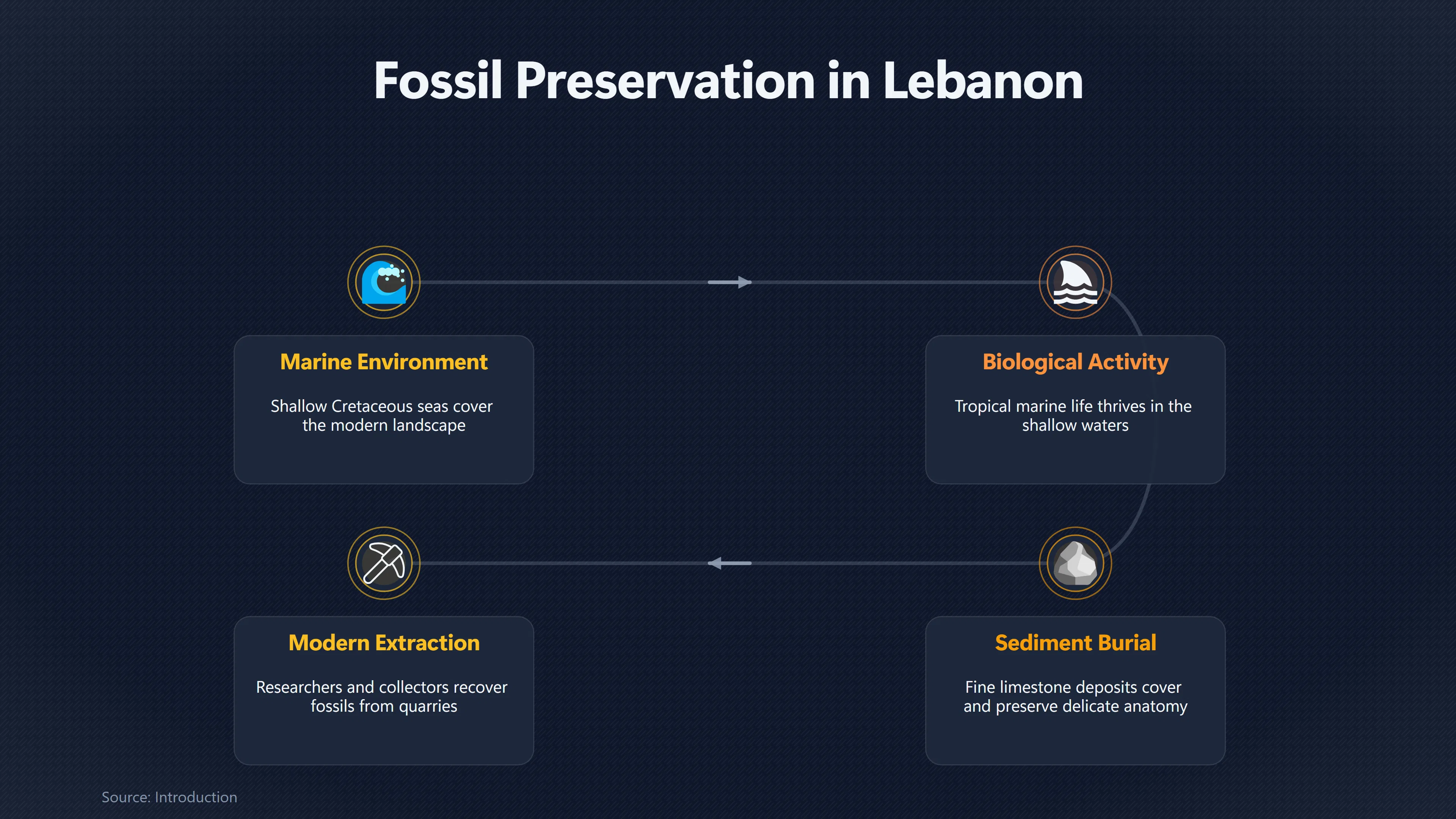
Lebanon’s limestone mountains were once part of a shallow Cretaceous sea. Today they yield fossils with astonishing detail, while the country’s museums also celebrate minerals whose vivid colours and geometric forms resemble sculpture more than geology. Rather than presenting rocks as dry scientific specimens, Lebanese collections often emphasise their beauty alongside their scientific importance.
The country’s best-known destination for this approach is the Mim Museum in Beirut, founded around the private collection of entrepreneur Salim Eddé. Since opening in 2013, it has developed into one of the world’s most significant private mineral museums, displaying thousands of mineral specimens representing hundreds of species from dozens of countries. Interactive displays explain crystal formation, fluorescence and mineral uses in everyday technology, making the exhibits accessible to visitors with no geological background.[beirut.com]beirut.comMim MuseumMim Museum
The mineral spectacle at Mim Museum
What makes the Mim Museum unusual is that it treats minerals as both scientific specimens and natural works of art. Instead of rows of anonymous rocks, visitors encounter brilliantly coloured quartz, calcite, malachite, fluorite and other crystals displayed with dramatic lighting that highlights their natural symmetry and colour.
The museum’s collection extends well beyond Lebanon itself. Although it includes Lebanese minerals, its wider aim is to demonstrate the diversity of crystal formation across the world. Multimedia exhibits explain why crystals grow in particular shapes, how minerals fluoresce under ultraviolet light and how geology connects to mining, industry and everyday life. This emphasis on aesthetics explains why the museum attracts visitors who might never otherwise choose to visit a geology museum.[Beirut.com]beirut.comMim MuseumMim Museum
The museum has also incorporated palaeontological exhibits into its permanent displays, including the remarkably complete Lebanese pterosaur Mimodactylus libanensis (“Mimo”), reconstructed using holograms and digital interpretation. Although not the main focus of this page, its presence reinforces the museum’s broader mission of presenting Lebanon’s geological history through visually striking specimens.[MIM]mim.museumOpen source on mim.museum.

Lebanon’s fossil fish and ancient seas
Lebanon is internationally famous among palaeontologists for fossil fish preserved in exceptionally fine limestone dating from the Late Cretaceous. Deposits around Haqel, Hajoula and En Nammoura have produced some of the world’s finest fossil fish, often preserving delicate fins, scales and even soft anatomical details that are rarely fossilised elsewhere.[American University of Beirut]aub.edu.lbAmerican University of Beirut Geology MuseumAmerican University of Beirut Geology Museum
These fossils record a tropical marine ecosystem that existed when much of modern Lebanon lay beneath a shallow sea. Sharks, rays, eels, coelacanths, flying fish, shrimps, squid and many extinct species appear in remarkable condition, allowing researchers to study ancient marine evolution in exceptional detail. Because preservation is so fine, Lebanese fossils frequently feature in scientific descriptions of new prehistoric species.[edu.lb]aub.edu.lbAmerican University of Beirut Geology MuseumAmerican University of Beirut Geology Museum
The Mim Museum has periodically highlighted this heritage through dedicated fossil exhibitions such as Fish’N’Stone, displaying hundreds of marine fossils alongside explanations of how such delicate preservation occurred. The exhibition links spectacular specimens with the geological processes that created them, rather than treating them simply as collector’s pieces.[MIM]mim.museumMIMApril 8, 2016…
Byblos and the Memory of Time
The strongest concentration of visitor-facing fossil collections outside Beirut is found in the old town of Byblos. The Byblos Fossil Museum, also known as Memory of Time, displays fossils recovered largely from nearby villages including Haqel, Hajoula and En Nammoura.
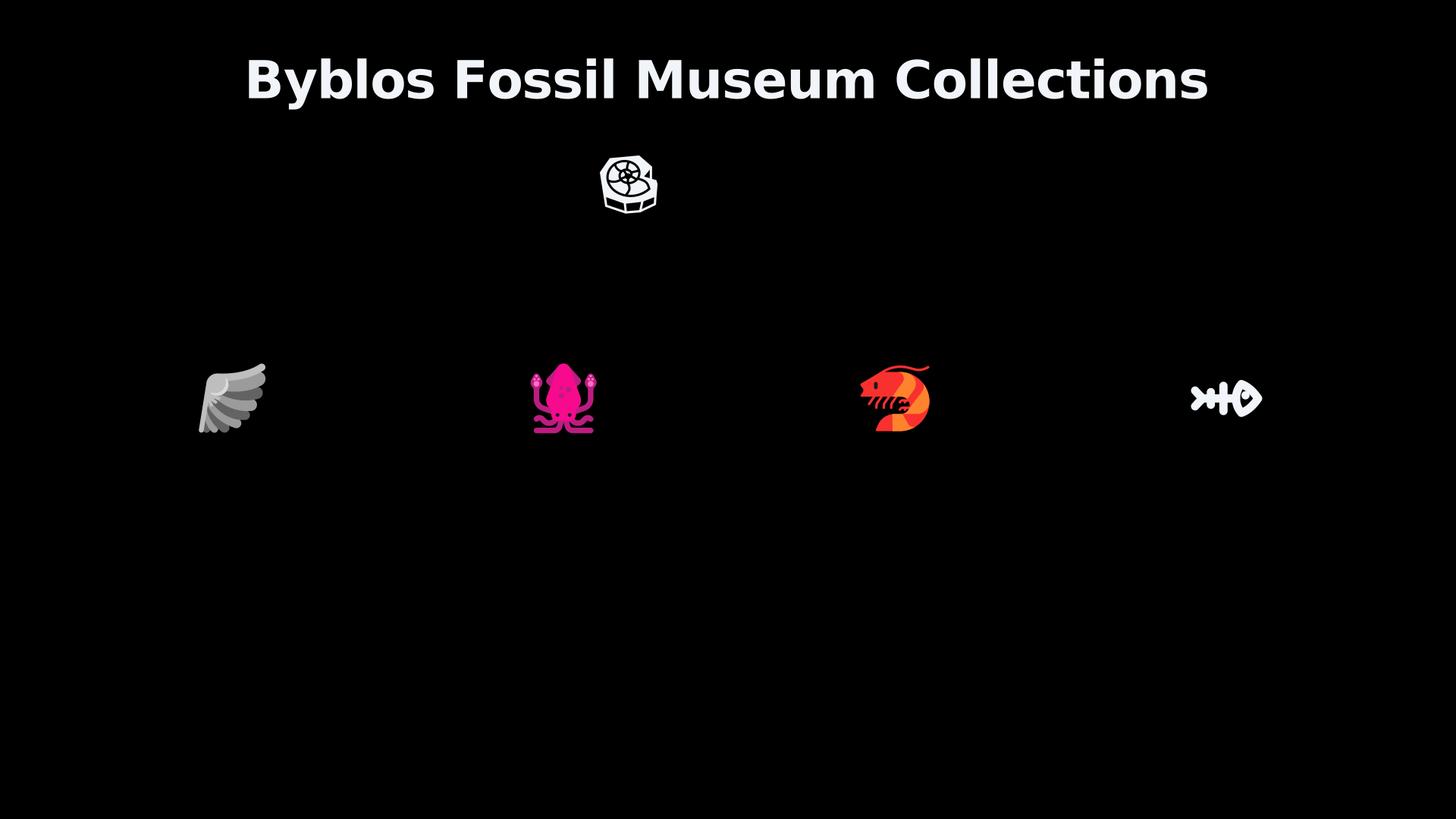
Its collections include fossil sharks, rays, flying fish, shrimps, squid and numerous extinct bony fishes. Unlike many natural history museums, visitors are only a short distance from the original fossil-bearing quarries, making it easier to understand how these discoveries emerged from the surrounding landscape rather than distant excavations.[Wikipedia]WikipediaByblos Fossil MuseumByblos Fossil Museum
The museum also illustrates how private family collecting helped preserve many important discoveries before formal museum infrastructure developed. That history reflects a broader Lebanese tradition in which local collectors, commercial fossil dealers and scientific researchers have often worked in parallel, sometimes cooperatively and sometimes with competing priorities.[Wikipedia]WikipediaByblos Fossil MuseumByblos Fossil Museum
Science, collecting and the souvenir trade
Lebanon occupies an unusual position because fossils are simultaneously scientific treasures, museum exhibits and commercial products. Fossil fish have long been sold in Byblos and nearby towns as decorative objects and souvenirs, while the finest examples may instead enter museums or research collections.
This dual identity creates continuing debates about conservation. Commercial collecting has undoubtedly brought many spectacular fossils to public attention, but it has also dispersed scientifically valuable specimens into private ownership. Museums therefore play an important role in documenting provenance, preserving significant examples and making them accessible to researchers as well as visitors.[American University of Beirut]aub.edu.lbAmerican University of Beirut Geology MuseumAmerican University of Beirut Geology Museum
The same tension appears in mineral collecting. Private collectors such as Salim Eddé assembled internationally important collections through decades of acquisition, yet by transforming those collections into public museums they shifted exceptional specimens from private display into educational institutions. In Lebanon’s curiosity landscape, this combination of collector passion and public access is one of the defining features that makes these collections distinctive.[Beirut.com]beirut.comMim MuseumMim Museum
Meteorites occupy a much smaller place in Lebanon’s public collections than minerals or fossil fish. They occasionally appear within broader geological displays to illustrate the diversity of natural materials reaching Earth, but they are not a defining feature of Lebanese museum culture. Instead, the country’s international reputation rests overwhelmingly on its extraordinary fossil-bearing limestone and the vivid mineral collections that turn geology into one of Lebanon’s most visually striking scientific attractions.[American University of Beirut]aub.edu.lbAmerican University of Beirut Geology MuseumAmerican University of Beirut Geology Museum
Amazon book picks
Further Reading
Books and field guides related to Why Do Lebanon's Stones Look Almost Alive?. Use these as the next step if you want deeper reading beyond the article.
The Crystal Bible
The Crystal Bible has become the world's favourite crystal reference guide, having sold over a million copies. The directory format enabl...
A Field Guide to Rocks and Minerals
Explains how to start and organize a rock collection; provides detailed descriptions of hundreds of minerals with information on geograph...
Life Among the Savages
In a hilariously charming domestic memoir, America’s celebrated master of terror turns to a different kind of fright: raising children. I...
The Fossil Book
First published 1958. Subjects: Fossiles, Identification, Paléontologie, Fossils, Guides, manuels.
eBay marketplace picks
Marketplace Samples
Live-tested eBay searches with available results related to this page.
Selected fromfossil collectible oneBay.co.uk.
Endnotes
1.
Source: beirut.com
Title: Mim Museum
Link:https://www.beirut.com/en/directory/mim-museum/
2.
Source: Wikipedia
Title: Byblos Fossil Museum
Link:https://en.wikipedia.org/wiki/Byblos_Fossil_Museum
3.
Source: Wikipedia
Title: MIM Museum
Link:https://en.wikipedia.org/wiki/MIM_Museum
4.
Source: mim.museum
Link:https://www.mim.museum/
5.
Source: mim.museum
Link:https://www.mim.museum/collection
Source snippet
MIMApril 8, 2016...
Published: April 8, 2016
6.
Source: beirut.com
Title: the worlds most thrilling private collection of minerals resides in beirut
Link:https://www.beirut.com/en/63921/the-worlds-most-thrilling-private-collection-of-minerals-resides-in-beirut/
Source snippet
The World's Most Thrilling Private Collection of Minerals Resides in BeirutJuly 28, 2022 — SARAH TARHINI • 28 JUL 2022 THE WORLD’S MOST T...
Published: July 28, 2022
7.
Source: beirut.com
Link:https://www.beirut.com/en/62823/9-lebanese-museums-for-everything-but-paintings/
Source snippet
9 Lebanese Museums For Everything But PaintingsNovember 30, 2021 — LYNN FAKHRY • 30 NOV 2021 9 LEBANESE MUSEUMS FOR EVERYTHING BUT PAINTI...
Published: November 30, 2021
8.
Source: mim.museum
Title: Known throughout the world, those fossils… Explore More Halite Bea
Link:https://www.mim.museum/home
Source snippet
April 8, 2016 — Temporary Exhibitions Fish'N' Stone April 8, 2016 mim museum hosts a thematic exhibition “FISH’N’STONE” of 200 marine...
Published: April 8, 2016
9.
Source: mim.museum
Link:https://www.mim.museum/contact
10.
Source: youtube.com
Title: Mim Museum
Link:https://www.youtube.com/watch?v=P4gJbRMqwqg
Source snippet
Lebanese Fossils Museum/The story of fossilized fish in Lebanon...
11.
Source: aub.edu.lb
Title: American University of Beirut Geology Museum
Link:https://www.aub.edu.lb/fas/EarthSciences/Pages/Museum.aspx
12.
Source: sobeirut.com
Title: Mim museum
Link:https://www.sobeirut.com/mim-museum
Source snippet
Ashrafieh - Art - SOBEIRUTMIM MUSEUM * Image: IMG_0625.jpg * Image: IMG_0645.JPG * Image: IMG_0627.jpg * Image: IMG_0621.JPG * Image: IMG...
13.
Source: lonelyplanet.com
Title: MI M | Beirut, Lebanon | Attractions
Link:https://www.lonelyplanet.com/points-of-interest/mim/1577230
Additional References
14.
Source: youtube.com
Title: Lebanese Fossils Museum/The story of fossilized fish in Lebanon
Link:https://www.youtube.com/watch?v=LzYyL6z5rdc
Source snippet
Expo Hakel: Extracting Fossils from the Lebanese Mountains for Decades...
15.
Source: youtube.com
Title: Expo Hakel: Extracting Fossils from the Lebanese Mountains for Decades
Link:https://www.youtube.com/watch?v=295N3L9R07Q
Source snippet
LIVE: Lebanese Fossils Museum, Expo HAKEL...
16.
Source: memoryoftime.com
Link:https://www.memoryoftime.com/discover-us/mim
17.
Source: discoverlebanon.com
Link:https://www.discoverlebanon.com/en/panoramic_views/beirut/mim_museum.php
18.
Source: youtube.com
Title: LIVE: Lebanese Fossils Museum, Expo HAKEL
Link:https://www.youtube.com/watch?v=N4T4ZUGaHyw
Source snippet
The MiM Museum - A Beirut Hidden Gem...
19.
Source: youtube.com
Title: The Mi M Museum
Link:https://www.youtube.com/watch?v=qc28tOlGuvI