Where Bulgaria Keeps Its Strangest Stories
Bulgaria does not have a single national “museum of the strange”. Its curiosity culture is scattered across archaeological displays, folklore collections, preserved industrial sites, devotional objects, reconstructed socialist interiors and small museums devoted to subjects as specific as yoghurt, salt and satire.
Page outline Jump by section
Introduction
For visitors, the essential distinction is between evidence and interpretation. Bulgaria’s so-called vampire burials are genuine archaeological finds, but “vampire” describes the beliefs and funerary precautions of the living, not proof that anyone rose from the grave. Baba Vanga’s preserved homes document a powerful modern devotional culture, but claims about her predictions remain matters of belief. Elsewhere, commercial retro attractions may offer richer atmosphere than historical analysis. Together, these collections show how Bulgaria preserves its unsettling past through scholarship, folklore, nostalgia, tourism and faith.
Where Bulgaria’s strangest collections are found
The country’s unusual museums fall into several overlapping groups.
Archaeological curiosities appear within established regional museums rather than separate paranormal attractions. Human remains, ritual objects and unusual burials are normally interpreted as evidence of past societies, even when publicity gives them supernatural labels.
Folklore and devotional collections preserve beliefs that remain culturally alive. House museums, pilgrimage sites and ethnographic displays may sit somewhere between historical interpretation and reverence.
Museums of everyday socialism turn recent domestic life into heritage. Some are state-run art collections; others are private, immersive reconstructions designed for visitors.
Specialist museums elevate one trade, substance or local obsession into an entire institution. Bulgaria’s salt pans, underground mine, humour museum and yoghurt museum are among the clearest examples.
This dispersed pattern matters. It means a visitor interested in Bulgaria’s stranger history should not search only for attractions labelled “occult”, “paranormal” or “curiosity museum”. The most revealing objects are often embedded in apparently conventional archaeology, local history or ethnography collections.
The “vampire” of Sozopol: archaeology behind the legend
The best-known Bulgarian museum object associated with the supernatural is the medieval burial popularly called the “Vampire of Sozopol”. Archaeologists uncovered a male skeleton with an iron object driven through the chest area, part of a wider pattern of burials altered to prevent certain dead people from returning. The remains and a facial reconstruction have been associated with the Archaeological Museum in Sozopol, whose wider collection covers the settlement’s history from prehistory to the early modern period.[sozopol-museums.bg]sozopol-museums.bgSozopol Museums Archaeological MuseumSozopol MuseumsArchaeological Museum - Museum Center SozopolMay 27, 2020 — The museum is included, under No. 8, in the “100 National Tour…
The sensational nickname can obscure what makes the find important. Archaeologists do not treat the burial as evidence that vampires existed. It records a protective ritual performed by people who feared that a socially dangerous, improperly buried or suspiciously deceased person might become a harmful revenant. Similar precautions could include piercing, pinning, weighting or otherwise disabling a corpse. The Regional Historical Museum in Burgas has discussed such burials within the broader history of Bulgarian beliefs about vampires, werewolves and other dangerous beings.[Регионален исторически музей Бургас]burgasmuseums.bgToday the whole world is mad about vampires in popular culture and the name Bulgaria began to be perceived as their homeland.There are ma…
For visitors, Sozopol therefore offers something more interesting than a horror prop. The burial is physical evidence of how folklore could shape the treatment of an actual human body. It connects museum archaeology with death customs, community anxiety and the long European history of the restless dead.
The credibility level is comparatively high because the underlying burial is archaeological. The disputed element is interpretation: calling the individual a “vampire” is shorthand for an anti-revenant burial and a powerful tourism label, not a diagnosis of what the dead man was believed to have done during life.
Baba Vanga: a house museum between biography and pilgrimage
Bulgaria’s most prominent modern mystical figure is Baba Vanga, the blind clairvoyant whose reputation spread far beyond the country. Her former house in Petrich has been preserved as a museum containing personal belongings, clothing, photographs, icons, artworks and gifts reportedly presented by people who consulted or admired her. One visitor-oriented description states that the restored house displays more than 3,000 objects.[E-Tour Guide]e-tourguide.euE-Tour Guide HOUSE-MUSEUM VANGAE-Tour GuideHOUSE-MUSEUM VANGA - TOWN OF PETRICHThe house was built in 1947. Over 3000 objects are displayed – icons, artworks, clothes…
The collection is unusual because it cannot be understood simply as a biographical house museum. For sceptical visitors, its value lies in documenting the domestic setting, public image and material culture surrounding one of twentieth-century Eastern Europe’s most famous seers. For believers, the objects may carry emotional or spiritual significance. The nearby Rupite area, closely associated with her later life, further blurs the line between heritage destination, memorial and pilgrimage landscape.
A careful visit should separate three layers:
- Documented biography: the houses, possessions, photographs and records connected with her public life.
- Devotional culture: gifts, icons and personal testimonies showing how followers understood her abilities.
- Prophecy claims: statements repeatedly attributed to her in books, newspapers and online lists, often without reliable contemporary documentation.
The museums demonstrate that belief itself can be historically important even when supernatural claims cannot be verified. Baba Vanga’s preserved belongings show how private charisma became public heritage, tourist identity and continuing popular religion.
Socialist Bulgaria preserved as art, home and spectacle
Some of Bulgaria’s most distinctive collections concern a past that is recent enough to remain politically and emotionally contested.
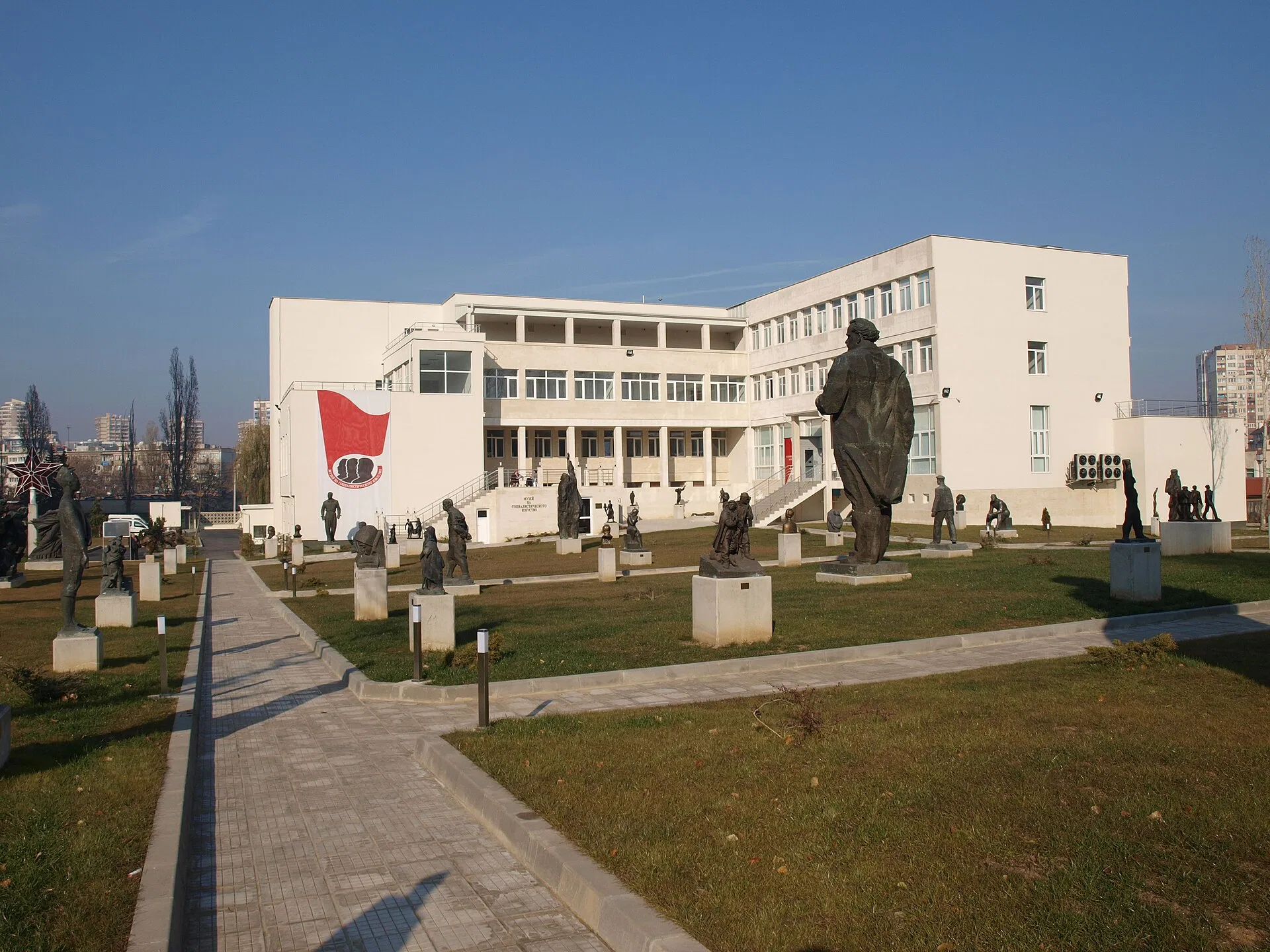
The National Gallery’s Museum of Art from the Socialist Period in Sofia is the most formally curated example. Opened in 2011, it presents art produced during socialist rule from 1944 to 1989. Its sculpture park contains displaced political monuments, while one of its most recognisable objects is the large red star that once crowned the Communist Party headquarters. Paintings, sculpture and film material allow visitors to examine the visual language through which the state represented workers, leaders, industry and national progress.[nationalgallery.bg]nationalgallery.bgmuseum of socialist periodOn a special pedestal, the large five-pointed star that once crowned the former Party House in the centre of Sofia is on display…. Clo…
The unusual quality lies partly in displacement. Statues formerly intended to dominate streets and ceremonial spaces now stand together as museum objects. Removed from their original settings, they can appear imposing, absurd, nostalgic or threatening depending on the visitor’s experience. The institution is public and art-historical, but the collection inevitably raises questions about whether such work should be interpreted mainly as propaganda, artistic production or evidence of everyday political life.
The Red Flat offers almost the opposite approach. It is a private, interactive, museum-like reconstruction of a 1980s Sofia home, built around personal memories and domestic routines. Visitors encounter furniture, household goods and ordinary possessions rather than monumental ideology. Its own description emphasises immersion in the daily life of late communist Bulgaria rather than the format of a conventional museum.[The Red Flat Sofia]redflatsofia.comThe Red Flat Sofia The FlatThe Red Flat Sofia The Flat
In Varna, the privately established Retro Museum occupies a large space inside the Grand Mall. Opened in 2015, it combines socialist-era consumer objects, memorabilia and vehicles in an overtly visitor-facing display. The city’s official tourism site describes it as a 4,000-square-metre museum devoted to the period.[Visit Varna]visit.varna.bgretro muzejretro muzej
These three attractions should not be treated as interchangeable. The Sofia art museum foregrounds official imagery; the Red Flat presents an edited domestic story; and the Retro Museum turns mass-produced objects into a large nostalgic spectacle. Seen together, they reveal how recent history can be curated as warning, memory, aesthetics and entertainment.
Medical instruments in Bulgaria’s first charity hospital
Varna’s Museum of the History of Medicine is one of the country’s strongest conventional curiosity collections. It occupies a building founded in 1869 as Bulgaria’s first charity hospital and is administered by the Medical University of Varna and its associated university hospital. The institution describes itself as the only museum dedicated to medical history in the Balkans.[MU Varna]mu-varna.bgOpen source on mu-varna.bg.
Medical museums are inherently unsettling because objects designed for treatment can become strange when removed from clinical practice. Early surgical equipment, diagnostic apparatus, pharmacy materials and anatomical teaching objects show how medicine developed through trial, changing technology and evolving ideas about the body.
Unlike a commercial “museum of horrors”, the Varna collection is academic and historical. Its value comes from context: instruments are evidence of particular medical systems rather than props arranged simply to shock. The former hospital setting adds another layer, allowing visitors to connect equipment with the social history of charity, public health and professional medicine.
This is an important stop for readers interested in cabinets of medical curiosity because it shows the difference between a sensational oddity collection and a research-led institution. The objects may look disturbing, but their interpretation belongs to the history of healthcare rather than the supernatural.
Underground, open-air and still working
Several Bulgarian specialist museums are unusual because the museum environment is itself the principal exhibit.
The Underground Mining Museum in Pernik occupies galleries of the former state mine, where digging began in 1891. The mine closed after its deposits were exhausted in 1966 and was later converted into a museum. Visitors enter real underground workings and encounter tools, machinery and displays charting the development of mining. Recent Bulgarian National Radio coverage describes 34 exhibition niches inside the historic gallery.[Visit Bulgaria]visitbulgaria.comVisit Bulgaria Museum of Mining – town of PernikVisit Bulgaria Museum of Mining – town of Pernik
This is industrial heritage with physical immediacy. The darkness, confined space and machinery convey working conditions more powerfully than objects placed inside a normal gallery. It is a public historical museum rather than an adventure attraction, although guided access and operational arrangements should be checked before travelling.
Pomorie’s Salt Museum uses a different landscape. Opened in 2002, it combines an indoor exhibition with adjacent salt pans where salt continues to be produced through solar evaporation. Its subject is the traditional local method of extracting sea salt, making the site part museum, part working environment and part wetland landscape.[Visit Bulgaria]visitbulgaria.comVisit Bulgaria Salt Museum, PomorieVisit Bulgaria Salt Museum, Pomorie
The strange appeal is not horror but transformation: seawater becomes both an everyday commodity and the organising principle of a town’s history. Tools, photographs and shallow evaporation pools demonstrate how an apparently ordinary substance created labour systems, local wealth and a distinctive environment.
These museums are most rewarding when understood as preserved processes rather than collections of isolated objects. Pernik preserves the descent into the earth; Pomorie preserves the patient manipulation of sun, water and salt.
Yoghurt, microbiology and national identity
The Museum of Yoghurt in Studen Izvor is a small museum built around an exceptionally large cultural claim: Bulgaria’s identification with fermented milk. The village was the birthplace of physician and microbiologist Stamen Grigorov, who in 1905 described the bacterium involved in yoghurt fermentation. The museum links his scientific work with traditional production methods, rural household culture and the later international reputation of Bulgarian yoghurt.[bnrnews.bg]bnrnews.bgOpen source on bnrnews.bg.
Its appeal lies in the meeting of folklore, food history and laboratory science. Traditional vessels and domestic techniques present yoghurt as inherited knowledge, while the story of bacterial identification reframes it as a microbiological phenomenon. The museum also illustrates how food becomes national symbolism: a familiar everyday product is presented as evidence of local landscape, health, scientific achievement and cultural continuity.
Some of the historical health claims surrounding yoghurt require caution. Early promoters connected Bulgarian yoghurt consumption with longevity, but such broad claims should not be treated as simple proof that one food explains long life. The stronger museum story is how scientific discovery, commercial branding and national identity became attached to the same substance.
Gabrovo’s museum of humour is more serious than it sounds
The Museum of Humour and Satire in Gabrovo is one of Bulgaria’s most genuinely eccentric institutions. Founded on 1 April 1972, it grew from the city’s traditions of self-mocking folklore and carnival humour. It collects and exhibits cartoons, paintings, sculpture, photography, literature and other forms of comic and satirical expression from Bulgaria and abroad. Its international biennial began in 1973.[Музей на хумора и сатирата]humorhouse.bgМузей на хумора и сатиратаAbout the Museum – Museum of Humor and SatireМузей на хумора и сатиратаAbout the Museum – Museum of Humor and Satire
Gabrovo humour often revolves around exaggerated thrift and ingenious economy. In museum form, those jokes become a type of social archive: they preserve how a community caricatures itself and how humour can express criticism that would be difficult to state directly.
The museum is not merely a room of jokes. Its history developed during a political system in which satire’s relationship with authority could be delicate. The institution’s own account notes its ambition to support humorous artists who were often at odds with official power.[Музей на хумора и сатирата]humorhouse.bgМузей на хумора и сатиратаAbout the Museum – Museum of Humor and SatireМузей на хумора и сатиратаAbout the Museum – Museum of Humor and Satire
This makes it relevant to Bulgaria’s wider strange-history landscape. Satire is a collection category rarely granted an entire museum, yet it can preserve unofficial attitudes more effectively than formal political records. Cartoons and comic images register embarrassment, dissent, stereotypes and public frustrations that official monuments tend to conceal.
How to judge Bulgaria’s unusual collections
Bulgaria’s curiosity sites vary widely in authority and purpose. A useful way to read them is to ask who assembled the display and what type of claim it makes.
Archaeological museums generally provide the strongest material evidence, but dramatic labels such as “vampire” may come from publicity rather than formal interpretation.
University and state museums usually offer clearer provenance and professional context. The medical museum and socialist art museum fall broadly into this category.
Municipal and regional museums often combine scholarship with local identity. Their displays may be modest, but they preserve objects and beliefs overlooked by major national institutions.
Private immersive attractions can communicate atmosphere effectively, although reconstructed scenes may compress several experiences into one idealised interior.
House museums and pilgrimage sites preserve genuine possessions and places while also reflecting reverence, storytelling and contested supernatural claims.
Working heritage sites are often most valuable for understanding process. At Pomorie and Pernik, place and environment carry as much meaning as the objects.
Opening arrangements can change seasonally, and smaller museums may require advance contact or a guided visit. Official institutional or municipal pages are generally more reliable than old travel articles for current access.

Why Bulgaria’s curiosity culture matters
Bulgaria’s unusual collections are most compelling when they refuse a neat division between the rational and the uncanny. Archaeology documents fears of the returning dead. A clairvoyant’s household becomes both biography and shrine. Communist statues migrate from political centres to museum lawns. Surgical devices become historical curiosities, while mines and salt pans become exhibition spaces.
There is comparatively little evidence for a large, established Bulgarian network of commercial witchcraft, cryptid or UFO museums. The country’s stranger heritage is instead rooted in local history institutions, archaeological finds, devotional memory and highly specialised collections. That makes it less packaged than some European “dark tourism” circuits, but often more revealing.
The central lesson is that Bulgaria’s oddest museums are not simply repositories of bizarre objects. They show how communities decide which fears, occupations, beliefs and discredited symbols deserve to survive. Their exhibits occupy the boundary between evidence and legend, private memory and public history, reverence and tourism—the territory where a country’s curiosity culture becomes most visible.
Amazon book picks
Further Reading
Books and field guides related to Where Bulgaria Keeps Its Strangest Stories. Use these as the next step if you want deeper reading beyond the article.
The Museum Experience Revisited
The first book to take a "visitor's eye view" of the museum visit when it was first published in 1992, The Museum Experience revolutioniz...
The Archaeology of Death and Burial
The archaeology of death and burial is central to our attempts to understand vanished societies. Through the remains of funerary rituals...
The Balkans: Nationalism, War, and the Great Powers,
From the bestselling author of McMafia and DarkMarket comes this unique and lively history of Balkan geopolitics since the early nineteen...
eBay marketplace picks
Marketplace Samples
Live-tested eBay searches with available results related to this page.
Selected fromBulgaria travel poster oneBay.co.uk.

Endnotes
1.
Source: sozopol-museums.bg
Title: Sozopol Museums Archaeological Museum
Link:https://sozopol-museums.bg/en/archaeological-museum/
Source snippet
Sozopol MuseumsArchaeological Museum - Museum Center SozopolMay 27, 2020 — The museum is included, under No. 8, in the “100 National Tour...
Published: May 27, 2020
2.
Source: nationalgallery.bg
Title: museum of socialist period
Link:https://nationalgallery.bg/visiting/museum-of-socialist-period/
Source snippet
On a special pedestal, the large five-pointed star that once crowned the former Party House in the centre of Sofia is on display.... Clo...
3.
Source: visit.varna.bg
Title: retro muzej
Link:https://visit.varna.bg/en/retro-muzej.html
4.
Source: visit.varna.bg
Link:https://visit.varna.bg/en/museums/1.html
5.
Source: mu-varna.bg
Link:https://www.mu-varna.bg/EN/AboutUs/Pages/MuseumOfHistory.aspx
6.
Source: sozopol-museums.bg
Title: GALLER Y
Link:https://sozopol-museums.bg/en/gallery-archaeological-sites/
7.
Source: sozopol-museums.bg
Link:https://sozopol-museums.bg/en/contacts/
8.
Source: sozopol-museums.bg
Title: Working Hours
Link:https://sozopol-museums.bg/en/working-hours/
9.
Source: sozopol-museums.bg
Title: Museum Center
Link:https://sozopol-museums.bg/en/
10.
Source: sozopol-museums.bg
Title: Municipal Cultural Institute “Museum Center” – Sozopol
Link:https://sozopol-museums.bg/en/municipal-cultural-institute-museum-center-sozopol/
11.
Source: visit.varna.bg
Title: bg Muzeul Retro
Link:https://visit.varna.bg/ro/retro-muzej.html
12.
Source: visit.varna.bg
Link:https://visit.varna.bg/de/retro-muzej.html
13.
Source: visit.varna.bg
Link:https://visit.varna.bg/fr/retro-muzej.html
14.
Source: visit.varna.bg
Link:https://visit.varna.bg/en/medical_museum.html
15.
Source: visit.sozopol.bg
Link:https://visit.sozopol.bg/en
16.
Source: daytripsbulgaria.com
Link:https://daytripsbulgaria.com/excursion/227/Sozopol-The-Archaeological-Museum
Source snippet
The reconstructed face of the "vampire from Sozopol" is aslo in the museum...
17.
Source: welcome.bg
Title: Archaeological Museum
Link:https://welcome.bg/en/listing/archaeological-museum-sozopol/
Source snippet
The museum is divided into two sections: archaeology (5^{th} millennium BC – 17^{th} century AD) and Christian art (17^{th} –19^{th} cent...
18.
Source: burgasmuseums.bg
Link:https://www.burgasmuseums.bg/en/article/lecture-vampires-goblins-289
Source snippet
Today the whole world is mad about vampires in popular culture and the name Bulgaria began to be perceived as their homeland.There are ma...
19.
Source: e-tourguide.eu
Title: E-Tour Guide HOUSE-MUSEUM VANGA
Link:https://e-tourguide.eu/place/house-museum-vanga-town-of-petrich/
Source snippet
E-Tour GuideHOUSE-MUSEUM VANGA - TOWN OF PETRICHThe house was built in 1947. Over 3000 objects are displayed – icons, artworks, clothes...
20.
Source: redflatsofia.com
Title: The Red Flat Sofia The Flat
Link:https://redflatsofia.com/the-flat/
21.
Source: redflatsofia.com
Title: The Red Flat Sofia The Red Flat
Link:https://redflatsofia.com/
22.
Source: visitbulgaria.com
Title: Visit Bulgaria Museum of Mining – town of Pernik
Link:https://visitbulgaria.com/museum-of-mining-town-of-pernik/
23.
Source: bnrnews.bg
Title: through the tunnels of time the underground mining museum in bulgaria s pernik
Link:https://bnrnews.bg/en/post/384170/through-the-tunnels-of-time-the-underground-mining-museum-in-bulgaria-s-pernik
24.
Source: visitbulgaria.com
Title: Visit Bulgaria Salt Museum, Pomorie
Link:https://visitbulgaria.com/salt-museum-pomorie/
25.
Source: bnrnews.bg
Link:https://bnrnews.bg/en/post/488980/7-unusual-must-see-museums-in-bulgaria
26.
Source: notevenpast.org
Title: the museum of sour milk history lessons on bulgarian yogurt
Link:https://notevenpast.org/the-museum-of-sour-milk-history-lessons-on-bulgarian-yogurt/
27.
Source: humorhouse.bg
Title: Музей на хумора и сатиратаAbout the Museum – Museum of Humor and Satire
Link:https://humorhouse.bg/en/about-the-museum/
28.
Source: humorhouse.bg
Link:https://humorhouse.bg/en/museum-of-humor-and-satire/
29.
Source: museumvarna.com
Title: Archaeological Museum
Link:https://www.museumvarna.com/en/exposures/archaeological-museum/
30.
Source: visitbulgaria.com
Title: Archaeological Museum, Sozopol
Link:https://visitbulgaria.com/archaeological-museum-sozopol/
31.
Source: facebook.com
Title: 7 unusual mustsee museums in bulgaria
Link:https://www.facebook.com/groups/BELgarije/posts/7_unusual_mustsee_museums_in_bulgaria/2176881913095320/
32.
Source: tripadvisor.com
Title: Underground Mining Museum
Link:https://www.tripadvisor.com/Attraction_Review-g1652642-d6942886-Reviews-Underground_Mining_Museum-Pernik_Pernik_Province.html
33.
Source: visitbulgaria.com
Title: house of humour and satire gabrovo
Link:https://visitbulgaria.com/house-of-humour-and-satire-gabrovo/
34.
Source: daytripsbulgaria.com
Link:https://www.daytripsbulgaria.com/excursion/219/Pomorie–The-Salt-Museum-and-The-Salt-Works
35.
Source: visitbulgariaon.com
Link:https://www.visitbulgariaon.com/tour/baba-vanga-park-museum-self-guided
Additional References
36.
Source: Wikipedia
Link:https://en.wikipedia.org/wiki/Museum_of_Socialist_Art
Source snippet
The museum spread over an area of 7500m2 in the Sofia suburb known as "Red Star" is in three parts - a park with sculpture installations...
37.
Source: youtube.com
Title: This Communist-Era Museum in Bulgaria Brought Back Memories I Didn’t Expect
Link:https://www.youtube.com/watch?v=gj-OzHugkA4
Source snippet
The Most Mysterious Place in Bulgaria: Rupite, Baba Vanga's Home...
38.
Source: youtube.com
Title: 25th Gabrovo Biennial of Humor & Satire
Link:https://www.youtube.com/watch?v=wrLeYqY6Ggs
Source snippet
This Communist-Era Museum in Bulgaria Brought Back Memories I Didn't Expect...
39.
Source: atlasobscura.com
Link:https://www.atlasobscura.com/things-to-do/bulgaria/museums
40.
Source: mindtrip.ai
Link:https://mindtrip.ai/attraction/petrich-bulgaria/baba-vanga-house-museum/at-7dksrCyO
41.
Source: bulgariatravel.org
Link:https://bulgariatravel.org/tourism-types/cultural-tourism/
42.
Source: evendo.com
Link:https://evendo.com/locations/bulgaria/southeast-bulgaria/landmark/baba-vanga-house-museum-in-rupite
43.
Source: visit.guide-bulgaria.com
Link:https://visit.guide-bulgaria.com/a/749/museum_of_the_kiselo_mlyako_%28yogurt%29.htm
44.
Source: facebook.com
Link:https://www.facebook.com/groups/archeologyandcivilizations/posts/27210480348618798/
45.
Source: comediarting.it
Link:https://www.comediarting.it/en/portfolio-articoli/meet-egyptthe-exhibition-of-the-rare-relics-and-mummies-2/