Within Strange Lithuania
Inside Lithuania's Hidden Machinery of Fear
Former shelters and missile sites reveal how surveillance, civil defence and nuclear weapons shaped everyday fear under Soviet rule.
On this page
- Secret surveillance devices inside the Atomic Bunker
- Civil defence objects and the culture of catastrophe
- The Plokstine missile base and nuclear history at full scale
Page outline Jump by section
Introduction
Lithuania’s most unsettling historical attractions are not built around folklore but around the physical infrastructure of Cold War fear. Hidden beneath forests, industrial estates and military compounds are former Soviet bunkers, missile installations and collections of surveillance technology that reveal how an authoritarian state prepared simultaneously for nuclear war and constant internal monitoring. Unlike reconstructed exhibitions, many of these sites occupy the original spaces where military personnel worked, communications were monitored and civil-defence plans were maintained. They are unusual because the buildings themselves are part of the collection: visitors walk through command posts, sealed tunnels and control rooms rather than simply viewing artefacts in display cases. Together, these museums show how secrecy became architecture and how everyday objects—from gas masks to concealed microphones—formed part of a wider machinery designed to control society as much as defend it.[atominisbunkeris.lt]atominisbunkeris.ltAtomic BunkerAtomic Bunker

Secret surveillance devices inside the Atomic Bunker
One of Lithuania’s most distinctive private collections is the Atomic Bunker in Kaunas, housed six metres below ground in a genuine Cold War shelter. Rather than presenting a conventional military museum, it focuses on the practical equipment that sustained Soviet civil defence, intelligence work and emergency planning. The atmosphere comes as much from the bunker itself as from the thousands of artefacts packed into its rooms.[atominisbunkeris.lt]atominisbunkeris.ltAtomic BunkerAtomic Bunker
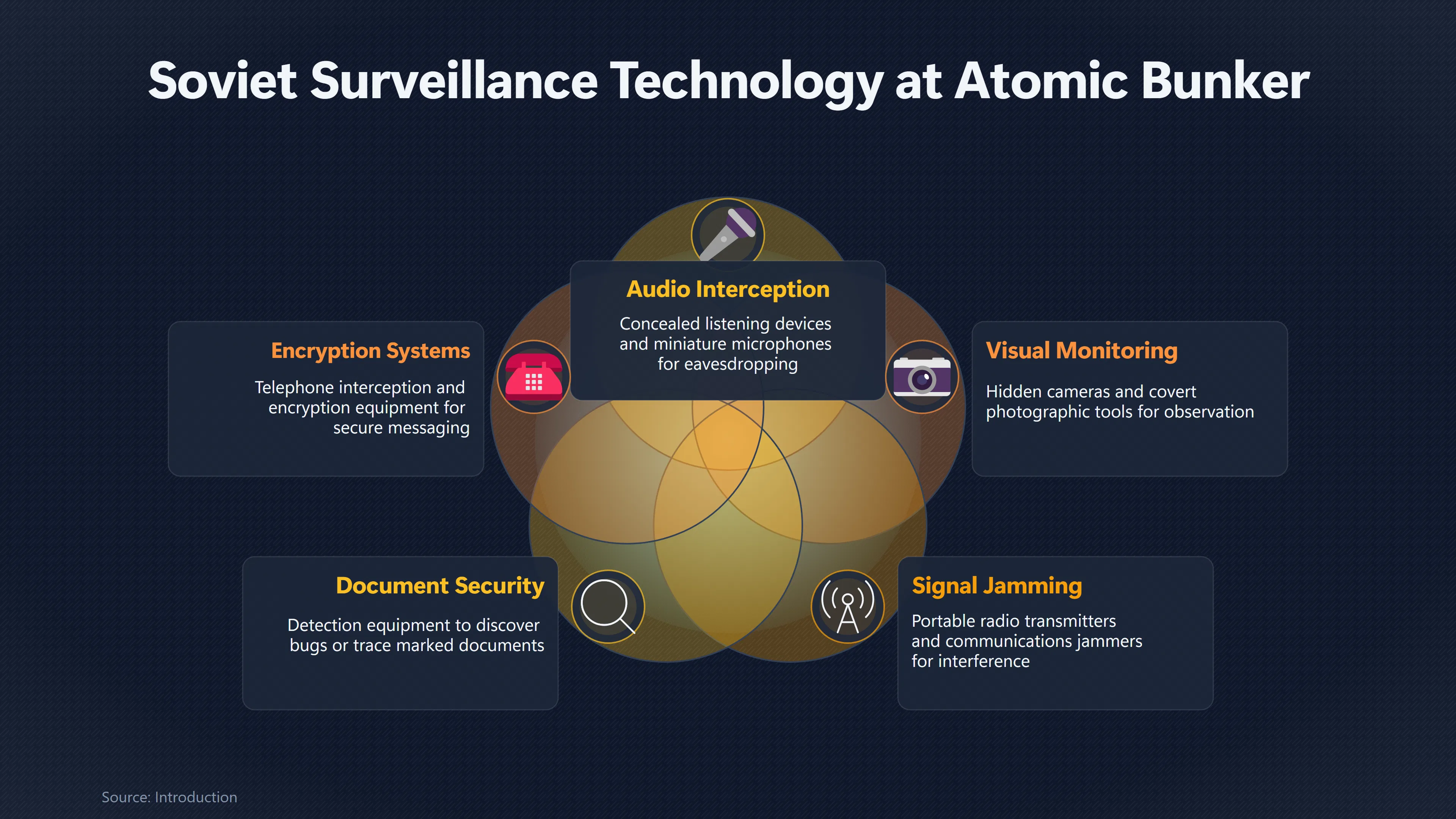
The collection is especially notable for its exhibition devoted to Soviet security services. Visitors encounter equipment once intended to remain invisible:
- Concealed listening devices and miniature microphones.
- Telephone interception and encryption equipment.
- Hidden cameras and covert photographic tools.
- Portable radio transmitters and communications jammers.
- Night-vision equipment and surveillance optics.
- Detection equipment designed to discover bugs or trace marked documents.
These displays are presented not as glamorous spy gadgets but as evidence of how extensive Soviet surveillance could become. The museum emphasises that the security services distrusted not only perceived opponents but frequently monitored officials, colleagues and military personnel as well. Many surviving devices are rare precisely because obsolete equipment was normally destroyed rather than preserved.[atominisbunkeris.lt]atominisbunkeris.ltAtomic BunkerAtomic Bunker
The bunker also contains unusually large collections of communications technology, including field telephones, switchboards, military radios, Morse equipment and aviation instruments. Seen together, they illustrate that surveillance depended on an entire communications infrastructure rather than isolated spy devices. The exhibition therefore shifts attention from fictional espionage towards the bureaucratic reality of information gathering during the Soviet period.[atominisbunkeris.lt]atominisbunkeris.ltAtomic BunkerAtomic Bunker
Civil-defence objects and the culture of catastrophe
Perhaps the most striking aspect of Lithuania’s bunker collections is how ordinary many of the objects appear. Gas masks, radiation meters, chemical testing kits, emergency lighting, breathing apparatus and medical supplies were once intended for routine preparedness rather than museum display. Their cumulative effect is to demonstrate how nuclear anxiety became embedded in everyday administration.[atominisbunkeris.lt]atominisbunkeris.ltAtomic BunkerAtomic Bunker
The Atomic Bunker preserves equipment issued not only to soldiers but also for wider civil-defence planning. Children’s gas masks, animal protective equipment, portable laboratories and decontamination devices reveal the scale on which Soviet planners imagined responding to chemical or nuclear attack. Rather than suggesting that survival was likely, these collections show how governments attempted to create an appearance of preparedness for catastrophes that would almost certainly have overwhelmed such systems.[atominisbunkeris.lt]atominisbunkeris.ltAtomic BunkerAtomic Bunker
This emphasis distinguishes the museum from collections centred purely on weapons. Visitors spend comparatively little time looking at missiles or tanks and much more examining the technologies of anticipation: alarms, filters, generators, communication systems and protective clothing. The result is a museum about the infrastructure of fear rather than battlefield combat.
The objects also raise questions about credibility and interpretation. Many items genuinely served civil-defence purposes, but their presence in a museum encourages reflection on the gap between official preparedness and practical reality. Historians generally regard Soviet civil-defence programmes as extensive in organisation but limited in their ability to protect civilian populations from large-scale nuclear conflict. The surviving equipment therefore documents both technological ambition and political messaging.[atominisbunkeris.lt]atominisbunkeris.ltAtomic BunkerAtomic Bunker

The Plokštinė missile base and nuclear history at full scale
If the Atomic Bunker explains the technologies of surveillance and preparedness, the former Plokštinė missile base demonstrates the strategic purpose behind them.
Hidden within Žemaitija National Park, the underground complex operated between 1963 and 1978 as one of the Soviet Union’s earliest underground missile bases. Four SS-4 medium-range ballistic missiles, each capable of carrying a two-megaton thermonuclear warhead, were stationed here and targeted towards Western Europe. At the time, the installation ranked among the Soviet Union’s most closely guarded military facilities.[Lithuania Travel]lithuania.travelTravel Cold War Museum in Žemaitija Park | Lithuania TravelCold War Museum in Žemaitija Park | Lithuania Travel…
Today the site functions as Lithuania’s Cold War Museum. Its greatest strength is that visitors move through the original military infrastructure rather than a reconstruction. The preserved complex includes:
- Missile silos extending deep underground.
- Launch-control rooms.
- Electronic security systems.
- Fuel and service tunnels.
- Technical machinery associated with missile operation.
- Exhibitions explaining Cold War propaganda alongside military technology.
The museum deliberately combines engineering with political history. Displays explain not only how missiles functioned but also how propaganda, secrecy and ideological competition shaped everyday life during the Cold War. This broader interpretation prevents the site becoming simply a showcase for military hardware.[Lithuania Travel]lithuania.travelTravel Cold War Museum in Žemaitija Park | Lithuania TravelCold War Museum in Žemaitija Park | Lithuania Travel…
The surrounding landscape reinforces the experience. Dense forest now conceals structures that once represented one of the most destructive elements of the Soviet nuclear arsenal. Visitors emerge from underground launch facilities into peaceful woodland, creating a stark contrast between the tranquillity of the present and the strategic purpose for which the landscape was transformed during the Cold War.
Why these places matter in Lithuania’s curiosity landscape
Lithuania’s Soviet bunkers occupy an unusual position among the country’s more eccentric attractions. They are certainly museums, but they are also preserved systems rather than collections of isolated artefacts. Corridors, ventilation shafts, blast doors and communications networks remain integral to understanding the objects displayed inside them.
Unlike folklore museums or collections devoted to mythical creatures, these sites present fears that were entirely real to those who lived through the Soviet period. Their power comes not from mystery but from authenticity. Visitors encounter genuine technologies of surveillance, original emergency equipment and operational missile infrastructure that once formed part of a secret military network extending across Eastern Europe.[atominisbunkeris.lt]atominisbunkeris.ltAtomic BunkerAtomic Bunker
They also demonstrate how Lithuania has chosen to interpret a difficult past. Rather than preserving Cold War machinery as monuments to technological achievement, museums frame it as evidence of authoritarian control, nuclear brinkmanship and the psychological burden of permanent preparedness. In doing so, they transform spaces originally designed for secrecy into public places of historical examination, allowing hidden machinery to illuminate the lived experience of Soviet rule rather than merely its military power.
Amazon book picks
Further Reading
Books and field guides related to Inside Lithuania's Hidden Machinery of Fear. Use these as the next step if you want deeper reading beyond the article.
The Sword and the Shield: The Mitrokhin Archive and the Secre...
'One of the biggest intelligence coups in recent years' The Times For years KGB operative Vasili Mitrokhin risked his life hiding top-sec...
Command and Control: Nuclear Weapons, the Damascus Accident,...
Presents a minute-by-minute account of an H-bomb accident that nearly caused a nuclear disaster, examining other near misses and America'...
eBay marketplace picks
Marketplace Samples
Live-tested eBay searches with available results related to this page.
Selected fromcold war memorabilia oneBay.co.uk.

Endnotes
1.
Source: atominisbunkeris.lt
Title: Atomic Bunker
Link:https://www.atominisbunkeris.lt/en/
2.
Source: lithuania.travel
Title: Travel Cold War Museum in Žemaitija Park | Lithuania Travel
Link:https://lithuania.travel/en/why-lithuania/culture-and-heritage/history/history-and-archeology-museums/cold-war-museum-in-the-zemaitija-national-park
Source snippet
Cold War Museum in Žemaitija Park | Lithuania Travel...
3.
Source: visit.kaunas.lt
Link:https://www.visit.kaunas.lt/en/see-and-do/sights/museums-and-galleries/museum/atomic-bunker/pdf
Source snippet
"KaunasIN[https://www.visit.kaunas.lt/en/see-and-do/sights/museums-and-galleries/museum/atomic-bunker/..."](https://www.visit.kaunas.lt/en/see-and-do/sights/museums-and-galleries/museum/atomic-bunker/...")...
4.
Source: lithuania.travel
Title: Travel Cold War Museum near Plungė | Lithuania Travel
Link:https://lithuania.travel/en/where-to-visit/regions/zemaitija-en/cold-war-museum-near-plunge
Source snippet
Cold War Museum near Plungė | Lithuania Travel...
5.
Source: atominisbunkeris.lt
Link:https://www.atominisbunkeris.lt/
6.
Source: lithuania-consulate.ir
Title: Cold War Museum
Link:https://lithuania-consulate.ir/en/cold-war-museum/
7.
Source: kaunasin.lt
Title: Atomic Bunker
Link:https://kaunasin.lt/en/what-to-do/atomic-bunker/
Additional References
8.
Source: lrt.lt
Link:https://www.lrt.lt/en/news-in-english/19/2700258/inside-lithuania-s-secret-cold-war-missile-base-from-top-secret-silo-to-local-gold-mine%3Fsrsltid%3DAfmBOors604CZtxhzzunzv8ttEwFIIWr3hMM2oPLCg5UlPzQWJwS8QOc
Source snippet
This is where the missiles were prepared prior to launch. One of the exhibits is a launch key marked with the number 13. The launch proce...
9.
Source: zemaitijosnpd.lrv.lt
Title: During the operation time of base the whole vast ar
Link:https://zemaitijosnpd.lrv.lt/en/information-for-visitors/expositions/the-cold-war-exposition1/about-exposition/
Source snippet
exposition - Žemaitijos nacionalinio parko direkcijaJune 1, 2024 — ABOUT EXPOSITION 3d tour of The Cold War Exposition First of all pay a...
Published: June 1, 2024
10.
Source: zemaitijosnpd.lrv.lt
Title: the cold war exposition1
Link:https://zemaitijosnpd.lrv.lt/en/information-for-visitors/expositions/the-cold-war-exposition1/
Source snippet
Cold War Exposition - Žemaitijos nacionalinio parko direkcijaMarch 18, 2025 — THE COLD WAR EXPOSITION Cold War Museum is located in the f...
Published: March 18, 2025
11.
Source: lrt.lt
Link:https://www.lrt.lt/en/news-in-english/19/2700258/inside-lithuania-s-secret-cold-war-missile-base-from-top-secret-silo-to-local-gold-mine
Source snippet
Inside Lithuania’s secret cold war missile base: from top-secret silo to local gold mine - LRTOctober 11, 2025 — On the surface, a small...
Published: October 11, 2025
12.
Source: youtube.com
Title: The USSR Hid Nuclear Missiles Under This Forest — 8 Soviet Secrets of Lithuania
Link:https://www.youtube.com/watch?v=WdcI5A6rxlk
Source snippet
PLOKSTINE MISSILE BASE // ROCKET BASE LITHUANIA // COLD WAR MUSEUM...
13.
Source: youtube.com
Title: PLOKSTINE MISSILE BASE // ROCKET BASE LITHUANIA // COLD WAR MUSEUM
Link:https://www.youtube.com/watch?v=XYhkvArA6-w
Source snippet
Plokštinė nnuclear cold war missile base Cold war museum Lithuania...
14.
Source: youtube.com
Title: Solo In Lithuania’s Nuclear Town 🇱🇹
Link:https://www.youtube.com/watch?v=KI2VHBelyXI
Source snippet
Atomic Bunker Kaunas Lithuania Soviet surveillance What Communists Won't Tell You — Sarah Paine Dwarkesh Patel...
15.
Source: youtube.com
Title: Plokštinė nnuclear cold war missile base Cold war museum Lithuania
Link:https://www.youtube.com/watch?v=HiZpLQ4ScKg
Source snippet
Electron D52 voice recorder | Atomic KGB Bunker...
16.
Source: lrt.lt
Link:https://www.lrt.lt/en/news-in-english/19/2700258/inside-lithuania-s-secret-cold-war-missile-base-from-top-secret-silo-to-local-gold-mine%3Fsrsltid%3DAfmBOoqYtZg1kyO-fJmxmPizkEjJkdWLrflYyaMo36HMgldig-ivhPio
Source snippet
Inside Lithuania’s secret cold war missile base: from top-secret silo to local gold mine - LRTOctober 11, 2025 — INSIDE LITHUANIA’S SECRE...
Published: October 11, 2025
17.
Source: coldwarbunker.lt
Link:https://coldwarbunker.lt/