Within Burkina Faso Curiosities
Inside Manega's Museum of Sacred Memory
Manega brings masks, drums, grave markers and reconstructed spirit spaces together as parts of a living system of memory.
On this page
- Why the museum was founded
- The House of the Dead and funerary displays
- Bendrology, drums and oral history
Page outline Jump by section
Introduction
The Museum of Manega, around 50 kilometres north-west of Ouagadougou, is one of Burkina Faso’s most distinctive cultural institutions because it presents sacred objects as parts of a living system of memory rather than as isolated works of art. Founded by the lawyer, poet and cultural scholar Titinga Frédéric Pacéré, the museum brings together masks, ritual drums, funerary monuments, ancestral objects and reconstructed ceremonial spaces to explain how history, belief and identity have traditionally been preserved through performance, ritual and oral transmission. Visitors expecting a conventional ethnographic museum instead encounter a carefully staged journey through the cultural logic of remembrance, where the boundary between museum display and sacred space is intentionally blurred.[manega.net]manega.net– Les sites de ManegaLes sites de Manega…

Unlike collections built around curiosities for their own sake, Manega is unusual because it argues that sound, movement, funerary practice and ancestral memory are themselves archives. That philosophy makes it one of the most remarkable museums in West Africa for anyone interested in unusual collections, sacred heritage and the ways societies preserve knowledge outside written records.[Le Monde.fr]lemonde.frOpen source on lemonde.fr.
Why the museum was founded
The museum was established by Titinga Frédéric Pacéré, who spent decades collecting cultural objects from across Burkina Faso and neighbouring regions. His aim was not simply to preserve attractive artefacts but to prevent ceremonial objects from disappearing through neglect, commercial sale or export. Pacéré repeatedly argued that African cultural heritage should remain connected to the communities that created it rather than becoming detached pieces in overseas collections.[manega.net]manega.netLe fondateur du musée – ManegaLe fondateur du musée – Manega
This preservation effort developed into what Pacéré called bendrology, a concept based on the sacred Mossi bendré drum. In his interpretation, the drum represented far more than a musical instrument. It embodied a sophisticated language through which genealogy, political authority, historical events and moral instruction could be communicated across generations. The museum therefore treats drums, masks, ritual performance and oral tradition as interconnected forms of historical documentation.[wikipedia.org]WikipediaMusée de ManégaMusée de Manéga
The collection has grown to include around 10,000 objects, although only a proportion are displayed at any one time. Rather than arranging them purely by artistic style or chronology, the museum groups them according to cultural function, allowing visitors to understand how individual objects once operated within ceremonies, funerals and systems of communal memory.[lemonde.fr]lemonde.frOpen source on lemonde.fr.
The House of the Dead and funerary displays
The museum’s most distinctive area is commonly translated as the House of the Dead or Pavilion of Death. It is designed less as an exhibition gallery than as a ritual threshold, introducing visitors to beliefs surrounding death, ancestors and the transition between the worlds of the living and the dead.[manega.net]manega.netPavillon de la Mort – ManegaPavillon de la Mort – Manega
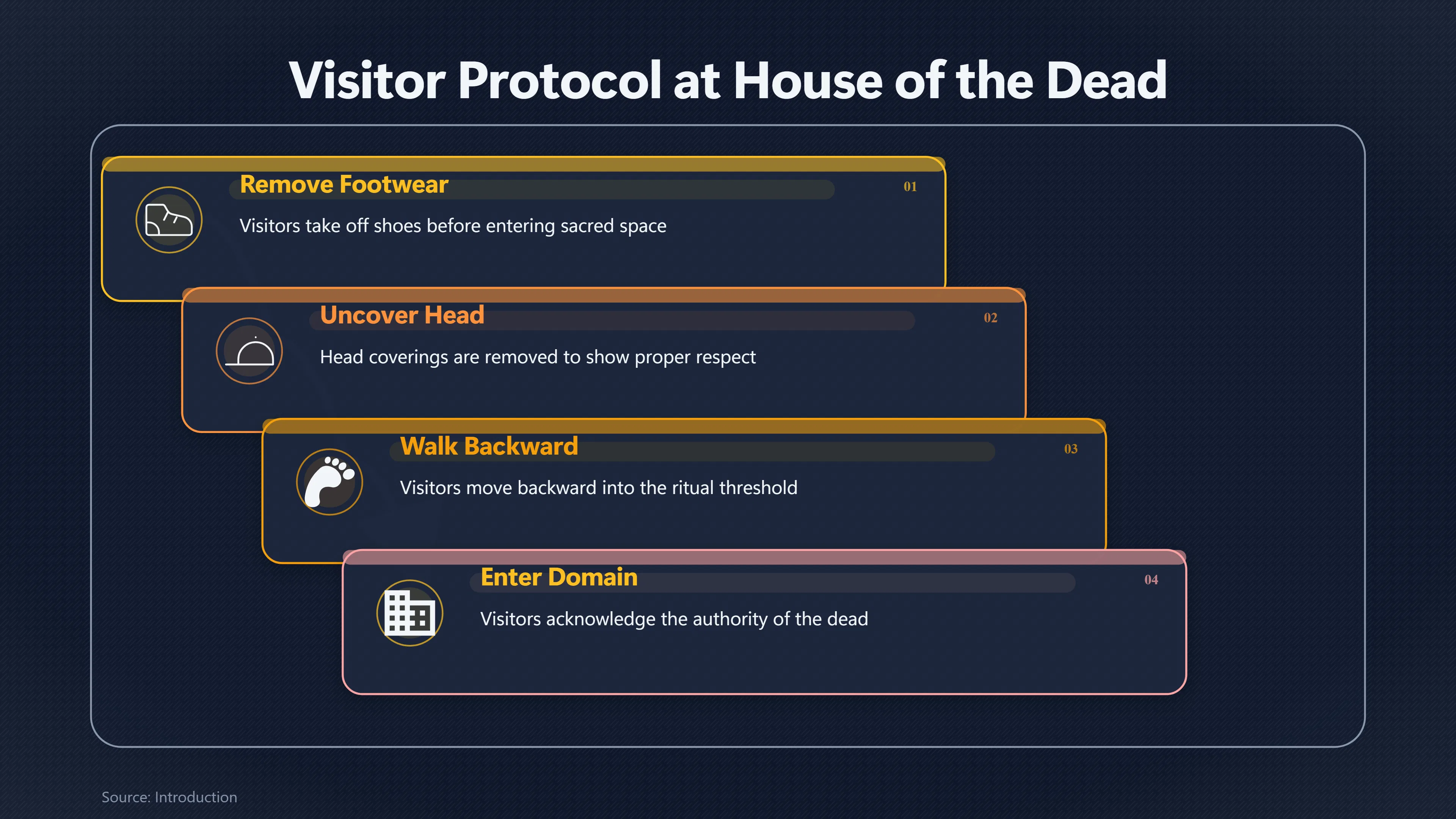
Visitors are traditionally asked to remove their shoes and head covering before entering, and to walk backwards into the space. These actions are not intended as theatrical entertainment. According to the museum’s interpretation of Mossi custom, they express respect for ancestral authority and acknowledge that the visitor is symbolically entering a domain governed by the dead rather than the living.[manega.net]manega.netPavillon de la Mort – ManegaPavillon de la Mort – Manega
Inside are reconstructions of funerary ceremonies alongside ritual masks, protective objects, amulets and ceremonial equipment associated with burial and remembrance. The museum presents these displays as educational interpretations of continuing cultural traditions rather than supernatural attractions. While some local stories surrounding particular masks have become part of the museum’s reputation—for example, accounts that certain masks should not be photographed—the institution frames such narratives within the wider context of respect for sacred objects and community beliefs rather than attempting to prove paranormal claims.[Le Monde.fr]lemonde.frOpen source on lemonde.fr.
Among the most striking exhibits are carved funerary stones known as Ya-kouga, memorial markers associated with the dead. Some museum publications and interviews attribute extremely great antiquity to certain examples, extending back several millennia. Those age claims are difficult to verify independently and have not been confirmed by widely available archaeological research. Their cultural importance, however, does not depend on extraordinary dating. They remain significant as rare survivals of regional commemorative traditions and illustrate how remembrance was given durable physical form.[Le Monde.fr]lemonde.frOpen source on lemonde.fr.
Bendrology, drums and oral history
The museum’s most original contribution lies in its explanation of bendrology. Rather than treating history as something preserved mainly in books or inscriptions, Pacéré argued that knowledge could be encoded in rhythm, ceremonial performance and the symbolic language of masks.
Within this framework:
- Sacred drums function as instruments of historical communication rather than simple musical accompaniment.
- Masks are understood through the ceremonies in which they participate instead of being displayed purely as sculpture.
- Ritual performance becomes a means of preserving genealogy, law, moral values and political authority.
- Oral tradition is presented as a disciplined cultural archive rather than informal folklore.[manega.net]manega.netLe fondateur du musée – ManegaLe fondateur du musée – Manega
This approach distinguishes Manega from many ethnographic museums, where ritual objects are often removed from the cultural systems that originally gave them meaning. At Manega, the visitor is encouraged to understand how objects, spoken history, music and ceremonial practice once worked together as an integrated method of remembering the past.[Le Monde.fr]lemonde.frOpen source on lemonde.fr.
What visitors experience today
Although the museum contains thousands of artefacts, many visitors remember it less for the quantity of objects than for its atmosphere. Dimly lit galleries, reconstructed sacred environments and carefully guided interpretation create an experience that resembles entering a cultural landscape rather than browsing display cases. Photography may be restricted in some sacred areas out of respect for the traditions associated with particular objects.[Le Monde.fr]lemonde.frOpen source on lemonde.fr.
The museum also includes reconstructed traditional dwellings, displays devoted to different cultural communities and collections of ritual instruments, bronzes, ceramics and masks from across Burkina Faso and neighbouring regions. Together these reinforce the central argument that memory survives not only through written documents but also through architecture, performance, craftsmanship and collective ritual.[Le Monde.fr]lemonde.frOpen source on lemonde.fr.
Official information indicates that the museum continues to welcome visitors, generally on weekdays by guided visit, although practical arrangements should be confirmed before travelling because operating conditions in Burkina Faso can change.[manega.net]manega.net– Les sites de ManegaLes sites de Manega…

Why Manega matters in Burkina Faso’s landscape of unusual museums
For travellers interested in unusual museums, Manega stands apart because it does not sensationalise sacred objects or present them as mysterious curiosities detached from their communities. Instead, it explains why masks, funerary monuments, drums and ritual spaces matter as parts of an entire philosophy of memory.
Its significance also extends beyond tourism. The museum represents one individual’s decades-long effort to resist the dispersal of African cultural heritage and to demonstrate that oral tradition possesses its own sophisticated systems for recording history. That combination of private collecting, cultural preservation and immersive interpretation makes the Museum of Manega one of the defining institutions within Burkina Faso’s landscape of unusual collections, where the most remarkable exhibits are not merely rare artefacts but the living traditions that continue to give those artefacts meaning.[manega.net]manega.netLe fondateur du musée – ManegaLe fondateur du musée – Manega
Amazon book picks
Further Reading
Books and field guides related to Inside Manega's Museum of Sacred Memory. Use these as the next step if you want deeper reading beyond the article.
The Predicament of Culture: Twentieth-Century Ethnography, Li...
The Predicament of Culture is a critical ethnography of the West in its changing relations with other societies. Analyzing cultural pract...
eBay marketplace picks
Marketplace Samples
Live-tested eBay searches with available results related to this page.
Selected fromAfrican heritage decor oneBay.co.uk.
Endnotes
1.
Source: manega.net
Title: – Les sites de Manega
Link:https://manega.net/
Source snippet
Les sites de Manega...
2.
Source: Wikipedia
Title: Musée de Manéga
Link:https://fr.wikipedia.org/wiki/Mus%C3%A9e_de_Man%C3%A9ga
3.
Source: manega.net
Title: Le fondateur du musée – Manega
Link:https://manega.net/index.php/le-fondateur-du-musee/
4.
Source: afrik.com
Title: Bendrologie: les masques ont la parole
Link:https://www.afrik.com/bendrologie-les-masques-ont-la-parole
Source snippet
Bendrologie: les masques ont la parole...
5.
Source: manega.net
Title: Pavillon de la Mort – Manega
Link:https://manega.net/index.php/pavillon-de-la-mort/
6.
Source: manega.net
Link:https://manega.net/index.php/books/hommage-a-dimdolobsom/
7.
Source: lemonde.fr
Link:https://www.lemonde.fr/afrique/article/2020/07/26/au-burkina-faso-le-musee-de-manega-protege-le-langage-des-tams-tams-et-des-masques-de-l-oubli_6047328_3212.html
Additional References
8.
Source: flickr.com
Title: Manéga Museum (Manéga/Burkina Faso) | Located about 50 km no… | Flickr
Link:https://www.flickr.com/photos/163660703%40N02/55048073668
Source snippet
January 18, 2026 — Image: Manéga Museum (Manéga/Burkina Faso) | by Manù Stefan Image: Manéga Museum (Manéga/Burkina Faso) | by Manù Stefa...
Published: January 18, 2026
9.
Source: museenational.bf
Title: les masques au delà du visible
Link:https://museenational.bf/exposition/les-masques-au-dela-du-visible/
Source snippet
Musée National du Burkina FasoJanuary 22, 2026 — LES MASQUES AU DELÀ DU VISIBLE * Administrateur * 22 janvier 2026 * Aucun commentaire MU...
Published: January 22, 2026
10.
Source: youtube.com
Title: The Hidden Mask Rituals of Burkina Faso: A Journey to the Spirit World
Link:https://www.youtube.com/watch?v=z4GGIAWbsaI
Source snippet
"Sankara's Mausoleum: Architecture's Power to Preserve History[https://www.youtube.com/watch?v=UvkF93Mgvw4..."](https://www.youtube.com/watch?v=UvkF93Mgvw4...")...
11.
Source: youtube.com
Title: Sacred Objects of Africa: Tools of Power, Spirit, and Memory
Link:https://www.youtube.com/watch?v=BIgYWsifAMY
Source snippet
The Hidden Mask Rituals of Burkina Faso: A Journey to the Spirit World...
12.
Source: youtube.com
Title: Burkina faso, Le musée de Manéga, garant du patrimoine culturel
Link:https://www.youtube.com/watch?v=CwPMOUsCnao
Source snippet
Sacred Objects of Africa: Tools of Power, Spirit, and Memory...
13.
Source: youtube.com
Title: El último dondonné (Frederic Pacere Titinga, Burkina Faso)
Link:https://www.youtube.com/watch?v=Oi6wWnngiRE
Source snippet
Burkina faso, Le musée de Manéga, garant du patrimoine culturel...
14.
Source: api.flickr.com
Link:https://api.flickr.com/photos/163660703%40N02/55048072618/
Source snippet
flickr.comManéga Museum plate (Manéga/Burkina Faso) | Located about 50… | FlickrJanuary 18, 2026 — Image: Manéga Museum plate (Manéga/Bur...
Published: January 18, 2026
15.
Source: si.edu
Link:https://www.si.edu/object/manega-histoire-coutumes-et-musee-maitre-titinga-frederic-pacere%3Asiris_sil_941193
16.
Source: momaa.org
Link:https://momaa.org/directory/musee-de-bendrologie-de-manega/
17.
Source: africabizinfo.com
Link:https://www.africabizinfo.com/fr-BF/mus%C3%A9e-de-bendrologie-de-man%C3%A9ga