Within Curious Namibia
When Namibia's Landscape Becomes the Museum
At Kolmanskop, Outapi and Otjikoto, abandoned structures and altered landscapes carry as much history as the objects displayed within them.
On this page
- Kolmanskop and the desert inside
- Outapi's bunker as a surviving artefact
- Lake Otjikoto as history, legend and weapons cache
Page outline Jump by section
Introduction
Some of Namibia’s most memorable heritage sites do not revolve around display cases or carefully arranged collections. Instead, they preserve entire places where the landscape itself has become the exhibit. A deserted diamond town slowly filling with sand, a Cold War-era bunker reused as a museum, and a deep sinkhole lake that still conceals wartime relics all demonstrate how environments can function as living museums. Rather than separating objects from their surroundings, these sites invite visitors to experience history where it happened, with buildings, terrain and atmosphere forming part of the interpretation.

This approach makes Namibia distinctive within the country’s wider curiosity landscape. The most unusual “collections” are often inseparable from the places that contain them. Visitors are not simply looking at historical artefacts; they are walking through abandoned streets, descending into military spaces or standing beside natural features that have accumulated stories, myths and physical evidence over generations.
Kolmanskop and the desert inside
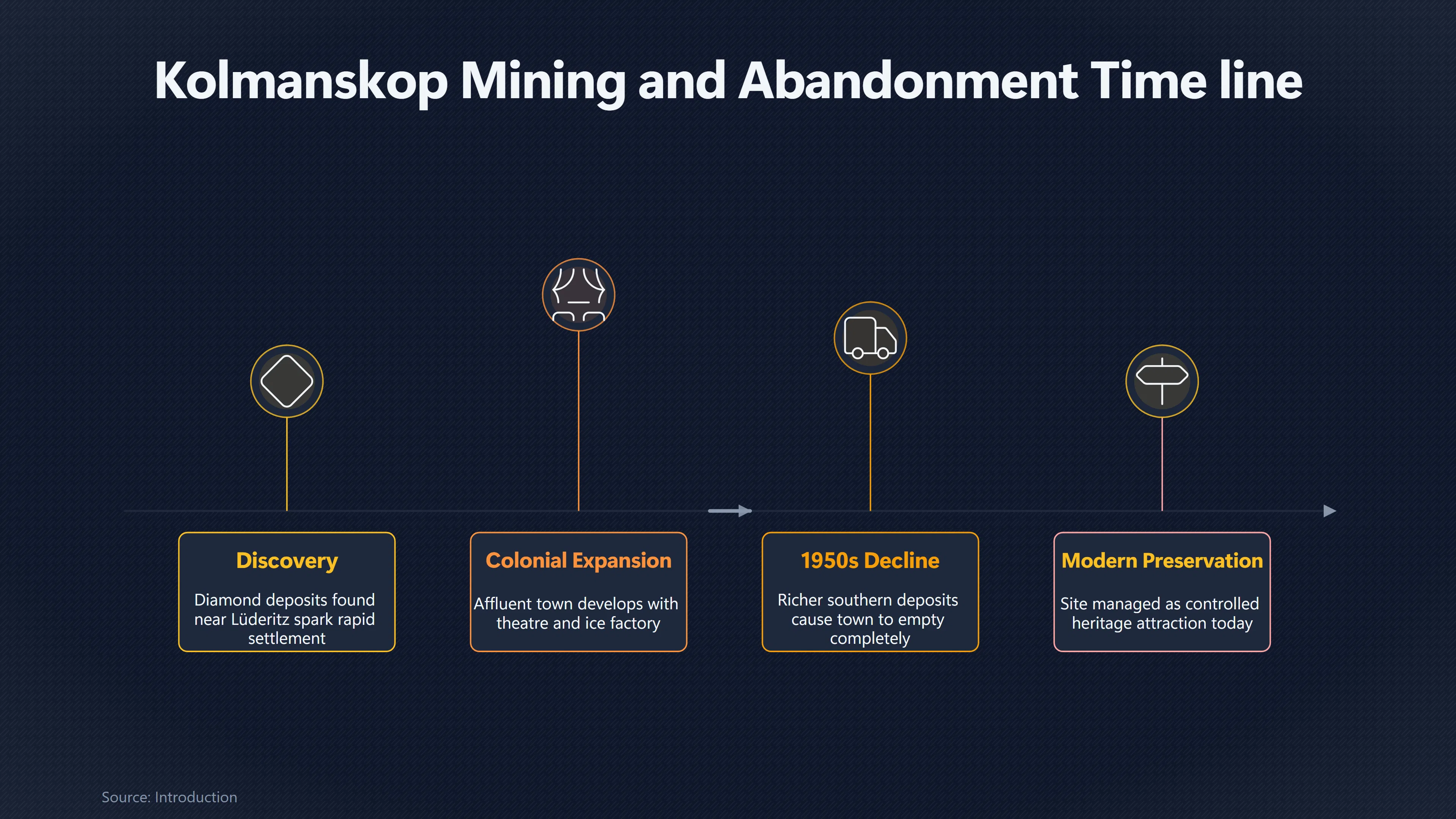
Kolmanskop is one of the world’s best-known ghost towns because its most striking exhibit is not a building but the relationship between architecture and the advancing Namib Desert. Founded after the 1908 diamond discoveries near Lüderitz, the settlement rapidly developed into an affluent German colonial mining town complete with a hospital, theatre, bowling alley, ice factory and elegant European-style homes. When richer diamond deposits were discovered farther south and local deposits declined, the town gradually emptied before being abandoned completely during the 1950s.[National Geographic]nationalgeographic.comNational GeographicLearn the history of Kolmanskop, a Namibian ghost town covered in sand | National GeographicMarch 20, 2019…
Unlike many abandoned industrial settlements, Kolmanskop was never simply left to decay unnoticed. Wind-driven sand steadily entered through broken doors and windows, filling rooms almost to ceiling height while preserving decorative details in the desert’s exceptionally dry climate. Visitors therefore experience an unusual form of museum in which nature is both curator and conservator. The dunes continually reshape interiors, creating scenes that have become internationally recognisable symbols of abandonment and environmental change.[National Geographic]nationalgeographic.comNational GeographicLearn the history of Kolmanskop, a Namibian ghost town covered in sand | National GeographicMarch 20, 2019…
The site’s fascination also lies in what it reveals about colonial history. The extraordinary wealth generated by diamonds depended upon German colonial rule, restrictive mining policies and the exploitation of African labour. Modern interpretation increasingly places the photogenic ruins alongside this more difficult history, encouraging visitors to see beyond the dramatic imagery of sand-filled houses. Kolmanskop is therefore both an architectural curiosity and a reminder that apparently romantic ruins often emerged from unequal social systems.[National Geographic]nationalgeographic.comNational GeographicLearn the history of Kolmanskop, a Namibian ghost town covered in sand | National GeographicMarch 20, 2019…
Today the ghost town is managed as a controlled heritage attraction within Namibia’s restricted diamond area. Some buildings have been stabilised while others remain deliberately weathered, allowing visitors to experience an environment where preservation does not mean restoring everything to its original appearance. Instead, the ongoing encroachment of the desert has become part of the exhibit itself.[National Geographic]nationalgeographic.comNational GeographicLearn the history of Kolmanskop, a Namibian ghost town covered in sand | National GeographicMarch 20, 2019…
Outapi’s bunker as a surviving artefact
In northern Namibia, the Outapi War Museum demonstrates a different way in which an environment becomes a museum. Rather than constructing replica military displays, the museum occupies part of a former South African Defence Force base dating from the final decades of the Namibian War of Independence.
The bunker itself is one of the principal artefacts. Thick concrete walls, defensive layouts and surviving military infrastructure allow visitors to experience spaces originally designed for conflict rather than exhibition. Displays of weapons, photographs, posters and equipment gain additional meaning because they remain within the environment where similar objects once operated.[museums.com.na]museums.com.naOutapi War MuseumMuseums Association of Namibia…
The museum presents itself as a privately owned, non-political initiative intended to preserve material from all sides of the conflict. Its stated aim is to educate younger generations while encouraging reconciliation rather than celebrating military victory. Border tours to former operational areas reinforce the idea that surrounding landscapes are extensions of the museum rather than separate tourist attractions.[museums.com.na]museums.com.naOutapi War MuseumMuseums Association of Namibia…
An unusual feature is the adaptive reuse of the bunkers themselves. Accommodation has been incorporated into parts of the former military complex, allowing visitors to spend time inside structures that once served defensive purposes. This reuse illustrates how military architecture can shift from strategic infrastructure into heritage without losing the physical qualities that made it significant.
Lake Otjikoto as history, legend and weapons cache
Lake Otjikoto offers perhaps Namibia’s clearest example of a natural landscape functioning as both archive and museum. The deep sinkhole lake, formed through the collapse of a limestone cave, became historically significant during the First World War when retreating German colonial forces dumped large quantities of weapons and ammunition into its waters before surrendering in 1915.[Info-Namibia]info-namibia.comLake OtjikotoLake Otjikoto - A lake full of arms and ammunition…
Many of the recovered cannons, machine guns and other military objects are now displayed at the Tsumeb Museum, but the lake itself remains an essential part of the story. Visitors standing beside the water are looking at the original repository from which the museum collection emerged. Unlike conventional archaeological sites, the archive has never been completely emptied. Divers continue to report surviving military material underwater, and an underwater display created by the Windhoek Diving Club allows qualified divers to encounter some objects in situ.[Discover Africa]discoverafrica.comDiscover AfricaThe Complete Guide to Landmarks & Monuments to Visit on a Holiday in Namibia – Discover AfricaJanuary 30, 2024…
The lake has also accumulated folklore alongside documented history. Persistent local stories claim that a safe containing German gold was thrown into the lake together with military equipment. Despite repeated searches, no convincing evidence has confirmed the treasure legend, making it an example of how verified history and local myth can coexist around the same landscape. The confirmed weapons cache is historical fact; the hidden treasure remains part of regional folklore rather than established history.[Wikipedia]WikipediaOtjikoto LakeOtjikoto Lake
This combination of geological wonder, military history and legend explains why Lake Otjikoto belongs naturally within Namibia’s landscape of curiosities. The lake is not merely the setting for museum exhibits elsewhere; it remains an active historical site whose physical characteristics continue to shape how its past is understood.
Why these landscapes matter differently from conventional museums
These three examples demonstrate a recurring pattern in Namibia’s unusual heritage.
- The setting cannot be separated from the collection. Sand inside Kolmanskop, reinforced bunkers at Outapi and the deep waters of Lake Otjikoto are essential parts of the interpretation rather than backgrounds.
- Natural processes remain visible. Wind continues to reshape Kolmanskop, while the lake still preserves submerged artefacts beneath its surface.
- Visitors experience scale directly. Walking through abandoned streets or standing beside a sinkhole creates an understanding that individual museum objects alone cannot provide.
- History is layered rather than isolated. Colonial mining, twentieth-century warfare, geology and local storytelling overlap within the same locations instead of being divided into separate galleries.
This approach also creates practical challenges. Conservators must balance visitor access against deterioration, decide how much intervention is appropriate, and acknowledge that these places carry difficult histories involving colonialism, conflict and displacement. Their power comes partly from remaining incomplete. Empty buildings, abandoned military structures and partially recovered landscapes encourage visitors to interpret absence as carefully as they would examine any displayed object.
In Namibia’s curiosity culture, some of the most compelling museums therefore have no walls around their collections. The buildings, bunkers and landscapes are themselves the exhibits, preserving not just artefacts but the physical settings in which those artefacts acquired their meaning.

Amazon book picks
Further Reading
Books and field guides related to When Namibia's Landscape Becomes the Museum. Use these as the next step if you want deeper reading beyond the article.

The sheltering desert
First published 1957. Subjects: Description and travel, Fiction, action & adventure.

Namibia: The Bradt Travel Guide
First published 1998. Subjects: Guidebooks, Namibia, description and travel.
Abandoned Places: A Photographic Exploration of More Than 100...
Steam trains half-buried in the desert, roller coasters entangled in trees, hulks of ships perched high and dry miles from water - images...
The Landscape of History: How Historians Map the Past
What is history and why should we study it? Is there such a thing as historical truth? Is history a science? One of the most accomplished...
eBay marketplace picks
Marketplace Samples
Live-tested eBay searches with available results related to this page.
Selected frommilitary bunker sign oneBay.co.uk.


Endnotes
1.
Source: museums.com.na
Title: Outapi War Museum
Link:https://www.museums.com.na/museums/north/outapi-war-museum
Source snippet
Museums Association of Namibia...
2.
Source: info-namibia.com
Title: Lake Otjikoto
Link:https://www.info-namibia.com/activities-and-places-of-interest/otavi/lake-otjikoto
Source snippet
Lake Otjikoto - A lake full of arms and ammunition...
3.
Source: Wikipedia
Title: Otjikoto Lake
Link:https://en.wikipedia.org/wiki/Otjikoto_Lake
4.
Source: kolmanskop.de
Link:https://www.kolmanskop.de/
Source snippet
Jahrhunderts. Es i...
5.
Source: info-namibia.com
Link:https://www.info-namibia.com/activities-and-places-of-interest/luederitz/kolmanskop?tmpl=component
Source snippet
Most popular ghost town in NamibiaKOLMANSKOP GHOST TOWN IN THE NAMIB DESERT After becoming one of the richest towns in Africa during a di...
6.
Source: nationalgeographic.com
Link:https://www.nationalgeographic.com/travel/article/eerie-fascinating-pictures-kolmanskop-desert-diamond-ghost-town
Source snippet
National GeographicLearn the history of Kolmanskop, a Namibian ghost town covered in sand | National GeographicMarch 20, 2019...
Published: March 20, 2019
7.
Source: lonelyplanet.com
Title: Lonely Planet Kolmanskop | Namibia, Africa | Attractions
Link:https://www.lonelyplanet.com/points-of-interest/kolmanskop/1346578
Source snippet
Kolmanskop | Namibia, Africa | Attractions - Lonely PlanetKOLMANSKOP Image Named after early Afrikaner trekker Jani Kolman, whose ox wago...
8.
Source: discoverafrica.com
Link:https://www.discoverafrica.com/blog/the-complete-guide-to-landmarks-monuments-to-visit-on-a-holiday-in-namibia/
Source snippet
Discover AfricaThe Complete Guide to Landmarks & Monuments to Visit on a Holiday in Namibia – Discover AfricaJanuary 30, 2024...
Published: January 30, 2024
Additional References
9.
Source: findtourguide.com
Link:https://www.findtourguide.com/destinations/namibia/lake-otjikoto-4149
Source snippet
Lake Otjikoto Travel Guide: Top Sights in Namibia, Tours & TravelLake Otjikoto- Travel Tips What to See, How to Plan & Tours Natural Scen...
10.
Source: namibian.com.na
Title: Kolmanskop, where no expense was spared
Link:https://www.namibian.com.na/kolmanskop-where-no-expense-was-spared/
Source snippet
The NamibianMay 17, 2010 — KOLMANSKOP, WHERE NO EXPENSE WAS SPARED Image: Kolmanskop, where no expense was spared By TANJA BAUSE 17 May 2...
Published: May 17, 2010
11.
Source: namibian.com.na
Title: lake otjikoto tsumebs wonder of nature
Link:https://www.namibian.com.na/lake-otjikoto-tsumebs-wonder-of-nature/
Source snippet
Lake Otjikoto – Tsumeb's wonder of nature - The NamibianOctober 24, 2017 — LAKE OTJIKOTO – TSUMEB’S WONDER OF NATURE Image By The Namibia...
Published: October 24, 2017
12.
Source: namibia.ellerstrand.se
Title: A black worker, Zachari
Link:https://namibia.ellerstrand.se/kolmanskop-1-the-ghost-town/
Source snippet
1: The ghost town | NamibiaMay 19, 2012 — KOLMANSKOP 1: THE GHOST TOWN Posted on 19 May, 2012 by Anders In 1908 the German railroad inspe...
Published: May 19, 2012
13.
Source: youtube.com
Link:https://www.youtube.com/watch?v=WbgmsStBkzY
Source snippet
The $600 Dinosaur Tail That Proved Warm-Blooded Dinosaurs...
14.
Source: youtube.com
Title: Illicit Fossils: The Ethical Dilemma in Protecting the World’s Natural History
Link:https://www.youtube.com/watch?v=PnssaLktiXw
Source snippet
A tale of two papers: ethics of Burmese amber...
15.
Source: tourismus.com.na
Title: Previously kn
Link:https://www.tourismus.com.na/tn-leisure/museums-in-namibia2025
Source snippet
Museums in Namibia - TourismusNovember 29, 2025 — MUSEUMS IN NAMIBIA * * 3 Months Ago * TN-Leisure Outapi War Museum is located undergrou...
Published: November 29, 2025
16.
Source: youtube.com
Title: Episode 135: Burmese Amber Pt2
Link:https://www.youtube.com/watch?v=ABC736Ron80
Source snippet
Illicit Fossils: The Ethical Dilemma in Protecting the World's Natural History...
17.
Source: youtube.com
Title: The $600 Dinosaur Tail That Proved Warm-Blooded Dinosaurs
Link:https://www.youtube.com/watch?v=Dr1mnTX3DP8
Source snippet
Episode 135: Burmese Amber Pt2...
18.
Source: youtube.com
Title: A tale of two papers: ethics of Burmese amber
Link:https://www.youtube.com/watch?v=0LxHpvgflBw
Source snippet
You stopped this response...