Within Strange Lithuania
Why Lithuania Displays Devils and Witches
Lithuania turns devils, witches and folk legends into collections that range from museum cabinets to carved forest paths.
On this page
- The collector behind the Devils' Museum
- How the Hill of Witches creates a modern legend landscape
- Folklore, tourism and the line between belief and performance
Page outline Jump by section
Introduction
Lithuania’s most distinctive folklore displays do not ask visitors to believe in devils or witches. Instead, they show how supernatural figures have remained culturally alive through collecting, sculpture, storytelling and performance. The country’s best-known examples—the Devils’ Museum in Kaunas and the Hill of Witches on the Curonian Spit—demonstrate two different approaches. One gathers thousands of objects into a curated collection that explores changing ideas about the devil in folk art and popular culture. The other turns a forest into an open-air stage where carved witches, devils and legendary beings invite visitors to walk through a modern landscape of myth. Together they illustrate how Lithuania has transformed folklore into a public cultural experience rather than a relic of vanished belief.[ciurlionis.lt]ciurlionis.ltDevil CollectionNACIONALINIS M. K. ČIURLIONIO DAILĖS MUZIEJUS…

The collector behind the Devils’ Museum
The Devils’ Museum in Kaunas began with an unexpected gift rather than a grand institutional plan. Painter Antanas Žmuidzinavičius received a carved wooden devil in 1906 and continued collecting similar figures for the rest of his life. Friends, artists and travellers added to the collection, and after his death it became part of the M. K. Čiurlionis National Museum of Art. Today the museum contains more than 3,000 representations of devils from Lithuania and dozens of other countries, making it one of the world’s most unusual themed collections.[ciurlionis.lt]ciurlionis.ltDevil CollectionNACIONALINIS M. K. ČIURLIONIO DAILĖS MUZIEJUS…
What makes the collection culturally significant is that Lithuanian folk devils differ from the purely demonic figures familiar from much Western Christian imagery. In folk tales they are often boastful, greedy or easily deceived rather than all-powerful embodiments of evil. Many sculptures portray them as comic tricksters who lose contests with clever farmers or ordinary villagers. This ambiguity allows the museum to display religious carvings beside humorous souvenirs, political satire and contemporary artworks without treating every object as evidence of literal belief.[ciurlionis.lt]ciurlionis.ltDevil CollectionNACIONALINIS M. K. ČIURLIONIO DAILĖS MUZIEJUS…
Visitors therefore encounter several overlapping traditions:
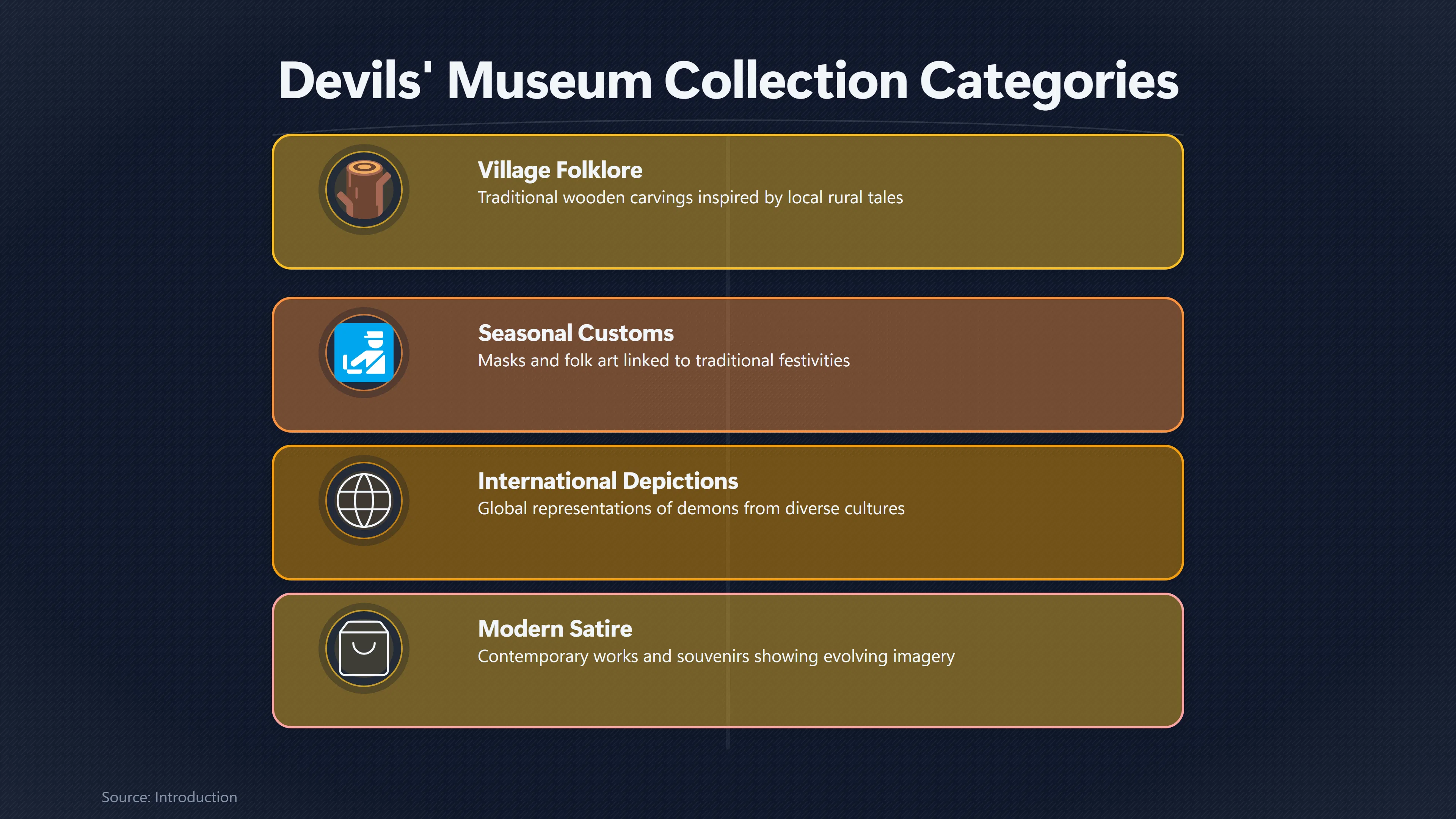
- Traditional wooden carvings inspired by village folklore.
- Masks and folk art connected with seasonal customs.
- International depictions showing how different cultures imagine devils and demons.
- Modern souvenirs and satirical works demonstrating how supernatural imagery continues to evolve.
The museum deliberately blurs the boundary between ethnography, art history and curiosity collection. Rather than preserving a single authentic tradition, it documents how one mythical figure has accumulated new meanings across different periods and societies.[Lithuania Travel]lithuania.travelTravel The Devils’ Museum | Lithuania TravelThe Devils’ Museum | Lithuania Travel…
How the Hill of Witches creates a modern legend landscape
On the Curonian Spit near Juodkrantė, the Hill of Witches offers almost the opposite experience. Instead of glass cases and catalogued artefacts, visitors follow woodland paths lined with large wooden sculptures of witches, devils, giants and characters from Lithuanian legends.
The attraction was created from 1979 onwards through gatherings of woodcarvers and blacksmiths rather than emerging from an ancient sacred site. The sculptures continue to expand as artists contribute new works, giving the location the character of a living cultural landscape rather than a finished museum. The managing institution describes it as a museum of wooden sculpture, emphasising artistic interpretation over archaeological authenticity.[neringosmuziejai.lt]neringosmuziejai.ltHill of WitchesHill of Witches
Its setting contributes as much as the carvings themselves. Dense forest, winding paths and changing light encourage visitors to experience folklore as an unfolding narrative instead of a sequence of labelled exhibits. Many sculptures can be climbed through or walked around, making the experience playful as well as atmospheric.
Importantly, the hill is often misunderstood. Although local traditions connected the surrounding landscape with midsummer celebrations and stories of supernatural beings, the present attraction is a modern artistic creation inspired by folklore rather than evidence of an uninterrupted centre of witchcraft. The site’s power comes from carefully combining landscape, sculpture and storytelling into an immersive visitor experience.[neringosmuziejai.lt]neringosmuziejai.ltHill of WitchesHill of Witches
Witches, landscape and remembered folklore
Lithuanian folklore frequently links supernatural activity with distinctive hills, forests and wetlands. Among the best-known legendary locations is Šatrija Hill, which appears in both folk narratives and historical witchcraft trial material as a place associated with gatherings of witches. Recent folklore scholarship argues that the importance of such places lies not simply in stories about magic but in the way landscapes become repositories of cultural memory. Rather than existing separately from the physical world, legends become attached to recognisable hills and forests that people continue to visit and reinterpret.[kgaa.bokorder.se]kgaa.bokorder.seDecember 26, 2025…
This helps explain why modern attractions such as the Hill of Witches resonate with visitors. They do not attempt to reconstruct historical witchcraft. Instead, they build upon an older habit of connecting remarkable landscapes with stories about extraordinary beings.

Folklore, tourism and the line between belief and performance
Lithuania’s folklore displays occupy an unusual position between heritage and entertainment. Neither the Devils’ Museum nor the Hill of Witches presents supernatural creatures as historical fact. Instead, both interpret folklore as an important part of national culture while encouraging curiosity, humour and participation.
That balance can be seen in several ways:
- Collecting rather than preaching. The Devils’ Museum studies representations of devils instead of promoting religious or occult beliefs.
- Performance rather than reconstruction. The Hill of Witches uses artistic installations to evoke legends rather than claiming to preserve an ancient ritual landscape unchanged.
- Living tradition rather than static heritage. New sculptures, exhibitions and visitor engagement allow folklore to evolve rather than freezing it in a single historical period.
- Tourism with cultural depth. Both attractions are popular visitor destinations, yet each also introduces audiences to distinctive aspects of Lithuanian folk imagination.[ciurlionis.lt]ciurlionis.ltDevil CollectionNACIONALINIS M. K. ČIURLIONIO DAILĖS MUZIEJUS…
This approach reflects a broader characteristic of Lithuanian curiosity culture. Instead of separating museums, folklore and public art into different worlds, the country often allows them to overlap. A private collector’s fascination can become a nationally recognised museum, while a contemporary sculpture park can become the setting through which traditional legends are experienced by new generations.
Why these displays matter
The enduring appeal of Lithuania’s devils and witches lies in their flexibility. They can be humorous without becoming trivial, artistic without abandoning traditional roots, and commercial without entirely losing their cultural significance. Visitors are encouraged to appreciate the craftsmanship of carved figures, recognise familiar folk characters and reflect on how stories survive through objects and places rather than only through books.
Seen together, the Devils’ Museum and the Hill of Witches demonstrate two complementary methods of preserving folklore. One preserves belief through collected artefacts; the other through an evolving landscape of sculpture and imagination. Both show that Lithuania’s supernatural traditions remain visible not because people universally accept them as literal truth, but because they continue to provide a rich language for discussing identity, morality, humour and the relationship between people and place.[ciurlionis.lt]ciurlionis.ltDevil CollectionNACIONALINIS M. K. ČIURLIONIO DAILĖS MUZIEJUS…
Amazon book picks
Further Reading
Books and field guides related to Why Lithuania Displays Devils and Witches. Use these as the next step if you want deeper reading beyond the article.
Cabinets of Curiosities
"Maurie`s' tour of strange objects is entertaining and fascinating." --Antiques And The Arts Weekly
The Oxford Illustrated History of Witchcraft and Magic
The 4000-year story of witchcraft and magic - from the ancient world to Harry Potter... and beyond...
The Witch-Hunt in Early Modern Europe
Between 1450 and 1750 thousands of people – most of them women – were accused, prosecuted and executed for the crime of witchcraft. The w...
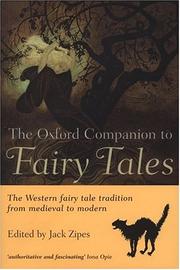
The Oxford Companion to Fairy Tales
Review: "Researchers from scholars to the general public will find this reference source an excellent starting place to find definitions,...
eBay marketplace picks
Marketplace Samples
Live-tested eBay searches with available results related to this page.
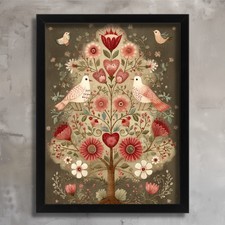
Selected fromfolk art print oneBay.co.uk.
Endnotes
1.
Source: ciurlionis.lt
Title: Devil Collection
Link:https://ciurlionis.lt/activity/permanent-exhibitions/velniu-kolekcija-en/
Source snippet
NACIONALINIS M. K. ČIURLIONIO DAILĖS MUZIEJUS...
2.
Source: neringosmuziejai.lt
Title: Hill of Witches
Link:https://www.neringosmuziejai.lt/en/hill-of-witches/
3.
Source: lithuania.travel
Title: Travel The Devils’ Museum | Lithuania Travel
Link:https://lithuania.travel/en/why-lithuania/culture-and-heritage/culture-and-art/museums/family-oriented-museums/the-devils-museum
Source snippet
The Devils’ Museum | Lithuania Travel...
4.
Source: kgaa.bokorder.se
Link:https://kgaa.bokorder.se/en-US/article/5581/arv-nordic-yearbook-of-folklore-vol-81-20/external/48457/the-flight-to-satrija-hill
Source snippet
December 26, 2025...
Published: December 26, 2025
Additional References
5.
Source: unknown.lt
Link:https://www.unknown.lt/en/location/devils-museum
Source snippet
Unknown LithuaniaDevils' Museum (Žmuidzinavičius Museum) — Kaunas, Lithuania | Unknown Lithuania...
6.
Source: youtube.com
Title: Evil side of a ‘Christian’ city • Kaunas Devil Museum
Link:https://www.youtube.com/watch?v=SbTAl-xUmMg
Source snippet
Devils Museum Kaunas Lithuania Evil side of a ‘Christian’ city • Kaunas Devil Museum T1D Wanderer...
7.
Source: youtube.com
Title: Juodkrante, Hill of Witches, wooden sculptures, Curonian Spit, Lithuania
Link:https://www.youtube.com/watch?v=QJBYbBZciuw
Source snippet
Evil side of a ‘Christian’ city • Kaunas Devil Museum...
8.
Source: oldvisit.kaunasin.lt
Title: Old Visit Visit Kaunas
Link:https://oldvisit.kaunasin.lt/en/see-and-do/top/a-zmuidzinavicius-creations-and-collections-museum-devils-museum/
Source snippet
Old VisitVisit Kaunas - A. ŽMUIDZINAVIČIUS CREATIONS AND COLLECTIONS MUSEUM (DEVILS MUSEUM)...
9.
Source: youtube.com
Title: Hiking Lithuania’s Hill of Witches
Link:https://www.youtube.com/watch?v=Mk45zxLJkPg
Source snippet
Juodkrante, Hill of Witches, wooden sculptures, Curonian Spit, Lithuania...
10.
Source: youtube.com
Title: VISITING DEVIL’S MUSEUM IN KAUNAS, LITHUANIA
Link:https://www.youtube.com/watch?v=eMuByvSfPtU
Source snippet
Devils' Museum (Velnių muziejus), Kaunas, Lithuania...
11.
Source: youtube.com
Title: Devils’ Museum (Velnių muziejus), Kaunas, Lithuania
Link:https://www.youtube.com/watch?v=GLDgJiXFz48
Source snippet
Hiking Lithuania's Hill of Witches...