Within Strange Sri Lanka
Inside Sri Lanka's Museums of Bodies and Bones
Sri Lanka's university museums preserve dissected bodies, skeletons and thousands of animal specimens for teaching, research and public display.
On this page
- What visitors encounter in the Peradeniya anatomy museum
- How university zoological collections preserve animals
- Public access, ethics and the difference between education and spectacle
Page outline Jump by section
Introduction
Sri Lanka’s most unusual public collections are not always found in conventional museums. Some of the country’s most striking displays are maintained by universities, where teaching collections of dissected human bodies, skeletons, preserved organs and thousands of animal specimens are used for medical education and biological research while also being opened, under controlled conditions, to schools and members of the public. Rather than presenting the macabre for entertainment, these institutions aim to explain anatomy, evolution, biodiversity and disease through carefully curated scientific collections.
For visitors interested in the country’s stranger side, these museums offer a rare opportunity to see the intersection of science, education and public engagement. They stand apart from commercial curiosity attractions because the specimens remain part of active teaching and research programmes, with public access shaped by ethical rules and academic priorities rather than spectacle.
What visitors encounter in the Peradeniya anatomy museum
The best-known visitor-facing anatomy collection is the Museum of Human Anatomy at the University of Peradeniya’s Faculty of Medicine. Opened in 2018, it was created primarily for medical and allied health education but was also designed to welcome schools and the wider public by prior arrangement.[med.pdn.ac.lk]med.pdn.ac.lkOpen source on pdn.ac.lk.
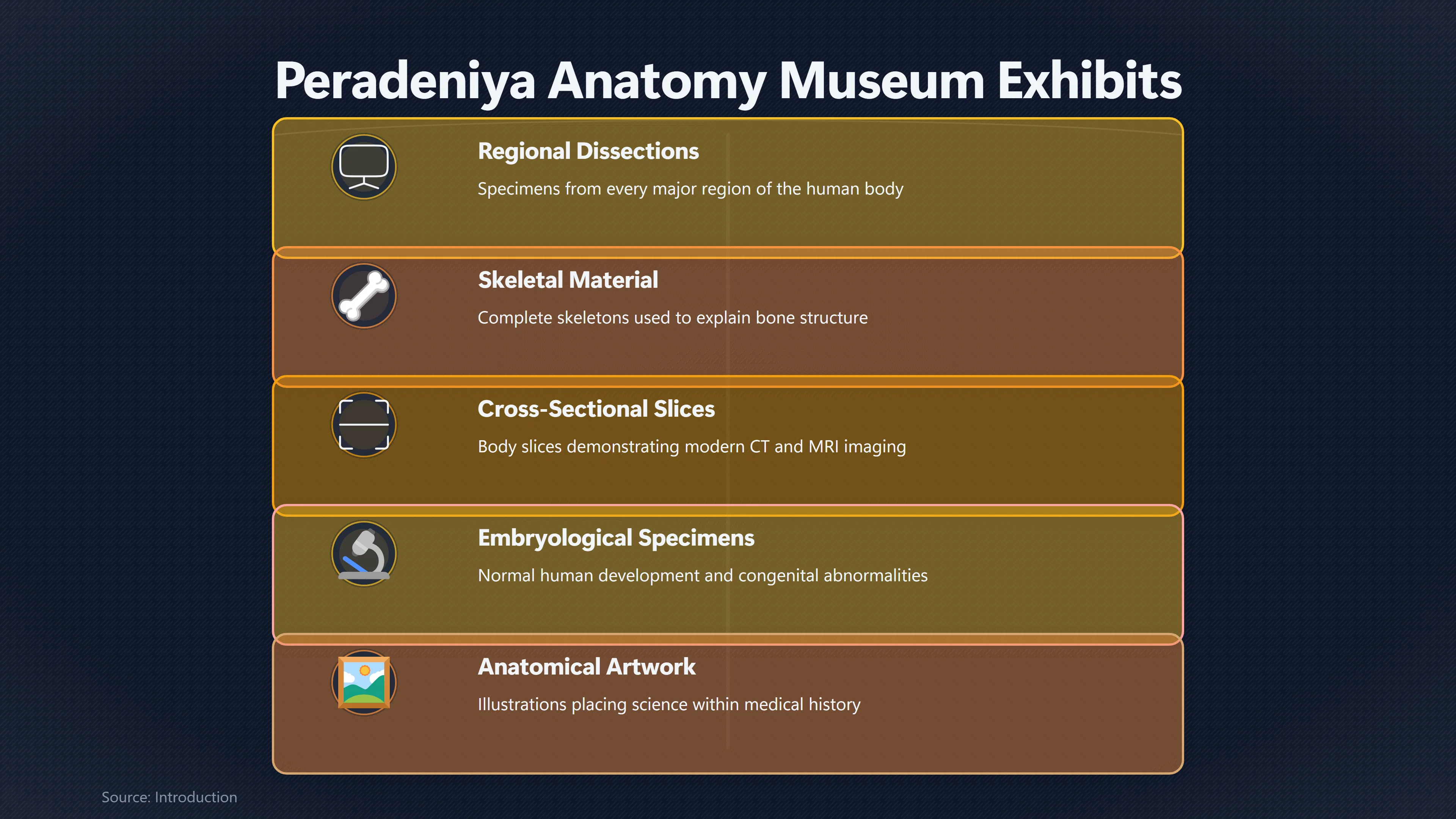
Visitors find a modern gallery rather than a traditional Victorian-style anatomy room. Human anatomical specimens are displayed in illuminated glass cases with explanatory labels presented in Sinhala, Tamil and English. The collection includes:
- Dissected specimens from every major region of the human body.
- Complete skeletal material used to explain bone structure.
- Cross-sectional body slices that help demonstrate modern medical imaging such as CT and MRI.
- Embryological specimens showing normal human development alongside examples of congenital abnormalities.
- Anatomical illustrations and artwork that place scientific study within the history of medicine.[med.pdn.ac.lk]med.pdn.ac.lkOpen source on pdn.ac.lk.
The emphasis throughout is educational. Instead of encouraging shock, displays explain how organs relate to one another, how disease alters anatomy and how medical students learn from donated human remains. The museum explicitly describes itself as a place to improve public understanding of the human body rather than as a collection of medical curiosities.[med.pdn.ac.lk]med.pdn.ac.lkOpen source on pdn.ac.lk.
Its existence also reflects a broader shift in anatomy education. Modern medical schools increasingly complement dissection laboratories with permanent museum displays that allow students to revisit complex structures long after practical classes have finished. For non-specialists, these preserved specimens provide an unusually detailed view of the human body that is rarely available outside medical institutions.
How university zoological collections preserve animals
Sri Lanka’s university zoological museums provide a different form of curiosity. Their collections preserve the country’s wildlife—and selected overseas species—in forms ranging from skeletons and taxidermy mounts to specimens stored in preserving fluid.
One of the largest public collections is the Zoological Museum at the University of Sri Jayewardenepura. The museum houses more than 8,000 specimens representing Sri Lankan and exotic animals preserved as wet specimens, dry preparations, skins and skeletons. Although built for undergraduate teaching and scientific research, it actively welcomes school groups, university students and members of the public on weekdays.[science.sjp.ac.lk]science.sjp.ac.lkMuseum – Department of ZoologyMuseum – Department of Zoology
Visitors encounter collections organised by major animal groups rather than by dramatic themes. Highlights include:
- Amphibians and reptiles preserved for comparative anatomy.
- Freshwater, marine and brackish-water fish collections.
- Bird skins, mounted specimens and skeletal material.
- Mammalian skeletons and taxidermy preparations.
- Extensive insect collections and other invertebrates preserved using both traditional and modern museum techniques.[science.sjp.ac.lk]science.sjp.ac.lkMuseum – Department of ZoologyMuseum – Department of Zoology
Because the museum continues to receive specimens from research projects and authorised donations, it functions as a living scientific collection rather than a static exhibition. Curators also train students in museum conservation, specimen preparation and preservation techniques, illustrating how biological collections are maintained for future generations.[science.sjp.ac.lk]science.sjp.ac.lkMuseum – Department of ZoologyMuseum – Department of Zoology
A similarly important resource exists at the University of Colombo’s Zoological Museum, whose collections exceed 9,000 specimens. The museum traces its history back roughly a century and welcomes public visitors, offering guided educational tours that focus on natural history rather than entertainment. Its collections include marine invertebrates, insects, mammals, birds, reptiles and skeletal material used in teaching and research.[museum.zoology.cmb.ac.lk]museum.zoology.cmb.ac.lkVisit Us – Zoological Museum of the University of ColomboVisit Us – Zoological Museum of the University of Colombo
Public access, ethics and the difference between education and spectacle
These collections differ fundamentally from commercial displays of preserved bodies or sensational “oddity” museums.
Human anatomical specimens at Peradeniya are displayed within a medical faculty under professional supervision. Access is controlled, and the university requires advance permission for public visits, reflecting the ethical responsibilities attached to human remains. The specimens exist because of medical education and anatomical donation, not because they were collected as curiosities.[med.pdn.ac.lk]med.pdn.ac.lkOpen source on pdn.ac.lk.
The zoological museums follow similar principles. Although visitors can see preserved animals at close range, the specimens support scientific identification, biodiversity research and teaching. Many have been obtained through authorised scientific work, natural deaths, research collections or official donations rather than being acquired for display alone. Museum staff continue to catalogue, conserve and expand the collections as part of ongoing academic programmes.[science.sjp.ac.lk]science.sjp.ac.lkMuseum – Department of ZoologyMuseum – Department of Zoology
For visitors accustomed to commercial “body worlds” exhibitions or private cabinets of curiosities, Sri Lanka’s university museums therefore feel quite different. They are quieter, more restrained and strongly contextualised. Labels focus on anatomy, evolution, ecology and conservation rather than on provoking emotional reactions.
Photography policies also reflect this educational approach. The University of Sri Jayewardenepura’s Zoological Museum permits non-commercial photography without flash, while the University of Colombo’s Zoological Museum similarly allows photography under specified conditions. The anatomy museum, however, places greater emphasis on controlled access because of the sensitive nature of its human collections.[sjp.ac.lk]science.sjp.ac.lkVISI T US – Zoology MuseumVISI T US – Zoology Museum
Why these collections matter within Sri Lanka’s curiosity landscape
Sri Lanka has relatively few institutions dedicated solely to medical history or natural-history curiosities. Instead, universities have become custodians of some of the country’s most remarkable preserved collections.
These museums broaden the idea of what counts as a “strange” attraction. Their fascination comes not from folklore or mystery but from direct encounters with real anatomy and biodiversity. Human organs prepared for teaching, complete animal skeletons, preserved reptiles, embryological specimens and comparative anatomical displays reveal aspects of life that most people rarely see.
Placed alongside Sri Lanka’s ritual mask museums, folk collections and religious displays, these academic museums demonstrate another strand of the country’s curiosity culture: one grounded in scientific observation, careful preservation and public education. They remind visitors that collections of bodies and bones can inspire wonder without sacrificing accuracy, dignity or ethical responsibility.
Amazon book picks
Further Reading
Books and field guides related to Inside Sri Lanka's Museums of Bodies and Bones. Use these as the next step if you want deeper reading beyond the article.
The Body: A Guide for Occupants
NATIONAL BESTSELLER NEW YORK TIMES BESTSELLER INTERNATIONAL BESTSELLER A NEW YORK TIMES EDITORS' CHOICE NAMED ONE OF THE BEST BOOKS OF 20...
The Museum Experience
As the first book to take a "visitor's eye view" of the museum visit, The Museum Experience revolutionized the way museum professionals u...
The Sixth Extinction: An Unnatural History
"Over the last half billion years, there have been five major mass extinctions, when the diversity of life on Earth suddenly and dramatic...
Stuff: Compulsive Hoarding and the Meaning of Things
The New York Times bestseller. "Gripping . . . By turns fascinating and heartbreaking . . . Stuff invites readers to reevaluate their des...
eBay marketplace picks
Marketplace Samples
Live-tested eBay searches with available results related to this page.
Selected fromnatural history poster oneBay.co.uk.
Endnotes
1.
Source: med.pdn.ac.lk
Link:https://med.pdn.ac.lk/departments/anatomy/museum.php
2.
Source: science.sjp.ac.lk
Title: Museum – Department of Zoology
Link:https://science.sjp.ac.lk/zoo/services-and-facilities/museum/
3.
Source: science.sjp.ac.lk
Title: About Us – Zoology Museum
Link:https://science.sjp.ac.lk/zoologymuseum/about-us/
4.
Source: science.sjp.ac.lk
Title: VISI T US – Zoology Museum
Link:https://science.sjp.ac.lk/zoologymuseum/visit-us/
5.
Source: science.sjp.ac.lk
Title: SERVICE S OF THE MUSEUM – Zoology Museum
Link:https://science.sjp.ac.lk/zoologymuseum/services/
6.
Source: museum.zoology.cmb.ac.lk
Title: Visit Us – Zoological Museum of the University of Colombo
Link:https://museum.zoology.cmb.ac.lk/visit-us/
7.
Source: museum.zoology.cmb.ac.lk
Title: Collections – Zoological Museum of the University of Colombo
Link:https://museum.zoology.cmb.ac.lk/collections/
8.
Source: science.sjp.ac.lk
Link:https://science.sjp.ac.lk/zoologymuseum/
9.
Source: museum.zoology.cmb.ac.lk
Link:https://museum.zoology.cmb.ac.lk/
10.
Source: sci.pdn.ac.lk
Link:https://sci.pdn.ac.lk/zoology/
Additional References
11.
Source: ahs.pdn.ac.lk
Title: pdn.ac.lk Faculty of Allied Health Sciences | University of Peradeniya
Link:https://ahs.pdn.ac.lk/dept_and_unit/Basic_Sciences/bs_lab
Source snippet
of Allied Health Sciences | University of PeradeniyaMay 23, 2026 — DEPARTMENT OF BASIC SCIENCES Faculty of Allied Health Sciences CONTACT...
Published: May 23, 2026
12.
Source: arts.pdn.ac.lk
Title: pdn.ac.lk Faculty of Arts | University of Peradeniya
Link:https://arts.pdn.ac.lk/
Source snippet
of Arts | University of PeradeniyaJuly 6, 2026 — FACULTY OF ARTS UNIVERSITY OF PERADENIYA SRI LANKA * Departments * Archaeology * Arabic...
Published: July 6, 2026
13.
Source: ahs.pdn.ac.lk
Title: pdn.ac.lk Department of Basic Sciences
Link:https://ahs.pdn.ac.lk/dept_and_unit/Basic_Sciences/index
Source snippet
of Basic Sciences - University of PeradeniyaMay 23, 2026 — DEPARTMENT OF BASIC SCIENCES Faculty of Allied Health Sciences CONTACT US * Op...
Published: May 23, 2026
14.
Source: youtube.com
Title: I Tried to Visit Every UCL Museum in One Day
Link:https://www.youtube.com/watch?v=hFi8k3AWCeg
Source snippet
This video offers a guided tour of the Hunterian Museum at the Royal College of Surgeons, directly highlighting the public display of his...
15.
Source: youtube.com
Title: London’s Grisliest Museum? A Guided Tour of The Hunterian Surgical Museum
Link:https://www.youtube.com/watch?v=fRzM3GxF1dk
Source snippet
Hunterian Museum Puts Weird and Wonderful Anatomical Curiosities Back on Display...
16.
Source: museum.gov.lk
Link:https://www.museum.gov.lk/v1/services/ticket-pricing
17.
Source: medicine.kln.ac.lk
Link:https://medicine.kln.ac.lk/depts/anatomy/
18.
Source: fmas.rjt.ac.lk
Link:https://fmas.rjt.ac.lk/anatomy/
19.
Source: youtube.com
Title: Museum Vrolik
Link:https://www.youtube.com/watch?v=vldst7OvxwM
Source snippet
I Tried to Visit Every UCL Museum in One Day...
20.
Source: sundaytimes.lk
Link:https://www.sundaytimes.lk/180603/news/university-of-pera-opens-anatomy-museum-to-the-public-296707.html