Within Strange Denmark
Were Denmark's Witches Victims of Belief?
Ribe and Koge use documented trials to show how fear, accusation and legal authority turned neighbours into convicted witches.
On this page
- Ribe, Maren Spliids and the HEX! Museum
- The Koge accusations and the Possessed exhibition
- How museums separate persecution history from occult myth
Page outline Jump by section
Introduction
Denmark’s witch museums are unusual because they are not celebrations of magic or the occult. Instead, they are carefully researched places that examine how fear, religious belief and legal authority combined to destroy real lives. Visitors expecting displays that argue witches possessed supernatural powers will find something very different: exhibitions built around court records, eyewitness testimony, surviving artefacts and the documented experiences of people accused of impossible crimes.
The two principal centres for this history are Ribe and Køge. Each focuses on a different wave of seventeenth-century prosecutions, yet both reach the same conclusion. The accused were not punished because witchcraft had been proved. They were convicted because communities believed it existed, and legal systems accepted that belief as evidence. Modern Danish museums make that distinction central to their interpretation rather than treating witchcraft as historical fact.[HEX! Museum of Witch Hunt]hexmuseum.dkHEX! Museum of Witch Hunt WelcomeHEX! Museum of Witch HuntWelcome - HEX! Museum of Witch Hunt…
Were Denmark’s Witches Victims of Belief?
Denmark’s museums deliberately shift attention away from the idea of “real witches” and towards the mechanisms of persecution. Their exhibitions ask visitors to consider how ordinary neighbours came to accuse one another, why courts accepted extraordinary testimony, and why so many of the convicted were women living on the margins of accepted social expectations.
Rather than presenting a supernatural mystery, they present a social one. Visitors encounter records showing accusations growing from illness, failed harvests, personal disputes, rumours and religious anxieties. Within this worldview, misfortune required an explanation, and alleged witches became convenient targets.
This approach also reflects current historical scholarship. Researchers generally regard the Danish witch trials as products of early modern religious culture, local politics and judicial practice rather than evidence that authorities uncovered genuine supernatural crimes. The museums therefore treat magic as a historical belief that produced real consequences, not as a phenomenon that has been historically verified.[HEX! Museum of Witch Hunt]hexmuseum.dkHEX! Museum of Witch Hunt Our storyHEX! Museum of Witch HuntOur story - Engelsk - HEX! Museum of Witch HuntJune 29, 2020…
Ribe, Maren Spliids and the HEX! Museum
Ribe occupies a special place in Danish witch-trial history because it witnessed some of the country’s best-known prosecutions. The modern HEX! Museum of Witch Hunt stands among streets where many of these events unfolded, giving visitors a direct geographical connection to the people whose lives were transformed by accusation.[HEX! Museum of Witch Hunt]hexmuseum.dkHEX! Museum of Witch Hunt WelcomeHEX! Museum of Witch HuntWelcome - HEX! Museum of Witch Hunt…
Maren Spliids as a documented individual
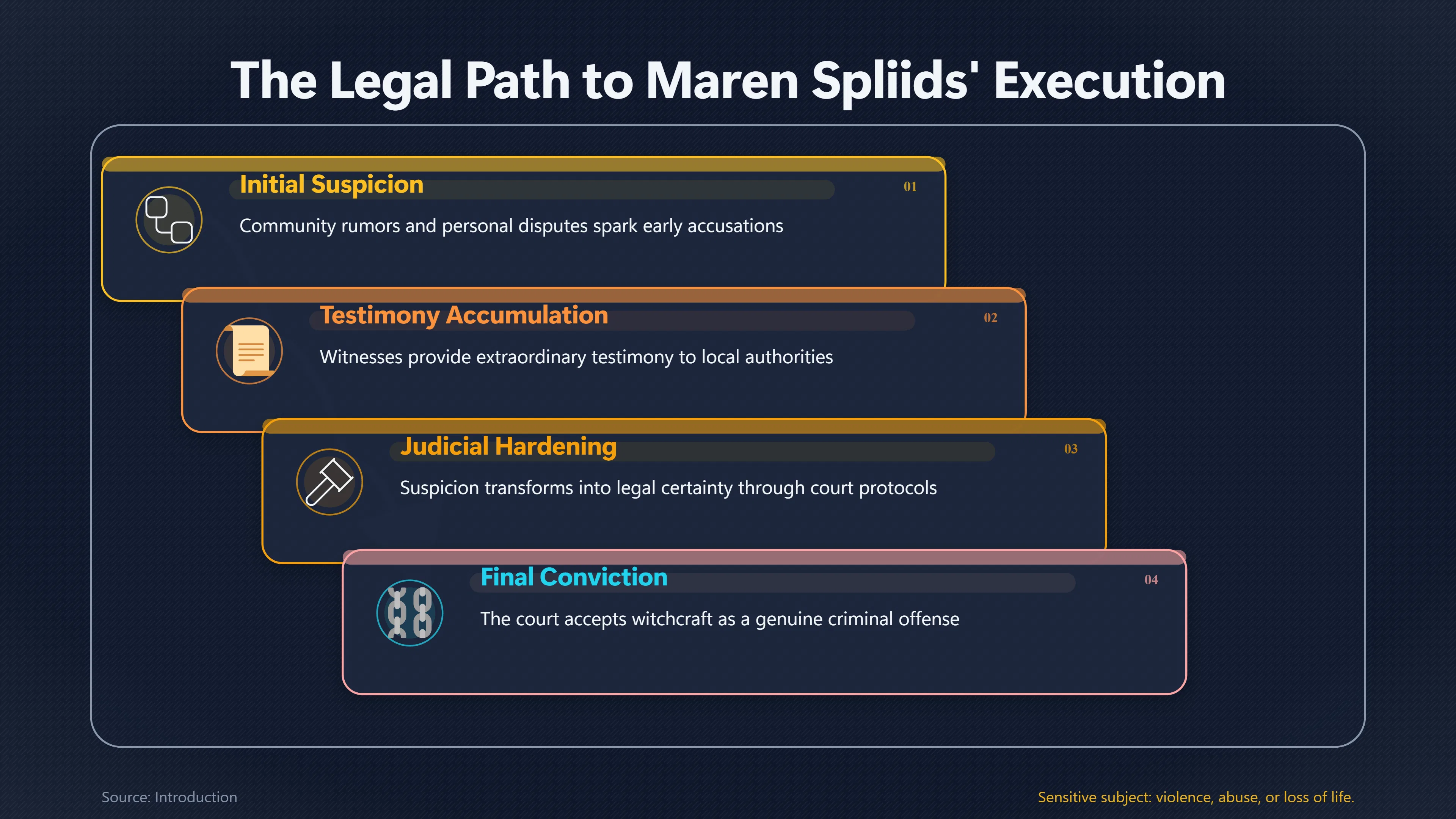
The museum’s best-known figure is Maren Spliids, a prosperous tailor’s wife executed in 1641 after one of Denmark’s most famous witch trials. Her story has endured partly because unusually rich documentary evidence survives.
Rather than presenting her as a mysterious sorceress, the museum reconstructs the legal process that led to her execution. Visitors learn how testimony accumulated, how suspicion hardened into certainty, and how a respected resident could ultimately be condemned under laws that accepted witchcraft as a genuine criminal offence.
Importantly, the museum also reminds visitors that Maren Spliids was not unique. Other women, including the lesser-known Lamme Sidsel, appear in the exhibition to demonstrate that many victims have disappeared almost entirely from public memory despite suffering the same fate. Short films, reconstructed objects, interactive maps and surviving historical material place individual lives within the wider European pattern of persecution.[HEX! Museum of Witch Hunt]hexmuseum.dkHEX! Museum of Witch Hunt The permanent exhibitionHEX! Museum of Witch HuntThe permanent exhibition - HEX! Museum of Witch Hunt…
Explaining fear rather than encouraging it
A striking feature of HEX! is that many displayed objects are shown not because they possessed magical power, but because people believed they did. Protective charms, supposed witchcraft implements and reconstructed ritual objects illustrate contemporary ideas rather than endorsing them.
Interactive displays ask questions such as why communities believed witches could cause illness or steal prosperity, encouraging visitors to understand the mentality of seventeenth-century Europe instead of simply mocking it. Maps comparing persecution across Europe further reinforce that Denmark formed part of a much broader historical phenomenon rather than an isolated episode.[HEX! Museum of Witch Hunt]hexmuseum.dkHEX! Museum of Witch Hunt The permanent exhibitionHEX! Museum of Witch HuntThe permanent exhibition - HEX! Museum of Witch Hunt…

The Køge Accusations and the Possessed Exhibition
While Ribe concentrates on famous individual cases, Køge Museum’s exhibition Possessed examines Denmark’s largest witch-trial episode through the experience of an entire community.
Between 1612 and 1615, sixteen women from Køge were accused of witchcraft. Only one survived. The exhibition reconstructs these events using municipal records, witness statements and the rare written account left by local resident Anna Bartkær, whose family experienced the accusations directly. These surviving documents allow visitors to follow the gradual escalation from suspicion to formal prosecution.[Museum Sydøstdanmark]museerne.dkMuseum Sydøstdanmark Køge MuseumMuseum SydøstdanmarkKøge Museum - Exhibitions - POSSESSED – Museum Sydøstdanmark…
Unlike fictional depictions of witch hunts, the exhibition concentrates on administrative reality. Court protocols reveal expenses incurred for executions, witness examinations and legal proceedings, illustrating that persecution became embedded within everyday civic government rather than existing outside it.
The museum also displays authentic seventeenth-century objects associated with beliefs about witchcraft alongside carefully explained reconstructions. Their purpose is not to demonstrate that supernatural practices worked, but to reveal what contemporaries genuinely feared and how these fears influenced legal decisions.[Museum Sydøstdanmark]museerne.dkMuseum Sydøstdanmark Køge MuseumMuseum SydøstdanmarkKøge Museum - Exhibitions - POSSESSED – Museum Sydøstdanmark…
How Museums Separate Persecution History from Occult Myth
One reason these museums stand out within Denmark’s broader landscape of unusual collections is their careful distinction between folklore and evidence.
They avoid suggesting that historical accusations validate modern claims about magic. Instead, they separate three different ideas:
- Historical belief: People genuinely believed witches existed and could cause harm.
- Historical fact: Courts prosecuted and executed real people on that basis.
- Modern interpretation: Historians examine these events through surviving records rather than accepting supernatural explanations.
This distinction is especially important because witchcraft has accumulated centuries of folklore, popular fiction and commercial imagery. The museums acknowledge those traditions while continually returning visitors to documented evidence.
HEX!, for example, explicitly describes one of its goals as replacing myth and hearsay with historical understanding. It also connects early modern witch persecution with broader themes including prejudice, fear, gender expectations and the dangers of identifying social outsiders as threats.[HEX! Museum of Witch Hunt]hexmuseum.dkHEX! Museum of Witch Hunt Our storyHEX! Museum of Witch HuntOur story - Engelsk - HEX! Museum of Witch HuntJune 29, 2020…
Why These Museums Matter Within Denmark’s Curiosity Culture
Many unusual museums display mysterious objects and invite visitors to wonder whether extraordinary claims might be true. Denmark’s witch museums achieve almost the opposite effect.
Their collections are compelling precisely because the tragedy requires no supernatural explanation. The horror lies in ordinary institutions—courts, churches, neighbourhoods and families—that collectively accepted impossible accusations as legal reality.
This makes them distinctive within Denmark’s landscape of curious museums. Instead of preserving evidence for magic, they preserve evidence of belief itself: how fear can become official policy, how rumours acquire legal authority, and how historical records restore individuality to people long reduced to the label of “witch.”
For visitors interested in strange history, these museums therefore offer something more enduring than tales of spells or curses. They demonstrate how societies construct enemies, how institutions legitimise those constructions, and why remembering documented victims remains more important than perpetuating the myths that condemned them.[hexmuseum.dk]hexmuseum.dkHEX! Museum of Witch Hunt Our storyHEX! Museum of Witch HuntOur story - Engelsk - HEX! Museum of Witch HuntJune 29, 2020…
Amazon book picks
Further Reading
Books and field guides related to Were Denmark's Witches Victims of Belief?. Use these as the next step if you want deeper reading beyond the article.
The Witch-Hunt in Early Modern Europe
Between 1450 and 1750 thousands of people – most of them women – were accused, prosecuted and executed for the crime of witchcraft. The w...
Witches, Witch-Hunting, and Women
We are witnessing a new surge of interpersonal and institutional violence against women, including new witch hunts. This surge of violenc...
The Participatory Museum
Offers a practical guide to working with community members and visitors to make cultural institutions more dynamic, relevant, essential p...
Europe's Inner Demons: The Demonization of Christians in Medi...
First published 1975. Subjects: Witchcraft, History, Demonology, Church history, Witchcraft, europe.
eBay marketplace picks
Marketplace Samples
Live-tested eBay searches with available results related to this page.
Selected fromhistorical witchcraft print oneBay.co.uk.
Current eBay listing
Rare FRAMED ART PRINT , Occult Witchcraft Demonology, Historical
Current eBay listing
Rare FRAMED ART PRINT , Occult Witchcraft Demonology, Historical
Current eBay listing
Witchcraft Art Print Witch Trials Old Historical Reproduction Print
Endnotes
1.
Source: hexmuseum.dk
Title: HEX! Museum of Witch Hunt Welcome
Link:https://www.hexmuseum.dk/en/welcome-to-hex-museum-of-witch-hunt/?lang=en
Source snippet
HEX! Museum of Witch HuntWelcome - HEX! Museum of Witch Hunt...
2.
Source: museerne.dk
Title: Museum Sydøstdanmark Køge Museum
Link:https://museerne.dk/en/pages/koege-museum-besat
Source snippet
Museum SydøstdanmarkKøge Museum - Exhibitions - POSSESSED – Museum Sydøstdanmark...
3.
Source: hexmuseum.dk
Title: HEX! Museum of Witch Hunt Our story
Link:https://www.hexmuseum.dk/en/our-story-engelsk/
Source snippet
HEX! Museum of Witch HuntOur story - Engelsk - HEX! Museum of Witch HuntJune 29, 2020...
Published: June 29, 2020
4.
Source: hexmuseum.dk
Title: HEX! Museum of Witch Hunt The permanent exhibition
Link:https://www.hexmuseum.dk/en/the-permanent-exhibition/
Source snippet
HEX! Museum of Witch HuntThe permanent exhibition - HEX! Museum of Witch Hunt...
5.
Source: hexmuseum.dk
Link:https://www.hexmuseum.dk/en/page/2/
Source snippet
Museum of Witch HuntWELCOME TO HEX! MUSEUM OF WITCH HUNT WHEN PEOPLE FEAR PEOPLE THE MUSEUM TELLS A FRIGHTENING STORY OF HOW THE FEAR OF...
6.
Source: hexmuseum.dk
Link:https://www.hexmuseum.dk/
Source snippet
Museum of Witch HuntVELKOMMEN TIL HEX! Museum of Witch Hunt NÅR MENNESKER FRYGTER MENNESKER. HEX! Museum of Witch Hunt fortæller den uhyg...
7.
Source: hexmuseum.dk
Title: Den faste udstilling
Link:https://www.hexmuseum.dk/den-faste-udstilling/
Source snippet
Museum of Witch HuntHEKSE, HEKSEFRYGT OG HEKSEFORFØLGELSE MUSEET FORTÆLLER DEN UHYGGELIGE HISTORIE OM HEKSEFRYGTEN, SOM FOR ALVOR RAMTE D...
8.
Source: hexmuseum.dk
Title: Historien om
Link:https://www.hexmuseum.dk/historien-om/
Source snippet
Museum of Witch HuntHISTORIEN OM TANKERNE OM AT LAVE ET MUSEUM OM DE DANSKE OG EUROPÆISKE HEKSEFORFØLGELSER BEGYNDTE AT TAGE FORM I 2013...
9.
Source: pure.kb.dk
Title: dk HE X!
Link:https://pure.kb.dk/en/publications/hex-museum-of-witch-hunt/
Source snippet
Museum of Witch Hunt - The Ministry of Culture Research PortalHEX! MUSEUM OF WITCH HUNT * Louise Hauberg Lindgaard (Developer) *, Lulu A...
10.
Source: visitdenmark.com
Link:https://www.visitdenmark.com/denmark/plan-your-trip/hex-museum-of-witch-hunt-in-ribe-gdk1115856
Source snippet
Museum of Witch Hunt | Ribe | By the Wadden SeaHEX! MUSEUM OF WITCH HUNT IN RIBE Ribe was the home of Denmark's most famous witch Maren S...
11.
Source: visitdenmark.dk
Link:https://www.visitdenmark.dk/danmark/explore/hex-museum-of-witch-hunt-i-ribe-gdk1115856
Source snippet
Museum of Witch Hunt | Ribe | VadehavskystenHEX! MUSEUM OF WITCH HUNT I RIBE Ribe var hjemstedet for Danmarks mest berømte heks Maren Spl...
12.
Source: museerne.dk
Title: Køge Museum
Link:https://museerne.dk/en/pages/koge-museum
Source snippet
Experience witches, werewolves, gods and satanic cults...
Additional References
13.
Source: youtube.com
Link:https://www.youtube.com/watch?v=OINhhPOxXvg
14.
Source: youtube.com
Link:https://www.youtube.com/watch?v=gVuiWaAqh_4
15.
Source: youtube.com
Link:https://www.youtube.com/watch?v=pKQweH72LAI
16.
Source: youtube.com
Link:https://www.youtube.com/watch?v=pKiGkcvJTMk
17.
Source: youtube.com
Link:https://www.youtube.com/watch?v=we0BqoNhiWk