Within Uganda Curiosities
Ancient Tools and Fossils That Changed Uganda's Story
Uganda's fossils and ancient stone tools reveal a different kind of mystery rooted in deep human history rather than folklore.
On this page
- Stone tools and early human activity
- Fossils and the science of the past
- Why prehistoric objects still fascinate visitors
Page outline Jump by section
Introduction
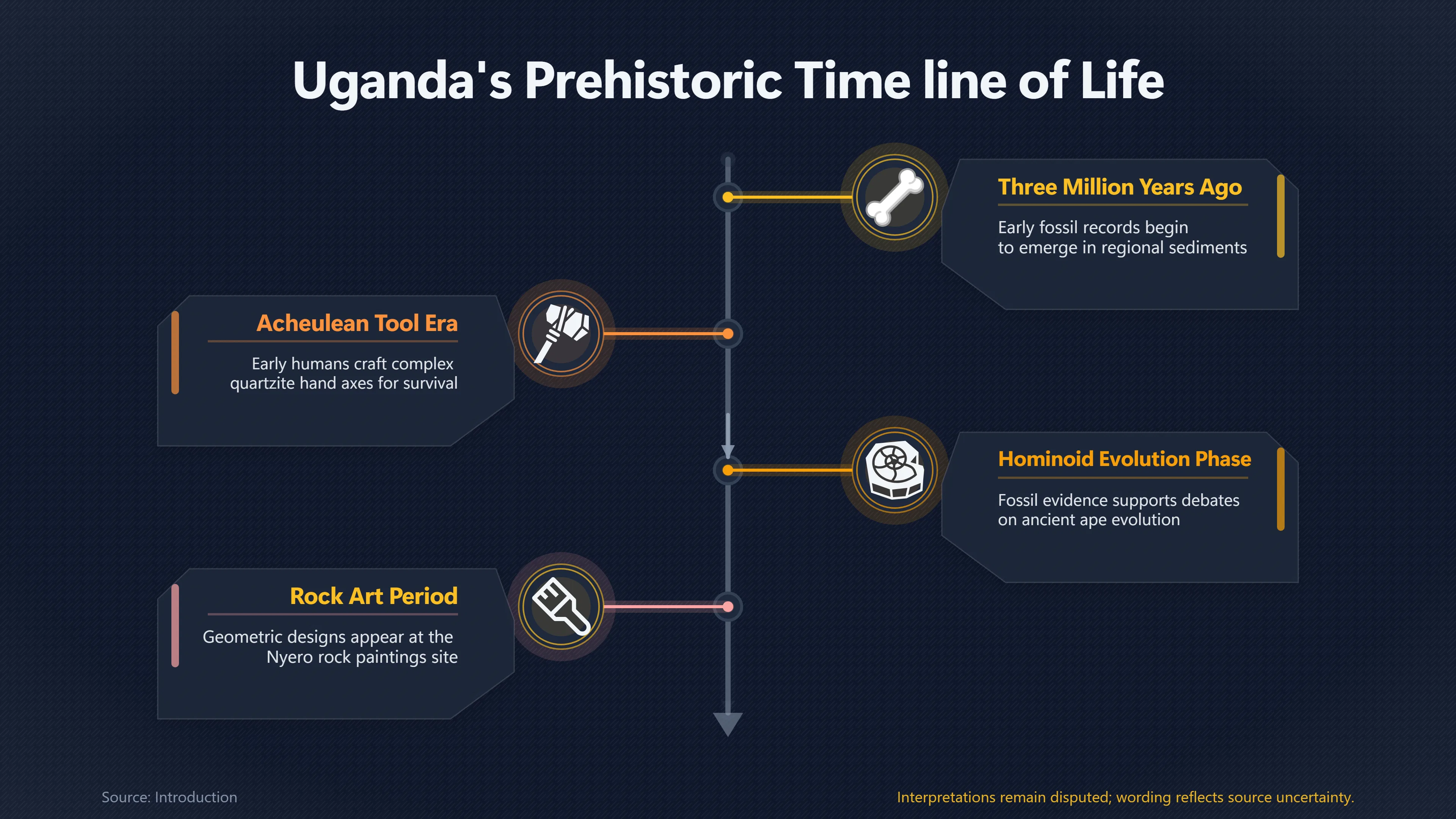
Uganda’s prehistoric collections offer a different kind of mystery from folklore objects or unexplained curiosities: they preserve physical evidence of deep time. Stone tools, fossil remains and ancient traces of human activity show that the landscapes of modern Uganda have been connected to major chapters in the history of life and human development. The Uganda National Museum’s archaeological and palaeontology collection contains thousands of prehistoric objects, including fossils, stone tools and pottery, covering a period from around three million years ago into later human history.[Uganda Museums]museums.tourism.go.ugUganda Museums Archaeological & Palaeontology CollectionUganda MuseumsArchaeological & Palaeontology Collection - Uganda Museums…
For visitors interested in unusual collections, these objects are remarkable because they are not mysterious because their origins are unknown. Their significance comes from the opposite: they are carefully studied pieces of evidence that reveal vanished environments, extinct species and the abilities of early toolmakers. Uganda’s prehistoric heritage turns ordinary-looking stones and fossil fragments into scientific clues about how humans and landscapes changed over immense periods of time.[Uganda Museums]museums.tourism.go.ugUganda Museums Archaeological & Palaeontology CollectionUganda MuseumsArchaeological & Palaeontology Collection - Uganda Museums…
Stone tools and early human activity
Some of Uganda’s most fascinating prehistoric objects are stone tools, especially Acheulean hand axes. These large, carefully shaped tools were made by striking and shaping stone to create sharp edges, and they represent some of the earliest known traditions of complex tool production. The Uganda Museums collection includes an Acheulean hand axe made from quartzite recovered from the Lake Victoria shore region, showing that ancient toolmakers were active in landscapes that are now part of Uganda.[Uganda Museums]museums.tourism.go.ugUganda Museums Collections ArchiveUganda MuseumsCollections Archive - Uganda Museums…
Stone tools are important because they provide evidence of behaviour rather than simply survival. A fossil bone may reveal what an ancient creature looked like, but a shaped stone can reveal choices: which material was selected, how it was worked, and what tasks it may have supported. Archaeologists use these patterns to reconstruct ancient technology, movement across landscapes and changing relationships between humans and their environments.[Natural History Museum]nhm.ac.ukNatural History Museum Palaeoanthropology collection | Natural History MuseumNatural History Museum Palaeoanthropology collection | Natural History Museum
The Lake Victoria basin is particularly significant because its exposed sediments have preserved evidence of early human activity. Stone artefacts from the wider region have contributed to discussions about the age and spread of early technologies in East Africa, although individual discoveries must always be assessed carefully through dating methods, geological context and comparisons with securely identified sites.[Wikipedia]WikipediaEarly history of UgandaEarly history of Uganda
What prehistoric tools reveal about ancient Uganda
The value of Uganda’s stone tools is not only their age. They help answer questions that still interest scientists and visitors:
- How did early humans adapt to changing landscapes? Tools found in different geological settings help researchers understand how people responded to lakes, rivers, forests and open environments.
- How sophisticated were early technologies? Acheulean tools show planning and repeated techniques rather than random stone breaking.
- How did knowledge spread? Similar tool traditions across parts of Africa provide evidence for long-distance connections in early human history.
These objects also challenge a common misunderstanding: prehistoric artefacts are not simply “primitive objects”. Even a single hand axe can represent accumulated knowledge passed between generations.
Fossils and the science of the past
Uganda’s prehistoric story extends beyond human-made objects. Fossils preserved in museum collections provide evidence for ancient animals, environments and the long evolutionary history of life in the region. The Uganda National Museum’s research programmes include palaeontology and human origins studies, with work involving fossil hominoids and early ancestors from areas including Moroto and Napak in north-eastern Uganda.[Uganda Museums]museums.tourism.go.ugUganda Museums ResearchUganda MuseumsResearch - Uganda Museums…
The fossil record from Uganda is especially important because it helps scientists reconstruct environments that existed millions of years before modern humans appeared. Fossils can show what animals lived in a landscape, what vegetation may have been present and how climate changes affected ecosystems.
One of the most important discoveries associated with Uganda’s fossil record is the work around Moroto, where fossil evidence has contributed to debates about ancient ape evolution and the environments in which early hominoids lived. Research on Ugandan fossils has helped scientists investigate how habitats changed in eastern Africa and how those changes relate to the evolution of primates.[Uganda Museums]museums.tourism.go.ugUganda Museums ResearchUganda MuseumsResearch - Uganda Museums…
The scientific importance of these fossils lies in their context. A fossil displayed alone may appear to be only a fragment of bone or tooth, but researchers combine location, surrounding sediments, geological dating and comparisons with other discoveries to build a picture of vanished worlds.
Why prehistoric objects still fascinate visitors
Prehistoric artefacts are among Uganda’s most unusual heritage objects because they connect everyday museum displays with questions about human origins. A visitor looking at a stone axe or fossil fragment is seeing something that existed long before written records, kingdoms or modern borders.
The Uganda National Museum presents prehistoric collections alongside later cultural and natural history collections, creating a continuous story from ancient environments to human societies. Its archaeological and palaeontology holdings include fossils, stone tools, pottery and other evidence spanning Uganda’s long human past.[Uganda Museums]museums.tourism.go.ugUganda Museums Plan Your VisitUganda MuseumsPlan Your Visit - Uganda Museums…
This makes prehistoric objects especially compelling within Uganda’s wider curiosity landscape. They are not “mystery objects” in the sense of unexplained artefacts or legends; they are evidence-based mysteries, where the unanswered questions are scientific ones. Researchers continue to investigate who made particular tools, how ancient landscapes changed and how early human relatives adapted to their surroundings.
Sites such as the Nyero rock paintings show another side of Uganda’s ancient heritage, where archaeology meets questions of memory, symbolism and interpretation. The paintings are among the country’s most important rock art sites, with geometric designs whose exact makers and meanings remain debated by researchers.[African Rock Art]africanrockart.britishmuseum.orgAfrican Rock Art NyeroAfrican Rock Art Nyero
Together, Uganda’s fossils and prehistoric artefacts reveal a landscape with a much longer history than written traditions alone can show. They transform stones, bones and markings into records of survival, adaptation and creativity, making them some of the country’s most scientifically important curiosities.[Uganda Museums]museums.tourism.go.ugUganda Museums Archaeological & Palaeontology CollectionUganda MuseumsArchaeological & Palaeontology Collection - Uganda Museums…

Amazon book picks
Further Reading
Books and field guides related to Ancient Tools and Fossils That Changed Uganda's Story. Use these as the next step if you want deeper reading beyond the article.
Sapiens: A Brief History of Humankind
Rating: 4.5/5 from 12 Google Books ratings
'Interesting and provocative... It gives you a sense of how briefly we've been on this Earth' Barack Obama What makes us brilliant? What...
The Story of Earth
Hailed by The New York Times for writing “with wonderful clarity about science . . . that effortlessly teaches as it zips along,” nationa...
The Sixth Extinction
"Over the last half billion years, there have been five major mass extinctions, when the diversity of life on Earth suddenly and dramatic...
The Human Story: Our History, from the Stone Age to Today
OUR HISTORY, FROM THE STONE AGE TO TODAY.
eBay marketplace picks
Marketplace Samples
Example marketplace items related to this page. Use the search link to explore similar finds on eBay.
Selected fromancient artifact replica oneBay.co.uk.
Endnotes
1.
Source: museums.tourism.go.ug
Title: Uganda Museums Archaeological & Palaeontology Collection
Link:https://museums.tourism.go.ug/collections/archaeological-palaeontology-collection/
Source snippet
Uganda MuseumsArchaeological & Palaeontology Collection - Uganda Museums...
2.
Source: museums.tourism.go.ug
Title: Uganda Museums Home
Link:https://museums.tourism.go.ug/
Source snippet
Uganda MuseumsHome - Uganda Museums...
3.
Source: museums.tourism.go.ug
Title: Uganda Museums Research
Link:https://museums.tourism.go.ug/research/
Source snippet
Uganda MuseumsResearch - Uganda Museums...
4.
Source: museums.tourism.go.ug
Title: Uganda Museums Collections Archive
Link:https://museums.tourism.go.ug/collections/
Source snippet
Uganda MuseumsCollections Archive - Uganda Museums...
5.
Source: nhm.ac.uk
Title: Natural History Museum Palaeoanthropology collection | Natural History Museum
Link:https://www.nhm.ac.uk/our-science/services/collections/palaeontology/palaeoanthropology.html
6.
Source: Wikipedia
Title: Early history of Uganda
Link:https://en.wikipedia.org/wiki/Early_history_of_Uganda
7.
Source: museums.tourism.go.ug
Title: Uganda Museums Plan Your Visit
Link:https://museums.tourism.go.ug/plan-your-visit/
Source snippet
Uganda MuseumsPlan Your Visit - Uganda Museums...
8.
Source: africanrockart.britishmuseum.org
Title: African Rock Art Nyero
Link:https://africanrockart.britishmuseum.org/country/uganda/nyero/
9.
Source: ugandatourismcenter.com
Title: Nyero Rock Paintings
Link:https://ugandatourismcenter.com/place/nyero-rock-paintings
Source snippet
Uganda Tourism CenterJanuary 7, 2026 — Articles NYERO ROCK PAINTINGS * By ugandatourismcenter * * * * * * * * The Nyero rock paintings ar...
Published: January 7, 2026
10.
Source: allaboutuganda.com
Title: Nyero Rock Paintings
Link:https://www.allaboutuganda.com/places/nyero-rock-paintings.html
11.
Source: tourismuganda.org
Title: Nyero Rock Paintings
Link:https://www.tourismuganda.org/places/nyero-rock-paintings/
12.
Source: ugandaparks.com
Title: Nyero Rock Paintings
Link:https://www.ugandaparks.com/natural-monuments/nyero-rock-paintings/
13.
Source: ugandatourismguide.com
Title: Nyero Rock Paintings | Uganda Tourism Guide
Link:https://www.ugandatourismguide.com/landmarks/nyero-rock-paintings/
14.
Source: museums.tourism.go.ug
Title: tourism.go.ug About Us
Link:https://museums.tourism.go.ug/about-us/
15.
Source: museums.tourism.go.ug
Title: tourism.go.ug Ethnology & Cultural Heritage Collection
Link:https://museums.tourism.go.ug/collections/ethnology-cultural-heritage-collection/
16.
Source: nhm.ac.uk
Link:https://www.nhm.ac.uk/our-science/services/collections/palaeontology.html
17.
Source: africanrockart.britishmuseum.org
Link:https://africanrockart.britishmuseum.org/country/uganda/
18.
Source: collections.maa.cam.ac.uk
Link:https://collections.maa.cam.ac.uk/objects/622025/
Additional References
19.
Source: cambridge.org
Link:https://www.cambridge.org/core/product/identifier/S0079497X25100741/type/journal_article
Source snippet
ty | Cambridge CoreDecember 18, 2025 — EXCAVATIONS AT THE STONE AGE SITE OF NYABUSORA IN THE WESTERN LAKE VICTORIA-NYANZA BASIN, TANZANIA...
Published: December 18, 2025
20.
Source: whc.unesco.org
Link:https://whc.unesco.org/en/tentativelists/914/
Source snippet
UNESCO World Heritage CentreNyero and other hunter-gatherer geometric rock art sites in eastern Uganda - UNESCO World Heritage Centre...
21.
Source: youtube.com
Title: What Will Shock You at Nyero Rock Paintings?
Link:https://www.youtube.com/watch?v=MIrIR0HDe2s
Source snippet
Aping Human Evolution: What the Early Miocene Tells Us About Human Origins...
22.
Source: nature.com
Title: Fossil Monkeys from the Miocene of Napak, North-East Uganda | Nature
Link:https://www.nature.com/articles/220657a0
23.
Source: nema.go.ug
Link:https://nema.go.ug/chein/?page_id=253
24.
Source: nmk.go.ke
Link:https://nmk.go.ke/directorate-of-national-repository-and-research/earth-science-department/
25.
Source: tandfonline.com
Link:https://www.tandfonline.com/doi/abs/10.1080/0067270X.2025.2586371
26.
Source: kumi.go.ug
Link:https://www.kumi.go.ug/opportunity/iteso-authors-nyero-rock-paintings
27.
Source: sciencedirect.com
Link:https://www.sciencedirect.com/science/article/abs/pii/S0753396902010443
28.
Source: sciencedirect.com
Link:https://www.sciencedirect.com/science/article/abs/pii/S0047248418301568