Within Sudan Curiosities
When Sudanese Communities Curate Their Own Traditions
Sudan's regional museums mixed archaeology with crafts, pastoral life and oral testimony, giving communities a direct role in interpretation.
On this page
- Why regional museums mixed archaeology and everyday life
- Community voices, oral history and living practice
- War damage, digital archives and the future of access
Page outline Jump by section
Introduction
Sudan’s most distinctive regional museums were never intended to be simple storehouses of archaeological finds. Instead, institutions in Nyala, El Obeid and Omdurman developed a model that placed ancient artefacts alongside living traditions, inviting local people to contribute stories, craft knowledge and everyday objects rather than treating culture as something frozen in the distant past. This approach made the museums unusual within Sudan’s heritage landscape: they became shared community archives where archaeology, oral history and contemporary identity were interpreted together rather than in isolation.[heritage.arch.cam.ac.uk]heritage.arch.cam.ac.ukAugust 28, 2018…
That philosophy has become even more significant since the outbreak of war in 2023. Damage to museum buildings and collections has highlighted that preserving heritage is not only about protecting objects in display cases, but also about safeguarding the memories, skills and traditions that communities themselves continue to practise. The regional museum model therefore offers an important example of how cultural heritage can survive through people as well as collections.[AP News]apnews.comA curator at Sudan's National Corporation for Antiquities and Museums (NCAM), Abdrabo is creating a comprehensive digital database of Sud…
Why regional museums mixed archaeology and everyday life
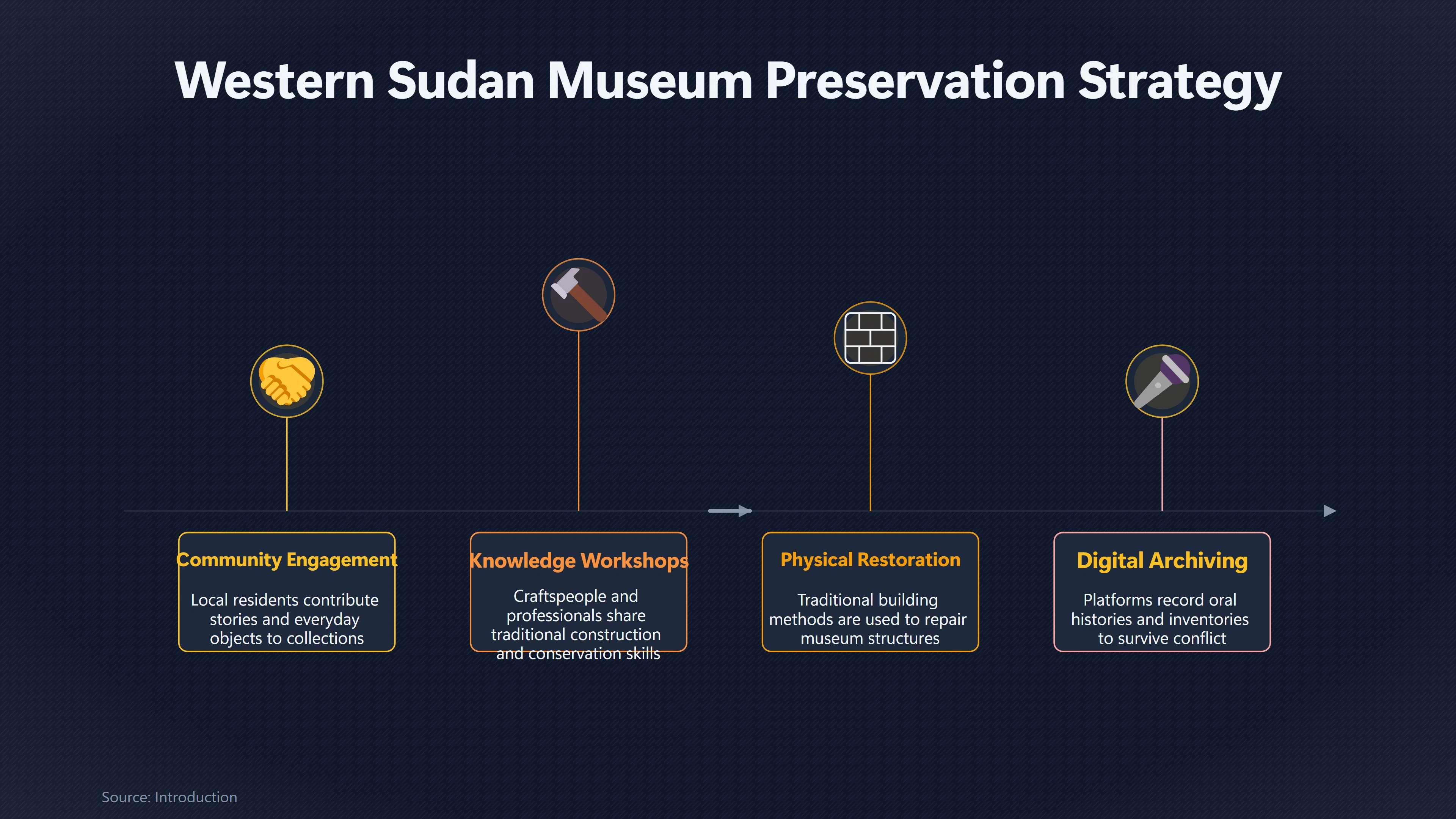
Many national museums separate archaeology from ethnography, displaying ancient kingdoms in one gallery and modern cultural life somewhere else. The western Sudan community museum programme deliberately blurred that boundary.
The three principal museums—the Darfur Museum in Nyala, the Sheikan Museum in El Obeid and the Khalifa House Museum in Omdurman—were connected by a heritage initiative that viewed each institution as a cultural centre rather than simply a repository of artefacts. Their collections reflected the histories of their surrounding regions while also documenting crafts, domestic life, pastoral traditions and local memories that remained part of everyday experience.[cultural-protection-fund.britishcouncil.org]cultural-protection-fund.britishcouncil.orgWestern Sudan Community Museums: Nyala, El Obaid, Omdurman | British CouncilWestern Sudan Community Museums: Nyala, El Obaid, Omdurman | British Council
This represented a governance choice as much as a curatorial one. Rather than presenting museums as places where experts spoke to visitors, the programme encouraged communities to participate in shaping exhibitions and determining which aspects of local heritage deserved preservation. Archaeological objects remained important, but they were interpreted alongside the people whose traditions continued to give meaning to the landscape.[ICCROM]iccrom.orgActivity in FocusActivity in Focus - Enhancing the Social and Cultural Role of Community Museums in Western Sudan…
A particularly distinctive feature was the Darfur Museum in Nyala, where parts of the displays were assembled through donations from local residents. Instead of relying solely on excavated antiquities, the museum incorporated objects that communities themselves regarded as culturally significant, reinforcing the idea that living heritage belonged within the museum alongside the ancient past.[heritage.arch.cam.ac.uk]heritage.arch.cam.ac.ukAugust 28, 2018…
Community voices, oral history and living practice
The regional museum project treated oral testimony as a heritage resource in its own right.
Workshops organised during the restoration programme brought together museum professionals, craftspeople, community organisations and bearers of traditional knowledge. These activities were designed not only to improve conservation techniques but also to strengthen the museums’ social role by ensuring that exhibitions reflected local experience rather than only academic interpretation.[ICCROM]iccrom.orgcommunity museums western sudan workshopsCommunity Museums in Western Sudan: Workshops | ICCROMApril 30, 2019…
This approach recognised several forms of heritage that cannot easily be preserved in display cases:
- traditional crafts and construction techniques;
- pastoral knowledge and everyday rural life;
- local historical memory passed between generations;
- community interpretations of regional history;
- skills demonstrated through workshops and public events rather than static exhibits.
Instead of treating these practices as background context for archaeological collections, the museums presented them as heritage requiring documentation in their own right. The result was a museum model in which visitors encountered not only objects but also the stories, practices and social relationships that gave those objects meaning.[ICCROM]iccrom.orgActivity in FocusActivity in Focus - Enhancing the Social and Cultural Role of Community Museums in Western Sudan…
The restoration programme also invested in local conservation skills. Craftspeople used traditional building methods during repairs, while museum staff received training in cataloguing, recording and preventive conservation. This linked the preservation of physical buildings with the continuation of practical knowledge held within local communities.[heritage.arch.cam.ac.uk]heritage.arch.cam.ac.ukAugust 28, 2018…

Why community participation mattered
Community participation addressed practical as well as cultural challenges.
Regional museums in western Sudan often operated with limited resources and served populations whose heritage extended well beyond formal archaeological sites. By encouraging local residents to contribute knowledge, objects and interpretation, museums expanded their collections without relying entirely on expensive excavation or acquisition programmes. At the same time, local involvement increased public ownership of heritage, making museums more relevant to everyday life rather than appearing as distant state institutions.[heritage.arch.cam.ac.uk]heritage.arch.cam.ac.ukAugust 28, 2018…
This model also reflected Sudan’s cultural diversity. Regions such as Darfur and Kordofan possess long histories shaped by trade, migration and pastoral traditions that are not fully represented by monumental archaeological remains alone. Recording oral histories, family memories and regional customs allowed museums to preserve cultural identities that might otherwise disappear through displacement or rapid social change.[Safeguarding Sudan's Living Heritage]sslh.infoOpen source on sslh.info.
War damage, digital archives and the future of access
The civil war that began in 2023 transformed the priorities of Sudan’s regional museums.[cultureincrisis.org]cultureincrisis.orgSource details in endnotes.
Museums that had been developing as community centres suddenly faced looting, destruction and displacement. Reports indicate that the Nyala museum suffered extensive damage, while heritage professionals warned that museum archives, catalogues and research records were also at risk. The loss therefore extended beyond individual artefacts to the documentation that connected collections with community knowledge.[AP News]apnews.comA curator at Sudan's National Corporation for Antiquities and Museums (NCAM), Abdrabo is creating a comprehensive digital database of Sud…
In response, heritage organisations increasingly shifted towards digital documentation. Projects that grew out of the Western Sudan Community Museum initiative expanded into broader efforts to record Sudan’s living heritage through digital platforms, oral history projects and partnerships with communities inside and outside the country. These initiatives aim to preserve photographs, recordings, inventories and traditional knowledge even where physical access to museums remains impossible.[Safeguarding Sudan's Living Heritage]sslh.infoOpen source on sslh.info.
This evolution reflects an important lesson from the regional museum model. Buildings and collections remain essential, but the survival of heritage also depends on maintaining relationships between communities and their cultural knowledge. Digital archives cannot replace museum visits, yet they can preserve memories, oral traditions and documentation until damaged institutions can eventually recover.[Safeguarding Sudan's Living Heritage]sslh.onlineOpen source on sslh.online.

What makes these museums unusual within Sudan’s heritage landscape
The regional museums of western Sudan stand apart because they challenged the idea that museums exist only to preserve the distant past. They sought instead to become places where archaeology, family memory, craftsmanship and contemporary identity met in the same space.
That combination makes them significant not because they housed the country’s strangest individual objects, but because they experimented with an unusually participatory model of heritage. By treating living traditions as collections worthy of preservation alongside archaeological artefacts, they turned regional museums into shared cultural archives whose most valuable exhibits were often the continuing knowledge and voices of the communities themselves.[cam.ac.uk]heritage.arch.cam.ac.ukAugust 28, 2018…
Amazon book picks
Further Reading
Books and field guides related to When Sudanese Communities Curate Their Own Traditions. Use these as the next step if you want deeper reading beyond the article.
The African Experience: An Introduction
This book provides an introduction to Africa -- covering its physical attributes, history, social structure, and culture.It emphasizes no...
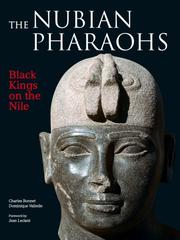
The Nubian Pharaohs of Egypt: Black Kings on the Nile
First published 2007. Subjects: Nubia, Egypt, civilization, Egypt, history, Antiquities, Sculpture.
Ancient Nubia: Egypt's Rival in Africa
First published 1993. Subjects: Nubia, Africa, African History, History, 15.51 Antiquity.
eBay marketplace picks
Marketplace Samples
Live-tested eBay searches with available results related to this page.
Selected fromAfrican art print oneBay.co.uk.

Endnotes
1.
Source: heritage.arch.cam.ac.uk
Link:https://www.heritage.arch.cam.ac.uk/community-museums-western-sudan-omdurman-el-obeid-nyala
Source snippet
August 28, 2018...
Published: August 28, 2018
2.
Source: cultural-protection-fund.britishcouncil.org
Title: Western Sudan Community Museums: Nyala, El Obaid, Omdurman | British Council
Link:https://cultural-protection-fund.britishcouncil.org/projects/western-sudan-community-museums-nyala-el-obaid-omdurman
3.
Source: iccrom.org
Title: Community museums of Western Sudan | ICCROM
Link:https://www.iccrom.org/news/community-museums-western-sudan
Source snippet
Community museums of Western Sudan | ICCROM...
4.
Source: iccrom.org
Title: Activity in Focus
Link:https://www.iccrom.org/annualreport/community_museum.html
Source snippet
Activity in Focus - Enhancing the Social and Cultural Role of Community Museums in Western Sudan...
5.
Source: iccrom.org
Title: community museums western sudan workshops
Link:https://www.iccrom.org/news/community-museums-western-sudan-workshops
Source snippet
Community Museums in Western Sudan: Workshops | ICCROMApril 30, 2019...
Published: April 30, 2019
6.
Source: apnews.com
Link:https://apnews.com/article/fa3849af561dd96f0612e395e75b84d8
Source snippet
A curator at Sudan's National Corporation for Antiquities and Museums (NCAM), Abdrabo is creating a comprehensive digital database of Sud...
7.
Source: sslh.info
Link:https://www.sslh.info/en
8.
Source: sslh.online
Link:https://www.sslh.online/en
9.
Source: sslh.info
Title: Crafts in Markets
Link:https://www.sslh.info/en/posts/crafts-in-markets
10.
Source: sslh.info
Title: New Trends
Link:https://www.sslh.info/en/themes/new-trends
Additional References
11.
Source: ft.com
Link:https://www.ft.com/content/5ea6dc34-271f-41a5-aa5f-6c716f0f91f0
Source snippet
The site, once vibrant with tourists, has been deserted since the conflict began in April 2023. The Rapid Support Forces (RSF) have loote...
Published: April 2023
12.
Source: youtube.com
Title: Fatima Mohamed Al Hazar, founder of Darfur Women’s Museum
Link:https://www.youtube.com/watch?v=mre7TT8ZE7E
Source snippet
Life on the Move: Darfur's Rezeigat Nomads - South Darfur, Sudan...
13.
Source: youtube.com
Title: How to Make a Museum: The Story of Sudan’s Community Museums
Link:https://www.youtube.com/watch?v=hKfWVKYyR-I
Source snippet
WSCM: Post-conflict Recovery of Living Cultural Heritage...
14.
Source: youtube.com
Title: WSCM: Post-conflict Recovery of Living Cultural Heritage
Link:https://www.youtube.com/watch?v=Ohubq3oXETM
Source snippet
Fatima Mohamed Al Hazar, founder of Darfur Women's Museum...
15.
Source: cultureincrisis.org
Link:https://cultureincrisis.org/projects/community-museums-of-western-sudan-omdurman-el-obeid-nyala
16.
Source: cultureincrisis.org
Link:https://cultureincrisis.org/projects/western-sudan-community-museums
17.
Source: youtube.com
Title: Life on the Move: Darfur’s Rezeigat Nomads
Link:https://www.youtube.com/watch?v=RnfEp7Kbxhk
Source snippet
Camel Culture - Darfur, Sudan...
18.
Source: mallinsonae.com
Title: Western Sudan Community Museum Project | mallinson ae
Link:https://www.mallinsonae.com/western-sudan-community-museums
19.
Source: unesco.org
Title: communities south sudan build their national museum
Link:https://www.unesco.org/en/articles/communities-south-sudan-build-their-national-museum
20.
Source: ucl.ac.uk
Title: Sudan Living Cultures | Museums and Collections
Link:https://www.ucl.ac.uk/museums-collections/petrie-museum/about-us/projects/sudan-living-cultures