Within Curious North Macedonia
When Does a Sacred Object Become a Museum Piece?
Icons, terracotta plaques and monastery relics reveal how religious objects can be viewed as both heritage and active sacred traditions.
On this page
- Vinica terracotta plaques
- Ohrid icon collections
- Bigorski Monastery relics
Page outline Jump by section
Introduction
In North Macedonia, the boundary between a museum object and a sacred object is often deliberately left intact rather than erased. Some of the country’s most remarkable religious artefacts are displayed in museum galleries where they are studied as works of art, while others remain in churches and monasteries where they continue to receive prayers, kisses, candles and processions. The result is a distinctive heritage landscape in which conservation and devotion exist side by side rather than replacing one another.

This balance is especially visible in three places: the Early Christian terracotta plaques from Vinica, the celebrated icon collections of Ohrid, and the relics preserved at Bigorski Monastery. Together they illustrate that the meaning of a religious object depends not only on its age or artistic quality, but also on where it is kept, who cares for it and how people continue to interact with it.
When does a sacred object become a museum piece?
Modern museums generally preserve objects by removing them from everyday use. Churches and monasteries, by contrast, preserve them by continuing the traditions for which they were created. North Macedonia contains examples of both approaches.
This distinction matters because many religious objects have more than one identity. An icon can be a masterpiece of Byzantine painting, a historical document and an object of prayer simultaneously. A relic may be catalogued by conservators yet still be approached by pilgrims as a living point of spiritual contact. Visitors therefore encounter different expectations depending on the setting. In a museum gallery, touching is prohibited and interpretation is historical. In an active monastery, respectful behaviour takes precedence over close visual inspection, and religious practice shapes how objects are experienced.
The country’s religious heritage has developed within one of Europe’s oldest Christian landscapes. UNESCO highlights the Ohrid region for its exceptional concentration of churches, frescoes and more than 800 Byzantine-style icons, recognising both their artistic importance and their continuing role within a historic religious centre.[UNESCO World Heritage Centre]whc.unesco.orgWorld Heritage Centre Natural and Cultural Heritage of the Ohrid regionUNESCO World Heritage CentreNatural and Cultural Heritage of the Ohrid region - UNESCO World Heritage Centre…
Vinica terracotta plaques: archaeological finds with sacred meaning
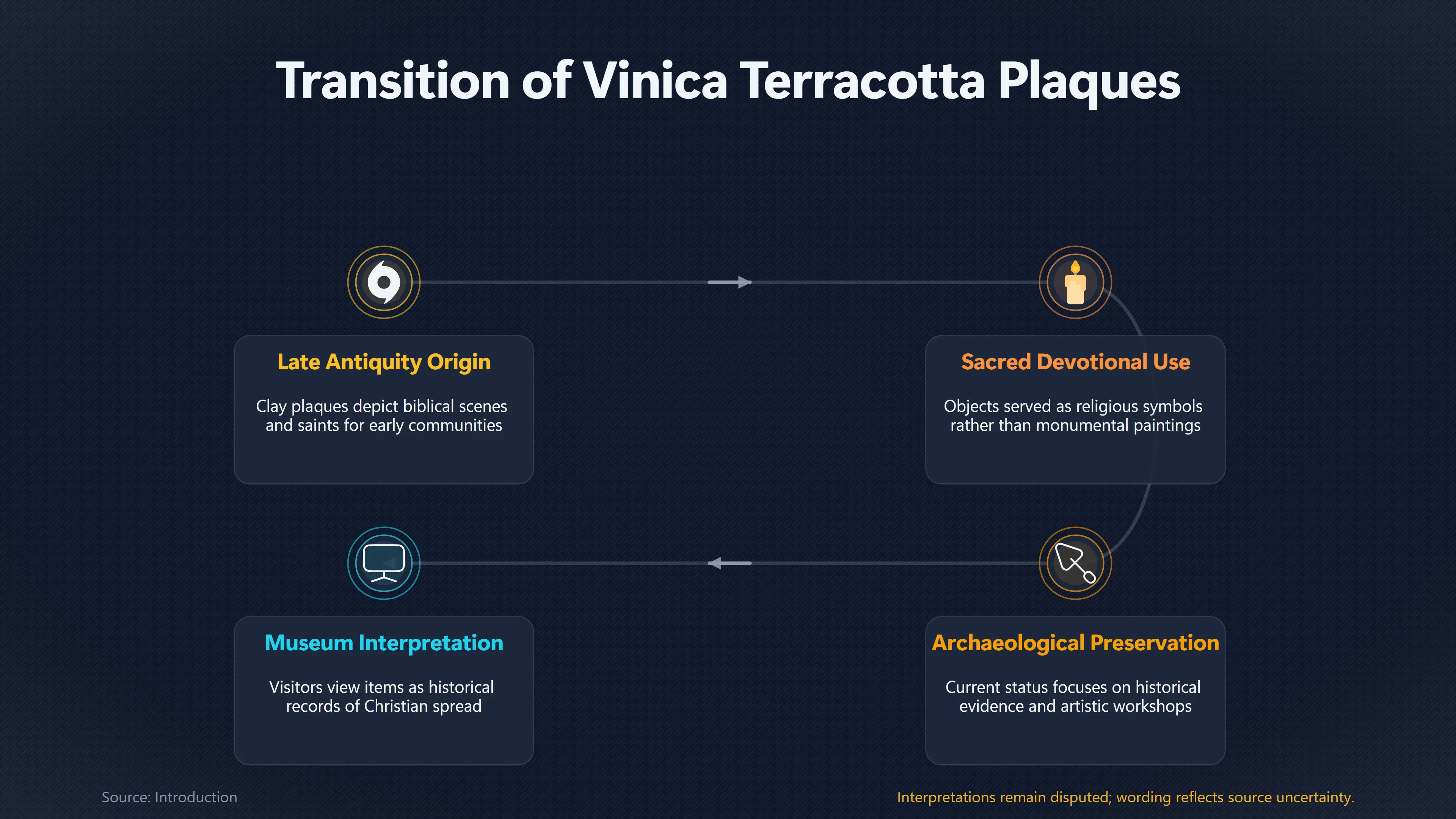
The terracotta plaques discovered at Vinica occupy an unusual position between archaeology and religious art. Dating from Late Antiquity, they depict biblical scenes, saints and Christian symbolism impressed into baked clay rather than painted onto wooden panels.
Unlike later icons, these plaques were not designed as monumental church paintings. Scholars generally interpret them as devotional objects connected with Early Christian communities, although questions remain about their precise use. Their rarity makes them one of the most distinctive collections of Christian material culture in the Balkans.
Today the plaques are preserved as archaeological artefacts. Their value lies in the evidence they provide about the spread of Christianity, artistic workshops and religious imagery during a period when the region was becoming firmly Christian. Their sacred subjects remain immediately recognisable, but their primary context for visitors is now historical interpretation rather than active worship.
This shift illustrates one of the clearest examples of a sacred object becoming a museum object. The plaques are no longer part of liturgical practice, yet they continue to communicate religious ideas that shaped the communities which produced them.
Ohrid’s icon collections: masterpieces still connected to worship
Ohrid presents a more complicated picture because many of its icons have never fully ceased to belong to religious life.
The city’s Icon Gallery displays some of the finest surviving examples from the eleventh to the nineteenth centuries. The permanent exhibition contains carefully selected masterpieces from a much larger collection that also includes church furniture, liturgical vessels, embroidery and other ecclesiastical objects. Conservators treat these works as exceptional achievements of Byzantine and post-Byzantine art while documenting their historical context and ensuring their long-term preservation.[Ohrid Museum]muzejohrid.mkOhrid MuseumIcon gallery – NI Institute for protection of monuments of culture and museum – OhridFebruary 23, 2023…
Yet many of these icons originally came from functioning churches, and similar works remain in active use throughout the Ohrid region. Their subjects—Christ, the Virgin Mary and numerous saints—are understood by believers not simply as paintings but as windows into the sacred. For Orthodox Christians, veneration is directed towards the holy figures represented rather than the wooden panel itself.
This creates an experience unlike that found in many secular art museums. Visitors may admire painting techniques, silver coverings and conservation methods, while local worshippers recognise familiar devotional images that remain central to religious identity. The museum setting encourages historical appreciation without entirely stripping the icons of their spiritual associations.
The Ohrid collection is internationally important. The museum identifies it as one of the world’s outstanding collections of Orthodox icons, while UNESCO recognises the region’s remarkable concentration of Byzantine icons and church art as part of its World Heritage significance.[Ohrid Museum]muzejohrid.mkOhrid MuseumIcon gallery – NI Institute for protection of monuments of culture and museum – OhridFebruary 23, 2023…

Bigorski Monastery: heritage that remains alive
Bigorski Monastery demonstrates the opposite end of the spectrum. Rather than presenting sacred objects primarily as museum exhibits, it preserves them within an active religious community where their devotional function remains central.
The monastery is famous for its extraordinary nineteenth-century carved wooden iconostasis, regarded as one of the masterpieces of Balkan woodcarving. Visitors naturally admire its artistic complexity, but within the church it remains part of the liturgical setting rather than an isolated artwork.[Bigorski]bigorski.org.mkBigorski Holy Relics | ‡ Bigorski MonasteryBigorski Holy Relics | ‡ Bigorski Monastery
Even more revealing are the monastery’s relics and miracle-working icon of St John the Baptist. According to monastery tradition, the icon has long been associated with miracles and continues to receive offerings from pilgrims. The monastery also preserves relics attributed to numerous saints together with a reliquary containing a fragment traditionally identified as part of the True Cross. These objects are presented by the monastic community not as historical curiosities but as living expressions of Orthodox faith.[Bigorski]bigorski.org.mkBigorski Holy Relics | ‡ Bigorski MonasteryBigorski Holy Relics | ‡ Bigorski Monastery
For visitors, this means the experience differs fundamentally from entering a museum. Photography may be restricted, services may interrupt sightseeing, and pilgrims approach the icons and relics with acts of veneration rather than detached observation. Conservation is important, but it serves the continuation of religious life rather than replacing it.

Different expectations for visitors
Understanding the setting helps visitors appreciate both the heritage and the living traditions without confusion.
- Museum collections emphasise preservation, research and historical interpretation. Objects are protected from handling, and explanatory labels place them within artistic or archaeological history.
- Historic churches may contain objects of exceptional artistic value while still functioning primarily as places of worship. Visitors are guests within an active religious environment.
- Monasteries such as Bigorski place devotion before tourism. Heritage interpretation exists, but the primary purpose of the objects remains spiritual rather than educational.
Respecting local practice—appropriate clothing, quiet behaviour and awareness of religious services—allows visitors to appreciate these sites without treating living traditions as performances for tourists.
Why this balance matters in North Macedonia
North Macedonia’s religious collections are unusual because they resist a simple division between museum heritage and sacred tradition. Some objects, such as the Vinica terracotta plaques, have entered the museum world almost completely. Others, especially the icons and relics associated with Ohrid and Bigorski, continue to exist in both cultural and devotional spheres at once.
For travellers interested in unusual collections, this creates a distinctive experience. Instead of encountering religious artefacts only behind glass, they encounter a landscape where conservation, scholarship, pilgrimage and everyday faith continue to overlap. That overlap is itself one of the country’s most remarkable cultural characteristics, reminding visitors that some collections preserve not only objects from the past but also traditions that remain alive in the present.
Amazon book picks
Further Reading
Books and field guides related to When Does a Sacred Object Become a Museum Piece?. Use these as the next step if you want deeper reading beyond the article.
The Meaning of Icons
"The nature of the icon cannot be grasped by means of pure art criticism, nor by the adoption of a sentimental point of view. Its forms a...

The Icon: Image of the Invisible
First published 1988. Subjects: Byzantine Icons, Icon painting, In art, Orthodox Eastern Church, Russian Icons.

Byzantine Art
First published 2018. Subjects: Art, byzantine, Byzantine Art, Illustrated books, Kunst.
Icons and Saints of the Eastern Orthodox Church
Catalogues the heritage of images according to type and subject, from the ancient at the Monastery of Saint Catherine in the Sinai to tho...
eBay marketplace picks
Marketplace Samples
Live-tested eBay searches with available results related to this page.
Selected fromreligious icon art oneBay.co.uk.
Endnotes
1.
Source: whc.unesco.org
Title: World Heritage Centre Natural and Cultural Heritage of the Ohrid region
Link:https://whc.unesco.org/en/list/99/
Source snippet
UNESCO World Heritage CentreNatural and Cultural Heritage of the Ohrid region - UNESCO World Heritage Centre...
3.
Source: whc.unesco.org
Link:https://whc.unesco.org/en/documents/122215
4.
Source: unesco.org
Link:https://www.unesco.org/archives/multimedia/document-1449
5.
Source: muzejohrid.mk
Link:https://muzejohrid.mk/icon-gallery-2/
Source snippet
Ohrid MuseumIcon gallery – NI Institute for protection of monuments of culture and museum – OhridFebruary 23, 2023...
Published: February 23, 2023
6.
Source: muzejohrid.mk
Link:https://muzejohrid.mk/icons-liturgical-and-other-items/
Source snippet
Icons, liturgical and other items – NI Institute for protection of monuments of culture and museum – OhridJanuary 12, 2023 — NI Institute...
Published: January 12, 2023
7.
Source: bigorski.org.mk
Title: Bigorski Holy Relics | ‡ Bigorski Monastery
Link:https://bigorski.org.mk/en/about-monastery/holy-relics/
8.
Source: bigorski.org.mk
Link:https://bigorski.org.mk/en/media/photo-galleries/
9.
Source: bigorski.org.mk
Link:https://bigorski.org.mk/en/about-monastery/architecture/
10.
Source: bigorski.org.mk
Link:https://bigorski.org.mk/en/about-monastery/history/
11.
Source: bigorski.org.mk
Link:https://bigorski.org.mk/en/
Additional References
12.
Source: amuse.fsv.cvut.cz
Link:https://amuse.fsv.cvut.cz/muzeum6/en/
Source snippet
and Historical Museum “Terracotta” – Vinica – KA220-HED – Cooperation partnerships in higher educationMay 16, 2026 — CONTACT polemokles@f...
Published: May 16, 2026
13.
Source: commons.wikimedia.org
Title: * Icons of Dormition of Virgin Mary in North Macedonia (7 F)! * Icon galleri
Link:https://commons.wikimedia.org/wiki/Category%3AIcons_of_North_Macedonia
Source snippet
wikimedia.orgCategory:Icons of North Macedonia - Wikimedia CommonsJuly 11, 2023 — CATEGORY:ICONS OF NORTH MACEDONIA SUBCATEGORIES This ca...
Published: July 11, 2023
14.
Source: youtube.com
Link:https://www.youtube.com/watch?v=k5DhkeOS238
Source snippet
Confessions of the Heart: Georgi Danevski (Macedonian language version)...
15.
Source: youtube.com
Title: Confessions of the Heart: Georgi Danevski (Macedonian language version)
Link:https://www.youtube.com/watch?v=9alyJd1-EM0
Source snippet
The Renaissance started in San Panteleimon | Macedonia...
16.
Source: exploreohrid.com
Link:https://www.exploreohrid.com/the-icon-gallery
17.
Source: youtube.com
Title: Ohrid Icon Gallery
Link:https://www.youtube.com/watch?v=Wac29vIc3YI
Source snippet
Famous St. Jovan Bigorski Monastery | Miraculous Icon & Shocking Truth Behind the Legend...
18.
Source: youtube.com
Title: Intro & Icon Gallery
Link:https://www.youtube.com/watch?v=EEIRhOzmljg
Source snippet
Ohrid Icon Gallery North Macedonia Byzantine icons Ohrid Icon Gallery распетие тв...
19.
Source: northmacedoniatourism.com
Title: North Macedonia Tourism Monasteries of North Macedonia | North Macedonia Tourism
Link:https://northmacedoniatourism.com/things-to-do/monasteries
20.
Source: haemus.org.mk
Link:https://haemus.org.mk/vinicas-fortress/
21.
Source: youtube.com
Title: The Renaissance started in San Panteleimon | Macedonia
Link:https://www.youtube.com/watch?v=48bSBT-nAhk
Source snippet
Intro & Icon Gallery...