Why Germany's Strangest Museums Feel So Serious
Germany is one of Europe’s richest countries for strange museums, but its oddity culture is rarely packaged as a single “weird tourism” trail.
Page outline Jump by section
Introduction
The most rewarding places do more than display gruesome or bizarre objects. Kassel’s Museum of Sepulchral Culture examines how people mourn and remember; Berlin’s medical museum confronts both scientific achievement and medical wrongdoing; Halle preserves an authentic eighteenth-century cabinet of curiosities; and Rothenburg’s crime museum actively questions popular myths about medieval torture. Alongside these scholarly institutions are commercial experiences devoted to magic, disgust or preserved bodies, and idiosyncratic collections whose theatrical presentation is part of the attraction. Together, they reveal a German curiosity culture shaped by scholarship, folklore, religious history, collecting mania and a pronounced willingness to examine uncomfortable subjects.
Why Germany’s strange museums feel different
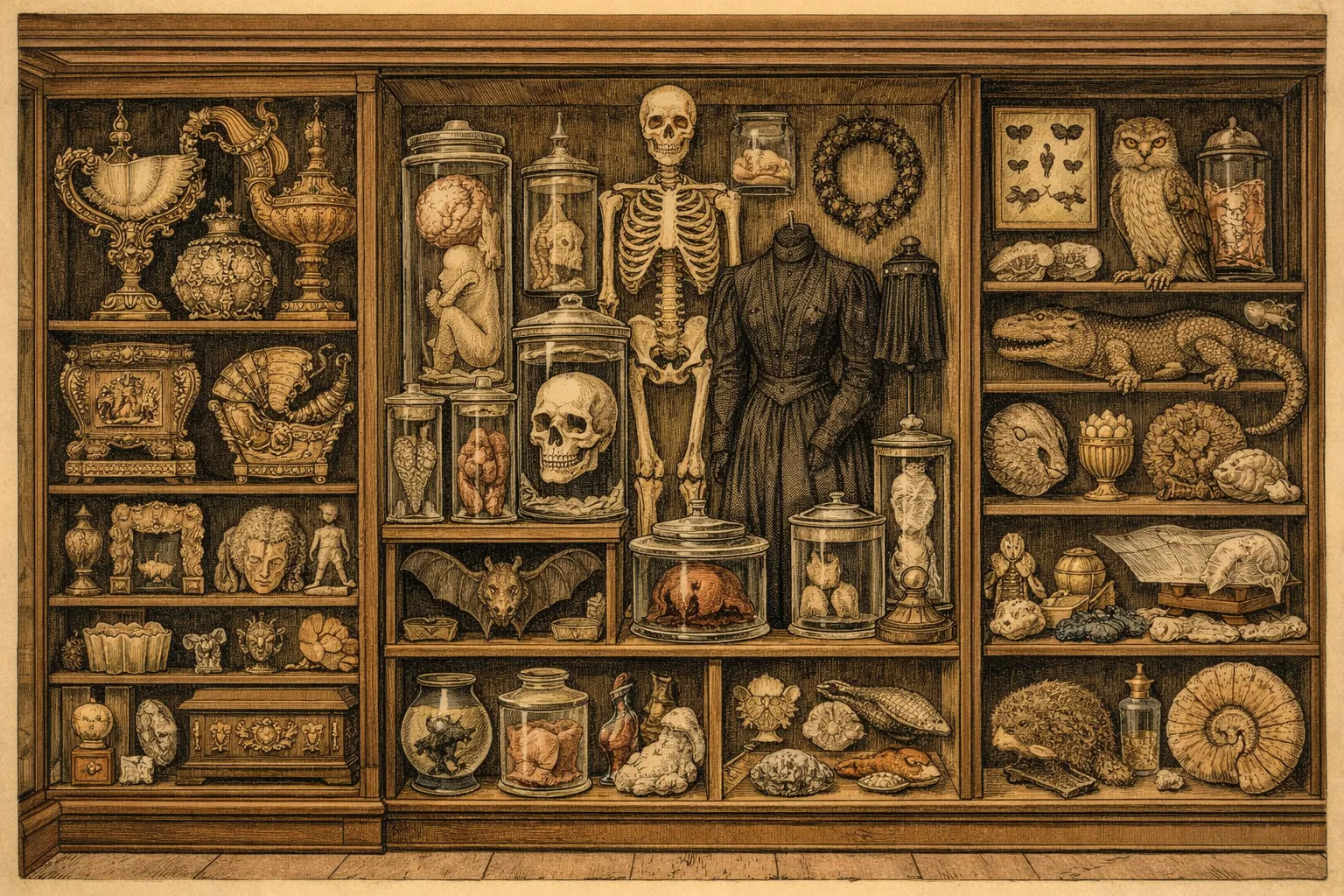
Germany’s unusual collections grow out of several overlapping traditions. The first is the princely or scholarly cabinet of curiosities: a room in which natural specimens, artworks, mechanical devices, religious objects and material from distant cultures were arranged as a miniature version of the known world. These collections did not separate art, science and wonder as firmly as modern museums do. Germany’s surviving examples therefore offer more than eccentric objects; they show how Europeans once organised knowledge at the border between observation, belief and spectacle.[rct.uk]rct.ukRoyal Collection TrustWunderkammer: Cabinet of CuriositiesWunderkammer is literally translated from German as a 'room of wonder'. In Engl…
A second tradition is the regional history museum housed in a castle, prison or former institution. In these settings, witch trials, punishment, burial and medicine are tied to actual places and documentary records. The result can be much more serious than the “torture museum” advertising sometimes suggests. Germany also has a strong tradition of academically connected medical and scientific collections, where human specimens are interpreted as evidence rather than merely displayed as shocks.[germany.travel]germany.travelMedieval Crime Museum RothenburgThe Medieval Crime Museum in Rothenburg ob der Tauber is a German legal museum offering an insight into t…
Finally, there is a lively private and commercial fringe. Berlin in particular contains small museums built around one collector’s imagination, immersive entertainment or deliberately unsettling sensory experiences. These attractions may be less historically rigorous, but they matter because they preserve the older cabinet-of-curiosities principle: the visitor is invited to stare, guess, doubt and construct connections.
The strongest places for historic curiosity culture
Halle’s surviving cabinet of curiosities
The Cabinet of Artefacts and Natural Curiosities at the Francke Foundations in Halle is arguably Germany’s most important destination for understanding where strange museums came from. It occupies its historic setting in the former dormitory of an eighteenth-century orphanage and retains more than 3,000 objects, its original fitted cabinets, painted decoration and a presentation reconstructed from historic catalogues. The foundations describe it as Germany’s only completely preserved Baroque cabinet of curiosities.[Franckesche Stiftungen]francke-halle.deThomas Müller-Bahlke, who as archivist rediscovered the Wunderkammer in the ruined buildings of the Francke Foundations between 1992 and…
Visitors encounter shells, preserved animals, rocks, artworks, ethnographic material and miscellaneous objects that resist modern categories. Their arrangement reflects an age when creation, science, craft and global exploration could be presented as parts of one connected system. The collection is unusual not because every item is inherently macabre, but because the entire room preserves an extinct way of seeing.
It is also not an innocent time capsule. Some objects reached Halle through missionary and colonial networks, including material from India and Borneo. Current research examines their provenance and the unequal relationships behind their movement. That makes the cabinet valuable on two levels: it preserves the wonder of early collecting while allowing modern visitors to question who collected, who classified and who was represented without control over the story.[francke-halle.de]francke-halle.deFranckesche Stiftungen Global PerspectivesFranckesche Stiftungen Global Perspectives
Dresden’s courtly theatre of marvels
Dresden’s Green Vault is more famous as a treasury than as a strange museum, yet it belongs firmly within Germany’s curiosity tradition. Created as a spectacular court collection, it mixes jewellery, precious stones, carved natural materials, elaborate vessels and virtuoso mechanical or sculptural objects. The institution calls itself a Baroque total artwork and a deliberately staged realm of wonders rather than a neutral sequence of display cases.[Grünes Gewölbe]gruenes-gewoelbe.skd.museumOpen source on skd.museum.
Its most curious objects combine nature and manufacture: shells or coral transformed into fantastical vessels, miniature carvings, table ornaments and devices intended to demonstrate wealth, ingenuity and control over rare materials. The Historic Green Vault presents thousands of free-standing objects in reconstructed rooms, while the New Green Vault isolates individual masterpieces behind glass. This division allows visitors to compare two museum languages: immersive princely spectacle and modern object-by-object interpretation.[Grünes Gewölbe]gruenes-gewoelbe.skd.museumOpen source on skd.museum.
The Green Vault also demonstrates that curiosity collections remain contested and vulnerable rather than frozen in the past. Several jewels were stolen in the major 2019 robbery, later recovered and eventually returned to display, some with damage. That episode added a modern layer of crime, security and disputed value to a collection originally assembled to project dynastic power.[SKD]skd.museumTheft in the Jewel Room, Historic Green VaultTheft in the Jewel Room, Historic Green Vault
Death, bodies and the medical gaze
Germany’s medical and funerary museums are among its most distinctive unusual collections because they treat subjects often hidden from everyday life as matters of public culture.
The Museum of Sepulchral Culture in Kassel is dedicated to dying, death, burial, mourning and remembrance. Its holdings comprise roughly 25,000 objects, primarily connected with Western Christian traditions, ranging from the early Christian period to contemporary funeral culture. The permanent displays include coffins, funeral vehicles, mourning clothes, memorial objects, grave sculpture and folk-religious material.[Sepulkral Museum]sepulkralmuseum.deOpen source on sepulkralmuseum.de.
Although the premise sounds morbid, the museum is not primarily a horror attraction. Its purpose is to show how communities give death a visible form: through clothing, ceremonies, monuments, symbols and objects kept by the bereaved. That approach turns apparently gloomy material into evidence about family, class, faith, changing attitudes to the body and the gradual professionalisation of the funeral trade. Visitors looking for Gothic spectacle will find some visually striking material, but the lasting value lies in the museum’s humane treatment of loss and memory. The institution plans a major renovation from 2027, so access and gallery arrangements should be checked before travel.[Sepulkral Museum]sepulkralmuseum.deOpen source on sepulkralmuseum.de.
Berlin’s Museum of Medical History at the Charité takes a different route into the human body. It descends from the pathological museum established by physician Rudolf Virchow and now interprets around 300 years of medical history. Its central specimen hall contains approximately 700 preparations and models, placed alongside patient histories and discussions of medical discovery, failure and abuse.[BMM Charite]bmm-charite.deImage: Wachssiegel mit den Initialen von Albrecht von Graefe… During the comprehensive renovation of the Charité from 1896, the museum…
The credibility of the collection comes partly from its institutional setting: this is a university medical museum rather than a travelling anatomy show. Yet that status does not make the specimens uncomplicated. Modern interpretation must address consent, the historical treatment of patients and the danger of reducing people to diagnoses. The museum explicitly includes the “dark sides” and wrong turns of medicine, encouraging visitors to see pathological collections as products of particular systems of authority rather than as transparent scientific facts.[BMM Charite]bmm-charite.dePhoto: Architekturmuseum der TU Berlin, InvBMM CharitePermanent and Special Exhibition Horizontal | Tours and Education | bmm – Berliner Medizinhistorisches Museum der CharitéIn th…
Dresden’s German Hygiene Museum is less macabre but equally important to Germany’s history of exhibiting bodies. Founded in 1912, it is known for the Transparent Man, an anatomical figure that made internal organs visible to mass audiences. Today its permanent exhibition treats the body as both a biological organism and a social experience, covering subjects such as the senses, thought, movement, nutrition, sexuality, illness and emotion.[Website Deutsch]dhmd.deOpen source on dhmd.de.
The museum’s name can mislead first-time visitors. It is not a collection of soap, bathrooms or public-health posters, although hygiene education forms part of its history. It is closer to a museum of what it means to inhabit a human body, using interactive displays alongside historic objects. Its unusualness lies in the scale and directness with which it makes private bodily experience public.
The Plastinarium: anatomy and production in one place
The Plastinarium in Guben occupies a more controversial position. It is the public exhibition gallery of Gubener Plastinate GmbH, the company associated with the plastination of human and animal bodies. Visitors see completed anatomical specimens, early experiments in the technique and examples connected with the Body Worlds exhibitions. They can also learn how water and fat are replaced with polymers to preserve tissue in a dry, durable form.[Plastinarium in Guben]plastinarium.dein Guben Visitin Guben Visit
What makes Guben different from a conventional anatomy museum is the overlap between exhibition, commercial production and technical demonstration. It is not simply an inherited university collection; it is a visitor-facing presentation connected to an operating specimen business. That proximity can be fascinating, but it also sharpens familiar questions about consent, dignity, ownership and the line between education and spectacle. The institution presents plastination as an anatomical teaching technology, while individual visitors may experience the posed bodies as scientific, artistic, unsettling or all three at once.
Witch trials without the fantasy costume
Germany does not have one dominant national museum of witchcraft comparable to a large specialist collection devoted to modern magical practice. Its strongest witch-related displays instead concentrate on persecution, law and regional history. That distinction matters: most interpret the people accused of witchcraft as victims of judicial and social systems, not as proven practitioners of supernatural power.
The Medieval Crime Museum in Rothenburg ob der Tauber is the most substantial example. Its collection of around 50,000 objects and documents covers approximately a millennium of German and European legal history. Witch-trial records appear beside executioners’ swords, punishment devices, legal books and shame masks designed to expose alleged misconduct to public ridicule.[rothenburg.de]rothenburg.deob der Tauber Rothenburg's Medieval Crime Museumedieval Crime Museumob der Tauber Rothenburg's Medieval Crime Museumedieval Crime Museum
The museum is valuable because it increasingly distinguishes documented punishment from later fantasy. Its displays and online material explicitly ask whether familiar images such as masked executioners and iron maidens are historical realities or “legal fantasies”. The celebrated iron maiden is not reliable evidence for routine medieval torture: the Nuremberg model behind the legend was a nineteenth-century construction arising from a misinterpretation of an older punishment garment.[rothenburg.de]rothenburg.deOpen source on rothenburg.de.
This self-correction is important. European torture attractions have often displayed reproductions or dubious devices without explaining their provenance, allowing Victorian inventions to become accepted as medieval fact. Rothenburg still offers the theatrical objects many visitors expect, but its strongest interpretation uses that expectation as a lesson in how historical myths are manufactured.
Penzlin Castle in Mecklenburg-Western Pomerania provides a more site-specific experience. Women accused of witchcraft were held in cramped subterranean cells there, and displays connect the surviving spaces with instruments, stocks and records relating to witchcraft and heresy proceedings. The castle is most meaningful when approached as a place of confinement and persecution rather than as a celebration of witches as folkloric characters.[Come to Germany]cometogermany.comCome to Germany Religious MuseumsCome to Germany Religious Museums
The broader German landscape also includes local towers, castle rooms, archives and temporary exhibitions associated with particular trials. Their quality varies. The most credible displays rely on court documents, local records and social history; weaker ones lean on generic torture replicas, devil imagery and theatrical decoration that may have little connection with the site.

Crime, punishment and the danger of “torture museum” history
Germany’s former prisons, bunkers and police sites form a large field, but not every dark heritage attraction belongs in a survey of strange collections. The most relevant are those where unusual objects reveal how authority operated: shame masks, execution tools, improvised prison possessions, surveillance equipment or preserved institutional interiors.
Rothenburg remains the essential starting point because it explains punishment as a legal and social system. Its shame masks, for example, are memorable not only because they look grotesque but because they materialise the concept of public dishonour. A long tongue might signify gossip; animal features or exaggerated expressions could turn an offence into a visible identity. Such objects show punishment working through humiliation and community judgement rather than physical injury alone.[Rothenburg ob der Tauber]rothenburg.deob der Tauber Rothenburg's Medieval Crime Museumedieval Crime Museumob der Tauber Rothenburg's Medieval Crime Museumedieval Crime Museum
Visitors should nevertheless be cautious whenever an attraction uses “medieval torture” as a broad marketing category. Devices may be replicas, later inventions or genuine objects given sensational interpretations. A credible museum should identify dates and provenance, distinguish judicial punishment from interrogation, and acknowledge when an object’s supposed use is disputed. The strangeness is often greatest not in what medieval people actually did, but in how later centuries imagined medieval cruelty.
Berlin’s private cabinets and invented realities
Berlin offers Germany’s densest concentration of small, eccentric museums. These places are not all scholarly in the conventional sense; several are closer to installations, personal archives or games of interpretation.
The Museum of Unheard-of Things is a tiny collection of overlooked artistic, technical and scientific objects accompanied by stories that may be invented, exaggerated or impossible. Objects are arranged according to weight, but classification is less important than narrative. The visitor’s task is not simply to decide whether each account is true. It is to notice how labels, display cases and a curator’s voice can give authority to almost anything.[museumsportal-berlin.de]museumsportal-berlin.demuseum der unerhoerten dingemuseum der unerhoerten dinge
This makes it one of Germany’s most effective museums of uncertain knowledge. It resembles a cabinet of curiosities while quietly parodying the expectation that museums deliver objective explanations. The collection is publicly accessible but operates on limited hours, so it requires more planning than a mainstream institution.
Designpanoptikum, the Surreal Museum of Industrial Objects, begins with real rather than invented artefacts. Its thousands of obsolete machines, medical devices, prostheses, lamps and unidentified metal structures are arranged to make ordinary technology appear threatening or alien. Items include an iron lung, an aircraft ejector seat and equipment associated with operating rooms or dissection.[Berlin.de]berlin.deDesign PanoptikumDesign Panoptikum
Labels are deliberately limited because guessing is central to the experience. Removed from the factory, laboratory or hospital, a practical machine can resemble a torture device or a prop from a dystopian film. The museum therefore exposes a useful truth about all curiosity displays: presentation changes what an object seems to be. It is privately shaped and highly theatrical, but the underlying artefacts are genuine remnants of technological history.
Berlin’s Magicum is more openly commercial. Spread through a basement exhibition, it presents objects and interactive experiences connected with magic, esoteric traditions and ritual practices. Its appeal is participatory rather than archival: visitors encounter symbols, illusions and activities designed to evoke mystery across cultures.[Berlin.de]berlin.deOpen source on berlin.de.
It should not be mistaken for a specialist historical archive of German witchcraft or ceremonial magic. Its strength is atmospheric introduction and entertainment, not the documentary reconstruction of a single belief system. That difference does not make it worthless, but it changes the standard by which it should be judged.
The Disgusting Food Museum uses smell, taste and bodily reaction as its organising principle. Its Berlin exhibition presents foods regarded as repellent by particular audiences, including fermented, strongly scented or culturally unfamiliar products. The premise is commercial and provocative, yet the underlying argument is sound: disgust is learned, culturally variable and often directed at other people’s normal food.[Berlin.de]berlin.de6503546 3104050 disgusting food museum.en6503546 3104050 disgusting food museum.en
At its best, the museum turns a novelty challenge into a lesson about cultural bias. At its weakest, it risks reproducing that bias by presenting other societies’ foods as spectacles. Much depends on whether visitors engage with the explanations or simply photograph the most extreme-looking samples.
Lies, hoaxes and objects that refuse to behave
The Museum of Lies in Radebeul occupies the uncertain territory between museum, kinetic art installation and private fantasy environment. Created around the work of artist Reinhard Zabka, it fills an old building with absurd collages, mechanical constructions, invented relics and knowingly unreliable stories. Reported exhibits have included a flying carpet, improbable celebrity possessions, puppets and rattling or flashing assemblages.[Visit Dresden Elbland]visit-dresden-elbland.deOpen source on visit-dresden-elbland.de.
The title is not a claim that the museum exposes political deception or historic forgery. Rather, lying is used as an artistic method. Museum conventions give nonsense an appearance of authority, while handmade objects undermine the seriousness of the institution around them. It belongs to the same family as Berlin’s Museum of Unheard-of Things, although it is more chaotic and overtly theatrical.
Its practical status has been less straightforward than that of Germany’s major institutions. Visitor listings reported a temporary closure beginning in September 2024, while regional tourism pages continued to carry contact details and promote the attraction. Anyone planning a journey specifically for it should therefore confirm that it has reopened and is admitting visitors rather than relying on older travel articles.[Tripadvisor]tripadvisor.comOpen source on tripadvisor.com.
This uncertainty illustrates a wider feature of private oddity museums. They may depend heavily on one collector, artist or building and can close, relocate or alter hours with little notice. Their fragility is part of their charm, but also a reason to distinguish established public institutions from personal collections.
What Germany does not strongly offer
Germany has abundant folklore, legends and reported anomalous phenomena, but there is no clearly established, nationally significant public museum devoted primarily to German cryptids or UFO evidence. Searches for such attractions often lead to temporary exhibitions, research groups, art projects or museums elsewhere. Readers should be wary of recycled travel lists that attach the words “UFO museum” or “cryptozoology museum” to a place without confirming a permanent public collection.
This absence is revealing. German strange-museum culture is much stronger in documented witch persecution, legal history, medicine, death, collecting and artistic fabrication than in institutions presenting extraterrestrials or unknown animals as unresolved evidence. Fortean interests exist, but they are more commonly preserved in private archives, clubs, popular media and temporary displays than in stable museums.
The same caution applies to occult collections. Magicum offers a visitor experience around magical traditions, and several historic museums interpret superstition or witch trials, but Germany’s most credible institutions generally separate belief from proof. They document what people feared, practised, prosecuted or collected rather than claiming that supernatural events occurred as described.
Choosing the right strange museum
Germany’s unusual collections vary sharply in purpose, and visitors will get more from them by knowing what kind of institution they are entering.
- For an authentic historic cabinet: choose the Francke Foundations in Halle. It preserves the room, furniture and organising logic of an eighteenth-century collection.
- For courtly marvels and precious curiosities: visit Dresden’s Green Vault, where unusual natural materials and extraordinary craftsmanship were used to stage princely power.
- For death and mourning without sensationalism: the Museum of Sepulchral Culture in Kassel offers the most focused and thoughtful collection.
- For medical specimens with institutional history: the Charité museum in Berlin provides the strongest scholarly setting.
- For public engagement with the body: Dresden’s Hygiene Museum is more interactive and less graphic, while the Plastinarium is more direct, commercial and ethically contentious.
- For witch-trial and punishment history: Rothenburg’s Medieval Crime Museum has the greatest depth, while Penzlin Castle offers a more intimate connection to an actual place of confinement.
- For private eccentricity: Berlin’s Museum of Unheard-of Things and Designpanoptikum foreground storytelling, ambiguity and the personality of the collector.
- For sensory entertainment: Magicum and the Disgusting Food Museum are visitor-led experiences rather than traditional research museums.
Practical information deserves special attention. Small private museums may open only on selected days, and even major institutions can require timed tickets or close galleries for renovation. Historic buildings may also have accessibility restrictions. Official museum pages should be checked shortly before a visit, particularly for the Museum of Lies, limited-hours Berlin collections and the planned redevelopment of Kassel’s Museum of Sepulchral Culture.
Why these collections matter
Germany’s strange museums preserve more than eccentric things. They preserve changing methods of deciding what counts as knowledge. The cabinet in Halle presents nature, religion, global contact and craft as one universal system. The Green Vault turns rarity into political theatre. Medical museums reveal how the human body became an object of study, display and institutional power. Witch-trial and crime collections show fear being converted into law. Private Berlin museums demonstrate how easily arrangement and storytelling can transform discarded machinery or anonymous fragments into mysteries.
The best institutions also challenge the visitor’s first reaction. A torture device may be a nineteenth-century fantasy rather than a medieval original. A pathological specimen may carry a patient history and an ethical burden. A “disgusting” meal may be ordinary elsewhere. An exotic object in an old cabinet may be inseparable from missionary or colonial networks. A confidently written museum label may be fictional.
That habit of doubt is the unifying feature of Germany’s curiosity culture. Its strongest strange museums do not merely ask visitors to marvel at the abnormal. They ask who defined it as abnormal, how the object entered the collection, what story has been attached to it and whether that story deserves to be believed.
Amazon book picks
Further Reading
Books and field guides related to Why Germany's Strangest Museums Feel So Serious. Use these as the next step if you want deeper reading beyond the article.
Baltic Homes
Extraordinary seascapes, a rigorous climate, a fascinating amalgamation of cultures, endless summer days and long winter nights - these a...

The Book of Miracles
First published 1900. Subjects: Art, renaissance, Art, german, Illumination of books and manuscripts, History of Biblical events, Illustr...
eBay marketplace picks
Marketplace Samples
Live-tested eBay searches with available results related to this page.
Selected fromGermany travel poster oneBay.co.uk.
Current eBay listing
Berlin Germany Travel Poster Wall Art Print Framed Unframed
Current eBay listing
Berlin Germany Travel Poster Wall Art Print Framed Unframed
Endnotes
1.
Source: germany.travel
Link:https://www.germany.travel/en/cities-culture/medieval-crime-museum-rothenburg.html
Source snippet
Medieval Crime Museum RothenburgThe Medieval Crime Museum in Rothenburg ob der Tauber is a German legal museum offering an insight into t...
2.
Source: bmm-charite.de
Link:https://bmm-charite.de/en/museum
Source snippet
Image: Wachssiegel mit den Initialen von Albrecht von Graefe... During the comprehensive renovation of the Charité from 1896, the museum...
3.
Source: bmm-charite.de
Title: Photo: Architekturmuseum der TU Berlin, Inv
Link:https://bmm-charite.de/en/tours-and-education/permanent-and-special-exhibition-horizontal
Source snippet
BMM CharitePermanent and Special Exhibition Horizontal | Tours and Education | bmm – Berliner Medizinhistorisches Museum der CharitéIn th...
4.
Source: gruenes-gewoelbe.skd.museum
Link:https://gruenes-gewoelbe.skd.museum/en/ueber-uns/
5.
Source: gruenes-gewoelbe.skd.museum
Link:https://gruenes-gewoelbe.skd.museum/en/ausstellungen/historisches-gruenes-gewoelbe/
6.
Source: shop.skd.museum
Title: Museum Shop Online-Shop of the Staatlichen Kunstsammlungen Dresden
Link:https://shop.skd.museum/blaue-stunde-grunes-gewolbe.html
7.
Source: skd.museum
Title: Theft in the Jewel Room, Historic Green Vault
Link:https://www.skd.museum/en/besucherservice/press/2019/theft-in-the-jewel-room-historic-green-vault/
8.
Source: skd.museum
Link:https://www.skd.museum/en/besucherservice/presse/2023/green-vault-jewels-will-not-be-exhibited-until-court-case-ends/
9.
Source: visit.kassel.de
Title: Visit Kassel Museum for Sepulchral Culture
Link:https://visit.kassel.de/en/poi/museum-of-sepulchral-culture
10.
Source: bmm-charite.de
Link:https://bmm-charite.de/en/tours-and-education/offers-for-adults-and-students/guided-tour-museum-permanent-exhibition-tracing-life
11.
Source: bmm-charite.de
Link:https://bmm-charite.de/en/tours-and-education/permanent-and-special-exhibition-slime
12.
Source: germany.travel
Link:https://www.germany.travel/en/cities-culture/german-hygiene-museum.html
13.
Source: plastinarium.de
Title: in Guben Visit
Link:https://www.plastinarium.de/en/visit/
14.
Source: plastinarium.de
Title: in Guben FAQ Archiv
Link:https://www.plastinarium.de/faq/
15.
Source: plastinarium.de
Title: in Guben Tour
Link:https://www.plastinarium.de/en/tour/
16.
Source: rothenburg.de
Title: ob der Tauber Rothenburg’s Medieval Crime Museumedieval Crime Museum
Link:https://www.rothenburg.de/en/entdecken/top-10/kriminalmuseum
17.
Source: rothenburg.de
Link:https://www.rothenburg.de/en/entdecken/museen/mittelalterliches-kriminalmuseum
18.
Source: european-traveler.com
Link:https://www.european-traveler.com/germany/visit-the-medieval-crime-or-torture-museum-in-rothenburg-ob-der-tauber/
19.
Source: museumsportal-berlin.de
Title: museum der unerhoerten dinge
Link:https://www.museumsportal-berlin.de/en/museums/museum-der-unerhoerten-dinge/
20.
Source: berlin.de
Link:https://www.berlin.de/en/museums/3108809-3104050-museum-der-unerhoerten-dinge.en.html
21.
Source: berlin.de
Title: Design Panoptikum
Link:https://www.berlin.de/en/museums/6503719-3104050-designpanoptikum-surreal-museum-for-indu.en.html
22.
Source: berlin.de
Link:https://www.berlin.de/en/museums/3748987-3104050-magicum-berlin-magic-museum.en.html
23.
Source: berlin.de
Title: 6503546 3104050 disgusting food museum.en
Link:https://www.berlin.de/en/museums/6503546-3104050-disgusting-food-museum.en.html
24.
Source: visit-dresden-elbland.de
Link:https://www.visit-dresden-elbland.de/en/poi/luegenmuseum-radebeul
25.
Source: tripadvisor.com
Link:https://www.tripadvisor.com/Attraction_Review-g679037-d5961280-Reviews-Lugenmuseum-Radebeul_Saxony.html
26.
Source: bmm-charite.de
Title: wir waren nie nur menschen
Link:https://bmm-charite.de/en/exhibitions/wir-waren-nie-nur-menschen
27.
Source: bmm-charite.de
Title: ausstellungseroeffnung horizontal
Link:https://bmm-charite.de/en/exhibitions/ausstellungseroeffnung-horizontal
28.
Source: bmm-charite.de
Link:https://bmm-charite.de/en/exhibitions/horizontal
29.
Source: bmm-charite.de
Link:https://bmm-charite.de/en/exhibitions/ausstellungseroeffnung
30.
Source: bmm-charite.de
Link:https://bmm-charite.de/en/visit
31.
Source: bmm-charite.de
Link:https://bmm-charite.de/en
32.
Source: bmm-charite.de
Link:https://bmm-charite.de/besuchen
33.
Source: bmm-charite.de
Link:https://bmm-charite.de/en/museum/lecture-hall-ruin
34.
Source: skd.museum
Link:https://www.skd.museum/en/about-us/
35.
Source: gruenes-gewoelbe.skd.museum
Link:https://gruenes-gewoelbe.skd.museum/en/exhibitions/new-green-vault/the-green-diamond-in-the-neues-gruenes-gewoelbe/
36.
Source: skd.museum
Link:https://www.skd.museum/en/
37.
Source: skd.museum
Link:https://www.skd.museum/en/visit/
38.
Source: gruenes-gewoelbe.skd.museum
Link:https://gruenes-gewoelbe.skd.museum/en/
39.
Source: skd.museum
Link:https://www.skd.museum/en/visit/royal-palace/
40.
Source: guide.skd.museum
Title: museum| SKD
Link:https://guide.skd.museum/en/Tour/Overview?id=2215
41.
Source: tripadvisor.com
Title: Mittelalterliches Foltermuseum
Link:https://www.tripadvisor.com/Attraction_Review-g187345-d4378150-Reviews-Mittelalterliches_Foltermuseum-Ruedesheim_am_Rhein_Hesse.html
42.
Source: tripadvisor.com
Title: Deutsches Hygiene-Museum Dresden
Link:https://www.tripadvisor.com/Attraction_Review-g187399-d519895-Reviews-Deutsches_Hygiene_Museum_Dresden-Dresden_Saxony.html
43.
Source: tripadvisor.com
Title: Attractions g9712457 Activities Penzlin Mecklenburg West Pomerania
Link:https://www.tripadvisor.com/Attractions-g9712457-Activities-Penzlin_Mecklenburg_West_Pomerania.html
44.
Source: germany.travel
Link:https://www.germany.travel/en/home.html
45.
Source: museum.ky
Title: from conquest to care rethinking the cabinet of curiosities
Link:https://www.museum.ky/post/from-conquest-to-care-rethinking-the-cabinet-of-curiosities
46.
Source: radebeul.de
Title: Museum of Lies closes on 31 August 2024
Link:https://www.radebeul.de/en/Town-hall/Latest-news/Latest-news/Archive-2024/Museum-of-Lies-closes-on-31-August-2024
Published: August 2024
47.
Source: plastinarium.de
Link:https://www.plastinarium.de/besuch/
48.
Source: plastinarium.de
Link:https://www.plastinarium.de/events/
49.
Source: plastinarium.de
Title: FA Q Archiv
Link:https://www.plastinarium.de/en/faq/
50.
Source: plastinarium.de
Title: Körperwelten Plastinarium
Link:https://www.plastinarium.de/en/plastinarium/
51.
Source: plastinarium.de
Title: FA Q Archiv
Link:https://www.plastinarium.de/pl/faq/
52.
Source: plastinarium.de
Link:https://www.plastinarium.de/pl/wizyta/
53.
Source: plastinarium.de
Title: PLANNIN G YOUR VISIT Archive
Link:https://www.plastinarium.de/en/thema/besuch-en/
54.
Source: plastinarium.de
Link:https://www.plastinarium.de/en/career/
55.
Source: plastinarium.de
Title: DEVELOPMEN T OF PLASTINATION
Link:https://www.plastinarium.de/en/plastination-guben/development/
56.
Source: rct.uk
Link:https://www.rct.uk/collection/stories/wunderkammer-cabinet-of-curiosities
Source snippet
Royal Collection TrustWunderkammer: Cabinet of CuriositiesWunderkammer is literally translated from German as a 'room of wonder'. In Engl...
57.
Source: moma.org
Link:https://www.moma.org/calendar/exhibitions/272
Source snippet
The Museum of Modern ArtWunderkammer: A Century of Curiosities10 Nov 2008 — Wunderkammern, or cabinets of curiosities, arose in mid-sixte...
58.
Source: wissenschaft.francke-halle.de
Link:https://wissenschaft.francke-halle.de/en/research-centre/projects/research-on-the-cabinet-of-artefacts
Source snippet
The Cabinet of Artefacts and Natural Curiosities of the Francke Foundations in Halle occupies a prominent place in the history of museums...
59.
Source: francke-halle.de
Link:https://www.francke-halle.de/en/exhibitions/detail/cabinet-of-artefacts-and-natural-curiosities-6
Source snippet
Thomas Müller-Bahlke, who as archivist rediscovered the Wunderkammer in the ruined buildings of the Francke Foundations between 1992 and...
60.
Source: wunderkammer.francke-halle.de
Link:https://wunderkammer.francke-halle.de/en/
61.
Source: francke-halle.de
Title: Franckesche Stiftungen Global Perspectives
Link:https://www.francke-halle.de/en/exhibition/global-perspectives-2025
62.
Source: wissenschaft.francke-halle.de
Link:https://wissenschaft.francke-halle.de/en/research-centre/projects/colonial-art-and-cultural-assets
63.
Source: wissenschaft.francke-halle.de
Link:https://wissenschaft.francke-halle.de/en/borneo
64.
Source: sepulkralmuseum.de
Link:https://www.sepulkralmuseum.de/en/
65.
Source: sepulkralmuseum.de
Link:https://www.sepulkralmuseum.de/en/dauerpraesentation/
66.
Source: dhmd.de
Link:https://www.dhmd.de/en/exhibitions/human-adventure
67.
Source: dhmd.de
Link:https://www.dhmd.de/en/
68.
Source: kriminalmuseum.eu
Link:https://www.kriminalmuseum.eu/en/
69.
Source: kriminalmuseum.eu
Link:https://www.kriminalmuseum.eu/en/blog/projekt/mythos-oder-wahrheit-rechtsfantasien/
70.
Source: cometogermany.com
Title: Come to Germany Religious Museums
Link:https://cometogermany.com/ENU/culture_and_events/religious_museums_witches/
71.
Source: dictionary.cambridge.org
Link:https://dictionary.cambridge.org/dictionary/english/official
72.
Source: francke-halle.de
Link:https://www.francke-halle.de/en/exhibitions/detail/the-reference-library-of-the-cabinet-of-artefacts-and-natural-curiosities-21
73.
Source: francke-halle.de
Link:https://www.francke-halle.de/en/calendar
74.
Source: francke-halle.de
Title: At a glance
Link:https://www.francke-halle.de/en/culture/at-a-glance
75.
Source: kultur.francke-halle.de
Link:https://kultur.francke-halle.de/en/exhibitions/exhibition/300-years-of-curiosity-hidden-knowledge-from-the-cabinet-of-artefacts-and-natural-curiosities
76.
Source: wunderkammer.francke-halle.de
Link:https://wunderkammer.francke-halle.de/en/kapitel/artefakte
77.
Source: francke-halle.de
Title: Research and Cooperations
Link:https://www.francke-halle.de/en/science/research-centre/research-and-cooperations
78.
Source: Wikipedia
Link:https://en.wikipedia.org/wiki/Germany
79.
Source: Wikipedia
Title: Cabinet of curiosities
Link:https://en.wikipedia.org/wiki/Cabinet_of_curiosities
80.
Source: Wikipedia
Link:https://en.wikipedia.org/wiki/Official
81.
Source: Wikipedia
Title: German Hygiene Museum
Link:https://en.wikipedia.org/wiki/German_Hygiene_Museum
82.
Source: Wikipedia
Link:https://en.wikipedia.org/wiki/Penzlin
83.
Source: Wikipedia
Link:https://en.wikipedia.org/wiki/Designpanoptikum
84.
Source: Wikipedia
Link:https://lld.wikipedia.org/wiki/Penzlin
85.
Source: tripadvisor.co.uk
Title: MUSEU M OF WITCHCRAFT SWITZERLAND
Link:https://www.tripadvisor.co.uk/Attraction_Review-g4345127-d14110152-Reviews-Museum_of_Witchcraft_Switzerland-Granichen_Canton_of_Aargau.html
86.
Source: tripadvisor.co.uk
Title: MUSEU M OF UNHEARD OF THINGS
Link:https://www.tripadvisor.co.uk/Attraction_Review-g187323-d2460164-Reviews-Museum_of_Unheard_of_Things-Berlin.html
87.
Source: tripadvisor.co.uk
Title: DISGUSTIN G FOOD MUSEUM BERLIN
Link:https://www.tripadvisor.co.uk/Attraction_Review-g187323-d23436067-Reviews-Disgusting_Food_Museum_Berlin-Berlin.html
88.
Source: tripadvisor.co.uk
Title: DESIGNPANOPTIKU M
Link:https://www.tripadvisor.co.uk/Attraction_Review-g187323-d3618456-Reviews-Designpanoptikum-Berlin.html
89.
Source: tripadvisor.co.uk
Title: Explore Penzlin
Link:https://www.tripadvisor.co.uk/Tourism-g9712457-Penzlin_Mecklenburg_West_Pomerania-Vacations.html
90.
Source: atlasobscura.com
Title: medieval crime museum
Link:https://www.atlasobscura.com/places/medieval-crime-museum
91.
Source: atlasobscura.com
Title: museum of sepulchral culture
Link:https://www.atlasobscura.com/places/museum-of-sepulchral-culture
92.
Source: GOV.UK
Link:https://www.gov.uk/foreign-travel-advice/germany
93.
Source: disgustingfoodmuseum.com
Title: Disgusting Food Museum
Link:https://disgustingfoodmuseum.com/
94.
Source: visitacity.com
Link:https://www.visitacity.com/en/kassel/attractions/museum-of-sepulchral-culture
95.
Source: vocabulary.com
Link:https://www.vocabulary.com/dictionary/official
96.
Source: sepulkralmuseum.de
Link:https://www.sepulkralmuseum.de/en/museum-fuer-sepulkralkultur/
97.
Source: jademellor.com
Link:https://www.jademellor.com/jadesjournal/2013/9/10/designpanoptikum-surreales-museum-fr-industrielle-objekte
Additional References
98.
Source: youtube.com
Title: Untold Art Stories From Germany’s Dark Era
Link:https://www.youtube.com/watch?v=YRVqBh0Qf8Y
Source snippet
By your side – whenever you need us. – The new Charité brand film...
99.
Source: atlasobscura.com
Link:https://www.atlasobscura.com/things-to-do/germany/collections
100.
Source: onetravel.com
Link:https://www.onetravel.com/going-places/quirky-international-museums-you-should-visit/
101.
Source: myguideberlin.com
Link:https://www.myguideberlin.com/things-to-do/museums/adventure-trip-to-the-designpanoptikum-surreal-museum-of-industrial-objects
102.
Source: facebook.com
Link:https://www.facebook.com/Antvmnos/posts/bestiary-or-museum-of-cryptozoology-a-great-place-for-anyone-interested-in-mytho/540376844294006/
103.
Source: visitsaxony.com
Link:https://visitsaxony.com/poi/deutsches-hygiene-museum-dresden-the-human-adventure
104.
Source: disgustingfoodmuseum.berlin
Link:https://disgustingfoodmuseum.berlin/media/2025/07/Pressemappe-Englisch2025.pdf?srsltid=AfmBOopuKoyk_IKQSpEP_ODhO348raiufee02C_cd_5bpo7ONm2zRgHx
105.
Source: museumforall.eu
Link:https://museumforall.eu/museum/dresden-german-hygiene-museum/
106.
Source: kulturgutverluste.de
Link:https://kulturgutverluste.de/en
107.
Source: reddit.com
Link:https://www.reddit.com/r/AskAGerman/comments/lqqetd/german_cryptidsalien_sightings/