Within Jordan Curiosities
The Ancient Faces That Changed Prehistory
The Ain Ghazal statues reveal how early communities created striking human figures whose purpose still invites debate.
On this page
- The discovery of the Ain Ghazal figures
- Why the statues remain mysterious
- How visitors encounter prehistoric Jordan
Page outline Jump by section
Introduction
The Ain Ghazal statues are among Jordan’s most extraordinary prehistoric discoveries: human figures made nearly 9,000 years ago, long before the pyramids, classical sculpture, or written history. Created by Neolithic communities near modern Amman, these fragile lime-plaster figures are some of the earliest known large-scale human representations and remain fascinating because archaeologists can study how they were made but cannot say with certainty what they meant.[museums.visitjordan.com]museums.visitjordan.comThe Jordan MuseumThe Jordan Museum
Today, the statues are among the most unusual objects in Jordan’s heritage collections. Their strange, almost modern faces, oversized eyes and occasional double-headed forms make them feel surprisingly familiar yet deeply distant. They are not mysterious because they are fake or unexplained artefacts; their importance comes from a genuine archaeological puzzle: what kind of society created such ambitious images, and why were they carefully buried after being made?[mci.si.edu]mci.si.eduAin Ghazal Statues | Museum Conservation InstituteAin Ghazal Statues | Museum Conservation Institute
The discovery of the Ain Ghazal figures
A prehistoric village beneath modern Amman
The Ain Ghazal site was a large Neolithic settlement near Amman, occupied for more than two thousand years during a period when communities in the Levant were moving towards settled farming and village life. The site was first identified during road construction in the 1970s, with major archaeological discoveries following in the early 1980s.[Acor Jordan]acorjordan.orgAcor Jordan‘Ain GhazalAcor Jordan…
The most remarkable finds came from two underground caches discovered in 1983 and 1985. Archaeologists uncovered groups of lime-plaster statues and busts deliberately placed in pits. The finds included full human figures, smaller busts and unusual two-headed examples, creating one of the most important collections of prehistoric art ever found in the Near East.[mci.si.edu]mci.si.eduAin Ghazal Statues | Museum Conservation InstituteAin Ghazal Statues | Museum Conservation Institute
The discovery was especially significant because these were not simple decorative objects. The figures show a level of planning and craftsmanship that changed assumptions about early human creativity. They demonstrate that communities thousands of years before writing were already producing complex symbolic art on a large scale.[museums.visitjordan.com]museums.visitjordan.comThe Jordan MuseumThe Jordan Museum
How the statues were made
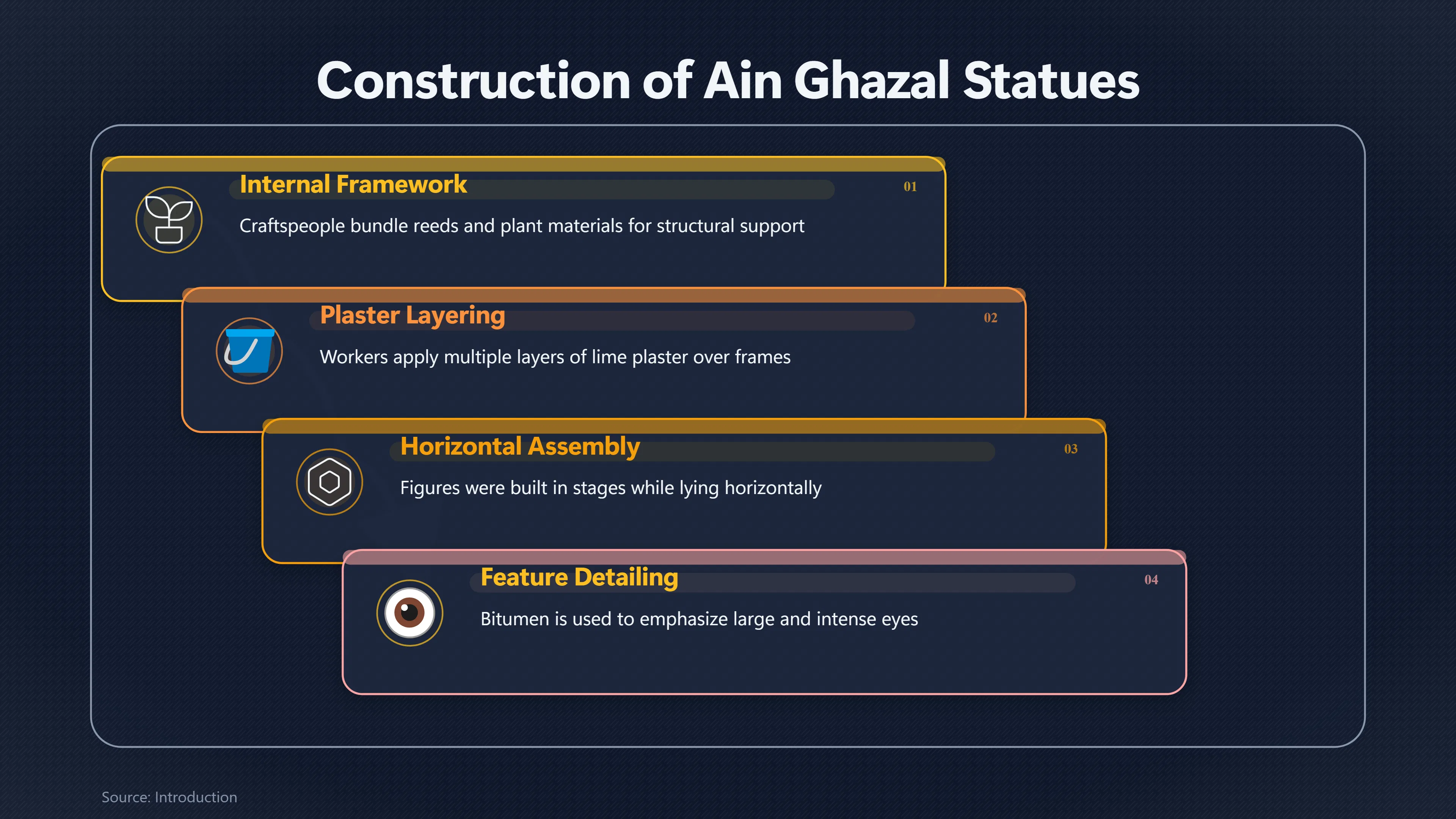
The Ain Ghazal figures were constructed from materials that seem simple but required considerable skill. Craftspeople created internal frameworks from bundles of reeds and other plant materials, then covered them with layers of lime plaster. Some features, especially the eyes, were carefully emphasised using materials such as bitumen, creating the intense expressions that make the figures memorable today.[Chicago Journals]journals.uchicago.eduOpen source on uchicago.edu.
The construction process also reveals practical choices. Researchers studying the statues found that many were built in stages while lying horizontally, with parts such as legs attached separately before the final plaster covering was applied. Their flattened bodies and delicate structure suggest they were not intended as permanent outdoor monuments but as carefully made symbolic objects.[Chicago Journals]journals.uchicago.eduOpen source on uchicago.edu.
Their survival is remarkable because lime plaster is fragile. Conservation teams had to treat the figures as highly vulnerable archaeological remains, with some blocks of material being carefully removed and transported for specialist conservation work before the statues could be displayed safely.[mci.si.edu]mci.si.eduAin Ghazal Statues | Museum Conservation InstituteAin Ghazal Statues | Museum Conservation Institute
Why the statues remain mysterious
The unanswered question: what were they for?
The greatest mystery of Ain Ghazal is not how the statues were created but why. Archaeologists have several possible explanations, but there is no single agreed answer.
One interpretation is that the figures had a ritual or symbolic role within Neolithic communities. Their careful burial suggests they may have had a special significance rather than being ordinary household objects. Some researchers have connected them with ideas about ancestors, identity or communal memory, although the evidence does not allow a precise reconstruction of the beliefs behind them.[mci.si.edu]mci.si.edu40221 | Museum Conservation Institute…
Another important clue is that the statues appear to have been intentionally placed underground rather than simply discarded. Their condition suggests they may have been buried soon after creation, possibly as part of a practice whose meaning was understood by the people who made them but is now lost.[Wikipedia]WikipediaAyn Ghazal statuesAyn Ghazal statues
This uncertainty is part of what makes the figures so compelling. Unlike later artworks with inscriptions, historical records or known religious contexts, the Ain Ghazal statues force modern viewers to interpret a world without written explanations.
Faces that look surprisingly modern
The visual impact of the statues is one reason they have become icons of prehistoric art. Their large open eyes, carefully shaped faces and upright human forms create an unusual sense of presence. They do not look like rough attempts at human representation; instead, they show deliberate choices about how people should be portrayed.
The figures also challenge the idea that sophisticated artistic traditions appeared only with later civilisations. Thousands of years before ancient Egypt’s monumental sculpture, Neolithic communities in Jordan were already experimenting with human images, materials and symbolic expression.[museums.visitjordan.com]museums.visitjordan.comThe Jordan MuseumThe Jordan Museum
At the same time, visitors should be cautious about modern interpretations. The statues are sometimes described in popular culture as mysterious “ancient faces” or compared with later religious imagery, but there is no firm evidence that they represented gods, kings or specific named individuals. Their meaning remains an archaeological question rather than a solved mystery.[mci.si.edu]mci.si.edu40221 | Museum Conservation Institute…
How visitors encounter prehistoric Jordan
Seeing Ain Ghazal in museums
For visitors interested in unusual collections in Jordan, the Ain Ghazal statues are among the clearest examples of archaeology becoming a curiosity display without relying on legend. They are genuine prehistoric objects whose strangeness comes from their age, appearance and unanswered purpose.
The figures are displayed through Jordan’s archaeological institutions, especially the The Jordan Museum, where they form part of a wider story of human history in the region. The museum presents the statues as among Jordan’s most important archaeological discoveries, alongside other major heritage objects.[museums.visitjordan.com]museums.visitjordan.comThe Jordan MuseumThe Jordan Museum
The Jordan Archaeological Museum at the Amman Citadel has also been closely associated with the display of the plaster figures and remains an important place for understanding Jordan’s archaeological collections.[museums.visitjordan.com]museums.visitjordan.comJordan Archaeological MuseumJordan Archaeological Museum
Some Ain Ghazal pieces have also travelled internationally through museum loans and exhibitions, allowing audiences outside Jordan to encounter one of humanity’s earliest large-scale artistic traditions. The Smithsonian Institution, for example, conserved and exhibited examples after a major conservation programme before their return to Jordanian collections.[mci.si.edu]mci.si.eduAin Ghazal Statues | Museum Conservation InstituteAin Ghazal Statues | Museum Conservation Institute
Why Ain Ghazal matters in Jordan’s strange-history landscape
The Ain Ghazal statues represent a different kind of mystery from legends, folklore creatures or disputed artefacts. Their fascination comes from the gap between what can be proven and what cannot be recovered. Archaeology can reveal their materials, age, construction and burial context, but the thoughts of the people who shaped those faces remain beyond reach.
That combination makes them especially powerful curiosities: real objects from the distant past that still invite questions. In Jordan’s landscape of unusual heritage, Ain Ghazal stands out because the mystery is not whether the figures existed, but what their makers wanted them to say.
Amazon book picks
Further Reading
Books and field guides related to The Ancient Faces That Changed Prehistory. Use these as the next step if you want deeper reading beyond the article.
The Dawn of Everything
THE NEW YORK TIMES BESTSELLER AND SUNDAY TIMES, OBSERVER AND BBC HISTORY BOOK OF THE YEAR FINALIST FOR THE ORWELL PRIZE FOR POLITICAL WRI...

The Human Past
First published 2005. Subjects: Social life and customs, Prehistoric peoples, Economic conditions, Human evolution, Hunting and gathering...
Prehistory: The Making of the Human Mind
A brief and original prehistory of the world Prehistory covers human existence before written records, i.e. most of human existence. But...
eBay marketplace picks
Marketplace Samples
Example marketplace items related to this page. Use the search link to explore similar finds on eBay.
Selected fromancient artifact replica oneBay.co.uk.

Endnotes
1.
Source: museums.visitjordan.com
Title: The Jordan Museum
Link:https://museums.visitjordan.com/en/Museum/5
2.
Source: mci.si.edu
Title: ‘Ain Ghazal Statues | Museum Conservation Institute
Link:https://mci.si.edu/ain-ghazal-statues
3.
Source: mci.si.edu
Link:https://mci.si.edu/node/1288243
Source snippet
40221 | Museum Conservation Institute...
4.
Source: Wikipedia
Title: Ayn Ghazal statues
Link:https://en.wikipedia.org/wiki/Ayn_Ghazal_statues
5.
Source: museums.visitjordan.com
Title: Jordan Archaeological Museum
Link:https://museums.visitjordan.com/en/Museum/15
6.
Source: si.edu
Title: Five Statues form Ain Ghazal, Jordan | Smithsonian Institution
Link:https://www.si.edu/object/yt_-WrNBuxRuyk
7.
Source: si.edu
Title: Five Statues from Ain Ghazal, Jordan | Smithsonian Institution
Link:https://www.si.edu/object/five-statues-ain-ghazal-jordan%3Ayt_ocKi8ZZ7dBw
8.
Source: mci.si.edu
Link:https://mci.si.edu/node/1226728
9.
Source: mci.si.edu
Link:https://mci.si.edu/node/1280713
10.
Source: si.edu
Link:https://www.si.edu/exhibitions/preserving-ancient-statues-jordan%3Aevent-exhib-3274
11.
Source: mci.si.edu
Link:https://mci.si.edu/node/1212121
12.
Source: si.edu
Link:https://www.si.edu/object/siris_sil_1078721
13.
Source: mci.si.edu
Link:https://mci.si.edu/node/1191967
14.
Source: mci.si.edu
Link:https://mci.si.edu/node/1299529
15.
Source: youtube.com
Link:https://www.youtube.com/watch?v=FscXHo7jXBI
Source snippet
'Ain Ghazal...
16.
Source: youtube.com
Title: ‘Ain Ghazal
Link:https://www.youtube.com/watch?v=aujaiAbq9sA
17.
Source: journals.uchicago.edu
Link:https://www.journals.uchicago.edu/doi/10.2307/506791
18.
Source: acorjordan.org
Title: Acor Jordan‘Ain Ghazal
Link:https://acorjordan.org/ain-ghazal/
Source snippet
Acor Jordan...
19.
Source: sites.utexas.edu
Title: ain ghazal
Link:https://sites.utexas.edu/dsb/ain-ghazal/
20.
Source: touristjordan.com
Title: The Jordan Museum | Tourist Jordan
Link:https://www.touristjordan.com/the-jordan-museum/
21.
Source: treccani.it
Title: Ain ghazal
Link:https://www.treccani.it/enciclopedia/ain-ghazal_%28Enciclopedia-dell%27-Arte-Antica%29/
Additional References
22.
Source: doa.gov.jo
Title: It was established by an Emiral Decree
Link:https://doa.gov.jo/default/en
Source snippet
Home Page - Department of AntiquitiesApril 5, 2026 — THE DEPARTMENT OF ANTIQUITIES The Department of Antiquities is one of the oldest gov...
Published: April 5, 2026
23.
Source: worldhistory.org
Title: World History Encyclopedia Lime Plaster Statue from Ain Ghazal
Link:https://www.worldhistory.org/image/8522/lime-plaster-statue-from-ain-ghazal/
Source snippet
World History EncyclopediaLime Plaster Statue from Ain Ghazal - World History Encyclopedia...
24.
Source: youtube.com
Link:https://www.youtube.com/watch?v=VzIWyRg_wyo
Source snippet
9,000-Year-Old Mystery: The Ain Ghazal Statues That Rewrote History...
25.
Source: collections.louvre.fr
Title: fr Statue d’Ain Ghazal
Link:https://collections.louvre.fr/ark%3A/53355/cl010149557
Source snippet
d'Ain Ghazal - Louvre site des collectionsMarch 17, 2026 — Image: Statue d'Ain Ghazal, image 1/6 Enlarge image in new window Image: Statu...
Published: March 17, 2026
26.
Source: youtube.com
Title: 9,000-Year-Old Mystery: The Ain Ghazal Statues That Rewrote History
Link:https://www.youtube.com/watch?v=bhdxDeAhJm4
Source snippet
Mysterious 9000-YEAR-OLD Prehistoric Statues of Ain Ghazal | Ancient Architects...
27.
Source: youtube.com
Title: Five Statues from Ain Ghazal, Jordan
Link:https://www.youtube.com/watch?v=ocKi8ZZ7dBw
Source snippet
Mystery of Ayn Ghazal Statues: Oldest & Most Comprehensive Artifacts Ever Found of Unknown Origins...
28.
Source: tandfonline.com
Link:https://www.tandfonline.com/doi/abs/10.1179/sic.1996.41.Supplement-1.70
29.
Source: thenationalnews.com
Link:https://www.thenationalnews.com/arts-culture/art-design/2023/09/30/google-doodle-ain-ghazal-jordan/
30.
Source: publication.doa.gov.jo
Link:https://publication.doa.gov.jo/Publications/ViewChapterPublic/2031
31.
Source: pswscience.org
Title: Preserving Ancient Statues from ‘Ain Ghazal, Jordan
Link:https://pswscience.org/meeting/preserving-ancient-statues-from-ain-ghazal-jordan/