Within Suriname Curiosities
When the Community Controls the Museum Story
Museums at Pikin Slee and Diitabiki preserve carved forms, oral histories and social knowledge under interpretation shaped by Maroon communities themselves.
On this page
- Saamaka memory, carving and architecture at Pikin Slee
- Aukan heritage and local authority at Diitabiki
- Planning respectful visits to remote community museums
Page outline Jump by section
Introduction
Maroon community museums in Suriname are unusual because they are not simply places where outsiders look at preserved objects. They are places where communities explain their own histories, skills and values through objects, stories and living practices. The Saamaka Marron Museum in Pikin Slee and Diitabiki Museum Fositen Gudu in the Aukan/Ndyuka village of Diitabiki represent a different model of heritage: the museum as a community-controlled space where carving, language, clothing, architecture and oral knowledge remain connected to everyday life.[Saamaka Museum]saamakamuseum.comOpen source on saamakamuseum.com.
For visitors interested in unusual collections, these museums offer something different from conventional displays of rare artefacts. Their importance lies less in mysterious objects behind glass and more in the question of who has the authority to explain them. Maroon communities in Suriname were historically studied and collected by outsiders, including colonial researchers and museum institutions abroad. Community museums reverse that relationship by allowing descendants of those communities to shape interpretation, decide what knowledge is shared and connect objects with the social systems that produced them.[Naturalis]repository.naturalis.nlNaturalis Institutional Repository: Surinamese Maroon and Indigenous Knowledge in the Creation of Natural and Ethnographic Colle…
Why these museums tell a different kind of story
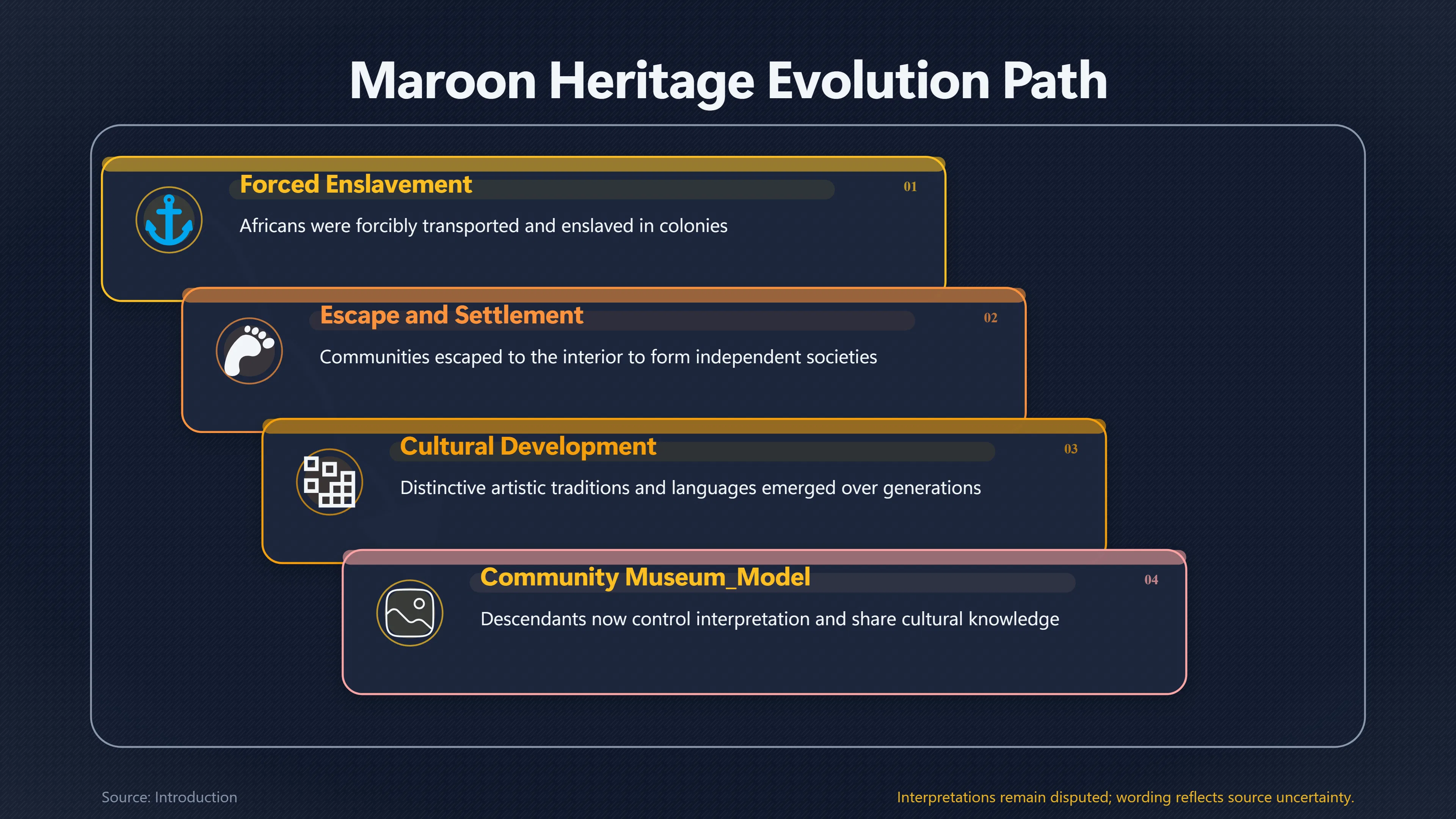
Maroon heritage in Suriname developed from communities founded by Africans who escaped slavery and created independent societies in the interior. Over generations, these communities developed distinctive artistic traditions, political structures, languages and relationships with the forest environment. Museums in Pikin Slee and Diitabiki do not present this history as a closed chapter; they show how historical knowledge continues through families, craftspeople, elders and community institutions.[MPM]mpm.orgNdyuka Collection | Milwaukee Public MuseumNdyuka Collection | Milwaukee Public MuseumJanuary 1, 2008…
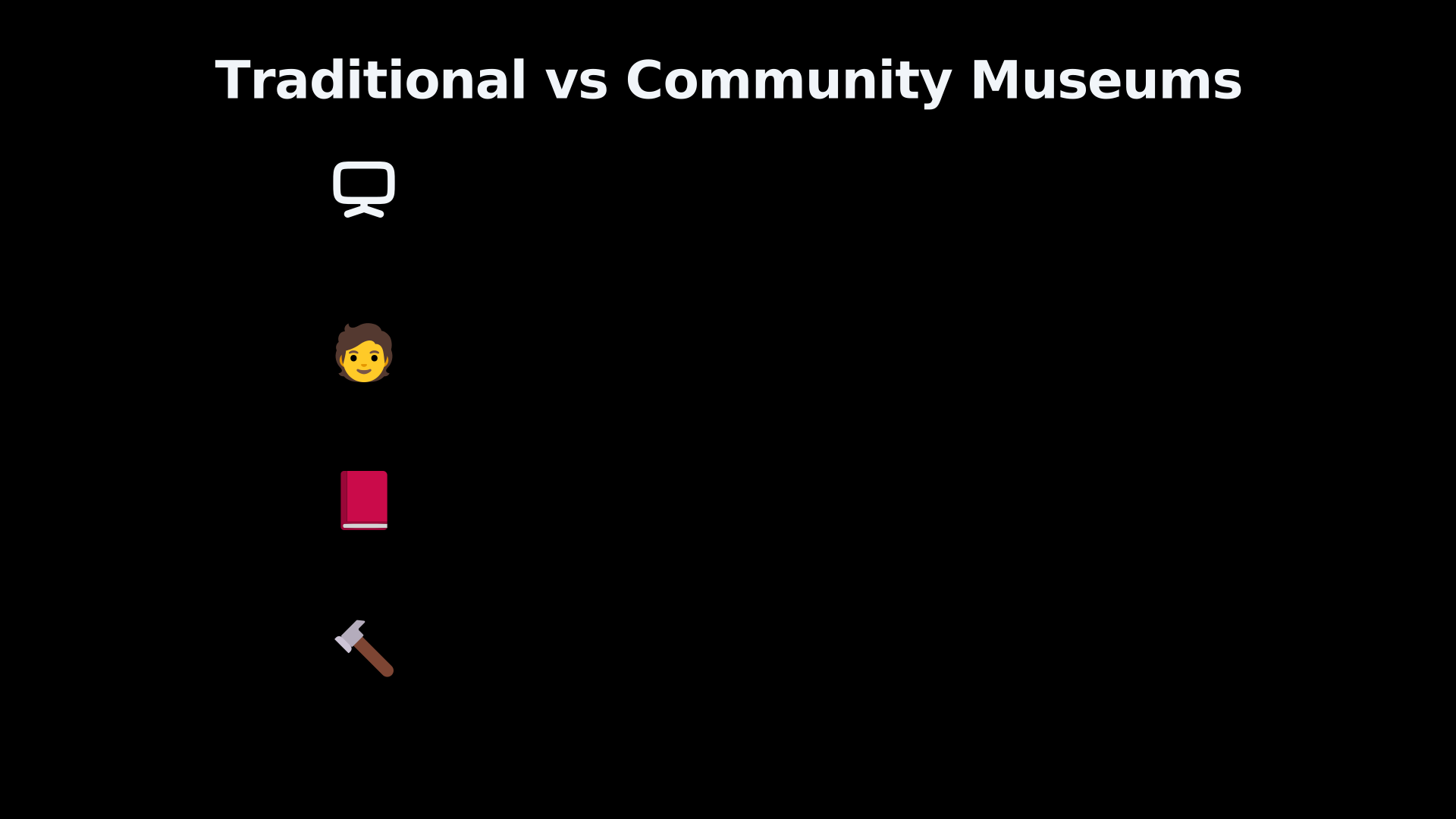
This approach challenges an older ethnographic tradition in which Indigenous and Maroon objects were often removed from their original settings and displayed mainly as examples of another culture. Research into historical collections in the Netherlands has shown that Maroon and Indigenous knowledge holders were essential contributors to colonial-era collecting expeditions, although their roles were often overlooked in official accounts. Community museums provide a contrasting model where cultural knowledge is not separated from the people who maintain it.[Naturalis]repository.naturalis.nlNaturalis Institutional Repository: Surinamese Maroon and Indigenous Knowledge in the Creation of Natural and Ethnographic Colle…
The result is a type of museum that sits between archive, cultural centre, craft workshop and village memory space. The collection is important, but the interpretation around it is equally significant.
Saamaka memory, carving and architecture at Pikin Slee
The Saamaka Marron Museum at Pikin Slee, a Saamaka village on the Upper Suriname River, focuses on the history and cultural heritage of the Saramaka people. The museum presents the journey from forced enslavement and escape to the creation of autonomous communities in the rainforest, while also showing contemporary Saamaka life.[Saamaka Museum]saamakamuseum.comSaamaka Museum Het museum – Saamaka MuseumSaamaka Museum Het museum – Saamaka Museum
One of the most distinctive parts of the museum experience is the way everyday objects become carriers of memory. Saamaka woodcarving, decorated houses, textiles and household objects are not treated as isolated artworks. They are linked to skills, family histories and social meanings. The museum highlights how craft traditions remain active rather than frozen remnants of the past.[Saamaka Museum]saamakamuseum.comSaamaka Museum Het museum – Saamaka MuseumSaamaka Museum Het museum – Saamaka Museum
Wood carving is especially important in Maroon cultural expression. Across Maroon communities, carved objects can combine practical use with artistic design. Collections of Maroon material culture elsewhere include paddles, benches, tools, household objects and musical instruments, showing how functional items can also preserve artistic traditions and community identity.[Surinaams Museum]surinaamsmuseum.orgSurinaams Museum CollectieSurinaams MuseumCollectie - surinaamsmuseum.org…
Pikin Slee also demonstrates how museums can support living cultural economies. The museum grew alongside local artistic initiatives, including the Totomboti collective, which promotes Saamaka carving and crafts. This connection between museum activity, education and local creative work means the collection is not only about looking backwards; it is also part of maintaining cultural skills for future generations.[Thami Mnyele Foundat]thami-mnyele.nlThami Mnyele Foundat Totomboti collectiveThami Mnyele Foundat Totomboti collective
For visitors, the unusual aspect is that the museum experience extends beyond exhibition rooms. The surrounding village, river landscape, buildings and craft traditions form part of the interpretation. A carved object makes more sense when seen as part of a living community rather than as a detached curiosity.
Aukan heritage and local authority at Diitabiki
Diitabiki Museum Fositen Gudu offers a related but distinct perspective through Aukan/Ndyuka heritage. Its collection presents cultural knowledge connected to textiles, wood carving, stories, traditional governance and the Afaka script, a writing system created in the early twentieth century by Aukan man Afaka Atumisi.[Diitabiki Museum Fositen Gudu]fositengudu.orgOpen source on fositengudu.org.
The museum is particularly interesting because it preserves forms of knowledge that do not fit easily into ordinary museum categories. A written script, a carved object, a ceremonial item or a story may each represent more than a historical artefact: they can represent identity, authority and continuity. The museum’s collection structure reflects this broader understanding by grouping material around themes such as wood carving, textiles, stories and community history rather than simply arranging objects by age or rarity.[Diitabiki Museum Fositen Gudu]fositengudu.orgOpen source on fositengudu.org.
The Afaka script is an example of knowledge preservation with a complicated history. Afaka developed a syllabic writing system for the Aukan language, but it did not become widely adopted after his death. Today, the script remains an important cultural symbol, and artists and cultural workers have used it as a way of reconnecting with Aukan heritage.[Diitabiki Museum Fositen Gudu]fositengudu.orgDiitabiki Museum Fositen Gudu See Afaka in our collectionDiitabiki Museum Fositen GuduSee Afaka in our collection - Diitabiki Museum Fositen Gudu…
This makes Diitabiki especially relevant to the idea of “living knowledge”. The museum is not only preserving things that survived from the past; it is helping communities discuss how older knowledge can continue in a changing world.
Planning respectful visits to remote community museums
Visiting Maroon museums in Suriname requires a different mindset from visiting a city museum. These are remote community institutions, and the journey itself is part of understanding the relationship between landscape, history and culture. Visitors should approach them as places where people live, work and maintain traditions, not as staged cultural performances.
Useful expectations include:
- Allow time for interpretation. Guided explanations and conversations often provide the meaning behind objects that cannot be understood from labels alone.
- Respect community authority. Some knowledge may be shared publicly, while other cultural information may belong within family, spiritual or community contexts.
- See objects as connected to life. A carving, garment or building style may represent skills, relationships and memories rather than simply artistic decoration.
- Recognise that remoteness is part of the experience. The location along rivers and within the interior landscape is central to why these museums exist in the first place.[Saamaka Museum]saamakamuseum.comOpen source on saamakamuseum.com.
These museums are also a reminder that heritage preservation is not always about keeping the past untouched. In Pikin Slee and Diitabiki, preservation means allowing communities to continue making, teaching and interpreting their own traditions.

Why Maroon museums matter in Suriname’s unusual heritage landscape
Among Suriname’s distinctive collections, Maroon community museums stand out because their unusual quality comes from control of meaning rather than from rarity or spectacle. They do not display “exotic” objects separated from their origins. Instead, they show how objects, stories and landscapes remain connected to communities that still use and interpret them.
For travellers interested in strange museums and forgotten histories, these museums offer a different kind of curiosity: not the curiosity of a cabinet of unusual things, but the curiosity of discovering how a society preserved freedom, identity and knowledge through generations. Their importance lies in showing that a museum can be not only a place where culture is stored, but also a place where culture continues.
Amazon book picks
Further Reading
Books and field guides related to When the Community Controls the Museum Story. Use these as the next step if you want deeper reading beyond the article.
Silencing the Past: Power and the Production of History
Rating: 4.5/5 from 5 Google Books ratings
Silencing the Past is a thought-provoking analysis of historical narrative. Taking examples ranging from the Haitian Revolution to Columb...
Museums and Communities: The Politics of Public Culture
Papers presented at a conference at the Smithsonian Institution International Center, March 21-23, 1990.

Rainforest Warriors: Human Ecology of the Suriname Maroons
First published 2011. Subjects: Human rights, Saramacca (Surinamese people), Civil rights, Legal status, laws, Human rights, suriname.
eBay marketplace picks
Marketplace Samples
Live-tested eBay searches with available results related to this page.
Selected fromcultural art print oneBay.co.uk.


Endnotes
1.
Source: repository.naturalis.nl
Link:https://repository.naturalis.nl/pub/801080/
Source snippet
Naturalis Institutional Repository: Surinamese Maroon and Indigenous Knowledge in the Creation of Natural and Ethnographic Colle...
2.
Source: mpm.org
Title: Ndyuka Collection | Milwaukee Public Museum
Link:https://www.mpm.org/research-collections/anthropology/online-collections-research/ndyuka
Source snippet
Ndyuka Collection | Milwaukee Public MuseumJanuary 1, 2008...
Published: January 1, 2008
3.
Source: thami-mnyele.nl
Title: Thami Mnyele Foundat Totomboti collective
Link:https://www.thami-mnyele.nl/artists-collection/totomboti-collective
4.
Source: repository.naturalis.nl
Link:https://repository.naturalis.nl/pub/802156
5.
Source: mpm.edu
Link:https://www.mpm.edu/index.php/research-collections/anthropology/online-collections-research/ndyuka/mpm-collection
6.
Source: mpm.edu
Link:https://www.mpm.edu/research-collections/anthropology/online-collections-research/ndyuka/history-and-culture
7.
Source: mpm.org
Link:https://www.mpm.org/index.php/research-collections/anthropology/online-collections-research/ndyuka/history-and-culture
8.
Source: saamakamuseum.com
Link:https://saamakamuseum.com/
9.
Source: fositengudu.org
Link:https://fositengudu.org/en/collection/
10.
Source: saamakamuseum.com
Title: Saamaka Museum Het museum – Saamaka Museum
Link:https://saamakamuseum.com/het-museum/
11.
Source: surinaamsmuseum.org
Title: Surinaams Museum Collectie
Link:https://surinaamsmuseum.org/collectie/
Source snippet
Surinaams MuseumCollectie - surinaamsmuseum.org...
12.
Source: fositengudu.org
Title: Diitabiki Museum Fositen Gudu See Afaka in our collection
Link:https://fositengudu.org/en/afaka/
Source snippet
Diitabiki Museum Fositen GuduSee Afaka in our collection - Diitabiki Museum Fositen Gudu...
13.
Source: Wikipedia
Title: Pikin Slee
Link:https://en.wikipedia.org/wiki/Pikin_Slee
14.
Source: tripadvisor.com.au
Title: Saamaka Marron Museum
Link:https://www.tripadvisor.com.au/Attraction_Review-g12330705-d12311987-Reviews-Saamaka_Marron_Museum-Pikin_Slee_Sipaliwini_District.html
15.
Source: dutchculture.nl
Link:https://dutchculture.nl/en/organisation/diitabiki-museum-fositen-gudu
16.
Source: saamakamuseum.com
Link:https://saamakamuseum.com/geschiedenis/
17.
Source: surinaamsmuseum.net
Link:https://www.surinaamsmuseum.net/collectie/
18.
Source: surinaamsmuseum.net
Link:https://www.surinaamsmuseum.net/collectie-marrons/
Additional References
19.
Source: youtube.com
Title: Slavery, Piranha Fishing and Village Life in the Rainforest Ep 102
Link:https://www.youtube.com/watch?v=Z3bx8h23q-w
Source snippet
Inside Suriname's Hidden Maroon Villages: Traditional African Culture in South America...
20.
Source: museum.sarawak.gov.my
Title: sarawak.gov.my Bongkissam Dan Bukit Maras
Link:https://museum.sarawak.gov.my/web/subpage/webpage_view/785
Source snippet
These locations reveal Santubong's early days as an India-China trading port...
21.
Source: youtube.com
Title: Granddaughter of Bob Marley visits Pikin Slee Suriname
Link:https://www.youtube.com/watch?v=SeKcFp6Vtyw
Source snippet
Slavery, Piranha Fishing and Village Life in the Rainforest Ep 102...
22.
Source: tripadvisor.com
Link:https://www.tripadvisor.com/Attraction_Review-g12330705-d12311987-Reviews-Saamaka_Marron_Museum-Pikin_Slee_Sipaliwini_District.html
23.
Source: evendo.com
Link:https://evendo.com/locations/suriname/sipaliwini-district/landmark/saamaka-marron-museum
24.
Source: brill.com
Link:https://brill.com/view/journals/nwig/89/3-4/article-p417_48.xml
25.
Source: clevelandart.org
Link:https://www.clevelandart.org/art/1974.201
26.
Source: nmk.go.ke
Link:https://nmk.go.ke/kisumu-museum/
27.
Source: nmk.go.ke
Link:https://nmk.go.ke/
28.
Source: maroonheritage.com
Link:https://maroonheritage.com/news/