Within Curious Palau
How Palau's Carvings Preserve Hidden Stories
Palauan storyboards turn legends, ceremonies and warnings about social conduct into densely coded carved scenes.
On this page
- From meeting house beams to portable panels
- How figures and scenes encode oral tradition
- Museum display, modern revival and tourist souvenir
Page outline Jump by section
Introduction
Palauan storyboards are far more than decorative wood carvings. They are portable narrative panels that preserve legends, historical episodes, moral lessons and social rules in visual form, functioning as a kind of carved social archive in a culture where knowledge was traditionally transmitted through speech, ceremony and performance rather than writing. Although they are now widely displayed in museums and sold as artworks, their origins lie in the richly painted beams and gables of the traditional men’s meeting house, or bai, where carved images helped communities remember complex stories and the values attached to them. Today, these storyboards remain one of Palau’s most distinctive cultural objects because they preserve not simply individual tales but an entire way of recording collective memory.[go.jp]jstage.jst.go.jpOpen source on go.jp.
From meeting-house beams to portable panels
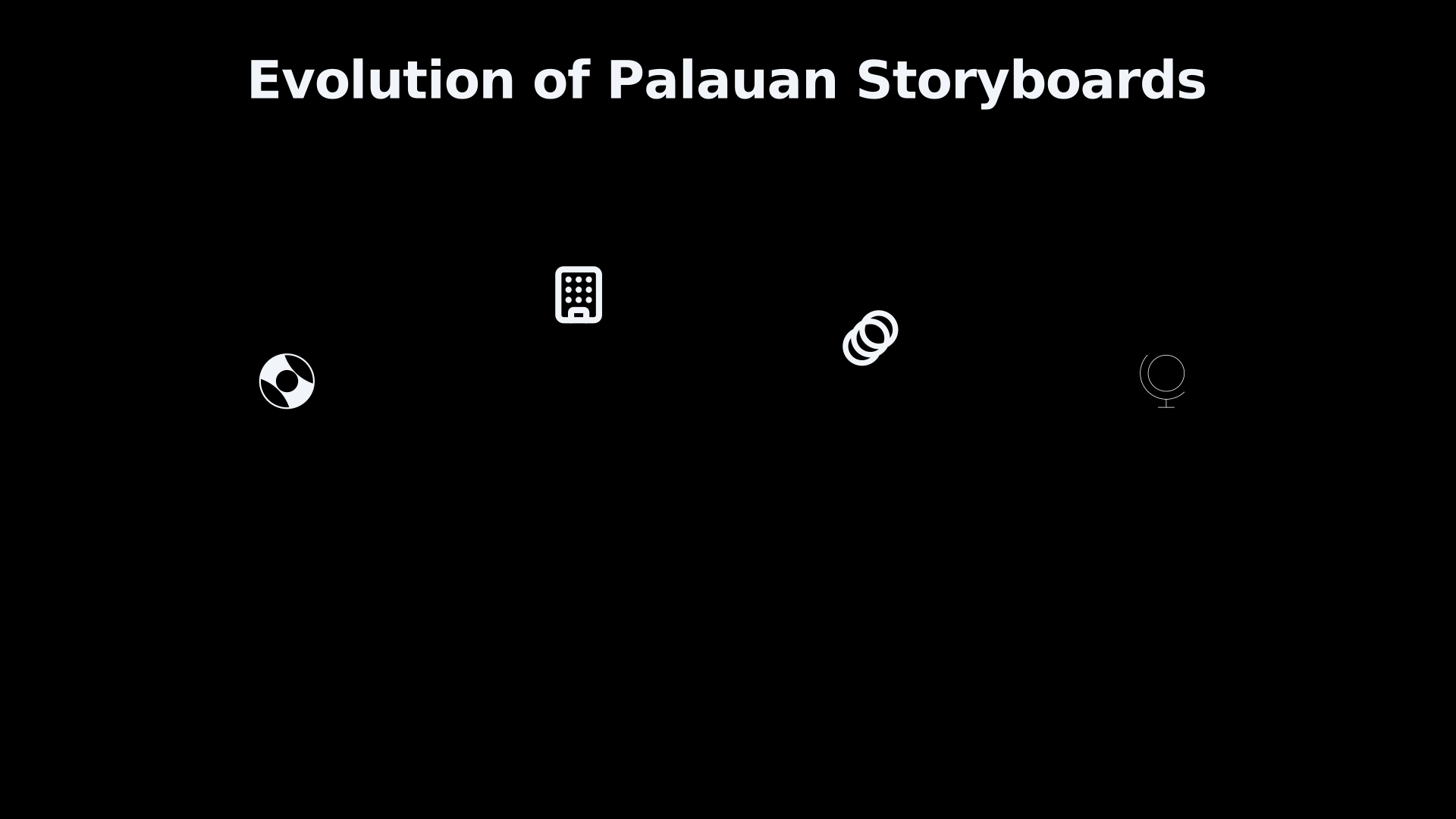
The original setting for Palauan visual storytelling was the bai, the ceremonial men’s meeting house that served as a political, educational and ritual centre. Its painted gables and interior beams carried sequences of carved and painted figures that recorded mythical ancestors, memorable historical events, humorous incidents and warnings about behaviour. Rather than functioning as illustrations for outsiders, these images acted as memory prompts for people who already knew the stories through oral tradition.[palauconsulate.be]palauconsulate.bePalau Consulate CulturePalau ConsulateCulture - Honorary Consulate-General of Palau in Belgium…
This architectural tradition faced disruption during the colonial era. Spanish, German and Japanese administrations altered village life, while changing patterns of labour and construction reduced the building of traditional bai. By the 1930s, Japanese artist and ethnographer Hisakatsu Hijikata encouraged Palauan carvers to transfer these narrative traditions onto smaller wooden panels. These portable storyboards could preserve the visual language of the meeting house while also providing an income through sale to visitors and collectors. Although created partly for a new market, they retained many of the narrative conventions of the older architectural carvings.[palauconsulate.be]palauconsulate.bePalau Consulate CulturePalau ConsulateCulture - Honorary Consulate-General of Palau in Belgium…
The result was not simply the invention of a souvenir. It represented a transformation in how cultural knowledge could survive. Stories once tied to specific buildings became transportable objects capable of entering museums, family collections and international exhibitions while continuing to express distinctly Palauan traditions.[J-STAGE]jstage.jst.go.jpOpen source on go.jp.
How figures and scenes encode oral tradition
The power of a storyboard lies in its organisation rather than its realism. Figures are arranged in deliberate sequences, with each carved scene marking a stage in a narrative. Viewers familiar with the tradition could reconstruct an entire legend from a relatively compact panel because every character, gesture or architectural feature acted as a mnemonic cue.[J-STAGE]jstage.jst.go.jpOpen source on go.jp.
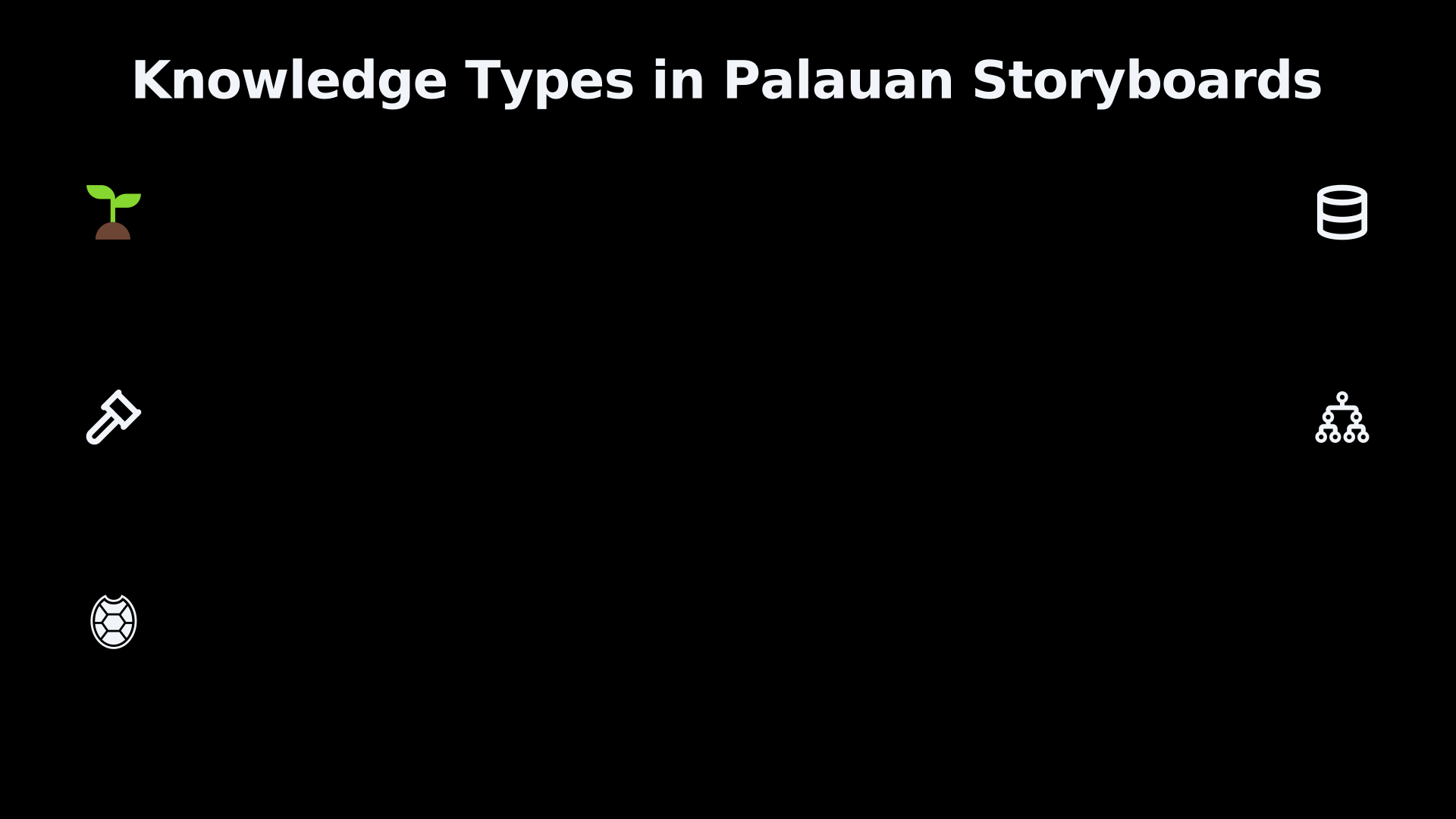
Many storyboards combine several kinds of knowledge at once:
- Origin stories, explaining how customs, technologies or practices first appeared.
- Historical memories, including remembered battles, migrations or political events.
- Social instruction, warning against greed, pride, sexual misconduct or failures of leadership.
- Genealogical and ceremonial knowledge, linking communities with ancestors and important places.[go.jp]jstage.jst.go.jpOpen source on go.jp.
A well-known example depicts the legend explaining the discovery of natural childbirth. According to the traditional story, a supernatural spider figure teaches people how childbirth can occur without the fatal abdominal cutting that had previously been believed necessary. The same narrative is often paired with the discovery of the turtle egg-laying cycle, showing how a single carved panel could preserve multiple strands of practical knowledge, myth and moral teaching. Museums including the British Museum document this combined narrative and its symbolic importance within Palauan tradition.[British Museum]britishmuseum.orgBritish Museumstoryboard | British MuseumBritish Museumstoryboard | British Museum
Other storyboards portray episodes from remembered warfare, canoe voyages or village life. One documented panel records a battle said to have taken place in the eighteenth century rather than a mythical event, demonstrating that storyboards preserve both legendary and historical memory.[British Museum]britishmuseum.orgBritish Museumstoryboard | British MuseumJanuary 1, 1987…
Importantly, the carvings rarely provide enough information to “read” independently. Their purpose was not to replace oral storytelling but to support it. A knowledgeable elder or carver supplied the spoken narrative, while the carved figures ensured that important details were remembered accurately across generations. This close relationship between image and performance explains why scholars describe storyboards as material expressions of oral tradition rather than simple works of decorative art.[J-STAGE]jstage.jst.go.jpOpen source on go.jp.
Why they function as social archives
Calling storyboards “social archives” highlights what they preserve. Instead of recording dates or official documents, they encode shared understandings about how society should function.
Stories frequently communicate expectations surrounding leadership, marriage, kinship, generosity, warfare or respect for community rules. Even humorous or sexually explicit episodes often carry moral consequences rather than existing purely for entertainment. Some modern tourist guides refer to certain carvings as “porno boards” because they depict sexual scenes openly, yet these episodes usually belong to older cautionary or explanatory legends rather than erotic art in the modern sense.[Discover Palau]palau.coDiscover Palau Storyboards | Carved Art Form | Discover the Heart of PalauDiscover Palau Storyboards | Carved Art Form | Discover the Heart of Palau
Because each generation retells these narratives, storyboards also reveal how cultural memory evolves. Modern artists sometimes reinterpret traditional stories or introduce contemporary artistic styles while preserving the underlying narrative structure. Researchers studying Palauan visual culture argue that this continuing adaptation demonstrates cultural continuity rather than the fossilisation of tradition. The storyboards remain active participants in cultural life instead of becoming static historical relics.[J-STAGE]jstage.jst.go.jpOpen source on go.jp.
Museum display, modern revival and tourist souvenir
Visitors today are most likely to encounter Palauan storyboards in Koror’s museums. The Etpison Museum maintains displays featuring works by leading master carvers alongside exhibitions explaining traditional ceremonies, money and other aspects of Palauan culture. Rather than treating the panels simply as artworks, the museum presents them within the wider context of Palauan history and cultural practice.[Etpison Museum]etpisonmuseum.orgOpen source on etpisonmuseum.org.
Storyboards have also entered museum collections worldwide. Institutions such as the British Museum preserve documented examples with detailed explanations of the stories they depict, allowing researchers to compare different artists’ interpretations of the same legends across decades. These collections demonstrate how a single narrative tradition has continued to evolve while retaining recognisable themes.[British Museum]britishmuseum.orgBritish Museumstoryboard | British MuseumBritish Museumstoryboard | British Museum
Tourism has inevitably shaped the art form. Portable panels became popular purchases from the mid-twentieth century onwards, encouraging carvers to produce works suited to collectors rather than architectural installation. Some later boards were left unpainted because visitors increasingly associated natural wood with authenticity, even though many traditional bai carvings were originally brightly painted. This shift reflects changing tourist expectations as much as indigenous artistic practice.[British Museum]britishmuseum.orgBritish Museumstoryboard | British MuseumBritish Museumstoryboard | British Museum
Modern exhibitions increasingly emphasise both continuity and innovation. Contemporary Palauan artists continue carving traditional stories while experimenting with new subjects, media and presentation, ensuring that the storyboard remains a living cultural form rather than merely a historical curiosity.[J-STAGE]jstage.jst.go.jpOpen source on go.jp.

Why storyboards matter within Palau’s curiosity culture
For visitors interested in Palau’s unusual heritage, storyboards occupy a distinctive place. They are not mysterious because they hide supernatural secrets, but because they compress an enormous amount of cultural knowledge into deceptively simple carved scenes. Without explanation they appear decorative; with context they become visual records of law, memory, humour, history and belief.
Unlike many museum objects that survive only because they were preserved behind glass, Palauan storyboards continue to be carved, interpreted and debated within the communities that gave rise to them. They therefore bridge several worlds at once: traditional meeting houses and modern galleries, oral performance and museum display, cultural preservation and commercial tourism. As carved social archives, they remain among the most revealing objects through which to understand how Palau has remembered its past while adapting to profound historical change.[go.jp]jstage.jst.go.jpOpen source on go.jp.
Amazon book picks
Further Reading
Books and field guides related to How Palau's Carvings Preserve Hidden Stories. Use these as the next step if you want deeper reading beyond the article.
The wayfinders
First published 2009. Subjects: Languages, Endangered languages, Cultural pluralism, Acculturation, Indigenous peoples.
The Story of Art Without Men
Instant New York Times bestseller One of Vanity Fair's Favorite Books to Gift • One of PureWow's 42 Books to Gift This Year • One of Kirk...

The Social Life of Things
First published 1986. Subjects: Social aspects, Commerce, Economic anthropology, History, Commodity exchanges.
Oral Tradition as History
Jan Vansina’s 1961 book, Oral Tradition, was hailed internationally as a pioneering work in the field of ethno-history. Originally publis...
eBay marketplace picks
Marketplace Samples
Live-tested eBay searches with available results related to this page.
Selected fromwood carving art oneBay.co.uk.
Endnotes
1.
Source: jstage.jst.go.jp
Link:https://www.jstage.jst.go.jp/article/jsos/30/0/30_41/_article/-char/en
2.
Source: penn.museum
Title: Museum Expedition Magazine | The Palauan Storyboards
Link:https://www.penn.museum/sites/expedition/the-palauan-storyboards/
Source snippet
Expedition Magazine | The Palauan Storyboards...
3.
Source: palau.co
Title: Discover Palau Storyboards | Carved Art Form | Discover the Heart of Palau
Link:https://www.palau.co/discover-palau/culture/storyboards/
5.
Source: palauconsulate.be
Title: Palau Consulate Culture
Link:https://www.palauconsulate.be/index.php/en/about-palau/culture
Source snippet
Palau ConsulateCulture - Honorary Consulate-General of Palau in Belgium...
6.
Source: britishmuseum.org
Title: British Museumstoryboard | British Museum
Link:https://www.britishmuseum.org/collection/object/E_Oc1987
7.
Source: britishmuseum.org
Title: British Museumstoryboard | British Museum
Link:https://www.britishmuseum.org/collection/object/E_Oc1987
Source snippet
January 1, 1987...
Published: January 1, 1987
8.
Source: etpisonmuseum.org
Link:https://www.etpisonmuseum.org/
9.
Source: etpisonmuseum.org
Title: Etpison Museum About Us — Etpison Museum
Link:https://www.etpisonmuseum.org/about-us/
10.
Source: britishmuseum.org
Title: British Museumstoryboard | British Museum
Link:https://www.britishmuseum.org/collection/object/E_Oc1987
11.
Source: britishmuseum.org
Title: British Museumstoryboard | British Museum
Link:https://www.britishmuseum.org/collection/object/E_Oc1987
12.
Source: britishmuseum.org
Link:https://www.britishmuseum.org/collection/object/E_Oc1987
13.
Source: jstage.jst.go.jp
Link:https://www.jstage.jst.go.jp/article/jsos/30/0/30_41/_article/-char/ja/
Additional References
14.
Source: collections.bowers.org
Title: Museum Collections Lintel – Works – Bowers Museum
Link:https://collections.bowers.org/objects/146910/lintel
Source snippet
Bowers Museum CollectionsLintel – Works – Bowers Museum...
15.
Source: researchgate.net
Link:https://www.researchgate.net/publication/310771534_Oral_Tradition_and_Archaeology_Palau%27s_Earth_Architecture
16.
Source: researchgate.net
Link:https://www.researchgate.net/publication/259905842_Palau%27s_petroglyphs_Archaeology_oral_history_and_iconography
17.
Source: palaumemorial.org
Link:https://www.palaumemorial.org/process-1.html
18.
Source: researchgate.net
Link:https://www.researchgate.net/figure/Storyboard-carved-before-1983-with-earthwork-complex-in-background-Elbebai-carved-by_fig4_310771534
19.
Source: cir.nii.ac.jp
Link:https://cir.nii.ac.jp/crid/1390867278055630976?lang=en
20.
Source: scholarhub.ui.ac.id
Link:https://scholarhub.ui.ac.id/wacana/vol18/iss3/7/
21.
Source: researchportalplus.anu.edu.au
Title: anu.edu.au Palau’s petroglyphs: Archaeology, oral history, and iconography
Link:https://researchportalplus.anu.edu.au/en/publications/palaus-petroglyphs-archaeology-oral-history-and-iconography/
22.
Source: museenouvellecaledonie.gouv.nc
Title: nc Storyboards des Palaos | Service du Musée de la Nouvelle-Calédonie
Link:https://museenouvellecaledonie.gouv.nc/expositions/les-objets-du-mois/storyboards-des-palaos
23.
Source: flickr.com
Title: Arts ʻOhana Reception: Storyboards of Palau Exhibition | Flickr
Link:https://www.flickr.com/photos/eastwestcenter/albums/72177720312423164/