Within Curious India
When Do Human Remains Become Museum Objects?
Brains and mummies can educate powerfully, but their display raises questions about consent, conservation, provenance and respect for the dead.
On this page
- Brains, mummies and medical teaching
- Consent, provenance and dignity
- Conservation failures and visitor responsibility
Page outline Jump by section
Introduction
Human remains occupy a distinctive place in India’s museum landscape because they are rarely displayed simply to shock or entertain. Instead, preserved brains, Egyptian mummies and anatomical collections are typically presented within medical education, archaeology or scientific research. Even so, these displays raise difficult questions that extend far beyond conservation: who gave consent, how were the remains acquired, what responsibilities do museums owe to the dead, and how should visitors behave in front of real human bodies?
In India, these debates are particularly relevant because many collections were assembled during the colonial era or through teaching institutions established under colonial administration. Modern museums increasingly balance educational value with concerns about provenance, dignity, cultural sensitivity and the changing expectations of visitors. International museum ethics have also shifted towards greater transparency, careful interpretation and, where appropriate, consultation with descendant communities or consideration of repatriation.[International Council of Museums]icom.museumInternational Council of Museums Code of EthicsInternational Council of MuseumsCode of Ethics - International Council of Museums - International Council of Museums…
When Do Human Remains Become Museum Objects?
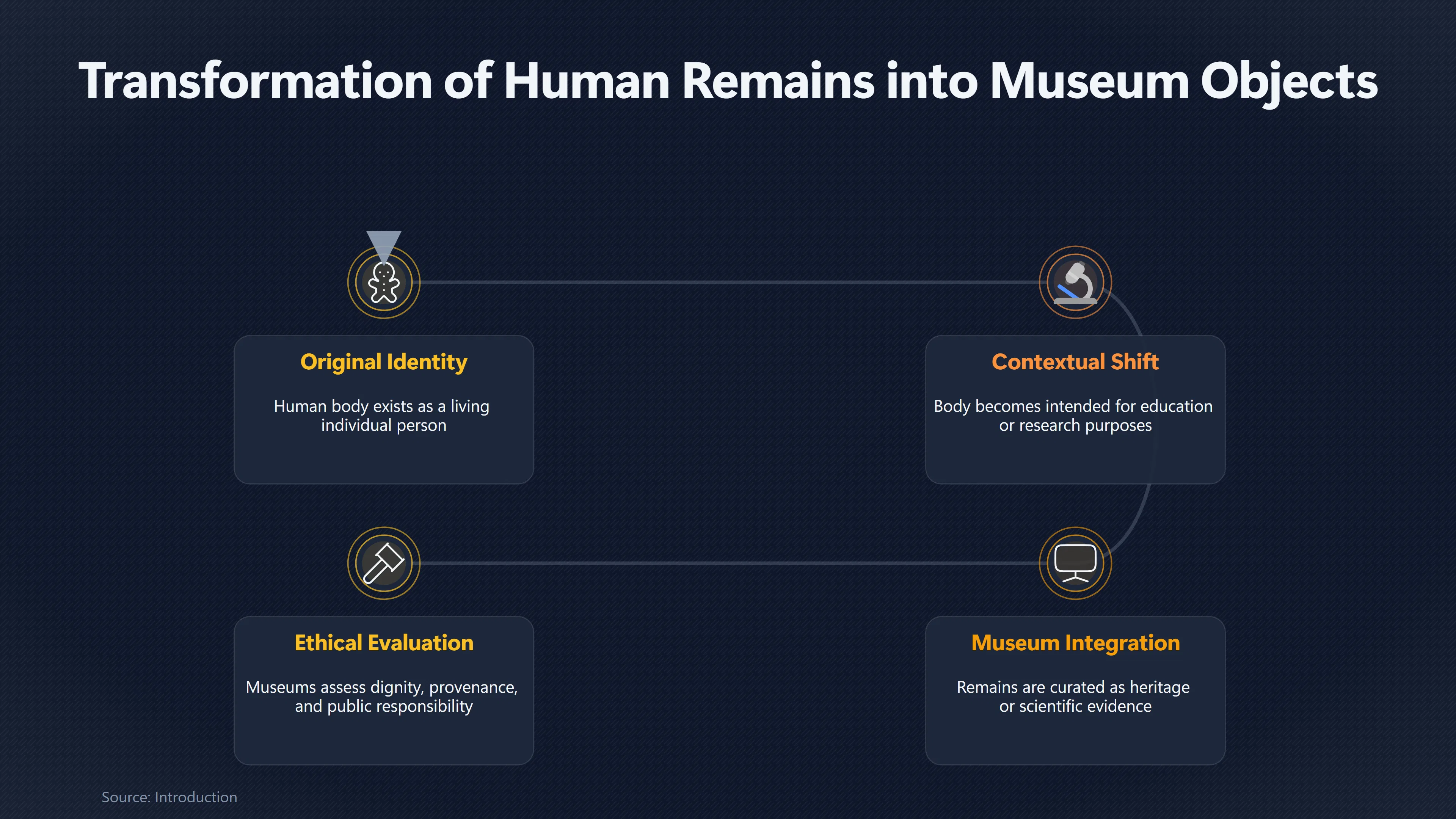
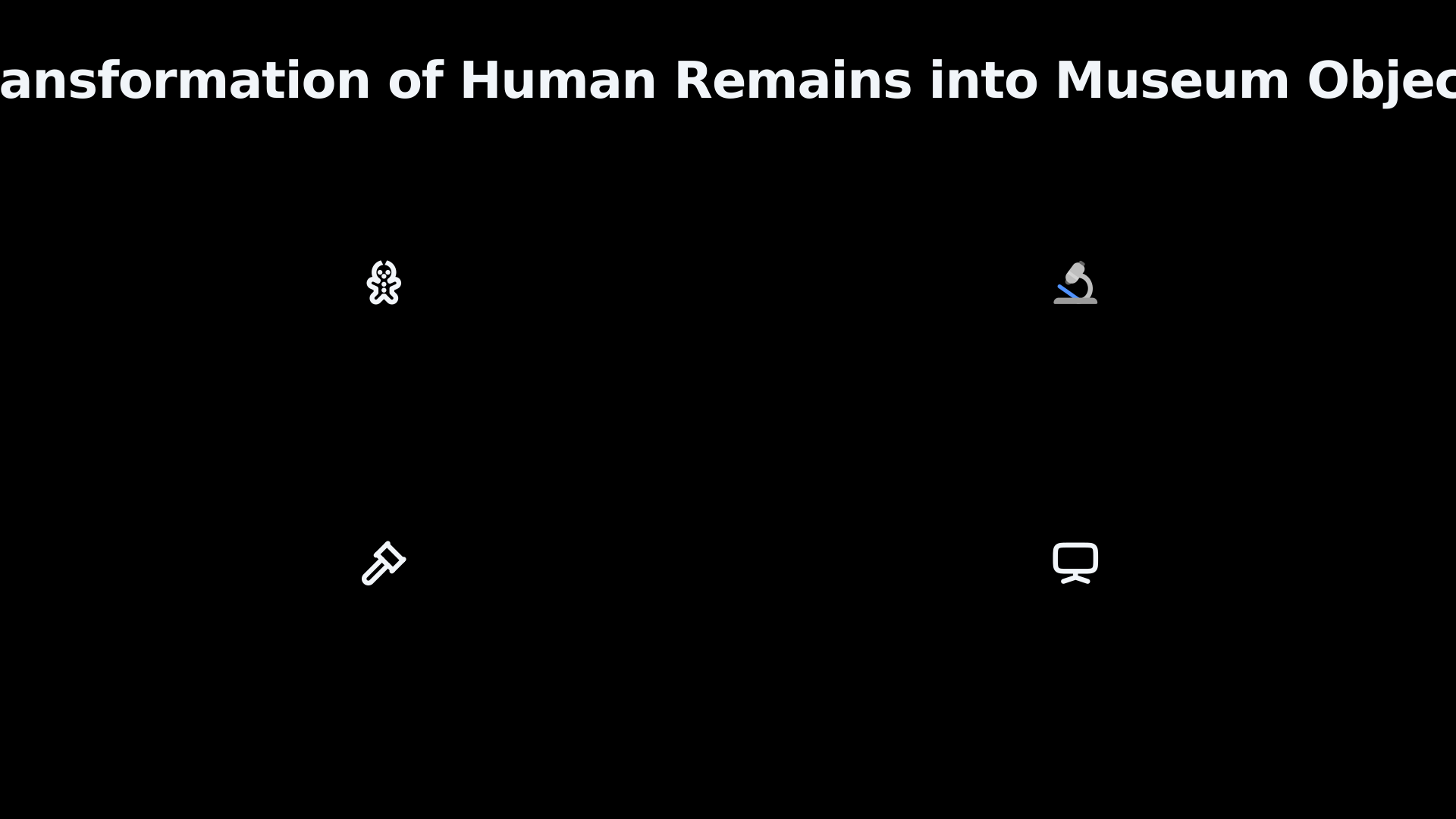
Human remains become museum objects only after their original identity as a person’s body has been transformed into something intended for education, research or heritage preservation. That transformation is never ethically neutral.
Museums generally justify displaying human remains on one or more grounds:[britishmuseum.org]britishmuseum.orgSource details in endnotes.
- advancing medical education;
- preserving archaeological evidence;
- explaining ancient civilisations;
- documenting disease or anatomy;
- supporting scientific research.
Modern museum practice increasingly asks an additional question: not merely whether a display is scientifically useful, but whether it remains respectful to the individual whose body is being exhibited. The International Council of Museums (ICOM) identifies human remains as requiring exceptional care, insisting on dignity, careful provenance research, compliance with law and sensitivity towards cultural and religious concerns.[International Council of Museums]icom.museumInternational Council of Museums Code of EthicsInternational Council of MuseumsCode of Ethics - International Council of Museums - International Council of Museums…
Within India’s unusual museum culture, this means the most striking exhibits are often also the most carefully contextualised.
Brains, Mummies and Medical Teaching
India’s best-known displays of human remains are educational rather than sensational.[britishmuseum.org]britishmuseum.orgSource details in endnotes.
Preserved brains at NIMHANS
The Brain Museum at the National Institute of Mental Health and Neurosciences (NIMHANS) in Bengaluru contains hundreds of preserved human brains showing the effects of neurological disease, trauma, infections, tumours and degenerative disorders. Rather than presenting specimens as curiosities, guided visits explain how different illnesses physically alter the brain and why early diagnosis matters.
The museum forms part of a research brain bank rather than an independent tourist attraction. Visitors encounter labelled specimens alongside explanations of medical conditions, making the experience closer to a university laboratory than a cabinet of horrors. This educational framing is central to the institution’s public mission.[International Council of Museums]icom.museumInternational Council of Museums Code of EthicsInternational Council of MuseumsCode of Ethics - International Council of Museums - International Council of Museums…
Yet the collection also illustrates modern ethical practice. The brains originate from individuals donated through recognised medical and research processes rather than anonymous historical collecting. Their continued preservation is justified by scientific and educational value rather than spectacle.
Egyptian mummies in Indian museums
Several Indian museums preserve Egyptian mummies acquired during the nineteenth century, the best known being the mummy housed in the Indian Museum in Kolkata. These bodies entered Indian collections during an era when European archaeological expeditions, imperial networks and wealthy collectors circulated Egyptian antiquities across the world.
For visitors, a mummy is often the most memorable exhibit in an archaeology gallery. For curators, however, it is also a human body requiring conservation, environmental control and careful interpretation.
Unlike fictional portrayals of cursed mummies, museum displays increasingly emphasise the individual’s life, burial customs and archaeological context instead of treating the remains as exotic entertainment. Conservation work also attempts to minimise handling because ancient tissue is extremely fragile and susceptible to fluctuations in humidity, temperature and light.

Consent, Provenance and Dignity
The hardest ethical questions are rarely about preservation technology. They concern how museums acquired human remains in the first place.
Many nineteenth-century collections around the world were assembled before modern ideas of informed consent existed. Medical schools often retained anatomical material under legal frameworks that would no longer be considered acceptable. Colonial archaeology also removed human remains across imperial networks with little consultation of source communities.
Consequently, museums increasingly ask several linked questions:
- Was the individual or their family able to consent?
- Can the origin of the remains be documented?
- Were they acquired legally under the standards of their time?
- Would display cause unnecessary distress to descendant communities?
- Does public exhibition still provide genuine educational value?
For ancient Egyptian mummies, living descendants usually cannot be identified in any practical sense, but debates continue over whether displaying an individual’s body remains appropriate centuries after death. For more recent remains, especially those linked to Indigenous peoples or identifiable communities, provenance and consultation have become much more significant parts of museum practice.[International Council of Museums]icom.museumInternational Council of Museums Code of EthicsInternational Council of MuseumsCode of Ethics - International Council of Museums - International Council of Museums…
These debates are not theoretical. Museums internationally have reassessed displays, reconsidered labels, increased consultation and, in some cases, removed human remains from permanent exhibition altogether while discussing future display policies with visitors and stakeholders.[The Guardian]theguardian.comAsru's remains were brought to the UK by the Garnett family—cotton merchants linked to the transatlantic slave trade—after being acquired…
Conservation Failures and Visitor Responsibility
Human remains cannot simply be treated like ordinary artefacts.[britishmuseum.org]britishmuseum.orgSource details in endnotes.
Organic material continues to deteriorate unless carefully protected. Ancient skin, bone, hair and soft tissue respond to changes in humidity, vibration, biological contamination and excessive lighting. Even repeated photography with flash was once considered a potential conservation concern, although modern LED lighting has reduced some earlier risks.
Visitors also influence how respectful a display feels. Museums increasingly discourage behaviour that turns human remains into novelty photographs or social media props. The expectation is not solemn silence, but recognition that these exhibits represent real people rather than theatrical objects.
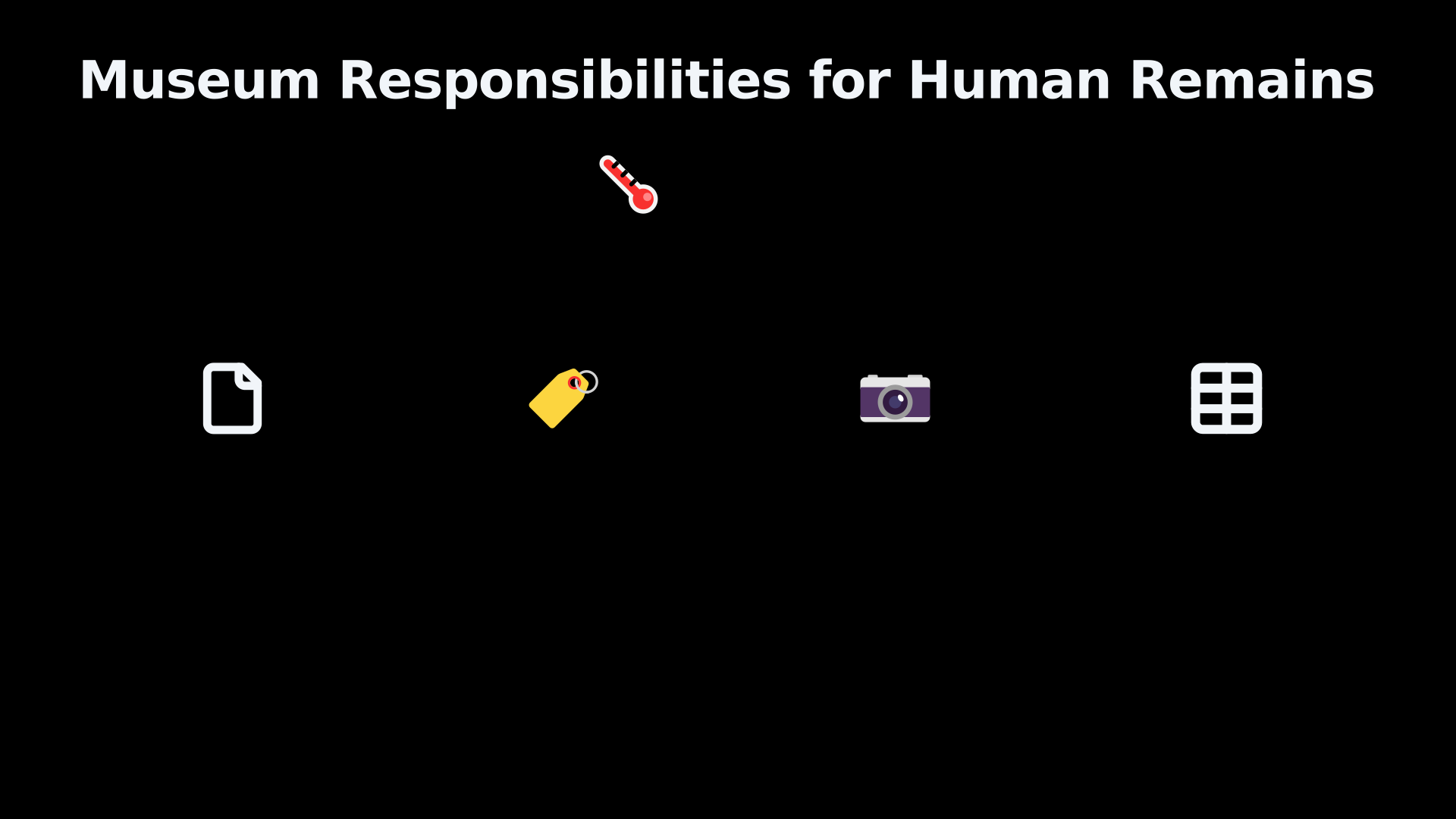
For museums, this means balancing three responsibilities:
- protecting fragile material from physical damage;
- explaining why the remains are displayed;
- encouraging respectful behaviour without making galleries inaccessible.
Where these elements are missing, displays can quickly appear exploitative even when the scientific intentions are genuine.
Why This Debate Matters in India
India’s unusual museums often attract visitors precisely because they contain things rarely encountered elsewhere. Human remains undoubtedly fall into that category, but they differ fundamentally from mechanical curiosities, odd inventions or eccentric private collections.
A preserved brain can help explain Alzheimer’s disease. An Egyptian mummy can illuminate ancient funerary beliefs and nineteenth-century collecting practices. An anatomical specimen can train future doctors. Their educational value is genuine, yet it exists alongside obligations that ordinary museum objects do not carry.
As international ethical standards evolve, museums increasingly present human remains less as astonishing objects and more as evidence of individual lives, scientific knowledge and historical responsibility. That shift reflects a broader change in museum philosophy: preserving the dead is no longer considered sufficient on its own. Institutions are also expected to explain why the remains are there, how they were acquired, and whether their continued display serves the public with dignity as well as knowledge.[icom.museum]icom.museumInternational Council of Museums Code of EthicsInternational Council of MuseumsCode of Ethics - International Council of Museums - International Council of Museums…
Amazon book picks
Further Reading
Books and field guides related to When Do Human Remains Become Museum Objects?. Use these as the next step if you want deeper reading beyond the article.
The Wonder That Was India
A. L. Basham’s The Wonder That Was India is a brilliant early history of one of the world’s oldest civilisations. When it was first publi...
The Idea of India
This Long Essay Makes An Eloquent And Persuasive Argument For Nehru'S Idea Of Nationhood In India. At A Time When The Relevance Of Nehru'...
Human Remains and Museum Practice
This edited volume contains valuable information for museums and academic institutions concerning the care and conservation of human rema...
Museums and the Interpretation of Visual Culture
This is a multi-disciplinary study that adopts an innovative and original approach to a highly topical question, that of meaning-making i...
eBay marketplace picks
Marketplace Samples
Live-tested eBay searches with available results related to this page.
Selected fromanatomy poster oneBay.co.uk.
Endnotes
1.
Source: icom.museum
Title: International Council of Museums Code of Ethics
Link:https://icom.museum/en/resources/standards-guidelines/code-of-ethics/
Source snippet
International Council of MuseumsCode of Ethics - International Council of Museums - International Council of Museums...
2.
Source: icom.museum
Link:https://icom.museum/en/news/international-repatriation-of-human-remains-of-indigenous-peoples/
Source snippet
International Council of MuseumsInternational repatriation of human remains of indigenous peoples - International Council of Museums - In...
3.
Source: icom.museum
Title: ICO M Code of Ethics: New standards for Fundraising and Accessioning
Link:https://icom.museum/en/news/icom-code-of-ethics-new-standards-for-fundraising-and-accessioning/
4.
Source: cimuset.mini.icom.museum
Title: museum ICO M code of Ethics for Museums
Link:https://cimuset.mini.icom.museum/members/icom-code-of-ethics-for-museums/
5.
Source: icom.museum
Title: Ethics Committee
Link:https://icom.museum/en/committee/ethics-committee/
6.
Source: icom-comms.mini.icom.museum
Title: museum ICO M Code of Ethics for Museums
Link:https://icom-comms.mini.icom.museum/code-of-ethics/icom-code-of-ethics-for-museums/
7.
Source: icom.nl
Title: Code of Ethics
Link:https://icom.nl/en/about-icom/code-of-ethics
8.
Source: obs-traffic.museum
Title: Observatory Traffic Ethical standards / Codes of ethics | www.icom.museum
Link:https://www.obs-traffic.museum/ethical-standards-codes-ethics
9.
Source: theguardian.com
Link:https://www.theguardian.com/culture/2025/jun/29/manchester-museum-asks-visitors-if-egyptian-womans-body-should-be-taken-off-display
Source snippet
Asru's remains were brought to the UK by the Garnett family—cotton merchants linked to the transatlantic slave trade—after being acquired...
10.
Source: thenimhansbrainbank.in
Link:https://thenimhansbrainbank.in/museum/
11.
Source: thenimhansbrainbank.in
Link:https://thenimhansbrainbank.in/brain-bank/
12.
Source: thenimhansbrainbank.in
Link:https://thenimhansbrainbank.in/about/
13.
Source: sciencemuseum.org.uk
Link:https://www.sciencemuseum.org.uk/human-remains
14.
Source: britishmuseum.org
Link:https://www.britishmuseum.org/our-work/departments/human-remains
Additional References
15.
Source: indianmuseumkolkata.org
Link:https://indianmuseumkolkata.org/visitors-information/
Source snippet
e Blueprint of the Indian Museum Kolkata showing the Ground Floor, First Floor and Second Floor OPEN: TUESDAY TO SUN...
16.
Source: mynewsdesk.com
Link:https://www.mynewsdesk.com/icom/pressreleases/icom-adopts-its-revised-code-of-ethics-for-museums-3455988
Source snippet
ICOM adopts its revised Code of Ethics for Museums | International Council of Museums (ICOM)...
17.
Source: indianmuseumkolkata.org
Title: Indian Museum Kolkata2 days ago — WELCOME TO INDIAN MUSEUM KOLKATA
Link:https://indianmuseumkolkata.org/
Source snippet
FOUNDED 1814 ANNOUNCEMENT Image: hero image HISTORY OF THE MUSEUM Founded in 1814 at the cradle of the Asiatic Society of Bengal (at the...
18.
Source: museumsassociation.org
Title: Icom adopts revised Code of Ethics for Museums
Link:https://www.museumsassociation.org/museums-journal/news/2026/06/icom-adopts-revised-code-of-ethics-for-museums/
Source snippet
Museums AssociationJune 29, 2026 — ICOM ADOPTS REVISED CODE OF ETHICS FOR MUSEUMS International framework sets out five core principles R...
Published: June 29, 2026
19.
Source: youtube.com
Link:https://www.youtube.com/watch?v=VEqvin_zMpQ
Source snippet
'It's rubbery, not gooey': What a trip to Bengaluru's brain museum taught us...
20.
Source: youtube.com
Title: ‘It’s rubbery, not gooey’: What a trip to Bengaluru’s brain museum taught us!
Link:https://www.youtube.com/watch?v=nMb1ACjKX5w
Source snippet
Human remains museum ethics Human Remains and Museum Collections leedsmuseums...
21.
Source: youtube.com
Title: Human Bodies in Museums // Death Debate
Link:https://www.youtube.com/watch?v=18gK1J-EbxQ
Source snippet
Should DEAD BODIES be on display? Should human remains be in museums? Egyptian mummies and bog men...
22.
Source: indianmuseumkolkata.org
Link:https://indianmuseumkolkata.org/gallery/egypt-gallery/
Source snippet
IT ARRIVED IN CALCUTTA IN...
23.
Source: icom-cc-publications-online.org
Link:https://www.icom-cc-publications-online.org/1873/Towards-a-binding-code-of-ethics-for-the-conservation-and-display-of-human-remains
24.
Source: nimhans.ac.in
Link:https://www.nimhans.ac.in/